
Let’s cut through the architectural hype. A modern structure isn’t just a glass box with a fancy thermostat.
Think of it this way: we’re giving a concrete skeleton a central nervous system and a dash of cognitive function. It’s an intelligent ecosystem that thinks, responds, and evolves.
This isn’t about simple automation—the clunky “if this, then that” programming of the past. We’re talking about ambient intelligence. Imagine a habitat that adjusts its own energy use based on the rhythm of the people inside. It can diagnose a system failure before it becomes a crisis.
From the Empire State Building’s legendary retrofit to Singapore’s sensor-laden towers, this is today’s spec sheet for competitive real estate. Smart Building Technologies weave together IoT devices, data analytics, and AI.
The real question has shifted. It’s no longer “What is it?” but how long can you afford to ignore it?
Key Technologies
Today’s Smart Building Technologies are more than just ‘automation’. They’re like a new internet, changing everything. We’re not just setting timers for thermostats. We’re creating a smart brain for buildings.
The core of this is IoT and AI. They work together like Lennon and McCartney. IoT collects data, and AI makes sense of it.

IoT is like a network of tiny sensors. They’re in air ducts and lights, watching over the building. They track temperature, who’s around, and how much energy is used. This data is the building’s lifeblood.
But data is just noise without AI. AI uses machine learning to understand the data. It finds patterns we can’t see.
The AI notices the conference room gets too hot by 2 PM. It cools it down before anyone gets uncomfortable. It also catches a weird vibration in the basement and fixes it before it breaks. This is predictive upkeep, not waiting for trouble.
This smart system needs a strong tech base. It uses fast networks and cloud computing for big tasks. This makes the building work better for everyone, all at once.
So, we’re moving past automation. We’re entering a new era of smart buildings. Your building is not just connected. It’s learning and making decisions on its own.
IoT for Sustainability
If a building could talk, its IoT sensors would share its energy secrets. This isn’t about filling it with gadgets. It’s about making it environmentally responsible. IoT in smart buildings is our best tool for fighting climate change.
Every watt wasted in an empty lobby is tracked. Every BTU overcooling a server room is noted. This detailed energy monitoring helps us understand our carbon use better. It’s like knowing exactly which part of your car is wasting gas.
By linking this data with sustainability goals, buildings become incredibly efficient. Occupancy sensors adjust HVAC schedules based on room use. Rooftop solar data helps manage battery loads. It’s a system where knowing leads to saving.
The uses are simple yet effective. AI predicts when a building needs to adjust its temperature. Lighting adjusts based on natural light. It’s not just convenient; it saves energy.
This approach goes beyond just saving energy. It also monitors indoor air quality and water use. This ensures healthy environments, not just efficient ones. It’s part of a shift in how we manage resources, like technology in waste.
So, what’s the outcome? IoT is key in reducing operational emissions, which make up 28% of global energy use. It turns vague green promises into real, measurable actions. The building isn’t just smarter; it’s accountable.
Integration Challenges
The biggest challenge in automation isn’t the tech itself. It’s making it work with old systems. You’re not starting from scratch. It’s like digging through a live site.
Imagine trying to install a neural network for a smart building. But the HVAC system is old, from the flip phone era. Getting a cloud-based AI to work with an outdated boiler is a tech challenge.
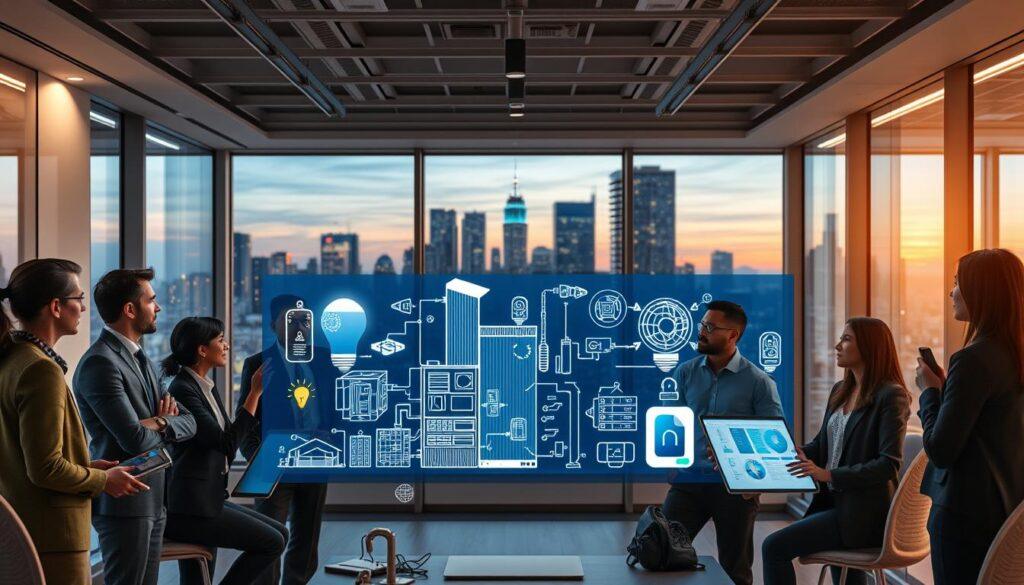
This old system gap is just the start. Adding sensors opens a box of connectivity issues. Every smart device is a new challenge. Your facility’s security looks like a house with open doors and windows.
Cybersecurity becomes a major concern. A breach can cause problems like frozen pipes or dark hallways. This keeps facility managers up at night.
To solve these issues, the industry uses digital translators and fortresses. Middleware helps old and new systems talk. Security measures include end-to-end encryption and strict access controls.
Two more challenges exist. The first is the vendor Tower of Babel, where systems from different makers have different languages. The second is the high cost of making a building smart. This is a big hurdle, as the benefits are long-term.
| Challenge | Real-World Analogy | Industry Solution Pathway |
|---|---|---|
| Legacy System Integration | Installing a USB-C port on a VCR. | Development of adaptive middleware and open-protocol gateways. |
| Cybersecurity Threats | Adding 100 new doors to a vault; each needs a lock. | Implementation of zero-trust architectures and network segmentation. |
| Multi-Vendor Interoperability | Hosting a UN meeting without translators. | Adoption of open standards like BACnet and MQTT. |
| High Initial Capital Cost | Funding a moon landing for your office building. | Growth of SaaS and managed service models to reduce upfront spend. |
True intelligence in smart buildings is more than just connecting things. It’s about making it secure, affordable, and working well with old and new systems. The puzzle is tough, but the pieces are falling into place.
Industry Examples
Forget the glossy brochures. The true test of Smart Building Technologies is in real buildings. These aren’t just blueprints. They are living examples of architectural dreams and real returns on investment.
Take Amsterdam’s The Edge. It’s called the world’s smartest office. It got a 98.4% BREEAM sustainability rating. How? It uses automation that feels like magic. A personal app lets employees book a desk and adjust settings.
Then, there’s New York’s Empire State Building. This historic building got a tech upgrade. It cut its energy use by 38%, saving millions each year. It shows that old buildings can be smart too.
Look at Singapore’s Frasers Tower. It uses a digital twin for real-time optimization. Dubai’s Burj Khalifa uses Honeywell’s system for maintenance. This cut maintenance hours by 40%, almost eliminating downtime.
These examples show that smart buildings exist worldwide. They prove that the real intelligence is in the execution, not just the idea. Here’s a table that shows what makes these buildings special.
| Building | Location | Core Smart Technology | Measurable Outcome |
|---|---|---|---|
| The Edge | Amsterdam, NL | Personalized IoT & App Integration | 98.4% BREEAM Rating |
| Empire State Building | New York, USA | Comprehensive Energy Retrofit | 38% Reduction in Energy Use |
| Frasers Tower | Singapore | Digital Twin & Microsoft Cloud | Real-time Operational Optimization |
| Burj Khalifa | Dubai, UAE | Predictive Maintenance Systems | 40% Fewer Maintenance Hours |
The common thread is data-driven automation with a purpose. Whether it’s comfort, sustainability, or cost, the tech serves a human or financial goal. The smart building technology behind these achievements is proven and leading the way in commercial spaces.
From London’s Tottenham Hotspur Stadium to global icons, the revolution is underway. The question isn’t if Smart Building Technologies work. It’s which landmark will inspire us next.
Benefits for Professionals
So, what’s in it for you? Let’s get to the point. Modern smart buildings turn your job into a superhero role. You’re not just fixing leaks; you’re stopping them before they start. Thanks to continuous energy monitoring, you have a crystal ball.
For investors or CFOs, it’s not just about being green. It’s about saving money. Knowing exactly how resources are used can make your bottom line fatter. Tenants want comfort and efficiency, which makes your building more valuable.
HR leaders know the benefits too. Better air quality and personalized temperature control boost productivity. Happy employees stay longer in a building that supports them. This is your secret weapon in the war for talent.
The real benefit isn’t just saving on bills. It’s the competitive edge you get. Knowing how your space works gives you a strategic advantage. A smart building is your command center.