
The term “eco-friendly” has been stretched too thin. We see products with a green halo, but what’s real?
True sustainable materials go beyond one feature. They balance environmental impact, economic sense, and social good. It’s like the triple-bottom-line: planet, profit, and people.
Environmentally, they cut down carbon footprint and save resources. Economically, they save costs and boost property value. Socially, they improve indoor air and build stronger communities.
So, why does your choice matter more than ever? It’s about real commitment, not just a superficial label. For more on green materials, check out our guide on green building materials.
Top Rated Materials in 2024
Concrete and steel are out. The 2024 construction world is filled with sustainable stars. They’re not just eco-friendly; they outperform the old favorites.
I’ve looked closely at the top seven materials for 2024. They’re all about sequestering carbon, growing from waste, and quick installation. Let’s explore the A-list of green construction.
Is bamboo the ultimate grass? Can mushroom roots outdo traditional brick? The facts are impressive. Here’s your guide to the essential materials of 2024.
| Material | Key Green Credential | Performance Superpower | Best For |
|---|---|---|---|
| Bamboo | Rapidly renewable grass (harvests in 3-5 years) | Tensile strength rivaling steel | Flooring, scaffolding, structural accents |
| Mycelium Brick | Grown on agricultural waste; fully biodegradable | Incredibly lightweight with natural insulation | Non-load bearing walls, temporary structures |
| Precast Concrete | Controlled production reduces waste; uses recycled content | High thermal mass for temperature regulation | Foundations, walls, large-scale commercial projects |
| Mass Timber | Engineered wood that sequesters carbon | Prefabricated for fast, precise assembly | Mid-rise buildings, beams, aesthetic structural elements |
| Wool Insulation | All-natural, renewable fiber | Moisture-regulating & naturally flame-resistant | Wall cavities, attic insulation, soundproofing |
| Structural Insulated Panels (SIPs) | Extremely airtight, slashing energy use | Factory-built for remarkably fast installation | Exterior walls, roofs, energy-efficient home envelopes |
| PVC Panels | Long-lasting & recyclable, reducing replacement frequency | Highly durable and water-resistant | Bathrooms, kitchens, exterior cladding |
Bamboo is the newcomer with a strong resume. It grows fast and is incredibly strong. But, it’s not ready to hold up a skyscraper alone.
Mycelium is the avant-garde artist in the mix. It’s grown from mushroom roots and turns waste into walls. It’s light, biodegradable, and makes traditional brick look old-fashioned. It’s not yet ready for all roles, but it shows where materials science is going.
Mass timber is the quiet brainiac. It’s not just wood; it’s engineered and locks away carbon dioxide. It’s a key player in green construction.
Choosing the right material isn’t about finding a single winner. It’s about picking the best for your project. The magic happens when these materials work together.
Sourcing and Certification
Trying to understand eco-material certifications is like trying to read a map written in emoji. It’s confusing and sometimes misleading. Welcome to the world of sustainable sourcing, where every letter has its own story.
As your guide, I aim to uncover the truth behind the shiny badges. Let’s look at bamboo flooring, for example. It might seem green, but it could actually harm the environment. Locally available materials often do better than exotic ones.
Durability is key. A long-lasting plastic composite might be better than a natural material that needs to be replaced often. It’s not just about where it comes from, but how long it lasts.
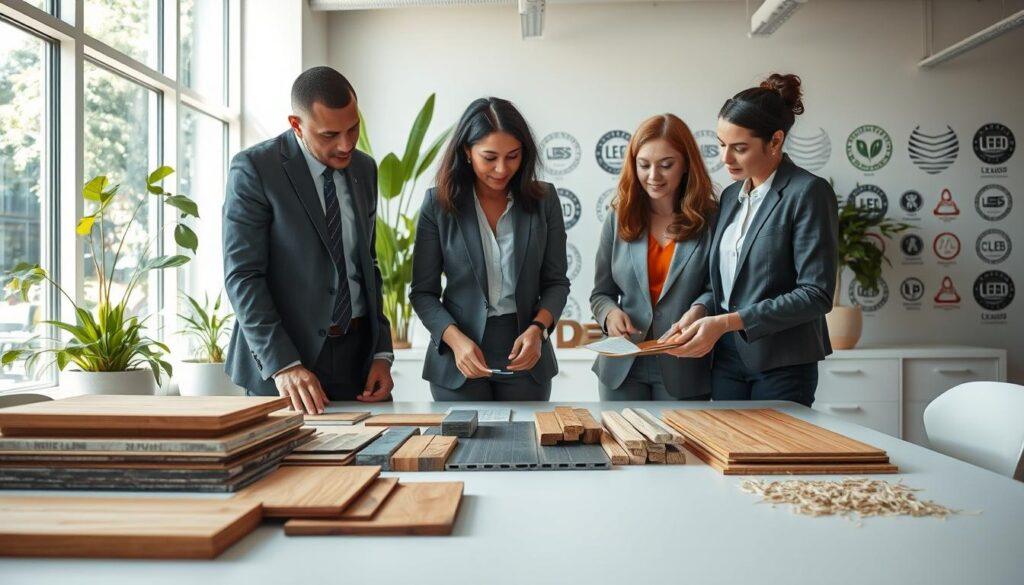
So, what should you look for? The green building world has clear criteria. Think of them as the seven virtues of sourcing. Here’s a table that cuts through the marketing fluff.
| Criteria | What It Really Means | Key Certification/Standard |
|---|---|---|
| Renewable/Plentiful | The material regrows or is abundant without depleting ecosystems. Fast-growing bamboo yes, old-growth teak no. | FSC (Forest Stewardship Council) for wood |
| Locally Available | Sourced within a 500-mile radius to slash transportation carbon. The ultimate low-hanging fruit. | Local sourcing mandates; LEED credits for regional materials |
| Recycled Content | Made from post-consumer or post-industrial waste. Giving trash a second life. | EPA Comprehesive Procurement Guidelines; Cradle to Cradle certification |
| Durable & Long-Lasting | The product won’t need replacement soon. Durability is the ultimate form of waste reduction. | Manufacturer warranties; independent testing data |
| Resource-Efficient Manufacturing | Made with less water, energy, and pollution. How it’s made matters as much as what it’s made of. | ISO 14001; LEED certification for building product disclosure |
Now, about LEED credits. The system is the gold standard, but it’s a game. You score points for using FSC-certified wood, recycled content, and local materials. It’s a great framework. Yet, a material can check the LEED box while having a questionable backstory.
My advice? Use certifications as a starting point, not the final answer. Look for the story behind the stamp. A locally salvaged barn wood might have no official certification. But its carbon narrative is impeccable. On the other hand, a product with three eco-labels might have traveled far.
In the end, sustainable sourcing is about being informed and skeptical. Demand transparency. Question distances. Prioritize durability. And remember, the most sustainable material is often the one you don’t need to buy at all.
Case Studies
I once stood in a warehouse that felt like a symbol of efficiency, thanks to its materials. The idea of sustainable materials is often debated in coffee shops. But, their true impact is seen in the buildings where we work, learn, and live.
- Bamboo flooring makes a living room feel bouncy and resilient.
- Mycelium bricks create a unique, organic wall in a gallery.
- Precast concrete panels quickly built a school addition in one summer.
- Mass Timber (CLT) frames an entire apartment building, quietly capturing carbon.
- Wool insulation makes a home office as quiet as a library.
- Structural Insulated Panels (SIPs) build a tight, draft-free cabin.
- PVC panels line a hydroponic farm, handling constant moisture well.
The precast concrete warehouse is a prime example. It looks simple from the outside but is efficient inside. The panels came with everything needed, speeding up construction. This saved time and money, making the building profitable sooner.
The mass timber cottage is another story. Walking in, you feel the wood’s story. The exposed CLT ceiling is more than structure; it’s a beautiful design. It shows the building’s carbon footprint, making it feel safe and new.
Wool insulation is amazing. It makes a room feel cozy, like an Irish pub. It keeps the room warm and quiet, changing the room’s mood.
But what about the less common materials? The table below shows their real-world impact:
| Material | Context | Real-World Verdict |
|---|---|---|
| Bamboo | Flooring & Furniture | Harder than oak, with a rapid renewability rate. Quality strand-woven is key, not cheap laminates. |
| Mycelium | Art & Non-Load-Bearing | Perfect for organic designs. It’s more art than structure now, but hints at a bio-fabricated future. |
| SIPs | Residential Envelopes | Creates a very tight building shell. The cost is worth it for long-term energy savings. It’s easy to maintain. |
| PVC Panels | Wet & Agricultural Spaces | Best for low-maintenance durability in harsh environments. Its sustainability is complex, but it excels in wet areas. |
Each material solves a specific problem efficiently when used correctly. This careful use is at the heart of a circular economy in construction. It’s not just about using green materials. It’s about using the right green materials in the right place, for decades, and telling a good story.
Cost & Performance
Does green construction make your wallet cry? The initial cost is often a big deal. But, the real story is how it performs over time. We’re not just buying a building; we’re investing in a long-term asset.
Think of it like choosing between a sports car and a hybrid. The sports car costs a lot upfront but doesn’t last long. The hybrid is more expensive at first but saves money in the long run. Sustainable building works the same way.
Structural Insulated Panels (SIPs) are a great example. They can be 50% more energy efficient than traditional framing. This means lower utility bills for years to come. The initial cost is spread out over decades, making it a smart investment.
Now, let’s look at the materials used in green construction. They have amazing performance specs.
Bamboo is as strong as steel, which is surprising. Mass timber is strong yet light, changing how we build tall structures. These materials are game-changers.
Wool insulation is another hero. It keeps your air clean and is as good as fiberglass at keeping warm. It’s like having an air purifier in your walls.
PVC panels last up to a century. That’s a long time. The savings on maintenance and replacement costs make it a smart choice.
| Material | Key Performance Metric | Economic Benefit |
|---|---|---|
| Structural Insulated Panels (SIPs) | 50% more efficient than timber frame | Major long-term energy cost savings |
| Bamboo | Tensile strength comparable to steel | Durable, renewable alternative to high-embodied energy materials |
| Mass Timber | Excellent strength-to-weight ratio vs. concrete | Faster construction, possible carbon credits |
| Wool Insulation | Competitive R-value vs. fiberglass | Improved air quality, natural and non-irritating |
| PVC Panels | Service life up to 100 years | Near-elimination of replacement costs for generations |
Is the cost of mass timber worth it? In green construction, it’s a smart investment. It’s not just about building; it’s about saving money and the planet.
Wool batts improve your air quality while keeping you warm. This adds value that’s hard to measure. It’s about looking at the big picture, not just the upfront cost.
Green doesn’t mean in the red. It’s about moving costs from now to later. This is smart, given today’s energy prices and climate concerns.
The data shows green building is worth it. The materials are better, more efficient, and last longer. The question is, can we afford not to build green?
Future Innovation
So, where does this material evolution lead? Imagine a skyscraper that doesn’t just sit there but actually breathes. It’s not fantasy. We’re already working on mycelium bricks that can biodegrade on command and advanced PVC that never ends up in landfills.
Prefabricated mass timber panels and SIPs are making construction faster. Carbon-negative bamboo is changing the game. These aren’t just products. They are the start of a new world after construction.
The big question is what LEED v5.0 will look like. Will it judge buildings on their ability to un-build themselves? The future isn’t about putting parts together. It’s about creating systems where today’s wall can become tomorrow’s garden bench.
I see a shift from hard hats to horticulture. The most innovative material might just be patience, as we learn to grow our shelters. This future, quietly growing in labs today, will change what a building is.