
Forget turning lead into gold. Today, we turn H₂ and air into electricity, leaving behind harmless water vapor. It’s like something out of a sci-fi story, but it’s real.
So, how does it work? Inside the fuel cell, hydrogen gas meets a catalyst at the anode. It loses its electrons. These electrons then power a motor.
At the same time, the positively charged protons go on a different journey. They meet oxygen from the air at the cathode. This reunion creates water as the only byproduct.
Carrying the hydrogen used to be hard because of the weight. Now, advanced tanks made of composite materials are lighter and stronger. This change isn’t just for cars; it’s for trucks, buses, and more.
This is your “Hydrogen 101.” It’s the smart, quiet kid in the clean energy class. It offers a clever solution to our zero-emission transportation needs.
Commercial Vehicle Applications: Hydrogen Trucks, Buses, and Long-Distance Transport Solutions
The commercial transportation sector is tackling the hydrogen dilemma head-on. They’re starting with large, hungry chickens. Consumer adoption of fuel cell cars is slow, but heavy-duty applications make sense. Fleet operators face daily headaches from downtime and range.
Fuel cell technology is a game-changer for heavy-duty needs. Trucks can’t wait for long charging breaks. City buses run long hours without stopping. This isn’t about looks; it’s about getting the job done.
Companies like Toyota are taking a smart approach. They’re focusing on areas with high demand. Their plan to deploy 600 fuel cell taxis in Tokyo by 2031 is more than just clean cabs. It’s about creating a demand that justifies new stations.
Toyota is also working on hydrogen truck corridors in Japan. Imagine routes for heavy goods vehicles with stations along the way. This is a focused effort, not a scattered approach.
Hyundai-Kia is also focusing on commercial vehicles in South Korea. They see buses, trucks, and trains as key. Fleets are easier to manage, making it easier to build stations.
Fuel cell buses are already in cities worldwide. They offer a quiet, clean ride that electric buses can’t match. The focus is now on heavier vehicles:
- Buses: Already in service in multiple cities, proving the technology in stop-start, high-utilization public transit.
- Trucks: From regional delivery to long-haul freight, prototypes and pilot programs are testing the limits of range and payload.
- Taxis & Fleet Vehicles: Like Toyota’s Crown initiative, these high-mileage, centrally managed vehicles are perfect early adopters.
- Rail: For lines that are difficult or too expensive to electrify, hydrogen locomotives present a compelling zero-emission alternative.
The path forward is clear and calculated. Focusing on sectors where benefits are clear—range, speed, and uptime—is key. The industry is building hydrogen infrastructure one step at a time. It’s a smart strategy, letting the market’s heavy hitters lead the way.
Passenger Vehicle Development: Toyota Mirai, Hyundai NEXO, and Next-Generation Fuel Cell Cars
Toyota sold 1,200 fuel cell vehicles last year. Hyundai-Kia sold 5,690 NEXO models. These numbers show a small market, not a big one.
This isn’t a failure. It’s a reality check. The hydrogen revolution’s passenger side is like a cult classic. It’s loved by a few, but not many see it.
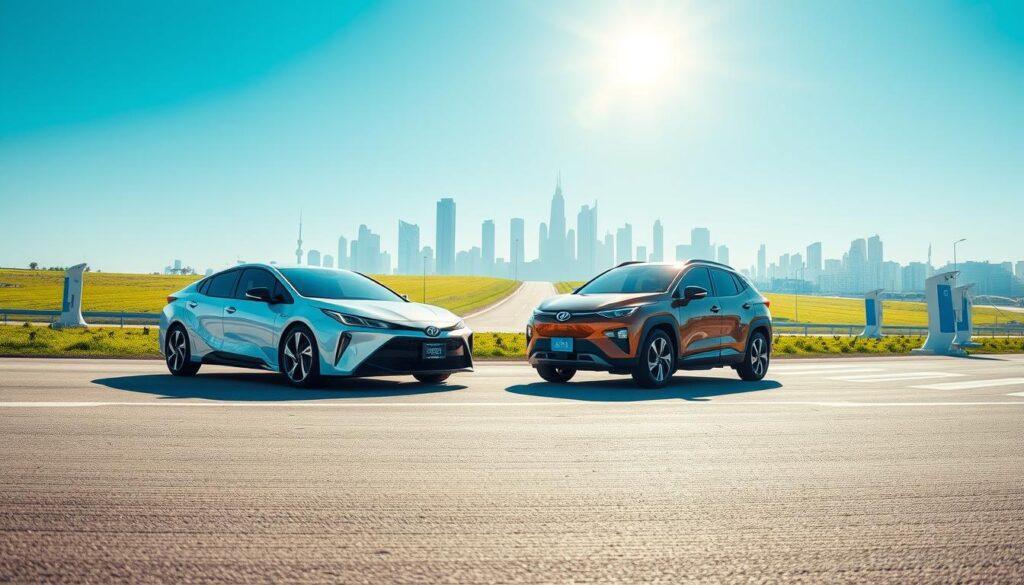
Toyota’s Mirai, meaning “future,” launched in 2014. It was a statement, not just a car. The latest Mirai looks sleek and emits only water vapor.
Hyundai’s NEXO is a sales leader. It’s a crossover SUV, familiar to Americans. Inside, it’s quiet and sophisticated, with an electric motor’s hum.
Driving one is simple and quiet. You start it, and it glides away silently. It’s fast, thanks to instant torque. The range is long, over 400 miles.
But, there’s a catch. You need to find a hydrogen station. If you can, it’s like a perfect EV. But, it’s not always easy.
Are these cars the start of a clean hydrogen economy, or just for a few? The answer is both.
They prove hydrogen tech works for cars. But, without more stations, they’re not for everyone. Battery-electric vehicles are more popular.
The market is small, but it could grow. The next fuel cell cars need more support. They need more people to use them.
Infrastructure Challenges: Hydrogen Refueling Stations, Production Methods, and Distribution Networks
The hydrogen economy faces a big problem: not enough infrastructure. There are too few stations, and they’re too far apart and expensive. This is a huge issue, worth trillions, for the hydrogen fuel cells transport movement.
Without a network, even the best fuel cell vehicles are useless. They become expensive paperweights. This is a major hurdle for the hydrogen economy.
The problem is like a chicken-and-egg situation. Car makers won’t make many cars without stations. Energy companies won’t build stations without cars. It’s a standoff that’s hard to solve.
In the U.S., there are only a few dozen hydrogen stations, mostly in California. This is a big difference from the thousands of gas stations across the country.
Worldwide, there are big plans to fix this issue. The European Union wants a station every 200 kilometers by 2031. China has similar plans. Toyota’s Yoshikazu Yamagata says things are slowly getting better.
But “slowly” is the key word. Building a station costs millions, and the return on investment is uncertain. This makes it hard to start.
Another big challenge is making hydrogen. Most hydrogen today is made from natural gas, which isn’t very clean. The goal is to use renewable power to make “green” hydrogen.
This requires a lot of solar and wind farms. This is another complex problem to solve.
Transporting hydrogen is also a big issue. It can’t be moved easily. It’s usually transported as a gas or liquid, which takes a lot of energy. Building a network of pipelines is needed for large-scale use.
The table below shows the global race for infrastructure. It highlights the gap between goals and reality.
| Region | Public H2 Stations (Approx.) | Key Initiative / Goal | Major Challenge |
|---|---|---|---|
| United States | ~55 | DOE’s “Hydrogen Shot” & California’s network expansion | High capital cost, fragmented state-level policies |
| European Union | ~180 | AFIR regulation: stations every 200 km on TEN-T core network by 2031 | Coordinating 27 member states, securing renewable energy for production |
| China | ~100 | National “Hydrogen Energy Industry Development Plan” focusing on heavy transport | Balancing rapid scale-up with a current reliance on coal-based (grey) hydrogen |
| Japan | ~160 | Basic Hydrogen Strategy targeting 1,000 stations by 2030 | High land costs, need for import strategies due to limited domestic renewables |
| South Korea | ~150 | Hydrogen Economy Roadmap aiming for 1,200 stations by 2040 | Dependence on imported hydrogen, public safety concerns |
The biggest problem for fuel cell technology is the lack of infrastructure. It’s a challenge of stations, production, and distribution. Solving it needs more than just engineering. It requires political will, investment, and patience.
The hydrogen highway is planned. The blueprints are ready. But the real work is building the infrastructure. This is the critical step to make this clean fuel dream a reality.
Green Hydrogen Production: Electrolysis, Renewable Energy Integration, and Cost Reduction Strategies
Turning water and sunshine into fuel is not magic—it’s electrolysis. This process is key to a clean hydrogen economy. A fuel cell vehicle running on hydrogen from natural gas is not truly clean. It just moves pollution from one place to another.
So, what is green hydrogen? It’s hydrogen made by using renewable electricity to split water molecules. No fossil fuels are used, so there are no carbon emissions. It’s a simple, elegant solution we’ve been waiting for.
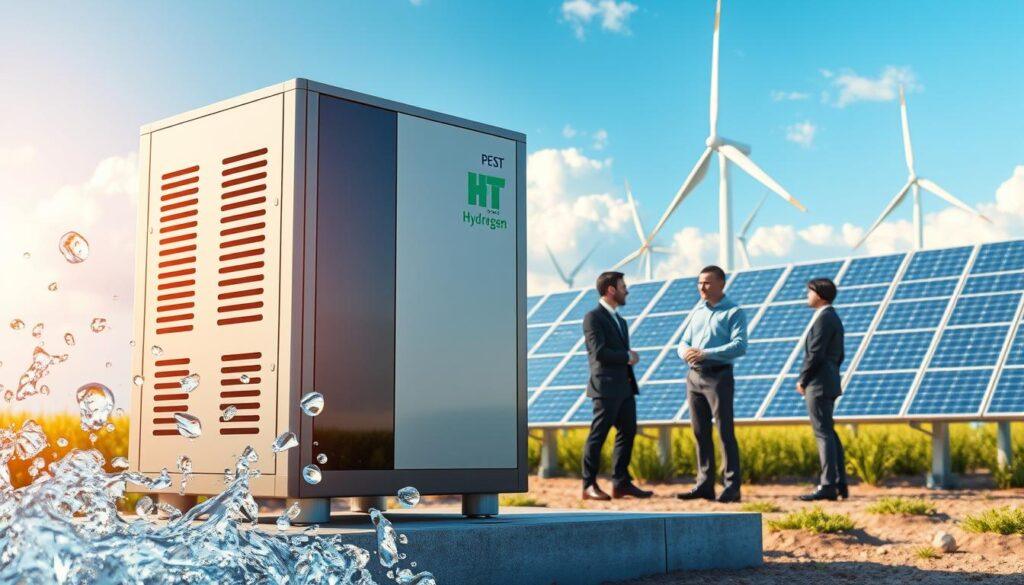
An electrolyzer is like a high-tech reverse engine. It uses power to make hydrogen, not burn it. When that power comes from solar or wind, you get carbon-neutral fuel. This is essential for sustainability.
Companies like Kawasaki Heavy Industries are aiming big. They’re building a global hydrogen infrastructure. Their plan is to ship liquefied green hydrogen from Australia to Japan. It’s like sending bottled sunshine across the ocean.
But there’s a catch: cost. Green hydrogen is currently expensive. Making it affordable needs a three-pronged approach.
- Scale: Building huge electrolyzer factories to lower costs, like we did with solar panels.
- Cheap Renewables: Using cheaper wind and solar energy. The cheaper the electricity, the cheaper the hydrogen.
- Tech Advances: Improving electrolyzer efficiency and durability to get more hydrogen from every kilowatt-hour.
The race is on to make green hydrogen affordable. The table below shows the stark reality of our current hydrogen options.
| Production Method | Feedstock | CO2 Emissions | Relative Cost | Long-Term Viability |
|---|---|---|---|---|
| Grey Hydrogen | Natural Gas | High | Low | Dead end. It’s fossil fuel with extra steps. |
| Blue Hydrogen | Natural Gas + CCS* | Lower (theoretically) | Medium-High | A transitional bridge, reliant on unproven carbon capture scale. |
| Green Hydrogen | Water + Renewable Electricity | Zero | High (decreasing fast) | The only sustainable foundation for a clean hydrogen economy. |
*CCS = Carbon Capture and Storage
Investing in green hydrogen production is both an environmental and economic choice. It builds a resilient, domestic hydrogen infrastructure powered by local sun and wind. It turns energy importers into energy creators. The goal is to create a new fuel, not just a cleaner version of fossil fuel.
So, when someone talks about hydrogen as the future, ask about its color. The answer will tell you everything about whether we’re building a cleaner world or just a more complicated detour.
Industrial Applications: Maritime Shipping, Aviation, and Heavy-Duty Equipment Fuel Cells
Forget the highway for a moment. The real revolution in hydrogen fuel cells transport is happening on the high seas and in the thin air. While our cars and buses get most of the press, the titans of global commerce—shipping, aviation, and mining—present a far knottier decarbonization puzzle. Batteries, for all their virtues, simply don’t cut it here. The energy density math fails when you need to move a 200,000-ton ship across an ocean or keep a wide-body jet aloft for ten hours.
This is where hydrogen gets to flex its high-energy-density muscles. I’m talking about decarbonizing the parts of our economy we simply cannot shut down. It’s a grand, industrial-scale vision that makes passenger cars look like a fascinating side project.
Conquering the Oceans: The Meta-Solution of Carrying Fuel
Let’s start with shipping, a sector responsible for nearly 3% of global CO2 emissions. The solution isn’t just putting a fuel cell on a container ship. First, you need to get the hydrogen to the port. Enter Kawasaki’s SUISO FRONTIER, the world’s first liquefied hydrogen carrier. Think about that: a massive ship whose sole job is to transport the clean fuel for other ships. How wonderfully meta.
This vessel is a floating prototype for a future hydrogen supply chain, moving liquefied hydrogen from production hubs to ports worldwide. Companies are testing hydrogen-fueled marine engines and fuel cell systems for ferries and coastal vessels. The goal? To turn the dirtiest leg of your online shopping journey into a zero-emission voyage.
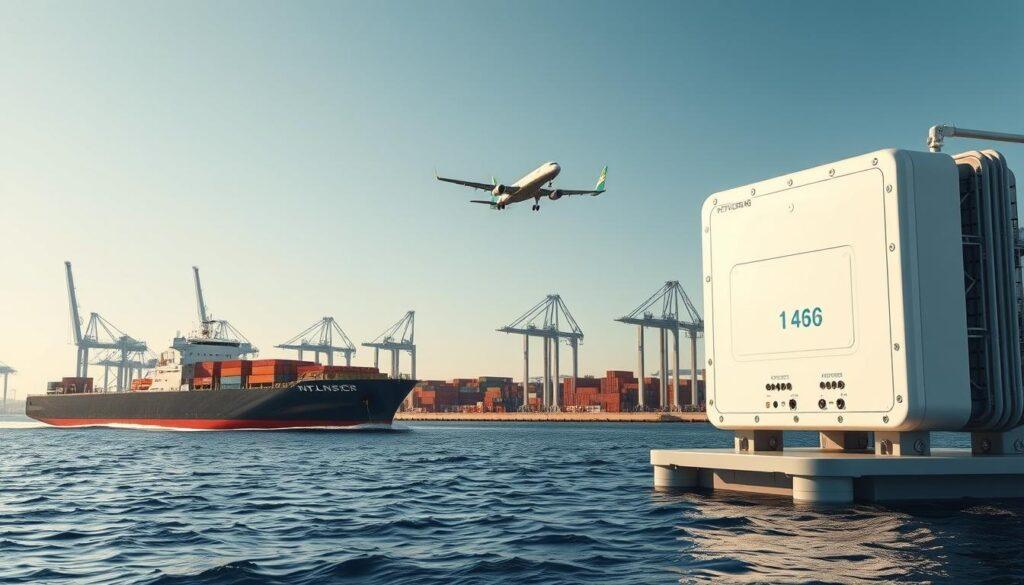
Aviation’s carbon problem is even more notorious. Electric batteries are too heavy for anything but short-hop flights. The industry’s bet for long-haul, zero-emission flight is squarely on hydrogen. Airbus has partnered with energy giants and unveiled ambitious concepts for hydrogen-powered aircraft, targeting entry into service by 2035.
The R&D is fierce, focusing on two paths: burning hydrogen in modified gas turbine engines or using fuel cells to power electric propellers. The challenges are immense—cryogenic fuel storage at -253°C, redesigning airframes, and building a completely new refueling infrastructure at airports. But the payoff? It might be the only viable green ticket for the industry’s survival.
Powering the Giants: Mining and Heavy Machinery
On the ground, the story gets equally heavy-duty. Imagine a mining dump truck the size of a small house. These beasts burn diesel by the barrel. Now, imagine them running silently on hydrogen. Trials are already underway, with companies deploying fuel cell-powered mining trucks and excavators.
The logic is perfect. These vehicles operate in confined, often remote areas like mines or ports. They follow predictable routes and return to a central base, making refueling infrastructure a solvable problem. Replacing one diesel mining truck with a hydrogen vehicle can eliminate thousands of tons of CO2 annually. It’s a quiet, powerful proof point.
To see how hydrogen stacks up against the unique challenges of each sector, consider this breakdown:
| Industrial Sector | Core Challenge | Hydrogen’s Prime Advantage | Key Development |
|---|---|---|---|
| Maritime Shipping | Need for immense, long-range energy storage. | High energy density per volume (special when liquefied). | Kawasaki’s SUISO FRONTIER liquefied hydrogen carrier. |
| Aviation | Extreme weight sensitivity for long-distance flight. | Superior specific energy (energy per unit mass) compared to batteries. | Airbus ZEROe concept aircraft and partnership ecosystems. |
| Heavy-Duty Equipment | High power demand and 24/7 operational duty cycles. | Rapid refueling and consistent power output, unlike battery degradation. | Fuel cell-powered mining truck trials by leading equipment manufacturers. |
This isn’t just about building new hydrogen vehicles. It’s about rebuilding the foundational energy logistics of global industry. The scale is staggering, and the stakes are the hardest-to-abate emissions on the planet. For a broader strategic overview of how these pieces fit into the wider energy transition narrative, the connections are profound. The highway was just the beginning; the ocean and the sky are the final frontiers.
Economic Analysis: Cost Comparisons with Electric Vehicles and Traditional Fuel Systems
Imagine a hydrogen truck at a refueling station. The driver looks at the price and frowns. The story of fuel cell technology is not just in labs or on test tracks. It’s also in the numbers on balance sheets. Let’s look at the costs.
First, the initial shock. A Toyota Mirai or Hyundai NEXO costs more than a battery-electric sedan. This extra cost is for being an early adopter. For commercial fleets, the numbers are even harder to swallow. A hydrogen truck can cost almost twice as much as a diesel one. An electric semi is in the middle, but it’s getting more affordable.
Then, there’s the fuel cost. A surprising fact: in some places, hydrogen costs almost as much as diesel per mile. But, the price can change a lot. Electricity for EVs is usually cheaper and more stable. This price change is a big challenge for hydrogen infrastructure.
So, what’s the real story? We need to talk about Total Cost of Ownership (TCO). This includes the cost of buying, fuel, maintenance, and what the vehicle is worth after use. For long-haul trucks, diesel is cheaper today. It’s cheap to buy and easy to find fuel for.
Electric trucks promise lower costs for fuel and maintenance. But, that big battery pack is expensive. Where does hydrogen fit in? Its story is complex. Today, it’s more expensive, the fuel price is unpredictable, and there are few places to get it fixed.
But, look ahead five years. Making more vehicles could lower their cost. Making green hydrogen could also make fuel prices stable. This is a big bet worth billions.
Government subsidies can help make the numbers work today. They can make clean trucks and hydrogen production cheaper. But, can these subsidies create a lasting market, or just help for now?
| Vehicle Type | Approx. Purchase Price | Fuel Cost per Mile | Estimated 5-Year TCO |
|---|---|---|---|
| Diesel Semi-Truck | $150,000 | $0.50 | $550,000 |
| Battery-Electric Semi | $350,000 | $0.20 | $625,000 |
| Hydrogen Fuel Cell Semi | $450,000 | $0.45 – $0.70 | $750,000+ |
| Toyota Mirai (Passenger) | $50,000 | $0.10 – $0.15 | $65,000 |
| Tesla Model 3 (Comparison) | $40,000 | $0.04 | $52,000 |
The table shows a clear story. Hydrogen is the most expensive option now. The high costs for vehicles and hydrogen infrastructure are big drawbacks. But, notice the fuel cost range. This shows the uncertainty.
Is fuel cell technology cost-effective today? For most, no. The case is built on future hopes and policy support. But, yes, it could be. If making more vehicles lowers costs and green hydrogen becomes cheap, everything changes. The economic analysis is just a snapshot of the beginning of a race.
Policy Support: Government Hydrogen Strategies, Funding Programs, and Regulatory Frameworks
Forget venture capital; the most significant checks written for the clean hydrogen economy are signed by governments. This isn’t just subsidies; it’s a full-spectrum geopolitical and economic strategy. Think of it as the ultimate de-risking mechanism for the private sector.
Why the massive state intervention? Look at the scale. Building a nationwide hydrogen infrastructure from scratch is a bet-the-farm endeavor. As noted in global carbon neutrality goals, governments have decided they can’t wait for the market to figure it out alone. The race is on.
Let’s survey the global chessboard. In the U.S., the Bipartisan Infrastructure Law earmarked $8 billion for Regional Clean Hydrogen Hubs. The goal is to create networked clusters of production, storage, and use. It’s a classic “if you build it, they will come” play, funded by the taxpayer.
Across the Atlantic, the European Union’s Hydrogen Backbone initiative aims to repurpose thousands of miles of natural gas pipelines. Their strategy is integration at a continental scale. Japan’s Green Growth Strategy, which includes partnerships with giants like Toyota, treats hydrogen as a national security imperative. They’re not just building trucks; they’re building energy independence.
But what does “funding” actually mean on the ground? It’s not a blank check. These programs target specific choke points.
- Production: Grants and tax credits for green hydrogen electrolyzers.
- Infrastructure: Capital for building refueling stations and retrofitting pipelines.
- Demand: Incentives for hard-to-abate sectors like steelmaking or shipping to switch.
This targeted approach aims to stimulate the entire value chain simultaneously. It’s economic engineering on a grand scale.
Of course, money alone isn’t enough. You need rules. Hydrogen, at high pressure, is finicky stuff. This is where regulatory frameworks enter, the unglamorous but critical paperwork. Agencies worldwide are updating codes for storage, transport, and dispensing.
These safety standards do more than prevent accidents. They build investor and public confidence. A clear, stringent rulebook tells companies, “Go ahead, innovate here. The playing field is safe and defined.” It turns a speculative fuel into a bankable asset.
| Region/Initiative | Key Funding / Goal | Strategic Focus |
|---|---|---|
| United States (Infrastructure Law & IRA) | $8B for H2 Hubs; $3/kg production tax credit | Kickstart regional ecosystems & reduce green H2 cost |
| European Union (Hydrogen Strategy) | Target of 10M tons domestic renewable H2 by 2030 | Energy sovereignty & pipeline repurposing |
| Japan (Green Growth Strategy) | Public-private partnerships (e.g., with Toyota) | Energy security & export of fuel cell technology |
The takeaway? The hydrogen infrastructure of tomorrow is being blueprinted today in legislative committees and budget offices. This policy layer is the quiet, essential foundation. It de-risks the massive capital expenditures required, making the private sector’s job not just possible, but profitable.
Without this web of strategies, funding, and rules, the technological marvels we discuss remain lab curiosities. With it, the clean hydrogen economy moves from white paper to reality.
Research and Development: Breakthrough Technologies, Efficiency Improvements, and Cost Reductions
Forget the boardrooms and policy papers for a moment. The most transformative action in the hydrogen saga is occurring at the molecular level. While the public eye is on new car models and filling stations, the engine room of this revolution is a global network of labs. Here, scientists and engineers are engaged in a silent, relentless campaign. Their mission? To solve the fundamental hurdles of fuel cell technology and make hydrogen vehicles not just viable, but downright compelling.
Let’s start with the heart of the matter: the fuel cell stack itself. The quest for greater efficiency and lower cost is a two-front war. On one front, researchers are attacking the platinum problem. This precious metal is the gold standard for catalysts, but its price and scarcity are major roadblocks. The goal is to either use far less of it or replace it altogether with cheaper, more abundant materials. Imagine iron or nickel-based catalysts doing the heavy lifting. That’s the kind of molecular hustle that could suddenly slash thousands off the price tag.
The other front is durability. Fuel cell membranes need to withstand years of thermal and chemical stress. Advances here mean longer-lasting stacks, which translates directly to lower lifetime costs for owners. It’s not sexy, but improving membrane chemistry is one of the most critical R&D battles being fought.
Then there’s the storage conundrum. High-pressure tanks work, but they’re bulky. The holy grail is solid-state storage—materials that can absorb and release hydrogen like a sponge, safely and at lower pressures. Breakthroughs in this area would be a game-changer, making hydrogen vehicles more flexible and efficient.
Of course, the hydrogen has to come from somewhere clean and cheap. That’s where electrolyzer R&D comes in. The focus is on making these machines more efficient and durable, while dramatically reducing the use of rare materials. The dream is a “green hydrogen” production unit so affordable it could sit at a depot or even a large truck stop. This isn’t just about big central plants anymore; it’s about distributed, cost-effective production.
This R&D spirit isn’t confined to passenger cars. Look at companies like Kawasaki Heavy Industries. They’re not just watching from the sidelines. Their research spans hydrogen gas turbines for power generation, direct injection hydrogen engines, and advanced liquefaction technology for shipping. This broad-based innovation shows the depth of the fuel cell technology push. It’s a whole ecosystem getting smarter and leaner.
So, what’s the bottom line of all this brilliant tinkering? It’s a direct assault on the cost curve. Every percentage point gain in efficiency, every gram of platinum saved, every new storage material discovered makes the entire proposition more attractive. This is where the magic gets upgraded, quietly and fundamentally. The next generation of hydrogen vehicles won’t just be cleaner—they’ll be cheaper, more reliable, and more capable. And that’s when the revolution shifts from a policy-led march to a consumer-driven sprint.
Career Pathways: Fuel Cell Engineering, Hydrogen Production, and Infrastructure Development Jobs
The plans for our hydrogen highway are ready. Now, we need the workers to build it. Who will pave the way for this clean hydrogen economy?
This isn’t just about new technology. It’s about jobs too. Chemical engineers are working on better fuel cells. Technicians are learning to fix cryogenic pumps at plants. Project managers are setting up refueling stations.
Companies like Toyota and Hyundai are leading the way. They’re not just making hydrogen cars. They’re building whole systems that need skilled workers.
For those looking for a career, this is a big chance. The sector is growing fast, but it needs more people with the right skills. This is a chance to be part of a new, clean energy future.
This shift will depend on people as much as technology. The race is on. The question is, who will build this new energy highway?