Imagine a world where energy is as clean as a fresh breeze on a spring day. Welcome to the fascinating realm of deep-water energy solutions. Here, innovation meets nature, creating a dance of technology and sustainability.
As we venture into these deeper waters, we find ourselves in a landscape where bigger blades are not just a trend; they are a necessity. The larger the blades, the more energy they can harness. It’s like upgrading from a small cup of coffee to a venti—who wouldn’t want that extra boost?
But let’s not just skim the surface. The challenges of this new frontier are as deep as the ocean itself. From engineering marvels to environmental considerations, every aspect deserves our attention. How do we balance the need for energy with the health of our planet? It’s a question worth pondering.
Technology leap XXL rotors nacelle ratings and drivetrain choices
The move to XXL rotors in offshore wind tech is groundbreaking. The average turbine rating jumped from 7.7 MW in 2022 to 9.7 MW in 2023. This shows we’re entering a new era of energy production.
Larger turbines mean more energy. A single floating turbine off the West Coast could produce about 15 megawatts. This is much more than the 6 MW of the biggest fixed-bottom turbines or the 2-3 MW of onshore models. Fewer turbines mean less maintenance and lower costs.
The XXL Rotor Revolution
The revolution is driven by wind energy physics. The power generated is linked to the rotor area and wind speed cubed. Doubling wind speed increases power eightfold. So, tall turbines are not just for looks; they’re to capture more energy.
Nacelle Ratings Redefined
Nacelle ratings are changing fast. The debate over direct drive vs. geared systems and permanent magnet vs. wound rotor is key. These choices will shape the future and decide which supply chains will grow. With a 41% global capacity factor, we’re getting more energy from the wind.
Drivetrain Choices for a New Era
Drivetrain choices are now critical. It’s not just about efficiency; it’s about reliability and scalability. The innovations in drivetrain tech will define the future of offshore wind. We’re building a strong, sustainable infrastructure.
In summary, the move to 15MW+ turbines and advancements in nacelle ratings and drivetrain tech are huge steps forward. This evolution is key to meeting energy demands while cutting costs and environmental impact.
Foundations monopile jacket suction bucket site fit
Foundations are key to offshore wind projects, though often overlooked. They support wind turbines, keeping them steady against nature’s forces. Foundations are essential for every successful offshore wind project.
Fixed-Bottom Foundation Types
Fixed-bottom foundations work up to 60 meters deep. But, deeper waters require new solutions. The National Renewable Energy Laboratory (NREL) says there’s 1,476 GW of wind power in U.S. waters for fixed-bottom installations.
Monopile, Jacket, and Suction Bucket Compared
Here are the three main fixed-bottom foundation types:
| Foundation Type | Depth Limit | Installation Method | Advantages |
|---|---|---|---|
| Monopile | Up to 60m | Pile driving | Cost-effective, simple |
| Jacket | 60m and deeper | Multiple anchor points | Stable in rough conditions |
| Suction Bucket | 60m and deeper | Pressure differential | Minimal noise, gentle installation |
Monopiles are dependable but not glamorous. They work well up to 60 meters. But, deeper waters need more advanced solutions. Jackets and suction buckets are designed for these depths, each with its own strengths.
Site Fit Assessment
Assessing site fit is complex. It involves understanding seabed topography, soil, seismic risk, and scour. This is why offshore wind floating platforms are becoming more popular.
The foundations we choose today affect tomorrow’s electricity costs. As we explore deeper waters, new foundation technologies are key to unlocking offshore wind’s full power.
Floating platforms spar semi sub TLP moorings anchors dynamic cables
Floating platforms are the future of wind energy in deeper waters. They come in four main types: spar-buoy, semi-submersible, tension leg platform (TLP), and barge. Each design has its own advantages.
Floating Platform Architectures
Each floating platform type is unique, like characters in a movie. The spar-buoy is stable and elegant but not practical for shallow ports. The semi-submersible is versatile and easy to tow, making it popular among researchers.
The TLP is the overachiever, kept rigid by taut mooring lines. But, its anchor loads can be harsh. The barge is the practical cousin, simple and affordable.
Spar, Semi-Sub, and TLP Designs
These platforms are key for accessing wind in waters up to 1,000 meters deep. Over 70% of wind resources are in depths over 50 meters. Designs from the North Sea might need changes for the West Coast’s waves.
Mooring and Anchoring Systems
Moorings and anchors are fascinating. They must hold a 15MW turbine in 500 to 1,500 meters of water. It’s a delicate balance between engineering and nature.
Dynamic Cables in Deep Water
Dynamic cables are vital for these setups. They must handle the platform’s motion and transmit power without failing. The National Renewable Energy Laboratory (NREL) sees 2,773 GW of floating wind power in U.S. waters.
The question is, can we build these platforms fast and cheap enough? The future of offshore wind energy depends on it. The stakes are high.
Port and vessel constraints crane limits wet storage marshalling plans
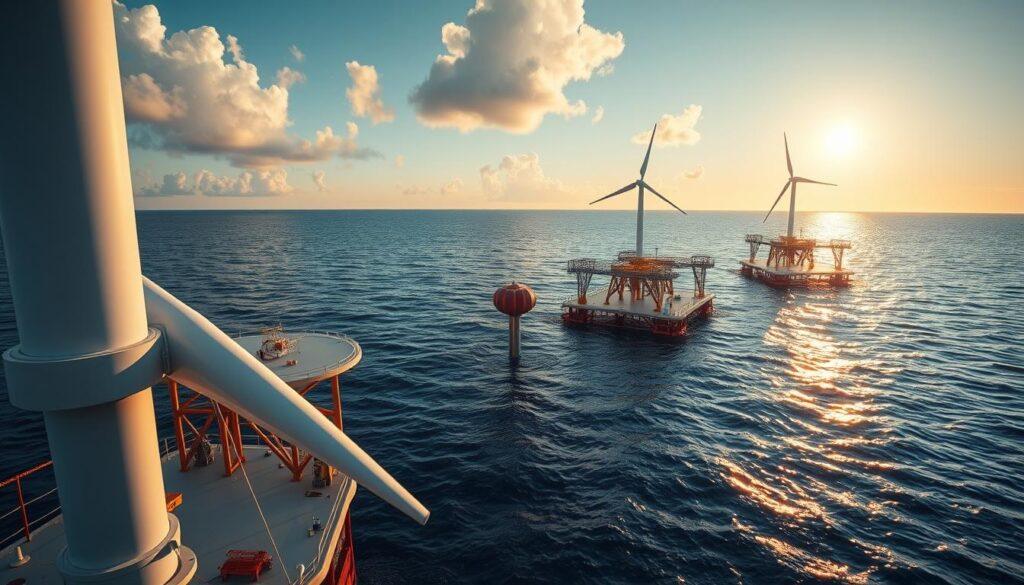
Offshore wind projects face big hurdles at the docks. Over $6.8 billion was spent on manufacturing facilities and ports from 2022 to 2024. Yet, the West Coast struggles with port logistics issues. Designing a top-notch floating platform is useless if it can’t leave the harbor.
The main problem is crane limits. These cranes must lift heavy nacelles onto tall towers. But most American ports were built for container ships, not for these massive machines. This makes it hard for developers to move forward.
Port Infrastructure Bottlenecks
Wet storage seems simple but is actually complex. Keeping platforms in the water while waiting for the right weather or vessel is tricky. They need sheltered, deep-water berths that don’t block commercial shipping lanes. This adds more complexity to port logistics.
https://www.youtube.com/watch?v=KRE_OdGukeM
The $6.8 billion investment in ports and vessels is impressive. But it’s dwarfed by the massive pipeline of over 80,000 MW projects. The floating platforms, like oil rigs with wind turbines, need special moorings. But these vessels are hard to find worldwide.
Vessel and Marshalling Plans
Marshalling plans are all about coordinating component delivery, assembly, and vessel schedules. This is where projects can get delayed. The West Coast lacks the right infrastructure and understanding of what it needs. This is a big problem that keeps many up at night but is rarely talked about.
In short, the success of offshore wind projects depends on solving these port logistics issues. As we move forward, tackling these challenges is key to unlocking floating wind technology’s full power.
Grid and onshore integration HVDC converter stations curtailment and storage options
The journey of electricity from sea to shore is filled with hurdles. Yet, the allure of offshore wind energy is clear. Electricity from offshore wind turbines travels through underwater cables to land. It then goes to coastal load centers, deciding where it should flow into the grid.
Offshore wind speeds are highest in the afternoon and evening, matching when we use the most electricity. On land, wind is stronger at night, creating a mismatch in energy supply and demand. Almost 80% of the nation’s electricity demand is in coastal and Great Lakes states, where offshore wind is abundant.
Grid Integration Challenges
Getting electricity from 20 to 30 miles offshore is just the start. The real challenge is getting it to our homes without losing a third of it. Offshore wind generation peaks when we need it most, but the real hurdles are regulatory, cost, and time to build HVDC infrastructure.
HVDC Converter Stations
HVDC converter stations are key to the offshore wind revolution. These massive stations are needed to send power over long distances. Unlike alternating current, direct current keeps its energy, but these stations are costly and large.
Curtailment and Storage Options
Curtailment is like throwing away food when people are hungry. Luckily, options like grid-scale batteries and green hydrogen production can help. These solutions make offshore wind a reliable source of energy, even when demand is high.
In conclusion, while electrons are ready, the grid faces big challenges. Integrating offshore wind into our system is tough, but possible with the right tech and strategies. For more on this, check out why we should act now.
Environmental and fishing coexistence monitoring birds marine mammals gear loss mitigation
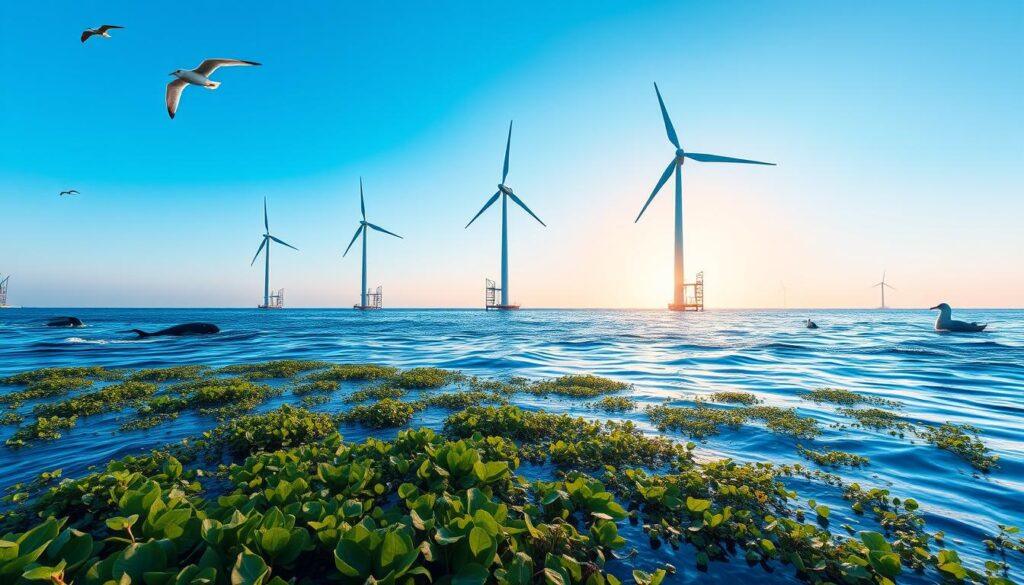
Offshore wind floating projects face a big challenge. They must balance protecting the environment with the needs of fishermen. These fishermen have been fishing in these waters for many years.
To solve this, environmental monitoring protocols are key. These systems use advanced tech like thermal imaging and radar. They help us see and hear even the smallest movements of wildlife, keeping their homes safe.
Environmental Monitoring Protocols
Birds and Marine Mammals
Birds and marine mammals have to deal with a lot when wind farms are built. The loud noise from pile-driving can scare them away. But, floating platforms are quieter, which helps a lot.
This is important because we should be careful and not wait for all the facts. The precautionary principle tells us to act with caution.
Fishing Coexistence Strategies
Fishing and wind farms can coexist, but it’s not easy. It’s not just about paying fishermen for lost gear. We need to make sure both can thrive together.
- Designing cable burial depths that minimize snagging risks.
- Establishing clear navigation corridors for fishing vessels.
- Creating co-use zones that allow for trawling amidst turbine spacing.
Gear Loss Mitigation
We’re moving from seeing it as a fight between wind farms and fishing to working together. How can we design projects that fit both needs? Talking to the community is key.
In the end, making offshore wind projects work with the sea and fishing is a big challenge. It’s about respecting our environment and the traditions of fishermen.
| Monitoring Method | Advantages | Challenges |
|---|---|---|
| Thermal Imaging | High accuracy in detecting species | Costly and requires specialized equipment |
| Acoustic Monitoring | Real-time data collection | Can be affected by background noise |
| Radar Systems | Effective for large areas | Limited detail on species behavior |
CAPEX OPEX learning curves insurance weather downtime model
Offshore wind is a field full of financial ups and downs, like the waves. Knowing the costs is key to success in this area. CAPEX and OPEX are vital for the financial health of floating wind farms.
The Department of Energy says building floating wind farms costs about 50% more than fixed ones. This might worry utility leaders, but it also shows we’re just starting. Using bigger turbines will help lower costs as we learn more.
Cost Structure Breakdown
Let’s look at the costs:
| Cost Type | Description | Estimated Percentage of Total Cost |
|---|---|---|
| CAPEX | Initial costs for construction and installation | 50% |
| OPEX | Ongoing operational costs | 30% |
| Learning Curves | Cost reductions from experience and technology improvements | 20% |
CAPEX, OPEX, and Learning Curves
Big turbines mean more energy and fewer turbines needed. This cuts down on maintenance and crane use, lowering OPEX.
Risk and Downtime Modeling
Insurance is key in this financial mix. It’s working on risk models for deep water, high wave areas. Weather downtime can also affect profits, changing project IRR by several points.
Insurance and Weather Downtime
It’s important to understand these risks. Offshore wind turbines have low emissions and quick carbon payback. This makes the costs worth it for the long-term benefits.
US lease areas permitting timelines BOEM and Jones Act realities
The U.S. is exploring offshore wind, but it’s a complex journey. The Bureau of Ocean Energy Management (BOEM) controls lease areas and permits. This path is not just about wind; it’s also about dealing with a lot of rules.
Offshore wind in the U.S. is promising but faces many challenges. As of May 31, 2024, we have 174 megawatts of installed capacity. China has over 40,000 megawatts. Yet, we have more than 80,000 megawatts in development.
The 132-MW South Fork Wind Farm started in December 2023. It’s the first big wind farm in the U.S. It will power over 70,000 homes in New York.
US Lease Areas and Permitting
BOEM’s timelines are slow, like continental drift. Developers wait years for permits. The Inflation Reduction Act has helped, but it’s not fast enough.
BOEM Timelines
BOEM timelines vary. They depend on site assessments, environmental reviews, public comments, and auction schedules. These factors can make the wait long and frustrating.
Jones Act Realities
The Jones Act is from 1920. It requires U.S.-built, U.S.-flagged, and U.S.-crewed vessels for U.S. port-to-port transport. The U.S. lacks specialized wind turbine installation vessels.
Developers use foreign vessels and U.S.-flagged feeder barges. This adds cost, complexity, and weather risks. Each vessel transfer increases expenses and complicates logistics.
Despite these challenges, the industry is optimistic. Between 2022 and 2024, over $6.8 billion was invested in manufacturing and ports. This shows hope that these challenges are just temporary.
In conclusion, the U.S. offshore wind sector is growing. But, it’s just starting. With floating wind on the West Coast a decade away, we face big regulatory hurdles. Let’s hope we can overcome these challenges.
Workforce pipeline fabrication welders technicians mariners HSE training
Finding the right workforce for offshore wind is a big challenge. It’s not just about building huge turbines. It’s about creating a team of skilled professionals ready for the unique challenges of this task.
We need fabricators who can weld steel sections as long as football fields. The precision needed is incredible. Then, there are technicians who must fix complex systems at high heights, all while facing harsh weather. And let’s not forget the mariners, who must master systems to safely move through rough seas. The need for a strong workforce is urgent.
Building the Workforce Pipeline
The offshore wind sector could create thousands of jobs, helping millions of Americans access renewable energy. To make this happen, we need to develop training programs for engineers, operators, and more. Working with schools and vocational programs is key. These partnerships can help prepare people for careers in offshore wind and marine engineering.
Fabrication, Welders, Technicians, Mariners
The challenge of fabrication is huge. A single floating platform substructure can need thousands of tons of steel, all welded to tight standards. Unfortunately, the U.S. doesn’t have enough certified welders for offshore work. This is because other industries, like shipbuilding and oil and gas, also need skilled workers.
Vocational programs and community colleges are starting to help. But becoming a skilled welder or marine technician takes years, not just a few months. The industry needs to offer scholarships and sponsor training for those who want to join.
HSE Training Standards
HSE training—Health, Safety, and Environment—is not just a formality. It’s the core of an industry where workers face dangers at height, over water, and near high-voltage equipment. The European offshore wind sector learned this the hard way. The U.S. has a chance to build a strong safety culture from the start.
We must focus on apprenticeships, certification paths, and career opportunities to attract young talent. It’s not just about energy production; it’s about building a skilled workforce for the future of renewable energy.
| Position | Skills Required | Training Duration | Industry Demand |
|---|---|---|---|
| Fabricator | Welding, Blueprint Reading | 2-4 years | High |
| Technician | Electrical Systems, Troubleshooting | 1-3 years | Very High |
| Mariner | Navigation, Safety Protocols | 1-2 years | High |
The offshore wind industry must focus on workforce development for the future. For more insights, check out this resource. The path forward is not just about technology; it’s about the people who will make it happen.
Case snapshots Europe Asia US West Coast with operating metrics
Looking at offshore wind energy, we see different regions playing big roles. Europe leads with about 30 GW of power, thanks to the UK and Germany. They’ve made the North Sea a hub of innovation with floating platforms.
Asia is also making a splash. China has over 30 GW, adding 17 GW in 2021 alone. Japan and South Korea are setting big goals for their energy futures. Their strong shipbuilding helps in making floating platforms, leaving the US to catch up.
The US West Coast has huge promise. It could have 2,773 GW of floating wind power. But, only 174 MW are up and running. The first big turbines won’t start for at least 10 years. This makes the US wonder if it will lead or follow in this energy shift.
Looking at how these turbines work, we see a big difference. Offshore wind turbines have a 41% capacity factor, much higher than onshore or solar. One big turbine can power thousands of homes. But, we need to build more to meet demand. We must act fast, as time is running out on cutting carbon emissions and grabbing economic chances.