Remember pumped storage? That old, outdated tech from the last century? It’s time for a new chapter.
We’re in the midst of a pumped storage renaissance. It’s not just about looking back. It’s about using water’s power when it’s cheap and valuable.
Our push for wind and solar has run into a problem: it’s not always there. Lithium-ion batteries are fast but can’t keep up for long.
We need long-duration storage for the long haul. We’re talking days, not hours.
Expert Janice Goodenough says we’re running out of time. Without clear signals, we’ll miss the mark. The old “water battery” is our best bet for now.
It already powers 94% of the world’s long-duration energy storage. That’s over 200 gigawatts of power, ready when we need it.
So why now? The future of our grids is getting more exciting. And a lot wetter.
Renewable penetration and LDES need
We’re racing toward a future with renewable energy, but we’re not ready. Solar and wind power are setting records, but the grid is struggling. This change is huge, causing ups and downs in power supply.
Variable renewable energy (VRE) doesn’t follow old rules. The sun goes down, and the wind stops. Suddenly, lots of power disappears. On sunny, windy days, the grid gets too much power, forcing it to pay others to stop making electricity.
Long‑duration energy storage (LDES) is key. It’s like a shock absorber for the grid. Batteries are great for quick fixes and short-term power shifts. But for longer periods, like weeks, we need something else.
This is where pumped storage hydro (PSH) becomes essential. Rebecca Goodenough of HYDROGRID says comparing power capacity alone is misleading. What really matters is storage volume. A battery might match a PSH plant’s power, but it can’t hold a fraction of the energy.
Let’s look at why endurance is critical:
- Grid Inertia: Old plants keep the grid stable. PSH can do this too.
- Black Start Capability: After a blackout, PSH can start itself and other plants. Most batteries can’t.
- Seasonal Shifting: Store summer solar for winter nights. Today’s batteries can’t do that.
| Storage Technology | Typical Power Rating | Typical Energy Capacity | Duration at Full Power | Primary Grid Service |
|---|---|---|---|---|
| Pumped Storage Hydro (PSH) | 100-3000 MW | 5-30+ GWh | 6-24+ hours | Long-duration shifting, inertia, black start |
| Lithium-ion Battery | 10-300 MW | 0.05-1 GWh | 1-4 hours | Frequency regulation, intra-day shifting |
| Flow Battery | 5-100 MW | 0.2-4 GWh | 4-12 hours | Medium-duration shifting, renewables integration |
| Compressed Air (CAES) | 50-300 MW | 1-10 GWh | 4-24 hours | Bulk energy management, capacity |
The numbers show the truth. For long-term grid support, only certain technologies will do. Pumped storage hydro stands out for its long-lasting power.
The focus is shifting. We’re not just smoothing out small changes. We need to handle big weather patterns and seasonal changes. This means thinking in terms of gigawatt-hours, not just gigawatts.
As renewables grow, the grid needs a reliable energy storage system. Long‑duration storage is essential for a clean grid. And right now, pumped storage hydro is the only proven technology at scale.
Technology Options
Remember those huge, concrete dams from history books? They changed valleys. Now, pumped storage hydro has a new story.
We’re not just looking for canyons anymore. We have a wide range of choices. It’s not just about where to build; it’s about how to build it.
The open-loop system is classic. It connects to rivers or lakes. It’s strong but can be hard to get permits for.
The closed-loop, or “off-river,” design is popular now. It uses two man-made reservoirs. It’s better for the environment and easier to get permits for.
Hybrid systems are getting attention too. Adding solar panels on reservoirs saves water and connects to the grid. Even old mines and dams are being reused.
This part of the guide shows you the latest in PSH technology. We’ll talk about the good and bad of each type. The field has moved from simple energy storage to smart, strategic use.
Ternary sets, adjustable‑speed, underground
Modern pumped storage is all about the tech, not just the water. It’s about turning gravity into power. Think of it as a high-tech machine, not just simple pipes and turbines.
The ternary set is like a car with two engines. It lets the plant pump water and make power at the same time. This fine-tunes the power flow, making it perfect for the grid.
The adjustable-speed pump-turbine is a game-changer. Unlike old turbines, it can adjust its power. This is key when the wind and sun aren’t working.
When it’s quiet outside, adjustable turbines can handle the extra power. They’re not just storing energy; they’re keeping the grid stable.
This makes pumped storage more than just a storage unit. It’s a key player in keeping the grid stable. It’s all about making the grid work smoothly.
Using old mines or caverns is smart. It saves space and cuts down on costs. It’s like using nature’s own storage.
These sites are perfect for storing water. They’re safe and easy to use. It’s a win-win for the environment and energy.
With these new techs, pumped storage plants are always ready to help. They can start the grid after a blackout or smooth out power changes. They’re essential for keeping the power flowing.
The money side of things changes too. Plants can make money in many ways. They get paid for quick power changes and for being ready to go. It’s a big change from just making money when it’s cheap to make power.
Places like Germany and Switzerland are already using this tech. They show how it can make a big difference. It’s a big step forward for clean energy.
The real magic is in the control room, not just the reservoirs. With the right tech, pumped storage can do so much more. It’s not just about storing power; it’s about controlling the grid.
This tech makes pumped storage a key player in clean energy. It’s not just about storing power; it’s about keeping the grid running smoothly.
Siting & Permitting
Finding the perfect spot for a grid-scale battery isn’t like picking real estate on Zillow. It’s more like playing geographical Tetris with billion-dollar consequences.
You need serious elevation change, proximity to transmission lines, and a community that won’t treat your groundbreaking ceremony like a protest rally. This is where closed‑loop reservoirs enter the chat as the clever workaround.
By being “off-river,” these systems dodge the thorniest water-rights battles and ecological headaches of their open-loop cousins. Think of it as building your own private water slide, instead of trying to redirect the Mississippi.
But here’s the rub: “closed-loop” doesn’t mean “fast-track.” You’re moving literal mountains of earth. The real bottleneck, as experts like Goodenough at HYDROGRID highlight, is the permitting gauntlet.
This bureaucratic maze can make Kafka’s novels read like straightforward instruction manuals. We’re talking multi-year environmental reviews, political landmines, and enough paperwork to fill a reservoir itself.
Closed‑loop benefits, land/water issues
Imagine a huge water battery that doesn’t harm rivers or valleys. Welcome to closed‑loop reservoirs. It’s not like old pumped storage. It’s an off‑river system with two man‑made basins on a hill, talking to each other only.
This system has big environmental benefits. It reduces the project’s impact on water. Aquatic ecosystems are healthier. Water temperatures and sediment flows stay natural.
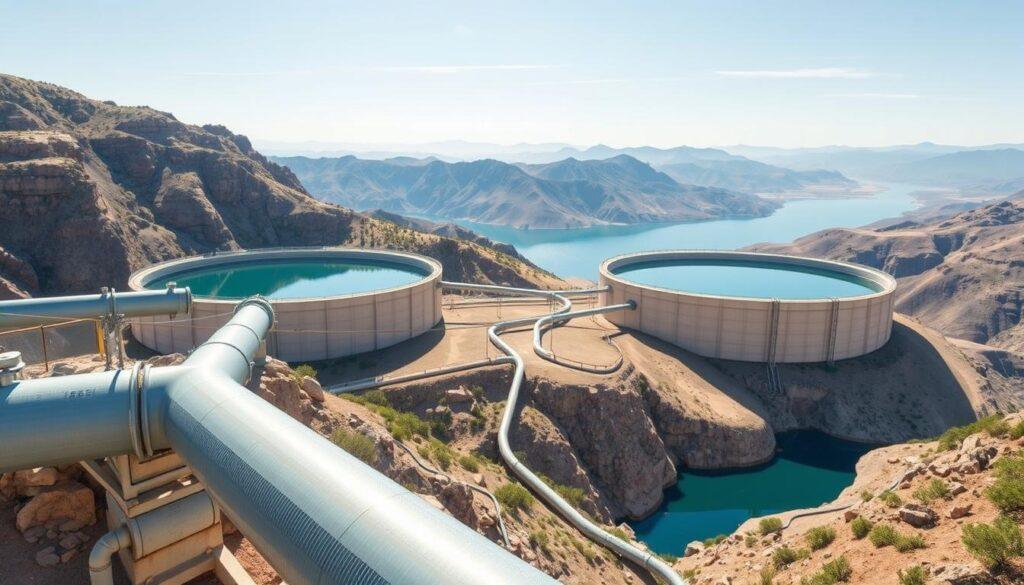
This setup makes regulators and neighbors less worried. The environmental review process is easier. Local opposition can turn into cautious support.
But, land and water issues remain. You need a lot of land for two big reservoirs. And there’s the water.
Initial fill and evaporation makeup water is the project’s silent, thirsty partner. Finding millions of gallons for the first fill is key. It can come from groundwater, treated wastewater, or far away. This choice affects the project’s economics and social acceptance.
But there’s a clever benefit. These basins can also store water for firefighting and irrigation. They can even help with flood control.
Is it perfect? No technology is. But closed‑loop systems are a smarter choice. They offer climate‑resilient storage with less ecosystem harm.
| Consideration | Closed‑Loop Advantage | Key Challenge | Mitigation Strategy |
|---|---|---|---|
| Water Source | Isolated from rivers; no continuous diversion | Initial fill & evaporation makeup requires new water sourcing | Use non‑potable sources: treated wastewater, brackish groundwater, stormwater capture |
| Land Use | Flexible siting away from sensitive riparian zones | Stil requires 200‑500+ acres for reservoirs | Co‑locate with existing infrastructure like retired mines or solar farms |
| Permitting | Simpler vs. river‑based projects; fewer aquatic impacts | Stil faces scrutiny for earthmoving, water rights, and visual impact | Early community engagement and offerring ancillary benefits (fire protection) |
| Climate Resilience | Not dependent on river flows; operates in droughts | Evaporation losses increase in arid, hot climates | Implement floating solar panels or covers to reduce evaporation |
In the end, closed‑loop pumped storage is a trade. You swap river impacts for land and water puzzles. For many, it’s a good deal. Closed‑loop reservoirs are a step toward a renewable future without harming nature.
Revenue Stack
Remember when energy arbitrage was enough? Buy low, sell high seemed like a solid plan. But today, it’s like trying to win the Super Bowl with only a quarterback.
The smart money isn’t on a single play. It’s on building a revenue stacking portfolio. Think of it as a financial layer cake for the grid.
The base layer is that classic energy trade. The next tier? Capacity markets. You get paid just to be ready, a financial guardian for when demand spikes.
The real profit lives in the icing: ancillary services. These are the grid’s premium products. We’re talking frequency regulation, system inertia, and the ultimate reliability tool—black-start capability.
One asset. Multiple paychecks. This turns a bulky piece of infrastructure into a cash-flow Swiss Army knife. That’s the modern economic reality.
Energy arbitrage, capacity, inertia, black start
While energy arbitrage gets all the headlines, today’s PSH facilities are quietly collecting paychecks from three other essential grid services that keep the lights on. Think of it as a four-act play where each act commands its own ticket price from desperate system operators.
Energy arbitrage is the classic buy-low, sell-high maneuver, now supercharged by renewable patterns. Solar panels flood the grid at noon, creating a surplus that tanks prices. PSH plants absorb this cheap power, pumping water uphill. Then, as the sun sets and everyone fires up their air conditioners, they release that stored energy during the evening ramp when prices spike. It’s basic economics, just with water instead of widgets.
The real financial magic happens in capacity markets. This isn’t about selling electrons—it’s about selling peace of mind. Grid operators like PJM and ERCOT pay PSH plants a premium just for being on call, ready to deliver full power for hours during emergencies. In 2022, capacity payments in PJM’s auction reached over $200 per megawatt-day. That’s the grid’s insurance policy, and PSH is the reliable underwriter.
Then there’s inertia—the grid’s invisible gyroscope. As coal and nuclear plants retire, we’re losing the massive spinning turbines that naturally resist frequency changes. Enter modern PSH. Its huge rotating mass provides synthetic inertia, stabilizing the grid during sudden disturbances. System operators now procure this service through ancillary services markets. In Australia’s National Electricity Market, inertia services can fetch up to $15,000 per megawatt-year.
But the crown jewel is black-start capability. Imagine the entire Eastern seaboard goes dark. Who turns the lights back on? A PSH plant with black-start capability can self-start (often using a small diesel generator or its own stored water) and then act as a seed to restart other power plants, one by one. It’s the ultimate resilience product, and operators pay dearly for it. The New York ISO has paid over $50,000 per event for black-start services.
| Service | What It Does | Market Example | Revenue Potentail |
|---|---|---|---|
| Energy Arbitrage | Buys cheap surplus power, sells during high demand | CAISO day-ahead markets | $20-80/MWh spread |
| Capacity | Provides “insurance” for peak demand periods | PJM capacity auctions | $100-250/MW-day |
| Inertia/Frequency Regulation | Stabilizes grid frequency instantly | ERCOT ancillary services | $5,000-15,000/MW-year |
| Black Start | Restarts grid from complete blackout | NYISO reliability services | $10,000-50,000/event |
The beauty of this model? These revenue streams don’t compete—they complement. The same turbine that earns capacity payments by being available can also provide inertia while it’s spinning and black-start capability when called upon. It’s like getting paid four separate salaries for one job.
Modern capacity markets are increasingly recognizing this value. Some ISOs now offer “stackable” compensation where PSH can participate in multiple ancillary services simultaneously. The financial math becomes compelling: a 1,000 MW plant might earn $50 million annually from capacity, another $10-15 million from frequency services, plus arbitrage profits and black-start retainers.
So when developers talk about the “revenue stack,” they’re not exaggerating. Each layer—from the basic energy trading to the high-value black-start contracts—builds a more resilient business case. And as the grid gets more unstable, each layer becomes more valuable. It’s not just storage; it’s a financial Swiss Army knife for the energy transition.
Cost & Timeline
Let’s tackle the big question. We’re not just launching an app; we’re creating massive infrastructure. The cost and time needed for this tech are huge hurdles.
The capital expenditure is huge upfront. Single projects cost billions. Most investors need a sure way to get their money back before they invest.
The timeline is also long. It takes decades from start to finish. An investment today will shape the grid in 2035 and later.
This creates a big problem. Why would private capital wait 15 years? It could fund a solar farm in 18 months. The numbers don’t work for quick returns.
To solve this finance challenge, we need patient investors and better policies. The future of the grid depends on making these long projects safer. Without the right support, these plans are just expensive ideas.
CapEx ranges, lead times, financing
Financing a pumped storage hydro project is like assembling the Avengers. You need a specific, powerful team, often backed by the government. The capital expenditure numbers are huge, making you double-check the decimal point. It’s an investment that could fund a small nation’s coffee budget for a decade.
To get a PSH project from a sketch to a humming grid asset, it’s a three-act play. It involves eye-watering costs, long schedules, and financial innovation. This would make a Wall Street quant blush.
The Price Tag: CapEx Ranges That Demand a Strong Drink
The money needed is staggering. For a new, closed-loop pumped storage hydro facility in the United States, the capital expenditure (CapEx) ranges from $1,500 to $2,500 per kilowatt of installed capacity. For a standard 1 gigawatt project, that’s $1.5 to $2.5 billion just to start.
Why so high? You’re not just building a dam. You’re constructing two massive reservoirs, miles of tunnels, and installing reversible pump-turbines that are engineering marvels. It’s less construction and more like sculpting a mountain range to hold water.
To put that in perspective, a single large-scale PSH project can cost more than the entire annual GDP of some small island nations. It’s capital intensity on steroids.
The Long Game: Lead Times That Test Your Patience
If you thought your 30-year mortgage was a long-term commitment, buckle up. The lead time for a pumped storage hydro project is typically 7 to 10 years. Yes, you read that correctly. A decade.
This timeline isn’t just bureaucratic red tape. It’s a marathon of stages:
- Years 1-3: Feasibility studies, environmental impact assessments, and securing more permits than a small-town festival.
- Years 4-6: Detailed engineering design that would make a NASA engineer proud.
- Years 7-10: Actual construction, where moving earth becomes an art form.
This isn’t just a “build it and they will come” scenario. It’s a decade-long commitment that requires more patience than a saint.
The Financial Engineering: Assembling the Capital Avengers
Financing a PSH project is unique. It’s a blend of:
- Utility Balance Sheets: The old guard, with deep pockets and a long-term view.
- Government-Backed Loans: Think DOE Loan Programs Office, playing the role of the financial Hulk.
- Strategic Investors: Pension funds and infrastructure funds looking for stable, long-term returns.
- Corporate Off-takers: Tech giants wanting clean, firm power for their data centers.
The key? Long-term revenue visibility. Investors need contracts or market designs that guarantee cash flow over 30 to 50 years. It’s less “build it and they will come” and more “build it and sign a 50-year revenue guarantee.”
This is where policy becomes the star of the show. Markets alone, as the Global Renewables Status Report highlights, won’t deliver enough PSH projects. Governments need to step in with mechanisms that reward the flexibility and grid stability services PSH provides.
Comparative Table of Financing Models for PSH Projects
| Model | Source of Capital | Typical Term | Key Requirement |
|---|---|---|---|
| Project Finance | Private Banks, Bond Markets | 10-15 years | Long-term Power Purchase Agreement (PPA) |
| Utility Balance Sheet | Utility Rate Base | 30-50 years | Regulatory Approval |
| DOE Loan Programs Office | Federal Government | 20-30 years | Technology Innovation |
| Strategic Investor | Pension Funds, Infrastructure Funds | 20+ years | Stable, Predictable Returns |
| Corporate Off-taker | Tech Company, Industrial User | 10-20 years | Clean, Firm Power Supply |
The Bottom Line: Slowly Making Mega-Projects Bankable
So, what’s the verdict? Modern financial engineering is slowly making these pumped storage hydro mega-projects bankable. It’s a complex puzzle of capital sources, but one that’s increasingly being solved.
The future of PSH financing lies in a hybrid approach. It’s about stitching together the right capital partners, each bringing their unique superpower to the table. It’s less “Shark Tank” and more “Mission: Impossible” with a dash of government support.
For developers, the message is clear: secure your long-term revenue visibility first. Everything else is secondary. Without that, even the most brilliant engineering becomes a financial fantasy.
In the end, financing a PSH project is a masterclass in patience, persistence, and financial creativity. It’s not for the faint of heart, but for those who succeed, the rewards are as massive as the projects themselves.
Portfolio Fit
So you’ve built your clean energy portfolio. Wind farms stretch to the horizon. Solar panels gleam in the sun. But have you built an army with only cavalry?
Energy expert Julia Goodenough cuts to the chase. “What we need is a stacked system,” she argues. “Short-duration storage layered on top of long‑duration storage.” Think of it as strategic depth for your grid.
Your portfolio is a pyramid. At the base: variable renewables—the fuel. The first layer: fast batteries for daily skirmishes. But the apex, the critical reserve? That’s the domain of true long‑duration storage.
This isn’t about replacement. It’s about foundation. Batteries handle the afternoon peak. But what about the week-long drought? The seasonal shift? That’s where endurance wins.
PSH is the infantry in your energy army. It provides the staying power when the cavalry tires. In portfolio terms, it’s the non-correlated asset that brings stability when everything else gets shaky.
Forget chasing the next shiny tech toy. The smart money builds from the ground up. And that foundation is built to last.
Co‑location with wind/solar
The grid’s most elegant dance happens when solar’s midday surge meets the gravitational grace of pumped storage hydro. It’s renewable energy’s version of a perfect partnership—one produces, the other stores, and together they smooth out the grid’s roughest edges.
Imagine a massive solar field next to a pumped storage hydro facility. When the sun shines at noon and electricity prices drop, the PSH plant pumps water. It uses that cheap, excess solar power and stores it in its upper reservoir. At night, when demand is high and solar power is low, it generates electricity that’s worth more.
IRENA calls these “coupled schemes,” and they come in two flavors. First, the straightforward neighbor approach—a wind or solar plant built right next to an existing PSH facility. The second is more integrated, like floating solar panels on the reservoirs themselves.
That floating PV idea is clever. Solar panels on water reduce evaporation from the reservoir—a big issue in dry areas. You’re solving two problems with one elegant solution: generating power and conserving water at the same time.
But here’s where Goodenough adds the cynical, practical twist. Sometimes, physical co-location isn’t driven by engineering necessity. It’s about gaming the system. By keeping the entire energy transfer—from solar to storage to generation—behind a single meter, developers avoid punitive grid fees.
Think of it as the energy version of a tax loophole. When you inject and withdraw power from the transmission grid separately, you pay charges both ways. Bundle everything behind one meter, and those fees disappear. The financial incentive can be as compelling as the technical one.
This creates hybrid projects that are equal parts engineering marvel and financial engineering. The pumped storage hydro plant becomes the battery for its renewable neighbor. Excess generation gets stored locally instead of stressing the grid or getting curtailed.
The economics get even more interesting when you consider time-shifting. Solar’s midday peak production, often worth little, gets transformed into evening peak power, which commands premium prices. The PSH facility effectively adds time-travel capabilities to renewable energy.
For developers, this co-location strategy offers multiple benefits:
- Reduced transmission costs: No need for separate grid connections
- Improved project economics: Higher capacity factors for both assets
- Grid fee avoidance: The behind-the-meter advantage
- Enhanced reliability: The renewable plant gains built-in storage
The technical synergy is undeniable. Solar and wind are intermittent; pumped storage hydro provides the inertia and flexibility the grid craves. Together, they create a more stable, predictable power source.
Yet the financial calculus often drives these partnerships more than pure physics. In markets with complex grid fee structures, that behind-the-meter arrangement can make or break a project’s profitability.
So the next time you see a solar farm cozying up to a pumped storage facility, remember: you’re witnessing both engineering brilliance and financial savvy. It’s renewable energy growing up, learning to play the system while making the grid smarter.
These hybrid projects represent the future of clean energy—not as separate technologies competing for grid space, but as integrated systems working in elegant harmony. The marriage of generation and storage isn’t just romantic; it’s ruthlessly practical.
Pipeline & Global Benchmarks
Talk is cheap. Let’s look at the hardware.
The pumped storage renaissance isn’t just talk. It’s about real projects made of steel and concrete. We’re moving from ideas to actual power plants.
Globally, the numbers are clear. About 600 GW of PSH capacity is in development. This is three times what we have now. It’s a big construction push.
But China is leading the way. They’re building more than the rest of the world together. They’re creating a 90-gigawatt site. This isn’t just about being green. It’s about keeping the grid stable and being energy independent.
In the U.S., projects are starting to grow again. From the West to the Appalachians, the world is writing its score in concrete. The numbers show the truth.
New/repowered PSH
A quiet revolution is happening in pumped storage. It’s not about building bigger dams but smarter reuse of disturbed land. The focus is often on new projects, but there’s a better option.
Think of it as energy storage’s version of adaptive reuse. Why build a new reservoir when an old mine is available? Why create a new plant when you can upgrade an existing dam? It’s not just smart, it’s also cost-effective and quick.
The future has two paths. One is building new, often closed‑loop reservoirs from scratch. The other is retrofitting old industrial sites.
Let’s look at these two strategies.
| Aspect | Greenfield (New Build) | Brownfield (Repower/Retrofit) |
|---|---|---|
| Site Examples | New paired closed‑loop reservoirs on undisturbed land | Disused mines, played-out quarries, non-powered dams, existing hydropower plants |
| Development Time | Long (10+ years common) | Shortened (permitting hurdles often reduced) |
| Capital Cost | Higher (new everything) | Lower (existing earthworks, infrastructure) |
| Environmental Opposition | Significant (new footprint) | Minimal (using already disturbed land) |
| Key Advantage | Optimized design from the ground up | Speed to market and community acceptance |
The case for brownfield projects is strong. Organizations like IRENA highlight retrofitting as key. An old quarry can become a lower reservoir. A dam can get a pump upgrade, turning it into a storage asset.
This approach cuts down on time and controversy. Communities prefer cleaning up an old site over a new one. It’s easier to get permits for projects that don’t flood new areas.
New closed‑loop reservoirs are also important. They offer a clean slate for engineers. They can be placed for the best head height and near renewable sources. They represent the latest in technology.
But we need both approaches. The targets for storage are too big for one way. Greenfield projects are for the future. Brownfield retrofits are for quick wins. One builds for tomorrow. The other meets today’s needs.
So, when you hear about a pumped storage project, ask a question. Is it starting fresh or giving an old site a new life? The answer shows our strategy’s depth.
Developer Playbook
Forget the old blueprint. The game has changed.
Building a major grid asset today is not like traditional civil engineering. It’s more like a high-stakes strategy game. You need a three-part playbook for the modern era.
First, you must be a market architect. Your plant’s design isn’t just about water and gravity. It’s about modeling decades of price signals.
Will you chase capacity markets for steady payments, or dive into the fast-paced world of ancillary services? The choice dictates everything.
Second, become a policy warrior. As experts like Goodenough point out, the rules are being written. Lobbying for market designs that value long-duration flexibility isn’t optional; it’s a core business strategy.
Your project’s economics live and die by regulatory tweaks.
Lastly, master the art of financial de-risking. The capital required is colossal. Your final move is layering partnerships and innovative financing to make the numbers work.
The new developer is a hybrid: part engineer, part financier, part lobbyist. Ready to play?
Modeling tools and risk management
Managing a modern pumped storage plant is like playing a game of multidimensional chess. You face challenges from the weather, markets, and physics. You need to fill reservoirs, cycle batteries, and follow hourly price signals.
Using spreadsheets for this is like trying to navigate a storm with a paper map. It’s not effective.
Digital intelligence is the final piece in any serious developer’s toolkit. Platforms like HYDROGRID’s digital optimization system are key. They help manage complex assets by automating forecasting, scheduling, and trading.
Manual processes can’t keep up with today’s fast-paced markets. This is true for hybrid hydro-battery systems. Every charge-discharge cycle has a cost. The right software makes quick decisions on when to pump, generate, or bid into a reserve auction.
This digital layer is not just about being efficient. It’s about managing risks. By simulating different market and hydrologic scenarios, developers can test their project’s economics. This data is valuable for securing financing.
Banks want to see how your plant handles droughts or price collapses. This data is essential.
In the pumped storage renaissance, success comes from combining engineering with digital intelligence. Your concrete and turbines are the strength. The modeling tools are the brain. You need both to succeed.