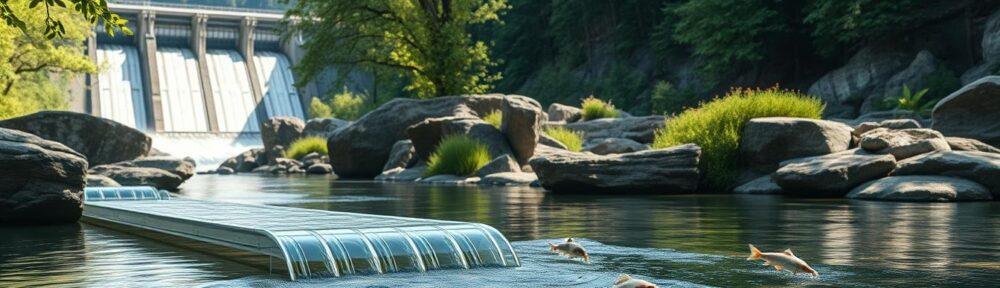
Let’s talk about the salmon in the spillway. Hydropower has had a bad environmental reputation for years.
It blocked fish migrations and turned turbine bays into death traps. Over 20% of fish died when passing through old plants.
The industry is changing. It’s not building more concrete monoliths. Instead, it’s focusing on hydropower innovations.
This change is due to new environmental rules. New turbines and passage systems have cut down fish deaths by over 20%.
Engineers created designs like the Alden turbine. Its wide, slow blades are a big improvement. Other designs, like minimum gap runner and very-low-head turbines, also help.
This isn’t just an apology. It’s a deep dive into the industry’s growth. The old “build it and they will adapt” model is outdated.
A new approach weighs power against nature’s needs. It’s like a promise to do no harm.
Improved fish passage technology shows this shift. It proves mandates can lead to real change, not just following rules.
Fish passage, sediment, temperature
The Thompson Falls hydroelectric plant in Montana is doing more than just making electricity. It’s also helping threatened bull trout by running an aquatic concierge desk. This isn’t your old-fashioned fish ladder. It’s a high-tech system that would impress Frank Lloyd Wright, if he designed for fish instead of buildings.
Today’s fish passage tech has come a long way from simple stairs. At Thompson Falls, they’ve created a system that’s like an underwater highway. This lets bull trout travel easily, without facing many obstacles.
But there’s more to it than just moving fish. The environment they swim through is also important. This is where the real hydroelectric innovation shines—managing the whole aquatic ecosystem, not just the fish.
Sediment is key to the river’s health. It builds homes for fish, shapes the river, and carries nutrients. Old dams ignored sediment, but now, it’s seen as vital. They use special techniques to move sediment, like a Swiss watchmaker.
The trick is timing and precision. They release sediment when the river can handle it. They also create artificial floods that mimic nature. It’s like managing a river with the skill of a symphony conductor.
Temperature is also critical. Cold-water fish like trout and salmon need cool water. The solution? They use systems that draw water from different depths to keep the right temperature.
It’s like controlling the temperature of a river, like choosing the right wine temperature. They can adjust the temperature to keep fish happy. It’s a mix of science and nature in action.
| Environmental Factor | Primary Challenge | Traditional Approach | Modern Innovation | Key Benefit |
|---|---|---|---|---|
| Fish Passage | Physical barriers to migration | Basic fish ladders | Full-length, species-specific passage systems | Enables natural life cycles |
| Sediment Management | Habitat degradation | Complete blockage | Timed sluicing & artificial floods | Maintains riverbed health |
| Temperature Control | Thermal pollution | Unregulated releases | Selective withdrawal systems | Preserves cold-water habitats |
This is the new frontier in hydroelectric innovation. We’re not just building power plants anymore. We’re creating balanced ecosystems. The technology is here to power homes and protect the environment.
This balancing act needs data, creativity, and a deep understanding of rivers. It’s a mix of engineering, ecology, and strategy. Get it right, and you power homes while saving ecosystems. Get it wrong, and you face big challenges.
These solutions work together. Better sediment management helps fish habitats. Proper temperature control supports healthier fish. Improved fish passage completes the cycle. It’s a circle of innovation.
The next big thing in hydroelectric innovation won’t just be about power. It’s about mastering the complex game of fish, sediment, and temperature. The plants that succeed will be the ones leading the way for years to come.
Turbine Tech
If the dam is the brawn, the turbine is the brain of a hydropower plant. But what if that brain just got a quantum leap in IQ? We’re in the middle of a quiet mechanical renaissance. Now, brute force is being traded for elegant, adaptable intelligence.
Forget the old, one-speed turbines of the last century. The new ones are like Swiss Army knives—modular, smart, and surprisingly gentle. These machines can now sip energy from a trickle or a torrent with equal grace. They’re also engineered to be good neighbors, drastically reducing harm to aquatic life.
This is where clever engineering meets biology. Think of the Archimedes screw, an ancient idea reborn as a fish-friendly marvel due to its slow, gentle rotation. Or consider variable-speed turbines that adjust their spin in real-time to optimize every drop of water. It’s not just power generation anymore; it’s a symphony of physics and precision.
Variable‑speed, low‑head, screw and VLH
Traditional hydropower is like a symphony orchestra. But these new turbine technologies are more like a jazz quartet. They adapt and make beautiful energy from overlooked sources.
These turbines don’t need a high place or lots of water to work. They are where engineering meets ecology in harmony.
Variable-speed turbines are like the chameleons of the group. They can change their speed in real-time. This means they can handle high or low water flow.
They’re not just efficient. They also work well with solar and wind’s unpredictable rhythms.
They’re like the ultimate renewable energy wingman. When the sun hides or the wind stops, they step in. They provide steady power without causing grid problems.
Very-low-head (VLH) turbines are the quiet revolutionaries of low-head hydropower. They work with just a few meters of vertical drop.
VLH designs focus on fish safety. They have slower speeds and special passages that reduce fish death. It’s like building a highway with wildlife crossings from the start.
The Archimedes screw is the hipster of turbines. It’s an ancient invention that’s now part of hydroelectric innovation. It’s a giant corkscrew that turns steadily as water flows through.
It’s popular because it’s gentle on fish. Fish can swim through it unharmed. Plus, it’s simple and works well with debris.
| Technology | Best Application | Key Advantage | Fish Safety Rating | Minimum Head Required |
|---|---|---|---|---|
| Variable-Speed Turbine | Grid stability with solar/wind | Adapts to changing flow conditions | Medium (site-specific) | 10+ meters |
| VLH Turbine | Low-head rivers & canals | Operates with minimal drop | High | 1.5-4 meters |
| Archimedes Screw | Small streams & irrigation | Extreme fish friendliness | Very High | 1-10 meters |
These technologies help rural communities with small waterways. They can tap into reliable renewable energy. An old mill race or a small river can become a power source.
These technologies solve big problems in small ways. They are scalable and specific. One community might use an Archimedes screw, another VLH turbines, and a third variable-speed units.
This isn’t just technical jargon. It’s the language of a more nuanced, sustainable energy future. It’s about working with geography and clean power in all sizes.
Controls & Flexibility
If the modern power grid were a stock market, flexibility would be its most valuable currency. Guess who’s sitting on a digital Fort Knox? The humble dam.
Forget what you know about lumbering mechanical behemoths. The old governors were like using a sledgehammer to play Chopin. Today’s digital control systems are the virtuosos.
This isn’t just about having water in a reservoir. It’s about the neurological system that decides when to release it, at what speed, and for what purpose. Grid operators facing solar dips and wind lulls need response times measured in seconds, not hours.
We’re talking about ramping rates that can chase a cloud’s shadow across a field of solar panels. Automated systems listen to the grid’s heartbeat in real-time. It’s the difference between a diesel generator and a Tesla Powerwall—and the network is starting to notice.
The transformation turns century-old water power into the ultimate grid shock absorber. More frequent starts and stops, faster response, operation beyond original design—this is how we balance our renewable future.
Ramping for renewables, AGC
Modern hydropower is not just about making power. It’s about knowing exactly when and how much to make in a split second. When solar power drops behind a cloud, the grid’s frequency starts to wobble. Something needs to fill the void quickly.
This quick adjustment is called “ramping.” It’s not done by a human frantically spinning dials. Today, it’s done by Automated Generation Control (AGC). AGC is like the grid’s algorithmic maestro, making tiny adjustments every few seconds.
This is where digital governors shine. They replace old mechanical controls with advanced software. This allows a hydropower plant to quickly change from a gentle hum to a loud roar.
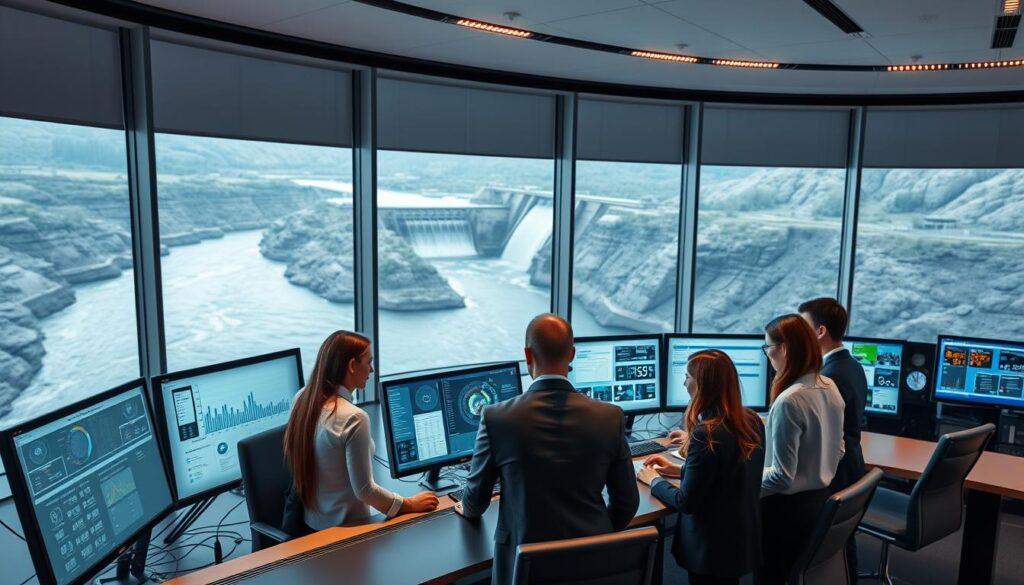
The XFLEX HYDRO project in Europe shows this hydroelectric innovation in action. It used AI and advanced controls to improve existing plants. One key innovation is the ‘hydraulic short circuit’ system.
This system lets turbines pump and generate at the same time. Smart software manages this flow in real-time. It acts as a dynamic shock absorber for the grid.
This turns a traditional plant into a flexibility superhero. It’s not just a source of energy; it’s a tool for balancing wind and solar’s erratic rhythms. The plant becomes the reliable bass player, keeping time for the flashy soloists.
To see the leap forward, compare the old way with the new digital approach:
| Control Aspect | Traditional Mechanical Control | Modern Digital & AGC System | Impact on Grid Flexibility |
|---|---|---|---|
| Response Time | Minutes to hours | Seconds to minutes | Enables real-time reaction to solar/wind dips |
| Adjustment Precision | Coarse, stepped changes | Fine, continuous modulation | Maintains perfect grid frequency (60 Hz) |
| Primary Function | Baseline power generation | Frequency regulation & ramping | Acts as a grid stabilizer, not just a generator |
| Human Involvement | Manual operator commands | Fully automated, algorithm-driven | Frees operators for strategic tasks |
| Technology Core | Levers, hydraulics, analog signals | Digital governors, AI, real-time data | Unlocks complex services like hydraulic short circuits |
So, the next time you flip a switch and the light comes on instantly, thank a digital governor. It’s the high-wire act you never see, performing millions of tiny corrections to ensure the music of the modern grid never skips a beat.
Digital Hydropower
If you think the digital revolution is just for Silicon Valley and smartphone apps, welcome to the control room of the future. We’re not just talking about fancy touchscreens replacing old dials.
This is a complete transformation—from concrete and steel to bits and bytes. Hydropower plants are becoming adaptive, intelligent assets that learn from their own operations.
Imagine having a perfect digital doppelgänger of your entire facility. That’s what digital twins offer: a virtual replica living in the cloud. Operators can run simulations, test new strategies, and spot trouble months before it becomes real.
We’re moving from the industrial age’s “scheduled maintenance” to something far smarter. Think of it as changing your car’s oil just before it fails, not just because the calendar says so.
This isn’t theoretical. Researchers estimate these digital upgrades could add a staggering 42 TWh to global generation. That’s like powering millions of homes with the same water, just better data.
The intelligence doesn’t stop at digital governors. Artificial intelligence now analyzes cavitation noise like a doctor listening to a heart. Sensors track turbine blade wear with nanometer precision.
Data has become the new water—a resource we can harness to get more value from existing infrastructure. Welcome to dam 2.0.
Sensors, AI for cavitation and wear
Imagine a world where a drone is the most valuable employee at a hydropower plant. It has better insurance than you. This isn’t science fiction; it’s the reality of hydroelectric innovation. Machine learning has become a key tool, turning maintenance into a science based on data.
Visual inspections in dangerous spaces are a thing of the past. Drones now monitor areas that were once off-limits. They create detailed 3D models, making Hollywood VFX artists jealous.
Drones collect valuable data, creating a digital twin of the infrastructure. Engineers can explore the turbine online, spotting issues without leaving their desks. It’s like having X-ray vision for expensive machinery.
Cavitation is a major problem for turbines. For years, it was hard to diagnose. Now, sensors detect it with precision. They listen for the sound of cavitation and pinpoint the problem.
Digital governors are now part of a health monitoring system. They adjust the turbine’s operation when cavitation is detected. This gives the plant time to plan maintenance.
Wear and tear is now predictable. New technologies include:
- Laser scanning for erosion mapping: Scans track material loss accurately, predicting failure points.
- Vibration analysis networks: Wireless sensors detect even slight changes, signaling wear or imbalance.
- Thermal imaging drones: Spot overheating components before they fail, preventing outages.
The Internet of Things (IoT) has given hydropower plants a central nervous system. Every sensor and drone feeds into a dashboard. Managers see trends and predictions, planning maintenance efficiently.
This predictive capability is a major hydroelectric innovation. We now maintain equipment based on its condition and predicted life. This saves millions annually by reducing downtime.
The new digital governors are key to this system. They optimize performance and alert maintenance teams to issues. It’s a mix of mechanical engineering and computer science, where algorithms protect assets.
So, when you hear about “smart” technology, think of a hydropower turbine. It’s humming along with sensors and AI, revolutionizing water power. It’s not just maintenance; it’s mechanical prescience.
Small Hydro & Canals
Forget the mega-dams. While everyone was looking up at the concrete giants, the real hydropower innovations were happening down in the ditch.
This is the distributed, farm-to-table movement of electricity generation. We’re talking about tapping the vast, sleepy network of irrigation canals, industrial outflows, and even town water mains.
The technology is brilliantly simple. An Archimedes screw turning in a modest stream can power a village. A vortex turbine in a canal drop can light up a neighborhood.
The data is compelling. Just by adding generation to existing non-powered dams across the U.S., we could unlock over 4 gigawatts of new capacity. That’s not a backwater idea; it’s a mainstream opportunity.
This is about thinking small to win big. It’s reliable, renewable energy for rural communities—and a quiet revolution in our own backyard.
In‑pipe micro, irrigation drops
While we debate big dams, our drinking water is secretly powering homes. This isn’t science fiction—it’s real. In-pipe micro-hydro turns water pipes into power plants. Every city has miles of pipes moving water to your tap.
What if this flow could make electricity before it reaches your sink? It’s a simple idea. Just put a small turbine inside the pipes. The pressure pushes water uphill and around corners, spinning the turbines.
The Archimedes screw is back in action. This ancient device works great for modern pipes. It handles water flows without causing pressure drops.
In the American West, irrigation canals waste energy. Farmers have seen this for years. Now, small units can turn this waste into power for farms.
A single 12-inch pipe can power several homes. A small drop in water can power a pump house or farm equipment. It’s clever and efficient.
Why didn’t we do this sooner? Utilities were cautious, and it wasn’t cost-effective. But now, with better turbines and lower costs, it’s changing.
This isn’t just about tech. It’s a new way of thinking. Water pipes and canals become power sources. It’s “stealth hydropower” that’s hidden in plain sight.
Companies now make turbines that look like plumbing fittings. They install them during maintenance, with little disruption. The Archimedes screw design works well in tight spaces, needing little upkeep.
Think about upgrading water pipes to energy-generating ones. Drought-stricken areas could use this power. It’s a smart way to use existing infrastructure.
This isn’t about replacing big dams. It’s about adding to them. These small solutions work with the water system, not against it. It’s a big win for both humans and nature.
The future might see water pipelines and canals making electricity. Your shower could be powered by the water flowing through it. That’s a closed-loop system.
Case Studies
Enough theory. Let’s talk about steel in the water and electrons on the grid.
This section is our field trip, a curated tour of projects actually doing what we’ve been analyzing. We’re moving from the whiteboard to the riverbank, from concept to concrete.
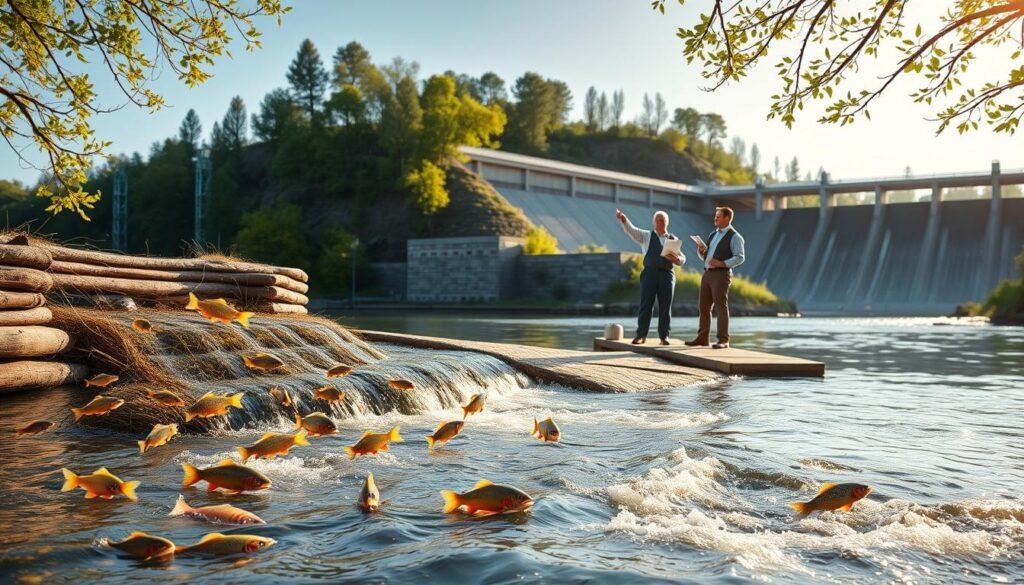
We’ll visit a dam that transformed from ecological villain to a pioneer in fish passage. We’ll examine a European facility redefining flexibility with something called a “hydraulic short circuit.” We’ll even look at tidal turbines braving the gritty waters of New York City’s East River.
These aren’t just success stories. Think of them as forensic case studies. What worked brilliantly? What proved harder than the engineers’ PowerPoint slides suggested?
This is where hydropower innovations meet reality. It’s where the rubber meets the river, the proof in the pudding, and any other cliché that means “ideas in action.”
We’re analyzing real data, unexpected challenges, and genuine results. Because in the energy game, the best laboratory isn’t a lab at all—it’s the real world.
River restoration + generation
The hydropower industry has spent decades apologizing for its environmental harm. Now, it’s trying to make amends by generating clean power. Can we fix damaged rivers while making electricity? The answer is yes, in projects that see energy production as a way to heal the environment.
Run-of-river hydropower is at the heart of this change. It uses water’s natural flow, with little need for big dams. Unlike old dams, these systems let rivers flow freely. Sediment moves naturally, and fish can migrate more easily. The basics of hydropower stay the same, but the approach has changed.
This new way of thinking is a big shift. We’re not just trying to lessen harm. We aim for positive effects on the environment. Imagine turbines that help rivers flow better and fund habitat restoration with the energy they make.
Improved fish passage designs are key to this change. For years, fish ladders were just a weak fix for blocked rivers. Now, engineers design systems that help fish migrate. Fish passage is now the main focus, not an afterthought.
The best projects use power generation to fund river restoration. The money from selling energy goes to improve habitats and monitor water quality. This creates a cycle where selling electricity helps the environment.
But is this a real change or just marketing? Let’s look at the evidence:
| Hydropower Approach | Ecological Philosophy | Power Output | Innovation Focus |
|---|---|---|---|
| Traditional Impoundment | Control and contain | High, stable | Efficiency maximization |
| Run-of-River | Minimal disruption | Variable, flow-dependent | Low-impact infrastructure |
| Restoration Hybrid | Active improvement | Moderate, seasonal | Fish passage and sediment management |
| Future Vision | Ecosystem service provider | Integrated with renewables | Whole-watershed health |
The table shows a journey from control to working with rivers. Modern fish passage tech is just part of this. We also focus on managing water temperature, sediment, and floodplains.
What surprised me: The best projects don’t see energy and environment as enemies. Healthy rivers often make more reliable power. Rivers with sediment and fish show true health.
Partnerships are key. Energy companies and environmental groups work together from the start. Biologists and hydrologists help design systems that respect nature. This new partnership is a big change.
So, where are we now? The model of restoring rivers while making power is a real innovation. It’s not perfect, but it’s a big step forward. We’re now asking how to help rivers through their energy, not just how much power we can take.
This shift changes everything. Hydropower can now be a force for good, not just a necessary evil. The future of hydroelectric innovation is in smarter ways to work with our waterways.
Funding & Policy
Let’s be honest. You can create the world’s most brilliant turbine. It can be fish-friendly, variable-speed, and AI-controlled. But if the rules and money are hard to get, your amazing turbine won’t go anywhere.
A recent study shows this problem. It found two big hurdles for investment. The first is not knowing how the electricity market will value hydropower. The second is the Byzantine complexity of the relicensing process. The tech is ready, but the system often isn’t.
We’re moving from engineering to policy and money now. Think about FERC’s struggle with relicensing. Also, the fight for dams to get paid for grid services like flexibility, not just megawatt-hours.
Many governments are starting to wake up. They’re adding modernization to their power system plans. Why? To help wind and solar work better. The right money and clear rules are the secret keys. Without them, even the smartest hydropower innovations won’t move forward.
Licensing streamlining
Imagine trying to get a driver’s license but the DMV asks for environmental studies and public hearings. This is like the hydropower relicensing process. It’s a long, slow process that stops hydroelectric innovation from reaching the grid.
The current system is outdated. It was made for when dams were new and science was basic. Now, it’s hard to update dams because of old rules.
Streamlining means making the process faster and smarter. It’s not about cutting corners. It’s about making the rules work better.
Real change is coming. The Federal Energy Regulatory Commission (FERC) is working on new ideas. They want to make the process better for everyone.
- Early and Often Engagement: This means getting everyone involved from the start. It helps avoid delays.
- Quantified Trade-off Tools: These tools help everyone see the costs and benefits. They make decisions easier.
- Integrated Licensing Process: This makes the process faster. It cuts down the time it takes to get a license.
Every year we wait is a year without clean energy. We need to make the process faster to use our resources better.
New laws are helping. They see updating dams as a smart way to fight climate change. It’s cheaper than building new power plants.
We can make great turbines and smart grid controls. But if the rules are slow, it won’t matter. We need to make the rules work faster for our clean energy goals.
Implementation Guide
Alright, you’re sold. The case for modern hydropower innovations is strong. The technology is top-notch. The policy world is changing fast. But now, the big question is: how do you actually build this?
This is your guide to action. Whether you’re a utility manager, a developer, or a community leader, we’re moving from “why” to “how.” This is your step-by-step guide for starting projects in the 2020s.
We’ll cover site screening, choosing the right technology (like variable-speed turbines), and dealing with regulations. But the real game-changer is modular construction.
Think of it like IKEA for clean energy. Make parts in a factory and assemble them on-site. It cuts down build time, keeps costs steady, and improves quality. The U.S. Department of Energy sees huge chances here—retrofitting dams could add 4.8 gigawatts to the grid. Let’s start building.
Site screening checklist
Let’s get real. This is your first step, a simple list to weed out bad ideas. It’s like a pre-flight checklist for hydropower.
First, check the basics. What’s the water flow like? Is there a way to connect to the grid? Look at environmental concerns and the rules you must follow. These are your starting points.
Next, think about the tech. Is the site right for a fish-friendly turbine or an Archimedes screw? Could it use variable-speed turbines to help the grid?
Don’t forget about sediment. It can really hurt efficiency. Make sure fish can pass safely. This is now a key part of planning.
Use tools like the Department of Energy’s Flow Tradeoff Tool to help. It lets you model different scenarios. Can you balance power generation with protecting fish habitats? What’s the cost?
Your checklist combines all we’ve talked about. It looks at water, tech, environment, and grid benefits. It’s the difference between wasting time and finding a real chance.
Think of this as your first tool in the modern hydropower world. Run your site through it. The answers will show if it’s worth exploring further or if it’s time to move on.