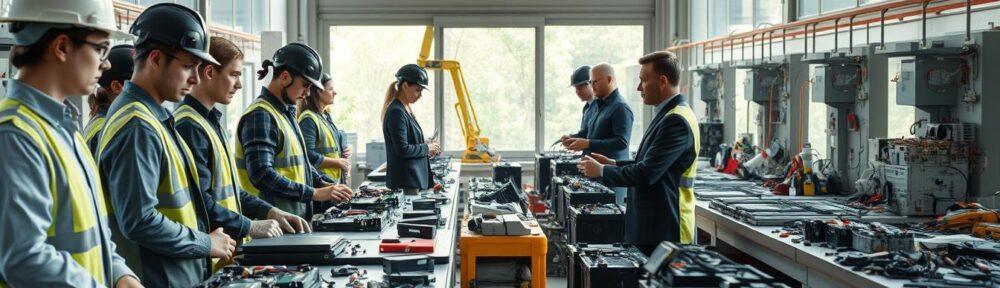
The move towards green energy is creating a big economic boost. Handling millions of old electric vehicle and electronics packs is now a key task. It’s turning into a major new supply chain.
This field grows by using old energy storage in new ways. This gives it a second act in less demanding roles. Then, advanced recycling pulls out valuable metals for making new products. These steps form the heart of a real circular economy.
Big investments and policies, like the U.S. Inflation Reduction Act, are speeding up growth. This growth is opening up many new jobs. There’s a high demand for people with skills ranging from hands-on work to business planning.
Our guide aims to help you understand this changing field. We’ll cover the key roles and skills needed for a career here. Join us in shaping the future of sustainable industries.
Value Chain: collection → disassembly → chemistry → refining → resale/second life
The battery recycling industry has a clear value chain. It turns waste into valuable materials and new energy solutions. This process supports the goal to drive reuse, recycling, and innovation across the battery lifecycle.
The chain starts with collecting and moving batteries. Used batteries come from consumers, auto shops, and electronic waste facilities. They are then safely taken to processing plants.
Next, batteries are disassembled. Technicians remove plastics, electronics, and casings. They aim to get to the core electrochemical components.
After disassembly, batteries go through chemical processing. Cells are shredded and sorted to make black mass. This dark powder has metals like lithium, cobalt, and nickel.
Refining then extracts pure materials from the black mass. Companies use special techniques to separate and purify metals. The result is high-quality materials sold to battery makers.
Another part of the chain is resale and ESS second life. Not all batteries are shredded. Some are tested and reused in ESS second life systems for solar energy or backup power.
This whole chain creates a circular economy. It makes sure materials are recovered and used again. Knowing this process helps us see the industry’s big impact.
Key Roles: operators, chem/process eng, quality/EHS, logistics, business development
The battery recycling value chain is brought to life by professionals in five core functional areas. Each role has distinct responsibilities. Success requires a team that takes initiative, follows through, and cares about their impact.
From the facility floor to the front office, these roles combine to transform hazardous scrap into valuable supply.
Plant Operator
The plant operator is the hands-on backbone of the recycling facility. They run the machinery that sorts, crushes, and processes battery materials. Their day involves monitoring equipment, handling feedstock, and ensuring the physical flow of material never stops.
Safety and vigilance are key. Operators must follow strict protocols for handling hazardous materials. They are often the first to spot a mechanical issue or a process irregularity.
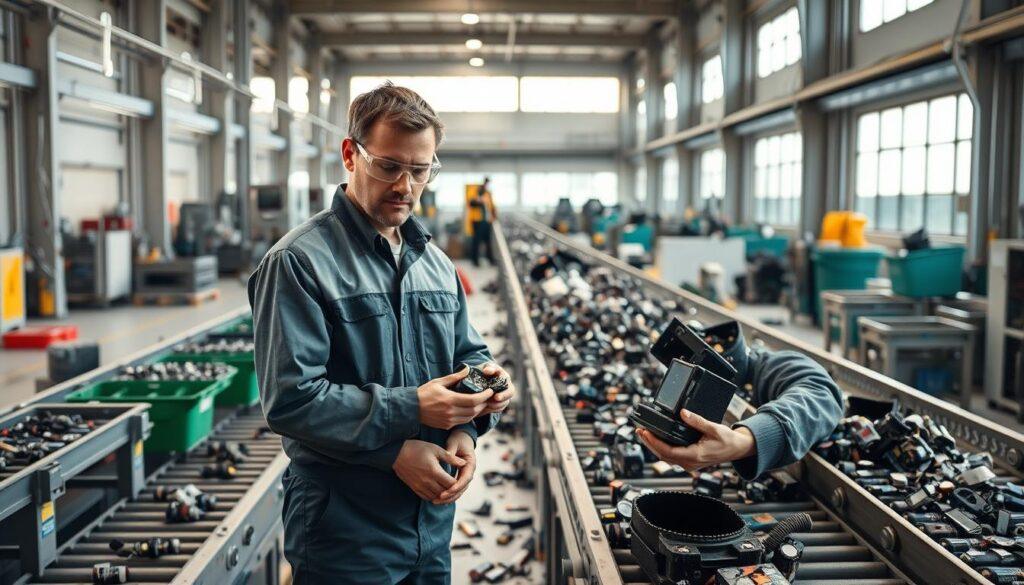
This role is perfect for detail-oriented individuals who thrive in a dynamic, industrial environment. It’s a critical entry point into the industry.
Chemical / Process Engineer
If the operator runs the machines, the process engineer designs and optimizes the entire system. They solve complex technical problems in material recovery. Their goal is to make operations safer, more efficient, and more profitable.
These engineers work on hydrometallurgical or pyrometallurgical processes. They model chemical reactions, specify equipment, and troubleshoot bottlenecks. A strong grasp of chemistry and mechanics is essential.
They bridge the gap between laboratory science and full-scale production. Their innovations directly improve recovery rates and reduce costs.
Quality & EHS Professional
Environment, Health, and Safety (EHS) and Quality professionals are the guardians of standards. They ensure operations comply with stringent regulations like OSHA and environmental permits. Their work protects both people and the planet.
Quality specialists test output materials to ensure they meet customer specifications. EHS experts conduct safety audits, manage hazardous waste documentation, and lead emergency response training. This role is mission-critical for maintaining a company’s license to operate.
Logistics Coordinator
Moving batteries is a complex challenge. Logistics coordinators manage the entire material flow. They arrange the collection of spent batteries from diverse sources and schedule shipments of recovered materials to buyers.
They navigate regulations for transporting hazardous materials (hazmat). This role requires sharp organizational skills and knowledge of supply chain networks. They ensure the right material is in the right place at the right time, safely and cost-effectively.
Business Development Manager
This strategic role focuses on growth and partnerships. Business development managers identify new sources for spent batteries. They also find buyers for recycled metals and second-life energy storage systems.
They build relationships with automakers, cell manufacturers, and utility companies. Understanding the broader market demand for battery recycling is key to their strategy. They turn operational capability into commercial success.
| Core Role | Primary Focus | Key Tasks & Impact |
|---|---|---|
| Plant Operator | Hands-On Material Processing | Operating shredding/sorting lines, monitoring equipment, following safety protocols, maintaining material flow. |
| Process Engineer | System Design & Optimization | Improving recovery yields, reducing energy use, troubleshooting processes, scaling up lab techniques. |
| Quality/EHS Pro | Compliance & Safety Assurance | Conducting safety audits, ensuring material purity, managing hazmat paperwork, leading training. |
| Logistics Coordinator | End-to-End Material Movement | Coordinating collection & shipping, managing hazmat transport permits, optimizing supply routes. |
| Business Development | Market Growth & Partnerships | Securing battery supply contracts, selling recycled output, forging strategic industry alliances. |
Together, these roles form a complete ecosystem. The plant operator and process engineer ensure technical excellence. Quality, EHS, and logistics professionals provide the necessary control and framework. Business development experts secure the future. It’s a field where every commitment matters and every role impacts our sustainable energy transition.
Safety & Compliance: UN 38.3, hazmat, fire protection, OSHA/ATEX
Understanding safety rules is key for those in battery recycling. It turns risks into manageable steps. Knowing Environmental, Health, and Safety (EHS) rules is what makes a team successful.
The U.S. Environmental Protection Agency (EPA) has strict rules for hazardous waste, like spent lithium-ion batteries. Following these rules is essential. It keeps workers, communities, and the environment safe while keeping businesses running.
Many important standards guide daily work. Knowing them is vital for anyone in this field.
| Regulation / Standard | Scope & Purpose | Key Requirements | Relevance to Battery Recycling |
|---|---|---|---|
| UN 38.3 | International transport safety | Rigorous testing for shock, vibration, short circuit, and thermal stability before batteries can be shipped. | Mandatory for moving collected batteries to recycling facilities. Ensures they don’t catch fire in transit. |
| Hazardous Materials (EPA/DOT) | Storage, handling, and disposal | Proper labeling, containment, manifest tracking, and use of certified hazmat personnel and packaging. | Every battery is considered a hazmat item. Defines procedures from collection through processing. |
| OSHA Standards | Workplace safety | Lockout/Tagout (LOTO) for machinery, personal protective equipment (PPE), hazard communication, and employee training. | Protects operators from chemical exposure, electrical risks, and crushing injuries during disassembly. |
| ATEX Directives | Explosive atmospheres | Use of specially designed equipment to prevent ignition in areas with flammable gases or dust. | Critical in processes like crushing or powder handling, where combustible dust may be present. |
| NFPA 855 | Fire protection for energy storage | Installation guidelines, spacing, detection systems, and suppression agents for lithium-ion battery systems. | Directly applies to second-life energy storage installations and storage areas for bulk batteries. |
Fire safety is a big deal. Water can’t stop lithium-ion fires. So, places need Class D fire extinguishers and special systems. Knowing this is a valuable skill.
OSHA rules help prevent daily dangers. They cover things like air quality and training on handling damaged cells. The ATEX directive is also key, mainly in Europe, for handling fine metallic powders.
These rules are not just about following rules. They define the skills needed for the job. A pro in EHS and hazmat is very important. They keep operations safe, reduce risks, and build trust.
This makes safety and compliance a key skill. It opens up jobs in management, auditing, and regulatory affairs. In a field that deals with dangerous materials, knowing this is essential.
Tech Primer: hydro vs pyro vs direct recycling; testing for second‑life ESS
Battery recycling has three main methods: pyrometallurgy, hydrometallurgy, and direct recycling. Each method has its own role in getting valuable materials from old batteries. The choice of method affects how much material is recovered, the cost of processing, and where the materials end up.
Here is a clear comparison of the three core recycling pathways.
| Method | Core Process | Key Advantages | Primary Challenges | Best For |
|---|---|---|---|---|
| Pyrometallurgy | High-temperature smelting in a furnace. | High throughput; handles mixed battery types well. | High energy use; lower purity of some metals. | Large-scale recovery of base metals like cobalt and nickel. |
| Hydrometallurgy | Chemical leaching with aqueous solutions. | High purity output; lower energy than smelting. | Complex chemical management; slower process. | Recovering high-value, pure cathode materials. |
| Direct Recycling | Physical and mild chemical separation. | Preserves cathode structure; lowest energy. | Requires sorted, uniform feed; emerging tech. | Future-focused, closed-loop cathode reuse. |
Pyrometallurgy is a big, hot process. It works well with many battery types. But, it uses a lot of energy.
Hydrometallurgy is all about careful chemistry. It gets metals very pure. This method costs more upfront but can be more profitable for certain metals.
Direct recycling is new and aims to reuse the cathode powder. It could save a lot of energy and money in the future.
After testing, batteries with life left go to second-life energy storage systems (ESS). This path needs different technology: testing, not recycling.
Checking a battery for a second life starts with a visual and electrical check. The main test is the State-of-Health (SOH). SOH compares the battery’s current capacity to its original specs.
More tests look at internal resistance or impedance. A sudden increase can mean damage. They also check for thermal runaway risk, looking for signs of shorts or unstable chemistry.
This testing phase is a big cost for second-life operations. But, it’s key for ensuring reliability and safety in new uses like grid storage. The challenge is balancing thorough testing with costs to make a business model work.
The recycling and second-life sectors are two sides of the same coin. One uses chemistry and heat to get raw materials. The other uses tests and data to extend battery life. Learning about these technologies is the first step to a career in either field.
Day-in-the-Life Profiles (Ops vs R&D)
The battery recycling industry has two main parts. One is the operations floor, where things get done. The other is the research lab, where new ideas are born. Knowing about these daily tasks helps you find where you fit best.
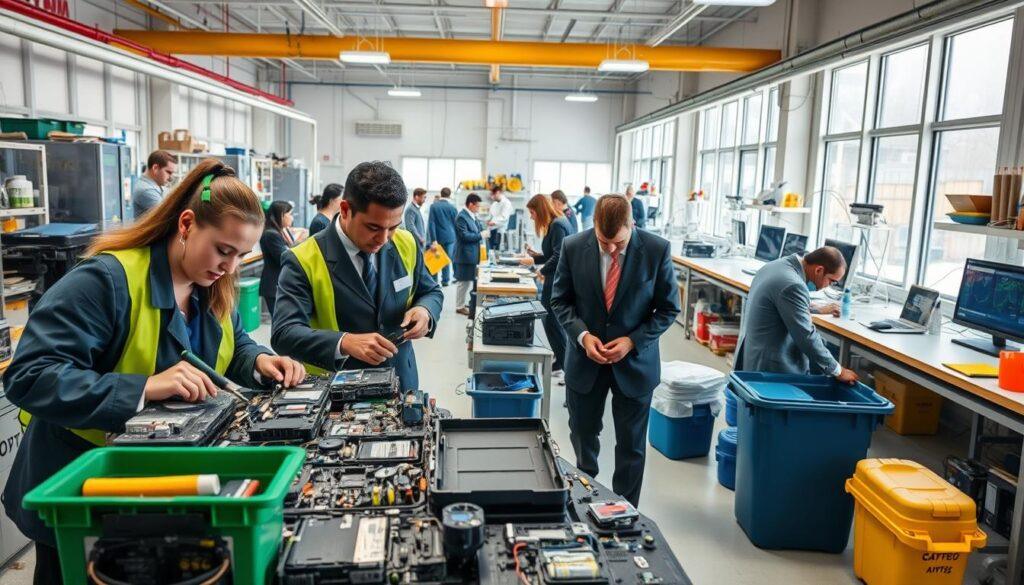
Your day begins with a safety briefing. Everyone goes over the rules for handling dangerous materials. As an operator, you then check the safety systems and watch the shredding and sorting lines.
Handling materials is a big part of your job. You might drive a forklift to move spent batteries. You also work with logistics to manage shipments. It’s hard work that needs your full attention. One worker says, “I love it here because it’s exciting. There’s a sense of freedom and lots of challenges.”
In the afternoon, you focus on monitoring and logging data. You make sure the machines are working right and report any problems. The day ends with another safety check. You see how your work turns old batteries into something useful every day.
The R&D Rhythm: Process or Research Engineer
An R&D engineer’s day is different. You might start by looking at data from the day before. You aim to improve how much you can get back from batteries or test new ways to use them again. You plan your experiments, get battery samples, and set up tests.
Working together is key. You meet with other engineers and scientists to talk about what you’ve found. You discuss how to make things better or how to take new ideas from the lab to the plant. Your work is all about solving problems that make battery recycling and second-life systems better.
In the afternoon, you might test your ideas on a bigger scale. You see if what worked in the lab works in real life. You write reports and share your findings with the team. The work is tough, but it’s worth it because you’re making a difference.
These profiles show the difference between operations and R&D. Operations roles mean you’re right in the action, making things happen fast. R&D roles are all about deep thinking and finding new ways to do things. Both are vital to the battery recycling & second-life world. Your choice depends on whether you like the fast pace of operations or the slow, careful work of R&D.
Skills & Certifications: forklift, hazmat, Six Sigma, lab methods
Being good at this job means having the right skills, getting certified, and focusing on safety. To do well in battery recycling or second-life jobs, you need a special mix of abilities. Employers want people who can do things practically, understand complex stuff, and help make things better and safer.
Having the right papers on your resume can really help. It shows that you’re ready to do the physical and technical parts of the job right away.
Jobs that involve working with equipment and materials need proof that you can do it safely. This is something employers usually need to see.
- Forklift Operation: You need a certification to handle materials in warehouses and on plant floors. It teaches you how to move heavy battery packs or processed materials safely.
- Hazmat Handling & DOT Training: Knowing how to handle hazardous materials is key. You’ll learn about U.S. Department of Transportation (DOT) rules, how to ship and store dangerous goods, and how to use safety data sheets (SDS).
- EHS-Specific Credentials: Having a strong background in Environmental, Health, and Safety (EHS) is very important. Certifications like the OSHA 30-Hour General Industry card or training in fire protection for lithium-ion batteries show you care about safety.
Process Improvement & Quality Methodologies
Being efficient and consistent is important for making money. Knowing about quality systems is very valuable, mainly for supervisory or engineering roles.
Skills like Six Sigma (Green Belt or Yellow Belt) and Lean Manufacturing help you cut waste, make processes better, and improve quality. These skills are great for making recycling lines work better and ensuring second-life battery modules are good quality.
Technical & Laboratory Analytical Skills
For jobs in quality control, R&D, and process engineering, you need lab skills. These are used to check the chemistry and health of batteries.
- Spectroscopy and Chromatography: Techniques like ICP-MS (Inductively Coupled Plasma Mass Spectrometry) help analyze the elements in black mass to find valuable metals.
- Battery Testing Protocols: Knowing how to do capacity checks, internal resistance measurements, and cycle life testing is key for checking batteries for second-life use.
- Data Analysis: Being able to understand test results from lab equipment and use them to make process changes is a valuable skill.
The Indispensable Soft Skills
Knowing technical stuff is important, but you also need good people skills and thinking abilities. The industry values these because it’s collaborative and fast-paced.
Problem-solving is part of the job every day, whether it’s fixing a sorting line or figuring out why purity is low. Clear communication is important too. Operators need to share safety concerns, engineers need to explain changes, and business people need to explain technical stuff to clients.
Most of all, being really committed to safety and EHS principles is the most important soft skill. It helps create a culture where everyone can stop work if they see a hazard.
The industry knows it needs these skills and often helps its workers get better. Many top companies give personal development budgets and educational support for employees to get new certifications or training. This helps fill the skills gap and makes the future of battery recycling safer, more efficient, and innovative.
Entry Paths & Portfolio Projects (Teardowns, SOC Modeling)
The battery recycling field is now remote-first and inclusive. It values talent and effort over where you live. This change opens many doors for those eager to start.
While school is important, it’s your skills that matter most. Show what you can do, build, fix, and improve.
Foundational Knowledge and Transitional Roles
Key subjects include chemical engineering, materials science, and more. These teach you about chemistry and how systems work.
People from other fields bring useful skills too. Car techs know about electrical systems. Waste experts understand logistics. Show how your past experience fits.
>
| Field of Study | Relevant Core Skills | Typical Entry-Level Role |
|---|---|---|
| Chemical / Process Engineering | Hydrometallurgy, process design, mass balance | Process Engineer, Recycling Technician |
| Electrical Engineering | Battery management systems (BMS), circuit analysis, data acquisition | Testing Engineer, Second-Life Assessment Specialist |
| Environmental Science | Regulatory frameworks, lifecycle assessment (LCA), sustainability reporting | EHS Coordinator, Compliance Analyst |
| Mechanical Engineering | Disassembly automation, thermal management, structural design | Mechanical Design Engineer, Operations Specialist |
Building Your Credibility Portfolio
For lithium-ion recycling jobs, a strong portfolio is key. It shows you’re resourceful and passionate. Focus on teardowns and software modeling.
Project 1: Documented Battery Pack Teardown
This project shows you can work with battery hardware safely. Disassemble a used lithium-ion battery pack and document it.
- Safety First: Wear gloves, safety glasses. Work in a well-ventilated area. Keep a fire extinguisher nearby.
- System Documentation: Photograph the pack before disassembling. Note its voltage and chemistry label.
- Methodical Disassembly: Remove the casing carefully. Photograph each step. Identify key components.
- Cell Analysis: Note the cell type. Measure the voltage of individual cells with a multimeter.
- Create a Final Report: Compile your photos, notes, and voltage data into a PDF. Include lessons learned and recycling pathways.
This project shows your analytical skills. SOC estimation is key for battery health and second-life use.
Build a model using Python or MATLAB. Use Coulomb counting and adjust for temperature and age. Train and test with public datasets.
Show your code on GitHub. Explain the model’s logic and its limitations. This shows you can handle battery data.
These projects are great for interviews. They show what you’ve done, not just what you know. For more learning, consider a comprehensive EV battery recycling program.
Getting into this field is about showing you’re ready. A portfolio with teardowns and digital analysis makes you a strong candidate.
Hiring Hotspots & Salary Ranges
The job market for battery recycling in the United States is not spread out evenly. It’s concentrated in certain areas that are growing fast. Knowing where to look can make your job search much shorter. Companies are setting up near their supply chains, customers, and existing factories.
Three main areas have become key for battery recycling and second-life operations. These places have the most job openings.
- The Midwest: Known as the “Battery Belt,” this area includes Michigan, Ohio, and Indiana. It’s where old car factories and new electric car plants are. Recycling facilities here help the electric car production lines.
- The Southeast: Georgia, Tennessee, and South Carolina are seeing a lot of clean energy projects. Big battery plants and car makers need recycling to get important materials.
- The Southwest: Arizona, Nevada, and Texas are close to big ports, mines, and clean energy projects. They use second-life energy storage systems.
For a plant operator or process engineer, being in these areas means more jobs and possibly higher pay. This is because there’s more competition for skilled workers. This pattern is similar to the sustainable reusable water bottles where location is key.
Knowing what to expect in terms of salary is important for negotiating. Below are salary ranges for two key roles, based on data from these hotspots. Salaries can change based on the company size, technology used, and local cost of living.
| Role | Experience Level | Estimated Salary Range (USD) |
|---|---|---|
| Process Engineer | Entry (0-3 years) | $70,000 – $85,000 |
| Process Engineer | Mid (4-7 years) | $85,000 – $110,000 |
| Process Engineer | Senior (8+ years) | $110,000 – $140,000+ |
| Plant Operator | Entry (0-3 years) | $45,000 – $55,000 |
| Plant Operator | Mid (4-7 years) | $55,000 – $70,000 |
| Plant Operator | Senior (8+ years / Lead) | $70,000 – $85,000+ |
These figures are a good starting point. When looking at an offer, think about the whole package. This includes bonuses, help with moving, and benefits like strong retirement plans.
People with special certifications or experience with certain recycling technologies can earn more. This is true for both process engineers and plant operators.
Strategic career move: If you’re open to moving, looking at companies in these areas can help you grow faster. The demand for skilled workers is often higher than the supply.
Use this information to guide your job search. Focus on companies in these areas and be ready to discuss salary based on solid data.
How to Advance to Plant/Program Management
Going from a technical expert to a leader is a big step. It’s about mixing your know-how with a business strategy. This is key for managing battery recycling & second-life systems.
Learn about business basics. You need to understand profit and loss, supply chains, and the demand for recycled batteries. Knowing how second-life energy storage adds value is also important.
Get good at leading teams. Plant managers work with many groups, like operations and logistics. Being open and having a flat structure helps you lead without formal power.
Learn to manage projects well. You might handle starting a new facility or upgrading a process. Getting trained in Six Sigma or PMP can help.
Understand the whole process. A top manager sees everything from start to finish. This view is essential for making smart choices.
Develop skills that make teams work better. Being proactive, creative, and solving problems are key. Your technical skills get you respect, but your leadership grows the business.
To move up, look for mentors, take on projects across departments, and show success. Leading in battery recycling & second-life means growing operations and supporting a green economy.