
Watching renewable energy get cut off feels like throwing away good avocado toast. The energy world has a secret. We lose clean power because the sun goes down and the wind stops.
Solar farms in California make too much electricity during the day. Then, they pay other states to take it. Later, gas plants start up when demand goes up. This waste is frustrating and shows we need a better way.
Energy solutions can make intermittent power act like baseload. This is key for utilities that have stuck to old methods. Also, these solutions can delay new transmission lines. Why wait years for approvals when smart assets can fix problems faster?
Technology Map: Flow Batteries, Iron-Air, Metal, Hydrogen, Pumped Thermal, CAES, Gravity
If the energy storage sector were a grand theater, flow batteries and their eclectic companions would steal the spotlight. Each technology brings its own flair to the stage, ready to tackle the energy challenges of tomorrow. Let’s dive into this captivating lineup, starting with the electrochemical contenders.
Electrochemical Contenders: Flow Batteries and Metal-Air Systems
Flow batteries are the dependable workhorses of the energy storage world. They operate on a simple principle: two electrolytes circulate through a cell, allowing for decoupled power and energy capacity. This makes them perfect for those 8-to-12-hour energy needs. Imagine a chemistry professor’s dream, where vanadium electrolytes swirl in a dance of energy efficiency.
On the other hand, metal-air systems, like iron-air batteries, are making waves with their straightforward yet revolutionary approach. These batteries leverage the rusting and un-rusting of iron to store energy, promising an astonishing $20 per kWh target. That’s like finding a discount on organic kale at Whole Foods!
Why Iron-Air Chemistry Changes the Cost Equation
The beauty of iron-air technology lies in its simplicity. By using abundant and inexpensive materials, it drastically reduces costs compared to traditional lithium-ion batteries. This chemistry not only makes it economically viable but also environmentally friendly. As we shift towards a renewable energy grid, iron-air batteries could be the unsung heroes of long-duration storage.
Mechanical and Thermal Storage: Pumped Thermal, CAES, and Gravity
Shifting gears, we explore the mechanical and thermal storage options. Pumped thermal storage and compressed air energy storage (CAES) are the engineering marvels that store energy in the form of heat or compressed air. Imagine heating rocks or compressing air in salt caverns, then releasing that energy when needed. It’s like a magician pulling energy out of a hat!
Hydrogen Storage: The Molecule’s Long Game
And then we have hydrogen storage, the molecule enthusiasts’ dream. By splitting water with surplus electricity, hydrogen becomes a clean fuel source. While the current efficiency might resemble trying to fill a bathtub with a teaspoon, the long-term storage is unmatched. As we look to the future, hydrogen could play a key role in achieving a sustainable energy landscape.
Use Cases: 4–100 Hour Windows, Day-Night, Multi-Day, Seasonal Price Spread Math
Long duration energy storage isn’t just a technical challenge; it’s a thrilling narrative of energy economics and strategy. This storage solution offers a sliding scale of temporal arbitrage. It’s not merely about charging and discharging; it’s about timing, market dynamics, and maximizing revenue.
The 4–12 Hour Window: Daily Arbitrage and Evening Peaks
The sweet spot for long duration energy storage often lies within the 4 to 12-hour window. Here, the game of daily arbitrage plays out. Solar energy floods the grid at noon, sometimes even at negative prices. Smart operators charge their systems during these times.
Then, as the sun sets and the demand peaks—between 4 PM and 9 PM—they discharge that energy. This scenario epitomizes the infamous “duck curve” that California ISO has made famous. The ramp rate required from conventional generators transforms from a gentle slope into a steep cliff.
Multi-Day and Seasonal Storage: When the Wind Takes a Vacation
Now, let’s turn our gaze to the multi-day and seasonal storage scenarios. What happens when a high-pressure system parks itself over the Midwest for a week? Wind turbines can become nothing more than expensive lawn ornaments.
In these moments, 100-hour storage isn’t just a luxury; it’s a necessity. It becomes the backbone of reliability, ensuring that the lights stay on even when the wind takes a vacation.
During these extended periods, the price spread math gets intricately complex. It’s no longer just about daily peaks; it involves modeling weather patterns, gas price futures, and the probability of coincident renewable droughts across entire regions. Some models indicate that the internal rate of return on a 100-hour iron-air system hinges on capturing just a handful of extreme price events per year.
Think of it as a hedge fund waiting for the market crash—only here, the stakes are the lights in your home.
Price Spread Math: How Arbitrage Revenue Justifies Capex
Now, let’s tackle the price spread math. This is where the rubber meets the road. Understanding how arbitrage revenue can justify capital expenditures (CapEx) is key. In Australia, the Capacity Investment Scheme and the REGO schemes are early attempts to monetize this value.
Yet, we’re in the “show your work” phase. Convincing capital markets that multi-day storage isn’t merely an expensive science project is no small feat.
In conclusion, the use cases for long duration energy storage are rich and varied. From daily arbitrage to multi-day and seasonal needs, this technology is more than just a backup plan. It’s a strategic asset in the evolving energy landscape.
Siting and Permitting: Safety, Land, Water, Noise, and Interconnect Timelines
Getting a building permit for a simple deck is hard. But getting approvals for grid-scale storage is even harder. It’s a long journey of engineering and community approval.
The land and water needs of different technologies are key. For example, lithium-ion batteries are dense but take up a lot of space. Flow batteries need big tanks, and iron-air systems need space for their modules.
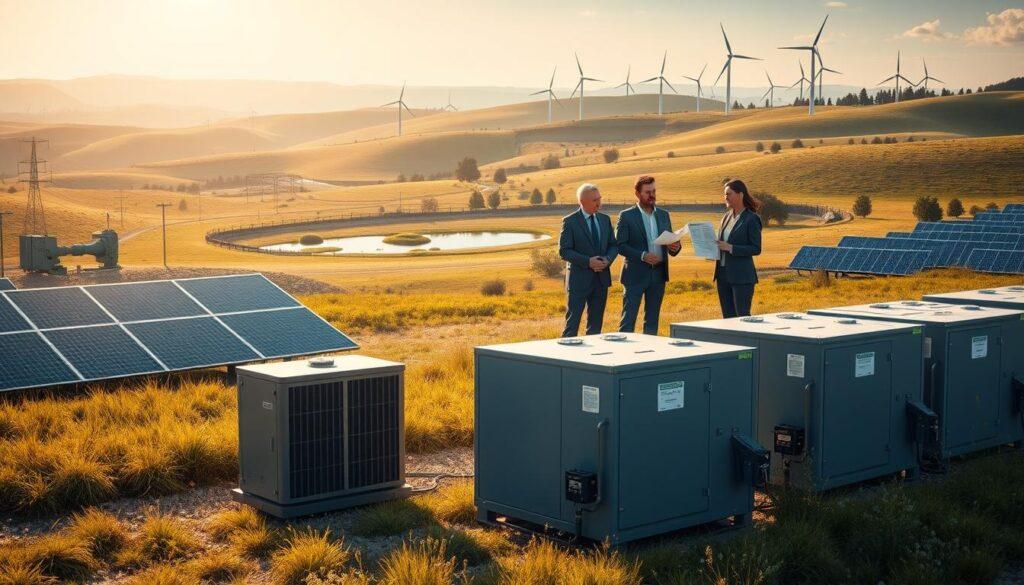
The Land and Water Footprint: Density Comparisons Across Technologies
Water use is often a big issue in public debates. For instance, Southern California Edison saved two million gallons of water a year. This is important in areas where water is scarce.
Knowing how each technology affects the environment is important. It helps win over local support.
Interconnect Queues: The Silent Project Killer
Interconnect queues can slow down projects. With more applications than transformers, the wait can be three to five years. This can make financing plans uncertain.
This delay can turn a solid plan into a risky venture.
Safety and Community Acceptance: From Thermal Runaway to Noise Ordinances
Safety worries can spark community opposition. But, lithium-ion batteries are safer than they seem. Flow batteries and iron-air systems are also safe.
Noise is another challenge. Inverters and coolers make noise that can upset people in quiet areas. Talking to the community early helps.
In conclusion, getting through siting and permitting needs a careful plan. It’s about understanding land, water, safety, and noise. For more on pumped storage hydropower, see this resource.
| Technology | Land Footprint | Water Consumption | Safety Rating |
|---|---|---|---|
| Lithium-Ion | High | Moderate | Medium |
| Flow Batteries | Medium | Low | High |
| Iron-Air | Medium | Low | High |
Cost Trajectories: $ per kW and $ per kWh, Stack, BOS, O&M, Financing Risks
Let’s explore the financial side of long-duration storage. The cost picture is complex, with different views from everyone. Lithium-ion battery costs have dropped from $1,000 per kilowatt-hour in 2010 to about $230 by 2016. But, iron-air battery costs are uncertain, unlike lithium-ion which got big subsidies and demand in electronics and EVs.
When we talk about stack costs, we’re not just talking about the parts that do the work. We also look at balance of system (BOS) costs, ongoing operations and maintenance (O&M), and financing risks. These can make the total cost go up quickly.
Decoding Stack Costs: Where the Money Actually Goes
The stack cost is just a small part of the total cost. The real work is done by the electrochemical parts, but they’re not the main expense. Balance of system costs, like inverters and containers, can double the price. For example, flow batteries’ electrolyte replacement can turn a good deal into a bad one.
Iron-air batteries, on the other hand, have a low degradation rate. This makes their 20-year cost look very attractive.
Balance of System and O&M: The Hidden Cost Multipliers
Let’s look at some numbers to show the difference in costs:
| Technology | Stack Cost ($/kWh) | BOS Cost ($/kWh) | O&M Cost ($/kWh/year) | Total Cost ($/kWh) |
|---|---|---|---|---|
| Lithium-Ion | 230 | 100 | 10 | 340 |
| Iron-Air | 300 | 150 | 5 | 455 |
| Flow Battery | 250 | 120 | 15 | 385 |
The total costs vary a lot, mainly because of BOS and O&M costs. These hidden costs can surprise even experienced developers.
Financing Risks: Technology Bankability and the Learning Curve Discount
Now, let’s talk about financing risks. This is where the real challenge is. Wall Street is eager to fund lithium-ion projects because they have a lot of data and a strong secondary market. But, getting funding for new thermal storage tech is much harder.
The Capacity Investment Scheme in Australia helps by providing government-backed revenue. This makes it easier for private capital to take on risk. Without similar programs in the U.S., developers face high costs for new tech. The learning curve discount is real, but someone has to pay for it.
Revenue Stack: Energy Arbitrage, Capacity, Ancillary, and IRA Tax Credits
The revenue stack is key to success in thermal storage. It’s a mix of income streams that turn energy into profit. Let’s explore this financial puzzle.
Energy Arbitrage: Playing the Spread in Day-Ahead and Real-Time Markets
Energy arbitrage is the main event in the revenue stack. It’s about buying low and selling high. Utilities use thermal storage to buy cheap electricity at night and sell it when prices are high during the day.
This strategy is like buying sneakers on sale and selling them for a profit the next day.
Capacity Markets and Resource Adequacy: Getting Paid to Exist
Capacity markets give energy providers a steady income. They get paid for being ready to help during system stress. In places like CAISO and ERCOT, this income is becoming more appealing.
But, the value can change due to regulatory shifts. It’s as unpredictable as a reality TV show.
Ancillary Services: Frequency Regulation and the Inertia Gap
Ancillary services are high-margin streams. They include frequency regulation and spinning reserves. These services need quick responses and smart bidding, like a high-stakes poker game.
The IRA Effect: How Tax Credits Rewrite the Pro Forma
The Inflation Reduction Act (IRA) has changed the game for thermal storage. Now, standalone storage gets tax credits. This makes projects that were once dreams now possible.
The IRA has made starting projects faster than a plot twist in a prestige drama.
Australia’s Capacity Investment Scheme and REGO schemes show a future where revenue is about clean energy. It’s about the time when that energy was made. Selling power from yesterday’s sunshine is a big plus.

Bankability Requirements: Warranties, Performance Guarantees, and Degradation Data
Finding your way through the bankability maze for hydrogen storage is tough. Developers are stuck, trying to convince investors while facing their tech’s limits. With lithium-ion batteries’ proven track record, hydrogen storage must prove its value.
The warranty issue is key. Hydrogen storage developers must offer warranties that match their tech’s physical limits. Unlike lithium-ion, which has a long history of performance, hydrogen developers face a trust gap with investors.
The Warranty Conundrum: Promising What Physics Allows
Developers face a big challenge. If they promise too much based on little data, investors might lose trust. They must find a balance between big promises and what’s possible. This is where degradation curves play a role.
Degradation Curves: Why Cycle Life Data Makes or Breaks Deals
Degradation data is key to bankability. For many new techs, data is scarce. Without it, investors can’t assess risks well. Here’s a look at different storage techs:
| Technology | Cycle Life (Years) | Degradation Rate (%) | Operational Data Availability |
|---|---|---|---|
| Lithium-Ion | 10-15 | 1-2 | High |
| Flow Batteries | 10-20 | 1-3 | Moderate |
| Hydrogen Storage | 5-10 | 3-5 | Low |
This table shows the big difference in data. Flow batteries have decades of data, but hydrogen storage is missing. Each new data point is a big deal, affecting how bankable it seems.
Performance Guarantees and the Insurance Underwriter’s Dilemma
Guarantees are a big deal. Developers must promise enough to lenders but not too much. It’s a delicate balance. I’ve seen deals fall apart over small differences in degradation rates. It’s like debating angels, but the stakes are huge.
The insurance market for new storage techs is just starting. Underwriters use analogies, not solid data. Hydrogen storage is complex, but its unique cost benefits are compelling.
With enough data, hydrogen storage could change seasonal storage economics. Developers face big challenges, but the right data could change everything.

Case Studies: Utility Procurements in CA, TX, NY—Lessons Learned
Let’s dive into the lessons from utility procurements in California, Texas, and New York. These states are testing long duration energy storage in real life. Each has faced unique challenges and found success, giving us valuable insights.
California: The Duck Curve Laboratory and Hybrid Peaker Experiments
California is known as the Duck Curve Laboratory. Solar energy peaks in the day, causing negative prices. Southern California Edison (SCE) has led the way with hybrid peaker plants.
By combining batteries with gas turbines, they cut greenhouse emissions by 60%. They also saved two million gallons of water each year. This wasn’t just a test; it was profitable without government help.
Texas: ERCOT’s Market Design and the Storage Gold Rush
In Texas, ERCOT’s market design makes storage assets earn by capturing price spikes. Winter Storm Uri in 2021 showed the importance of storage, with prices hitting $9,000/MWh. This sparked a storage gold rush in the state.
The key takeaway is that market design matters. With the right setup, storage can be very profitable, unlike in markets with price caps.
New York: The REV Initiative and Urban Storage Challenges
New York faces urban storage challenges through the REV initiative. The main hurdle is finding space in a city where land is expensive. Fire codes also complicate matters.
New Yorkers want reliable power but don’t want to see the infrastructure. The technology works, but commercial and regulatory hurdles remain. AMPYR Australia’s Bulabul projects show this.
We can build this technology; we just need to figure out how to fund it. For more on utility-scale electricity storage, see this report.
Career Paths: Electrochem Design, Project Development, Dispatch Analytics
Thinking about a career in long-duration storage? There are many paths to explore. The energy storage field is booming, and your skills could be a great fit. Whether you’re into electrochemistry or finance, there’s a role for you.
The Electrochemist’s Journey: From Lab Bench to Grid-Scale Deployment
The path of an electrochemist is exciting and challenging. You start in the lab, working with flow batteries and their chemistry. It’s where curiosity meets science.
But the real magic happens when you move to grid-scale deployment. Flow battery chemistry is seeing a revival. New materials like organic electrolytes and iron-based chemistries are attracting PhDs. The challenge is making these materials at scale without defects.
Project Development: Navigating Permitting, Finance, and Community Relations
Project development is for those who enjoy working with people. It combines finance, permitting, and community relations. Your day might include negotiating with utilities, presenting to planning commissions, and working on financial models.
Success here requires more than technical skills. You need to be a bridge between engineers, lawyers, and investors. Every conversation is a detailed dance to ensure everyone agrees.
Dispatch Analytics: The Quant Revolution Comes to Power Markets
Dispatch analytics is where quants are making their mark. Optimizing storage assets’ bidding strategies is complex. It involves advanced modeling, once used in hedge funds and weather forecasting.
With machine learning, the next dispatch analysts will create adaptive algorithms. For flow batteries, the challenge is unique. They can scale power and energy independently, giving analysts more options.
For those starting, learn the physics and markets well. Know when the model is wrong and when it doesn’t matter. This balance is key in energy storage.
2030 Outlook: Share of Grid Needs Under High Renewables Scenarios
Looking ahead to 2030, we wonder about the future grid. Models from NREL and IEA are becoming real plans. But, adding more solar and wind after 60-70% penetration loses value without long-term storage.
It’s like adding too many toppings to a pizza. The flavor gets lost.
Modeling the Storage Gap: When 4-Hour Lithium Isn’t Enough
Lithium-ion batteries will lead in short-term storage. But, the 10 to 100-hour gap is where the real battle is. Iron-air and hydrogen storage must grow fast to meet our needs.
The clock is ticking, and the stakes are high.
The Seasonal Storage Imperative: Hydrogen and Multi-Day Technologies
Winter brings its own set of challenges. We need solutions for weeks or months when solar and wind are low. Hydrogen storage in salt caverns is a top contender, but it’s not very efficient.
The race is on to make these technologies work.
Policy Catalysts: What Gets Us From Pilots to Gigawatt-Scale Deployment
Policies are key in this transition. The IRA’s storage ITC is a big step forward. But, we need more.
Streamlined permits and market designs that value long-term storage are essential. REGO schemes could make a big market for clean power backed by storage. By 2030, today’s debates might seem quaint, just like early solar projections.