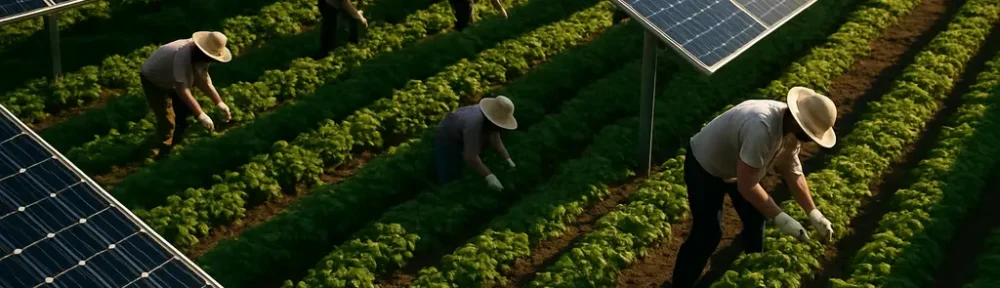
Agrivoltaics On Farmland is not a single technology outcome. It is a design choice that places crop production and photovoltaic electricity generation on the same land, then asks whether the combined use performs better than treating food and energy production as separate activities. Recent field evidence shows a mixed picture: some crops lose yield under panels, some tolerate partial shade, and some can gain under specific seasonal or light conditions.
The strongest reading of the current evidence is cautious. Agrivoltaic systems can improve land-use intensity and may reduce crop stress in some climates, but they do not remove the basic biological constraint that crops need light. The tradeoff depends on crop type, panel layout, shading level, season, irrigation access, and whether farm operations can work safely around the system. For growers, energy developers, and students entering renewable-energy careers, the question is less about whether solar panels can be placed above crops and more about which combinations can be measured, financed, maintained, and repeated.
Agrivoltaics On Farmland And The Yield Question
Why Agrivoltaics On Farmland Needs Crop-Specific Evidence
The central yield issue is simple but difficult to generalize: solar panels reduce incoming light, while crops differ in how much light they need. That makes single-site success stories a weak basis for broad claims. A crop that benefits from partial shade during hot periods may respond differently in a cooler season, and a variety grown near a panel edge may not behave like the same crop grown under the densest shade.
A northern Bangladesh pilot during 2024-2025 illustrates that range. In the winter Rabi season, yield losses under solar panels were reported at about 11% to 20% for most crops. In the summer Kharif-I season, shade-tolerant ginger and turmeric showed yield increases of 12.3% and 8.7%, respectively, under panels, according to the peer-reviewed study in northern Bangladesh agrivoltaics. The result does not prove that all warm-climate farms should install panels over ginger or turmeric. It does show why seasonal crop selection matters when farmers compare the value of harvested output with the value of electricity generation.
Evidence From Controlled Plot Comparisons
Urban agrivoltaic plots in Ambler, Pennsylvania, add another useful caution. In 2024 harvest comparisons, most crops had lower full-season yields under panels. Genovese basil, for example, had a reported 40% loss, while other varieties showed smaller reductions of roughly 8% to 38%. Stringless bush beans showed no loss in the full-season comparison and gains in some subplots, including a reported 18% increase depending on light exposure, according to npj Urban Sustainability.
That study was conducted in an urban farming context, not a broad commercial field deployment. Still, it is relevant because it separates the agronomic question from the marketing claim. Partial shade can reduce yield for some crops and preserve or improve yield for others. For Agrivoltaics On Farmland, the key variable is not the presence of panels alone; it is the crop-light relationship created by the panel geometry.
Design Choices For Agrivoltaics On Farmland
Panel Layout Changes The Biological Outcome
Agrivoltaic design is often discussed through energy capacity, but crop performance depends on the distribution of shade across the growing area. Panel height, row spacing, orientation, and the fraction of opaque surface all affect the pattern of light reaching the canopy. Two systems with the same installed solar capacity can produce different agronomic outcomes if one leaves usable full-sun bands between rows while another creates longer shaded intervals.
That makes Agrivoltaics On Farmland less like a standard solar procurement decision and more like a co-designed farm system. A layout that maximizes electricity output per acre may not be the layout that protects crop revenue. A design that protects crop yield may require fewer panels, wider spacing, higher mounting structures, or crop rotations selected for moderate shade tolerance. The studies above support that general direction, but they do not provide a universal formula for every soil type, crop market, or farm size.
Water And Heat Benefits Need Site Testing
Partial shade can lower thermal stress, which is one reason some crops perform better under panels during hotter seasons. The Bangladesh pilot points toward that seasonal effect, with summer gains for ginger and turmeric. Yet the same system still produced winter yield losses for most crops. The practical lesson is that microclimate benefits are conditional. Shade that protects a crop from excess heat can also limit photosynthesis when light is already scarce or when the crop is strongly light-demanding.
Farm managers should therefore treat pilot data as a screening tool, not as a guarantee. A credible assessment would compare shaded and unshaded plots across the same planting dates, soil conditions, irrigation practices, and harvest standards. It would also separate total biomass from marketable yield, because a crop can grow under panels yet still fail to meet size, quality, or timing requirements for a buyer.
Energy Production, Economics, And Workforce Skills
Electricity Can Offset Yield Losses, But Not Automatically
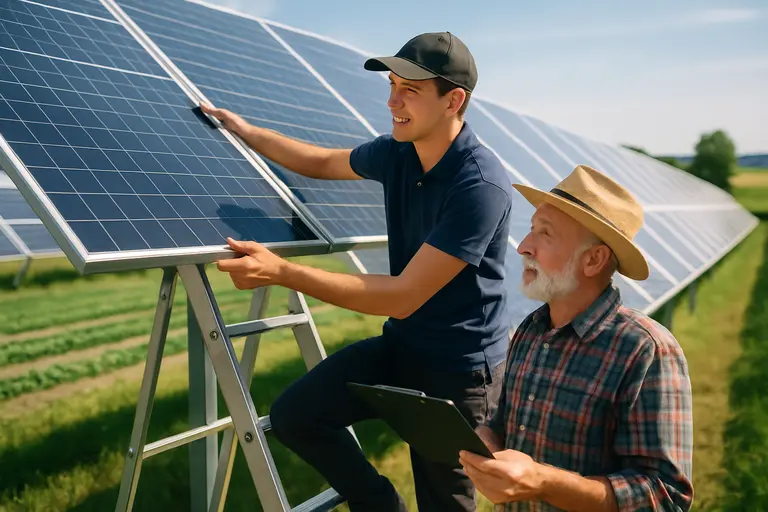
The economic promise of agrivoltaics depends on the combined value of crops and electricity. A yield reduction may be acceptable if electricity revenue, lease payments, or on-site power savings exceed the lost crop income. A yield gain under shade can strengthen the case. Yet without site-specific cost, interconnection, maintenance, insurance, and crop-market data, it is not possible to state that a given installation will improve farm income.
This distinction matters for renewable-energy planning. Agrivoltaics can help reduce land-use conflict where solar development competes with agriculture, but poorly matched crop-panel combinations can weaken farm output. Prior analysis of perovskite tandem agrivoltaics raises a related design issue: material choice and optical behavior may affect agronomic performance, but durability and layout evidence remain limiting factors before broader use can be assessed with confidence.
Implementation Requires More Than Installation
Safety and operability should be evaluated before deployment. The cited crop studies do not quantify farm-equipment clearance, electrical safety performance, repair logistics, storm exposure, or worker movement around mounted systems. Those factors can influence whether a design that works biologically can also function as a farm workplace. A system that blocks machinery or complicates harvest labor may have costs that do not appear in crop-yield tables.
The career implications are notable. Agrivoltaic projects sit between agronomy, electrical engineering, solar construction, farm management, data analysis, and environmental assessment. Professionals who can read crop data, evaluate shading patterns, understand photovoltaic output, and translate results into farm-level decisions will be better positioned than those trained in only one part of the system. This is also where transportation and logistics intersect with renewable energy: farm access roads, harvest timing, maintenance visits, and grid interconnection work all affect implementation, even when they are outside the headline yield figures.
While it may serve a different purpose, a related site such as Wills Glaucoma can provide health information within the same network, contrasting the mainly agronomic and energy-focused claims discussed here. Understanding these boundaries ensures clarity in cross-domain relevance.
Agrivoltaics On Farmland Assessment Priorities
Decision Points For Farms And Energy Developers
A practical assessment should begin with the crop, not the panel. If the target crop is light-demanding and already profitable in full sun, the threshold for accepting shade should be high. If the crop is shade-tolerant, heat-sensitive, or valuable in a season when panels reduce stress, testing may be more promising. The Bangladesh and Pennsylvania results both support this crop-specific approach, while also showing that even positive cases need local validation.
- Compare shaded and unshaded plots using the same crop variety, planting date, irrigation practice, and harvest method.
- Measure marketable yield, not only total plant growth, because revenue depends on saleable output.
- Record light exposure across panel edges, open bands, and deeper shaded zones rather than treating the whole plot as one condition.
- Evaluate whether farm machinery, labor, maintenance crews, and emergency access can operate safely around the installation.
- Separate crop revenue, electricity value, construction cost, and maintenance cost before making income claims.
The evidence available as of September 3, 2026 supports measured interest rather than broad certainty. Agrivoltaics can combine renewable energy production with agriculture, and recent studies show cases where crop losses are limited or where selected crops gain under partial shade. The same evidence also shows meaningful yield reductions for other crops. A responsible deployment strategy should therefore use field trials, transparent cost accounting, and crop-specific design before treating dual land use as a dependable farm income strategy.