
Welcome to the world of renewable energy, where innovation meets sustainability. Today, we’re exploring the life cycle of photovoltaic (PV) systems. You might wonder, “What happens when these panels reach the end of their days?” That’s where closing the loop comes in.
Imagine a future with less waste and materials reused continuously. It sounds like a dream, but we’re getting closer. The journey doesn’t stop after installation. It’s about making sure every part is reused, even after it’s no longer needed.
In places like the EU, strict rules help manage waste better. In the U.S., things are changing too. States are creating their own solutions. It’s a complex but interesting situation that needs our focus.
So, what’s the main point? Knowing how PV disposal works is key. It’s not just about energy; it’s about taking care of our planet. Want to learn more? Check out the latest on PV circularity and how we can help create a sustainable future.
Waste wave forecast retirements repowering and storm damage volumes
The first generation of solar panels is nearing the end of their life. This is causing a waste wave. By 2050, we could face up to 80 million tons of waste.
Repowering projects also play a role. They replace old panels with new, more efficient ones. This adds to the waste problem, as old panels are discarded.
Storms like hail and hurricanes are damaging solar panels. This is making more waste. By 2050, we expect over 200 million tons of damaged panels.
To solve this, we need circularity. We must change how we handle solar panels at the end of their life. The goal is to prevent waste and ensure the solar industry stays green.
We need new recycling solutions for solar panels. Embracing solar recycling circularity is key. This way, we can keep the solar industry sustainable and avoid environmental harm.
Process routes mechanical thermal chemical silver and silicon recovery %
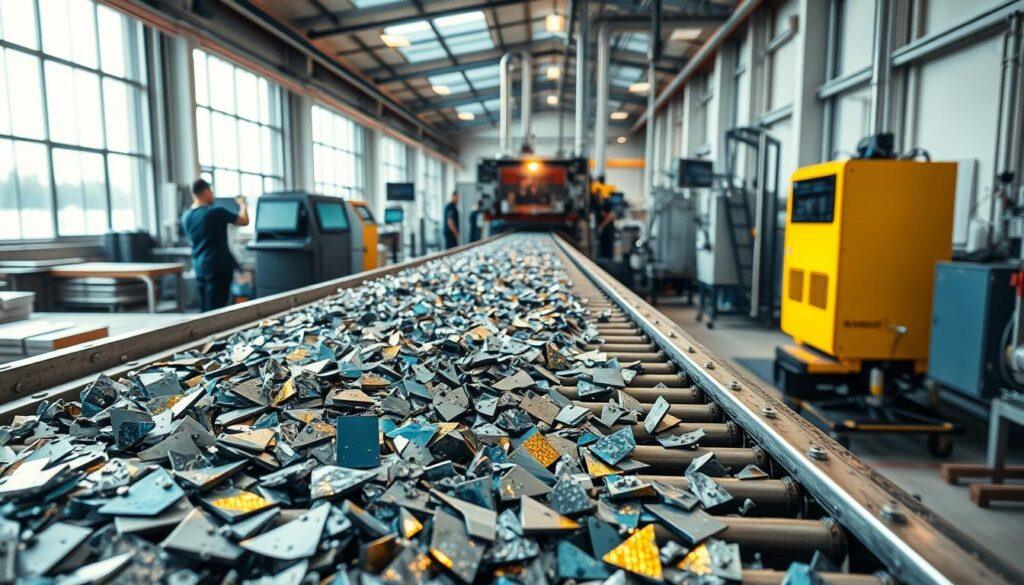
Recycling solar panels is like a complex heist. Each step uncovers hidden treasures. The first step is mechanical processing. It involves cutting, shredding, and grinding.
This stage gets bulk glass and aluminum. But silver and high-purity silicon are hidden. They need more work to be freed.
Then, thermal and chemical processes take over. Companies like ROSI and LuxChemtech use heat and solvents. They extract silver, achieving high purities.
These methods recover over 95% of a module’s value. It’s where the real magic happens.
But these advanced methods are expensive. Yet, as more panels are recycled, costs will drop. It’s not just recycling. It’s about finding precious metals for our energy future.
Economics scrap value logistics freight break even fees and EPR timelines
Let’s explore the financial side of solar panel disposal. The cheapest way to “recycle” a panel? Just dig a hole and bury it. Yes, landfilling can cost less than a latte per module, starting at around $0.50 to $1.80. Proper recycling, on the other hand, can cost as much as a nice dinner—anyone for $30 a plate?
But there’s a twist. Reuse is often the most attractive option, with credits between $10 and $65 per module. If you can find a buyer for a panel with a little character, that’s money back in your pocket. Isn’t that a delightful surprise?
Yet, the silent killer in this financial landscape is logistics. Freight costs can eat up your margins faster than seagulls at a beach picnic. When considering module takeback, these expenses must be factored in. You might find yourself questioning whether the profit is worth the hassle.
Then, there’s the game-changer: Extended Producer Responsibility (EPR) timelines. With regulations like Washington State’s ESSB 5939 or the EU’s WEEE directive, manufacturers will soon be footing the bill for module takeback and recycling. This means what once seemed like a cost—say, that $30 recycling fee—could transform into a pre-paid ticket to compliance. Suddenly, landfilling might become the expensive option, not just due to fees, but because of the valuable materials we’re burying.
| Disposal Method | Cost per Module | Potential Credits |
|---|---|---|
| Landfilling | $0.50 – $1.80 | N/A |
| Hazardous Waste Disposal | $3.60 | N/A |
| Recycling (Crystalline Silicon) | $8 – $30 | N/A |
| Reuse | N/A | $10 – $65 |
Design for disassembly fasteners encapsulants and backsheet choices
Solar panels soak up the sun’s rays but hide a dark secret. Their design makes them hard to recycle. It’s ironic, isn’t it? An industry that prides itself on renewable energy builds products that are hard to break apart.
To truly embrace circular design, we need to rethink how we make these panels. This means focusing on sustainable design by:
- Using feedstock that incorporates recycled content.
- Reducing the use of toxic materials.
- Designing reliable products with longer lifespans.
Instead of using encapsulants that bond like superglue, we should choose those that release cleanly under heat. Fasteners should be mechanical, not adhesive, for easy disassembly. And backsheets should be free of harmful materials, designed for recycling.
The European Union’s circular economy action plan is guiding us toward change. But real progress will come when contracts demand “circular-ready” labels. Until then, we’re stuck trying to extract valuable materials from a polymer tomb.
By adopting these principles, we can make big strides toward a sustainable future. It’s time to design solar panels that are not just efficient but also easy to disassemble and reuse. This will pave the way for a truly circular economy.
Policy tracker US states EU rules producer responsibility labels
The world of solar panel recycling is filled with complex policies. In the United States, each state has its own rules. For example, California has SB 489, making PV modules universal waste from 2021. This makes recycling easier and encourages the right disposal.
Hawaii is following California’s lead with HAR 11-273.1 by 2025. Washington State is also introducing EPR with ESSB 5939 in 2025. This law makes manufacturers pay for recycling and reuse.
But, the rest of the country is quiet, with many states using cheap landfills. This lack of a national policy raises big questions about solar panel waste management.
In contrast, the European Union has strict rules. The EU bans landfilling PV modules and has the Waste Electrical and Electronic Equipment (WEEE) Directive. This makes manufacturers pay for recycling. The US could learn from this.
But, both regions lack a clear producer responsibility label. Such a label would show who pays for recycling at the end of a panel’s life. Without it, we risk playing a dangerous game with waste that has harmful materials. The fate of solar panel recycling is closely watched, with a federal policy likely to follow soon.
| State | Policy | Effective Date | Key Features |
|---|---|---|---|
| California | SB 489 – Universal Waste | 2021 | Designates PV modules as UW for easier recycling |
| Hawaii | HAR 11-273.1 | 2025 | Follows California’s model for PV modules |
| Washington | ESSB 5939 – EPR | 2025 | Manufacturers responsible for reuse/recycling costs |
| EU | WEEE Directive | Ongoing | Mandates financing for PV module take-back |

Safety and compliance R2 eStewards hazmat transport and fire code
Handling end-of-life PV modules is like playing chess. One wrong move and you’re in trouble. In the U.S., these modules are seen as solid waste under the Resource Conservation and Recovery Act (RCRA). The Environmental Protection Agency’s (EPA) Toxicity Characteristic Leaching Procedure (TCLP) test checks if they’re safe.
If the test shows too much lead or cadmium, your panel is hazardous waste. This is a big problem.
The compliance rules are very strict. What’s okay in Texas might not be in California. The TCLP test makes sure only safe panels pass. If not, you face a lot of paperwork and strict rules.
Certifications like R2 and eStewards help keep things safe. They make sure panels are recycled properly. But, moving these panels can be tricky. It’s hard to explain to truckers that their load is safe, yet they shouldn’t inhale the dust.
As recycling grows, fire codes become more important. Storing many modules can be dangerous. If damaged, they can catch fire. This makes planning meetings very interesting.
Business models mobile shredders regional hubs OEM takeback portals
A solar recycling revolution is underway, bringing new business models. Imagine mobile shredders, like food trucks, but for solar panels. They travel around, ready to handle storm damage and old solar panels.
These units are like pop-up shops, providing quick recycling solutions. They’re essential for tackling a growing problem.
Regional hubs, like SolarCycle’s in Odessa, Texas, play a key role. They aim to collect waste within a 500-mile radius. It’s not just shredding; it’s about building a recycling community.
These hubs are vital for making recycling easier and ensuring panels don’t end up in landfills.
OEMs, like QCells’ EcoRecycle division, are taking responsibility. They’re partnering with distributors to create takeback portals. They’re saying, “We sold you the panel, now we’ll take it back—for a fee, naturally.” This module takeback model could change how we manage solar panels.
The best model is yet to be seen, but smart players are going vertical. They want to control logistics, shredders, and smelter relationships. Imagine an OEM giving you a takeback portal for free, making recycling part of the initial cost. This makes circular economy economics real.
Job roles plant ops materials science compliance and field removal crews
The solar circularity workforce is diverse, with engineers, scientists, and field workers. It’s not just about fixing things; it’s a complex system needing many skills. It’s like a sci-fi movie where every character is important.
Plant operators are the heroes behind the scenes. They run thermal furnaces, making sure recycling works well. They’re key in glass and silver recovery, ensuring materials are properly separated.
Materials scientists know silicon better than most know their families. They find new ways to recycle, improving what we can reuse. Their work is essential for finding new uses for old panels.
Compliance officers keep everything legal. They know all about following rules, like RCRA subtitles. They’re vital for keeping the recycling process right.
Field removal crews are the ones who take down old panels safely. They work in tough conditions, facing dangers like fire ants. Their skills are critical for removing panels without damage.
The industry faces a skills gap. We’re training fast installers but need more uninstallation knowledge. The future will need a mix of technical and scientific skills. It’s moving from basic panel handling to advanced recycling.
To show the variety of roles, here’s a table:
| Job Role | Key Responsibilities | Skills Required |
|---|---|---|
| Plant Operator | Manage thermal furnaces and oversee material separation | Technical knowledge, operational skills |
| Materials Scientist | Innovate recycling processes and improve material purity | Analytical skills, knowledge of materials science |
| Compliance Officer | Ensure adherence to recycling regulations | Regulatory knowledge, attention to detail |
| Field Removal Crew | Safely uninstall solar panels | Physical stamina, safety awareness |
In conclusion, solar recycling is about people, not just tech. As we innovate, we must also train and educate. With the right talent, we can achieve great things in glass and silver recovery.
Case studies utility decommission C and I rooftop HOA repower
Let’s explore real-world examples of solar panel decommissioning and repowering. These stories show the challenges and successes of using circular design.
In the California desert, a utility-scale project needed to be decommissioned. It had 200,000 modules that lasted 10 years in harsh conditions. The goal was to return the site to its original state. This task required a detailed plan and a bit of luck.
Next, imagine a commercial rooftop in a bankrupt store with a 500-kW solar array. The landlord wanted it gone fast. Luckily, the panels were not too old to be reused. They were tested, packed, and sent to a better location.
Lastly, consider a homeowners’ association (HOA) in Scottsdale. They wanted new solar panels, replacing their 15-year-old ones. The removal was complicated by HOA rules and the need to handle tile roofs. It was a challenging task.
SolarCycle aims to make panels last 5-10 years longer before recycling. This approach helps technology improve and makes projects more profitable. Each story teaches us about the importance of circular design in project success.
| Case Study | Challenges | Solutions | Outcomes |
|---|---|---|---|
| Utility Decommission | 200,000 modules, greenfield condition | Military-grade logistics | Successful site restoration |
| C&I Rooftop | Urgent removal, panels work | Test and ship to secondary market | Extended panel life, less waste |
| HOA Repower | Rules and homeowner worries | Navigating rules carefully | New look, better tech |
What owners need in contracts chain of custody reporting and certificates
In the solar energy world, the most important document isn’t the power purchase agreement. It’s the decommissioning clause in your EPC contract. Without a strong chain of custody, your “recycled” panels could end up in a landfill. This leaves you facing legal trouble when regulators show up.
Asset owners need contracts that name recycling partners and ask for certificates of destruction or recovery. This isn’t just a formality; it’s your defense against legal issues. A material recovery report should show the exact grams of silver and silicon reclaimed, not just a vague weight ticket from a shredder.
As the EPR policy becomes more popular, smart owners are including recycling in their financial plans. Recycling is not just a cost; it’s a way to avoid future regulations. When the EPA classifies PV as universal waste, those with good documentation will be fine, while others will face legal trouble.
Certificates are not just paperwork; they are your way out in the circular economy. Protect your investment and make sure your solar project is valuable for the future.