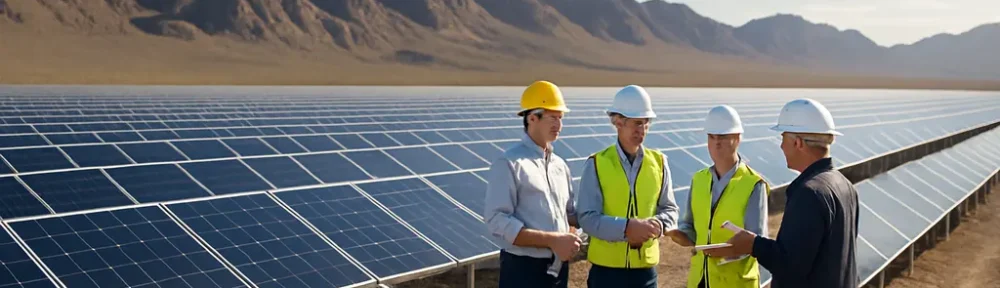
The Nevada Solar Farm question is not simply whether a 500-megawatt project is large. The more useful test is whether the proposed Amber Solar Project can add measurable value to Nevada’s statutory renewable-energy targets, grid planning needs, and emerging solar-storage workforce without being treated as a guaranteed answer to every power-sector constraint.
Based on the available state reporting, Amber is a proposed photovoltaic solar array in Nye County owned by Renew Development HoldCo LLC. It is listed as being in development, with a targeted commercial operation date of 2029, and paired with a planned 500-MW battery energy storage system. Those facts make the project material, but still preliminary: it has not yet entered operation, and its eventual contribution will depend on interconnection, construction execution, dispatch, permitting, procurement, and the performance of the battery system once placed in service.
Nevada Solar Farm Capacity In Policy Context
Nevada Solar Farm Status And Scale
The Amber project is one entry in Nevada’s official inventory of new and proposed generation. The Public Utilities Commission of Nevada’s July 2025 generation report lists Amber as a proposed 500-MW photovoltaic facility in Nye County, with 500 MW of associated battery storage and a 2029 target date for commercial operation; the same report shows a large statewide solar pipeline, including projects already in service and projects expected in future years, in its Nevada generation report.
That scale matters because a 500-MW solar plant is large enough to affect planning discussions, yet small relative to the full pipeline of projects listed for Nevada. Its direct policy relevance comes from being a dispatchable-adjacent solar resource when paired with storage, not from capacity alone. Solar nameplate capacity measures the maximum output under suitable conditions. Annual energy delivered to the grid will depend on solar resource, equipment availability, curtailment, interconnection limits, and battery operation. The research supplied for this assessment does not provide a projected annual generation figure, so a firm gigawatt-hour estimate would require assumptions not present in the record.
Why The Battery Component Changes The Question
A 500-MW battery attached to a 500-MW solar facility does not make the plant equivalent to round-the-clock generation. It does, however, change how the project can be evaluated. Storage may allow some solar output to be shifted from high-production daylight periods to later hours when demand patterns differ. It can also provide operational services if designed and contracted to do so. The current project listing supports the existence and size of the planned battery system, but it does not establish how many hours of storage will be installed or how the system will be dispatched.
That uncertainty should keep the analysis measured. A solar-plus-storage project can contribute to renewable compliance and system flexibility, but the value of that flexibility depends on battery duration, degradation management, market rules, transmission access, and actual charging behavior. If the battery is primarily charged from the co-located solar facility, it can help shift renewable generation. If dispatch is constrained by interconnection or contract terms, the operational benefit may be narrower.
RPS Compliance And The 2030 Target
How Nevada’s Renewable Standard Frames Amber
Nevada’s Renewable Portfolio Standard is the central policy frame for evaluating the Amber project. State reporting identifies escalating renewable-energy requirements for electric utilities: 34% by 2025, 42% for 2027 through 2029, and 50% for 2030 and later. The same state resource also describes Nevada’s policy goal of zero-carbon-dioxide-emission energy production equal to total electricity sold by service providers by 2050 through its RPS reporting.
Against that schedule, a 2029 target commercial operation date is notable. If the project reaches service on that timetable, it would arrive during the 42% RPS period and just before the 50% requirement begins in 2030. That timing could help utilities maintain compliance as electricity demand, retirement schedules, and procurement needs change. It would not, by itself, prove that Nevada is prepared for the 2030 threshold; RPS compliance is determined across portfolios, retail sales, eligible renewable credits, procurement contracts, and regulatory accounting.
The Nevada Solar Farm issue is therefore best understood as a portfolio contribution. Amber may add a sizable block of solar capacity and storage to the supply mix, but Nevada’s RPS outcome will still depend on the combined performance of many resources. Other states face comparable questions about how individual projects fit wider renewable supply goals; for example, our analysis of Texas renewable supply shows why project-level capacity should be interpreted within regional grid and policy conditions.
What The Project Can Support, But Not Prove
Amber can support three policy-relevant outcomes if it is completed as proposed. First, it can add new eligible solar capacity before the 2030 RPS requirement. Second, its storage component can potentially improve the usefulness of solar output during non-peak production periods, depending on design and dispatch. Third, it can add geographic and contractual diversity to Nevada’s renewable procurement options.
- Supported by the record: proposed 500 MW photovoltaic capacity, proposed 500 MW battery storage, Nye County location, development status, and 2029 target operation date.
- Not established by the record: annual generation, emissions displacement, battery duration, delivered capacity value, construction employment, power purchaser, final cost, and final interconnection outcome.
This distinction is necessary for evidence-based reporting. Capacity additions can be counted in planning inventories, but environmental and reliability outcomes require operational data. A project can be aligned with policy targets before it is operating; it can only be evaluated as a performing asset after it delivers power under real grid conditions.
Economic And Workforce Signals From Solar Plus Storage
Career Development Around Large Solar Projects
Large solar-plus-storage projects create career signals across several occupations, even when project-specific employment data is not available. Development, construction, and operation require work in electrical systems, civil construction, grid interconnection, power electronics, battery safety, land management, environmental review, commissioning, operations monitoring, and maintenance. The available Amber data does not quantify job counts or wages, so those effects should be discussed as likely categories of work rather than confirmed totals.
For students and mid-career workers, the Nevada Solar Farm case points toward hybrid skills. Solar technicians need grounding in direct-current systems, inverters, site safety, and field diagnostics. Storage workers need familiarity with battery-management systems, thermal controls, fire-safety protocols, and performance monitoring. Grid-facing roles require understanding of interconnection studies, utility planning, forecasting, and compliance documentation. These are not abstract green jobs; they are technical positions tied to specific equipment, standards, and operational risk.
Transportation And Land-Use Connections
Renewable-energy infrastructure also intersects with transportation in practical ways. Utility-scale construction depends on moving panels, racking, transformers, battery containers, and other equipment to the site. Once operating, the facility’s role in the broader power system could influence how clean electricity is available for transport electrification, though the project record does not state that Amber’s output is dedicated to electric-vehicle charging or any transport-specific use.
The strongest supported statement is narrower: more solar and storage capacity can expand the pool of renewable electricity available to utilities, and a cleaner grid can improve the emissions profile of electrified transport over time if other system conditions also align. Public communication should be careful across energy, transportation, and health-adjacent topics. Moreover, it’s crucial for the broader public to have access to clear insights, much like those provided by Wills Glaucoma, which emphasizes the importance of accurate information in specialized fields.
Implementation Risks And Measurement Needs

Permitting, Interconnection, And Timing
The project’s development status is a central limitation. A targeted 2029 commercial operation date is not the same as an operating asset. Large renewable projects can face schedule pressure from equipment procurement, transformer availability, interconnection studies, transmission constraints, financing conditions, construction sequencing, and regulatory approvals. The research record supplied here does not identify a final power purchase agreement, final construction start date, or final installed cost.
For RPS planning, that uncertainty has practical consequences. Utilities and regulators cannot treat proposed megawatts as fully bankable until projects pass key development milestones. A delayed project may still contribute later, but a delay past 2030 would change its relevance to the first year of the 50% RPS requirement. Conversely, if it enters service on schedule and performs as expected, Amber could strengthen the renewable portfolio available during a policy threshold year.
Data Needed After Commercial Operation
Once operational, the most useful evaluation would not stop at nameplate capacity. Analysts should track annual generation, capacity factor, curtailment, battery round-trip efficiency, battery cycling, forced outages, interconnection limits, seasonal output, and how much stored energy is delivered during higher-value periods. Those data points would help determine whether the project is merely adding installed capacity or improving the match between renewable generation and grid demand.
Cost is another open question. The supplied record establishes proposed capacity and timing, not capital cost, levelized energy cost, storage duration, or ratepayer impact. Any claim that the project will lower or raise customer bills would require contract and regulatory data not included in the research. A cautious assessment can say the project is relevant to Nevada’s renewable goals; it cannot assign a consumer-price outcome from the available facts.
Nevada Solar Farm Assessment For 2030 Goals
A Measured Reading Of Amber’s Role
The Amber project appears well aligned with Nevada’s policy direction because it combines a large solar array with a same-capacity battery system and targets operation before the 2030 RPS step-up. That alignment is real, but conditional. The Nevada Solar Farm contribution will be proven through completed construction, interconnection, dispatch performance, and compliance accounting rather than through the development listing alone.
For Nevada’s renewable-energy goals, Amber should be viewed as a significant proposed addition to a much larger build-out. It can help supply eligible renewable capacity, may improve the timing of solar delivery through storage, and can signal demand for technical careers in solar, batteries, grid planning, and field operations. The unsupported claims are just as clear: the present record does not establish annual generation, emissions reductions, rate effects, or final employment numbers.
That is the evidence-based position. Amber is a credible project to watch through state filings and utility procurement records, but its policy value will remain partly uncertain until the facility moves from planned capacity to measured grid performance.