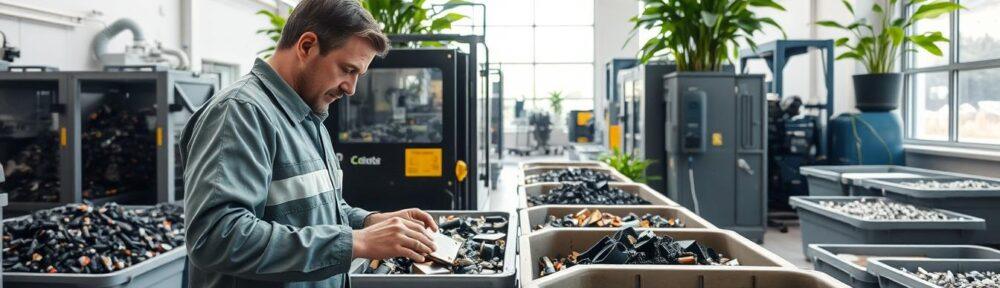
We thought we were doing the right thing by switching to electric cars. But, we have a big problem. It’s the old batteries from those cars, just sitting in warehouses.
These old lithium-ion packs are like the plastic straws of the car world. They were meant to help, but now they’re causing trouble.
The demand for important materials like cobalt and lithium is going to skyrocket. The old way of ‘dig, make, use, dump’ is not sustainable.
But here’s the good news: old car parts are worth more than new ones. They hold 20-30% higher economic value. This is not just about throwing away trash. It’s about keeping value and gaining power.
Now, governments in Europe and the U.S. are pushing to fix this problem. They want us to find a way to reuse these parts. It’s not just about if we can do it. It’s about how we can make it work.
This is our chance to show we really care about the environment. Let’s focus on lithium battery recovery.
Recycling Technology Innovations: Hydrometallurgy, Pyrometallurgy, and Direct Recycling Methods
The quest to reclaim a spent EV battery pits three distinct technological philosophies against each other, like a high-stakes, material science version of rock-paper-scissors. It’s not just about disposal; it’s a strategic extraction mission. The method you choose dictates what precious metals you save, what purity you achieve, and what environmental toll you pay. Let’s meet the contenders.
Hydrometallurgy
Hydrometallurgy is like the patient chemist of the lithium battery recovery world. It uses a gentle approach. Here, shredded battery components soak in a special chemical solution.
This process carefully pulls out the metals from the waste. It’s a delicate dance of molecules. The result? Metals are very pure. This method is great at getting lithium back.
For those who value high purity and lithium recovery, hydrometallurgy is the best choice. It’s all about finesse.
Pyrometallurgy and Direct Recycling Methods
Pyrometallurgy is the opposite, using high heat to melt everything together. It’s like a medieval blacksmith’s work. The goal is to create a molten soup of metals.
This method is good at getting metals like cobalt, nickel, and copper. But, it loses valuable lithium and aluminum. It’s effective but not perfect.
Direct recycling is new and different. It aims to fix the cathode material instead of melting it down. It’s like fixing a vintage record instead of recycling it.
This method uses little processing to make the cathode powder reusable. It’s clean and efficient but needs more development.
The future of EV battery recycling is a mix of methods. Use pyrometallurgy for bulk recovery and hydrometallurgy for lithium. Direct recycling is for high-quality battery cores. The key is knowing when to use each method.
Critical Material Recovery: Lithium, Cobalt, Nickel Extraction and Purification Processes
By 2040, we’ll need a lot more lithium, nickel, and cobalt. This is a big warning for our sustainable battery materials supply chain. The way we get these metals now is bad for the environment.
The secondary route of recycling is a better choice. It’s like urban mining, turning old batteries into valuable resources.
The circular economy EVs promise is real. It’s not just about recycling old batteries. It’s about making new, high-quality materials from them.
Lithium Extraction and Purification Processes
Getting lithium back from old batteries used to be hard. But now, we use a method called hydrometallurgy. It uses chemicals to extract lithium from old batteries.
The process to make lithium pure is complex. It includes steps like:
- Selective Precipitation: Adding chemicals to separate lithium from other metals.
- Solvent Extraction: Using solvents to get lithium ions out of the mix.
- Electrolysis: Using electricity to make ultra-pure lithium metal.
The goal is to make lithium as pure as the original stuff. But without harming the environment. It’s a big challenge in the circular economy EVs world.
Cobalt, Nickel Extraction and Purification Processes
Cobalt and nickel are key for recycling. They are valuable and hard to get. Their supply chains are complex and often involve risky places.
Getting cobalt and nickel back is a big deal. Here’s how recycling does it:
| Material | Primary Extraction Impact | Secondary Recovery Benefit |
|---|---|---|
| Lithium | ~500,000 gallons water/MWh (brine); High energy, landscape destruction (hard rock) | Recovers critical material without new water use or mining; closes the loop. |
| Cobalt | Associated with unethical mining practices; high carbon footprint. | Provides a clean, traceable supply; reduces geopolitical dependency. |
| Nickel | Energy-intensive smelting; significant sulfur dioxide emissions. | Offers a lower-carbon feedstock; stabilizes price volatility. |
Purification is key. After extracting, we use special methods to get cobalt and nickel pure. The last step is electrowinning, where we get pure metal.
This process is not just technical. It’s about turning waste into valuable resources. It’s essential for circular economy EVs to succeed.
Circular Economy Models: Closed-Loop Manufacturing, Material Reuse, and Waste Minimization
Recycling gets all the headlines, but the real innovation in battery lifecycle management happens long before the shredder starts. Think of a circular economy not as a bin, but as a multi-stage rocket for product value. Its mission? To delay the final act—recycling—for as long as humanly and technically possible.
The first stage is Closed-Loop Manufacturing. This is the art of designing batteries not just for a glorious first life, but for an elegant disassembly and rebirth. It’s the difference between a welded-shut smartphone and a Lego set. This philosophy, often called “Design for Disassembly,” enables powerful value retention processes like remanufacturing.
Studies show remanufacturing can slash costs by up to 50%, energy use by 60%, and material demand by a staggering 70% compared to building from virgin resources. It turns end-of-life from a liability into a feedstock. This is the foundational logic for circular economy EVs.
The second stage is Material Reuse, or giving batteries a second career. An EV battery retired at 80% capacity is like a marathon runner stepping off the track—
—it’s packed with endurance for a less demanding race. These units find perfect second lives in grid storage, smoothing out the bumps from solar and wind power.
This isn’t a niche idea. The “second-life” battery market is projected to explode from about 55 GWh today to nearly 1,000 GWh by 2030. Before that, strategies like integrated chargers extend the initial use phase. It’s all about maximizing every joule of stored energy.
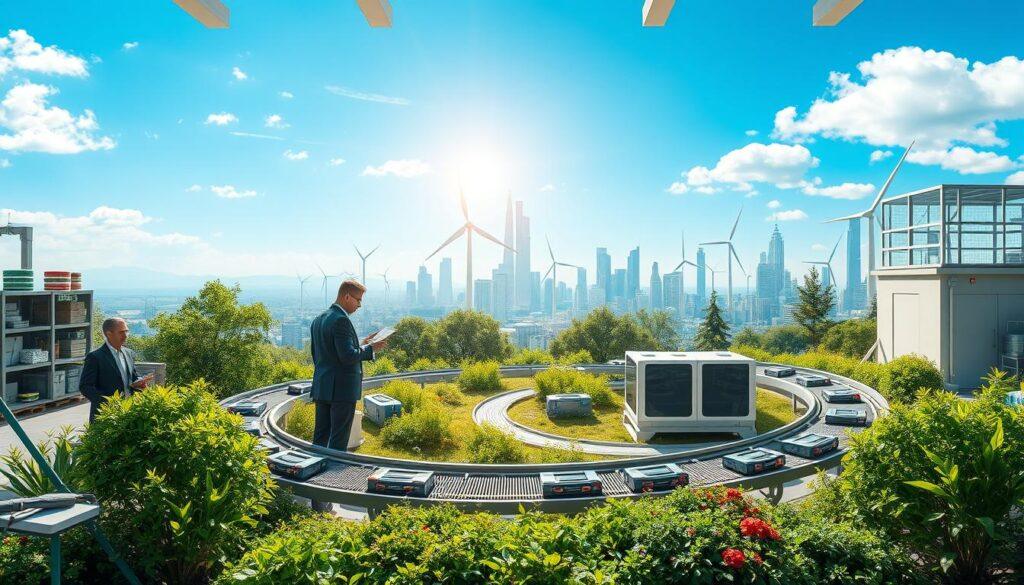
The final, critical stage is Waste Minimization. When every other option is exhausted, advanced recycling recovers critical metals with precision. This stage is vital, but in a mature circular model, it’s the last line of defense, not the first. The goal is to feed far less, and far less often, into this final loop.
Together, these stages form a cohesive system. It’s a symphony of strategies, each playing its part to extract maximum value from every atom. The table below breaks down this three-act play for battery lifecycle management.
| Circular Economy Stage | Core Strategy | Key Benefit | Projected Impact / Metric |
|---|---|---|---|
| Closed-Loop Manufacturing | Design for Disassembly & Remanufacturing | Reduces cost, energy, and material use by 50-70% vs. virgin production | Foundational for all downstream value retention |
| Material Reuse | Second-Life Applications (e.g., Grid Storage) | Extracts decades of additional utility from existing assets | Market growth to ~1,000 GWh by 2030 |
| Waste Minimization | Advanced Hydrometallurgical & Direct Recycling | Recovers >95% of critical materials, minimizes landfill | Completes the loop, enables true material circularity |
This model is the complete antithesis of our throwaway culture. It views a battery not as a consumable product, but as a temporary custodian of valuable materials. For the circular economy EVs promise to be real, this integrated thinking must be the default, not the exception. It’s where environmental necessity meets brilliant, systemic engineering.
Regulatory Requirements: Battery Regulations, Extended Producer Responsibility, and Compliance Standards
Forget about good intentions; the sustainable battery materials revolution is now law. It’s not about being nice; it’s about strict rules. Unsustainable practices are facing a tough new rulebook.
In Europe, the EU is leading with strict rules. Their plan includes Extended Producer Responsibility (EPR). This means you’re responsible for your product’s whole life. It makes manufacturers pay for EV battery recycling, not taxpayers.
Now, making batteries easy to recycle is smart business. EPR makes the circular model work financially.
The EU doesn’t stop there. They’ve set strict battery regulations. New rules require recycled content and recycling rates. Regulation 2019/631 pushed for more EVs, and now there are rules for clean manufacturing.
This framework has three main parts:
- Extended Producer Responsibility (EPR): Makes manufacturers pay for recycling.
- Material Mandates: Requires recycled sustainable battery materials in new products.
- Transparency & Reporting: Requires tracking carbon and resources.
Then, there’s compliance standards. Safety is key for using old batteries again. But, current standards don’t cover mixed-use batteries. This makes recycling hard.
In the U.S., things are changing too. Policymakers are focusing on the environment and resource security. They’re considering EPR and recycling laws to secure critical minerals.
This growing list of rules is the foundation for a sustainable future. It turns dreams into real, enforceable plans. It’s the rulebook for a circular economy for EVs, based on action, not just wishes.
Economic Opportunities: Recycling Industry Growth, Job Creation, and Resource Security
The story around electric vehicles is changing. We’re moving from focusing on the car’s cost to the value of its parts. The materials in an EV battery pack are worth 20-30% more than those in a gas car. This isn’t waste; it’s a valuable resource waiting to be recovered.
This isn’t just a green hobby. It’s the start of a major new industry. Laws are pushing us, but the real driver is the economics. Creating recycling systems is now seen as a smart investment, not just a nice gesture.
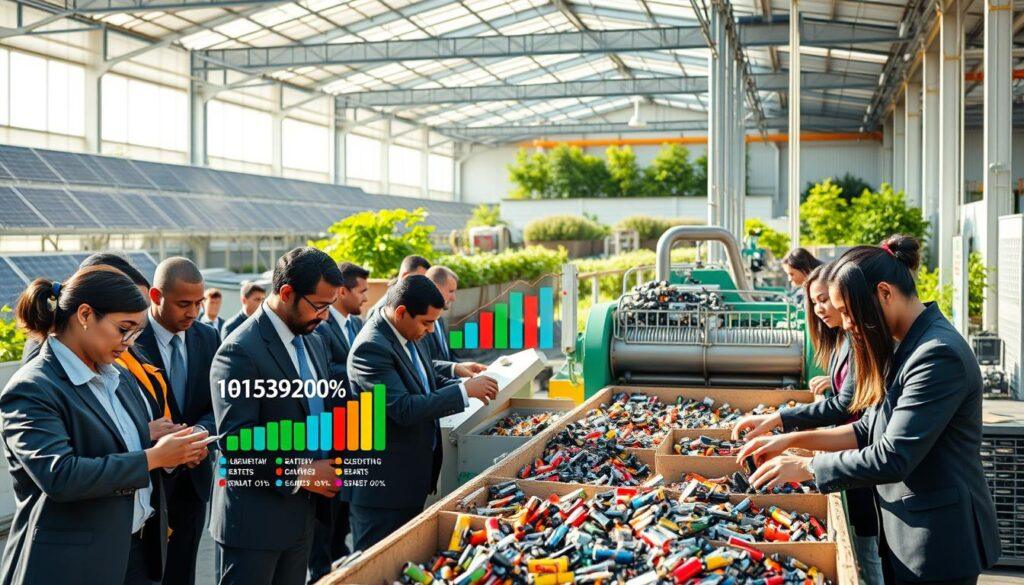
As this industry grows, so do the jobs. It’s not just about sorting materials. It’s about advanced technology. We need experts in chemistry, data science, and robotics to make it work.
These jobs are key to a circular economy. They involve materials science, logistics, and automation. It’s a chance for skilled workers to make a difference.
But the real prize is security. Relying on unstable regions for key metals is a national security risk. A strong recycling system is like a digital age version of the oil reserve. It supports US energy freedom by creating a local source of essential materials.
This approach also stabilizes prices and protects against supply disruptions. Recycling old batteries is often cheaper and better for the environment than mining new ones. This is where green thinking meets smart business. Good battery lifecycle management and lithium battery recovery are key to a strong, green future.
Research and Development: Advanced Recycling Technologies, Process Optimization, and Cost Reduction
If current battery recycling is like a reliable truck, R&D labs are building a hyperloop. The real story is in research grants and patents. This is a major rewrite of the EV battery recycling playbook for a true circular economy EVs future.
Advanced Recycling Technologies
Yesterday’s methods are outdated. Today, we focus on precision and elegance. We’re talking about techniques that are like molecular surgery.
Supercritical CO2 is a top-notch solvent. It can extract valuable metals without harsh chemicals, reducing water use and waste. Advanced robotics and AI are making pack disassembly safer and faster.
The ultimate goal is to recover materials with ultra-pure membrane technologies. Imagine filters that can pick out individual lithium ions. Direct recycling can even refurbish cathode crystals, preserving materials.
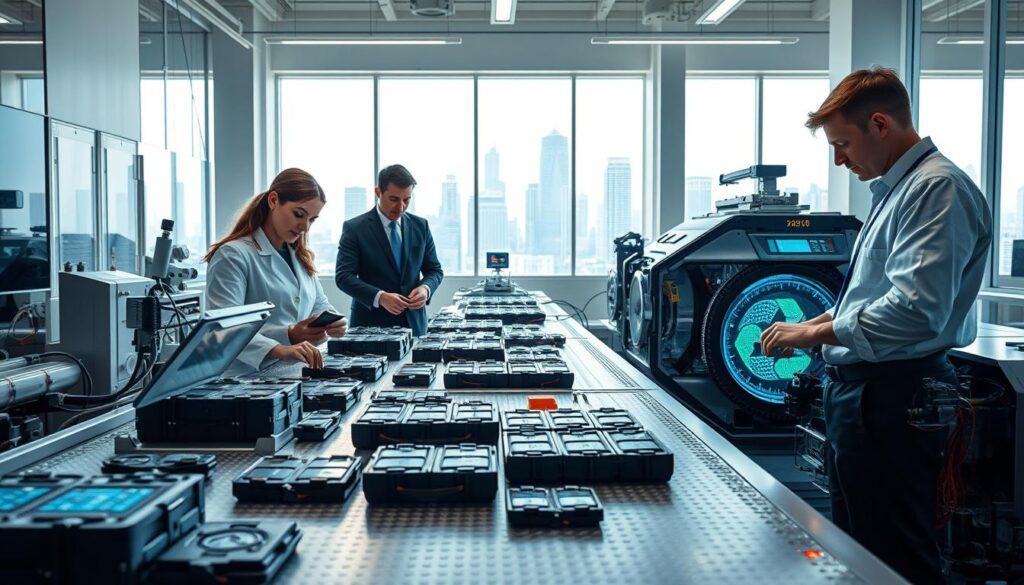
Great tech means nothing if it’s not practical. Process optimization is key here. We aim to reduce energy use and environmental impact.
Every bit of water and chemical recovered helps. It’s a big engineering challenge, but the rewards are worth it. Lower costs and a cleaner process are the goals.
The ultimate goal is cost reduction. Recycling must be cheaper than new production for circular economy EVs. R&D is working hard to lower costs. Smarter chemistry and automation are key.
The goal isn’t just to build a better recycling plant. It’s to make waste the most expensive option.
Supply Chain Integration: OEM Partnerships, Collection Networks, and Reverse Logistics
Advanced recycling tech is useless if we can’t get dead batteries to recycling plants. This is the hard, unseen part of the circular economy. It’s where great chemistry meets the tough world of logistics.
Imagine building a supply chain in reverse. The network that brought your EV must now take it back. It’s a complex task, full of risks and questions about who owns what.
It all starts with OEM partnerships. Car makers must design vehicles for easy disassembly and collection. This means thinking about the end of the vehicle’s life from the start.
Then, we need to build collection networks. This is a huge web of places to drop off batteries, hubs, and special transport routes. It’s like creating a new interstate system for hazardous materials. Who will fund and run it?
The puzzle of reverse logistics raises big questions. Who owns a battery when it’s no longer needed? The owner? The leasing company? The maker? How do we track each battery’s journey?
To solve this, we need everyone to work together. Car makers, recyclers, logistics companies, and governments must join forces. This is the only way to get the materials needed for lithium battery recovery and make sustainable battery materials.
Without this system, the circular economy is just a dream. But with it, we can turn a big problem into a chance to lead. The reward? A steady supply of key materials and a clean energy future.
Environmental Benefits: Reduced Mining Impact, Carbon Footprint Reduction, and Pollution Prevention
Recycling is key to saving our planet in the EV era. We’ve looked at the tech, the economy, and supply chains. But the real goal is the environmental benefits. This is where circular economy EVs really make a difference.
Think of it as a three-part harmony for a healthier planet: sparing the earth, slashing the carbon, and stopping the poison at the source.
First, the most visceral win: reduced mining impact. Every kilogram of lithium, cobalt, or nickel we recover is a kilogram we don’t have to violently extract. We’re talking about landscapes left unmangled. Brine lakes in fragile arid regions aren’t pumped dry. The toxic runoff from nickel mines doesn’t bleed into waterways.
The primary mining process is an environmental horror show of water profligacy and sheer energy intensity. Effective battery lifecycle management offers a stark alternative. It’s the difference between surgery and blunt-force trauma.
Second, we tackle the invisible enemy: the carbon ledger. Manufacturing a battery is a carbon-intensive marathon. Here’s the kicker: giving that battery a second life in grid storage saves nearly all of that embedded carbon. The data doesn’t lie. One study quantifies that one MWh of second-life batteries carries roughly 450 metric tons less embodied carbon than a fresh MWh of first-life batteries.
Recycling and remanufacturing can slash the carbon cost of new components by up to 70%. This isn’t marginal gain; it’s a strategic decarbonization lever. For the circular economy EVs vision to be credible, this carbon math is non-negotiable.
Lastly, the straightforward but critical win: pollution prevention. A linear economy treats end-of-life batteries as complex trash. A circular system sees them as a contained hazard. Keeping heavy metals like lead and cadmium, along with complex polymers and electrolytes, out of landfills is a direct victory for soil and groundwater quality.
It prevents a slow-motion environmental crime. This aspect of battery lifecycle management is the ultimate “do no harm” principle in practice.
So, why does this trio of benefits matter so profoundly? It recalculates the true cost of our consumption. The old, linear model—dig, refine, assemble, use, dump—externalized its environmental costs onto the planet and future generations. It was a form of ecological deficit spending.
A circular system, by design, internalizes those costs. It’s the accounting correction our industrial metabolism desperately needs. The reduced mining impact, the massive carbon footprint reduction, and the essential pollution prevention aren’t just feel-good side effects. They are the core deliverables.
They transform the EV from a product that simply moves pollution upstream into a catalyst for a cleaner industrial loop. That’s the real revolution. Not just what’s under the hood, but what’s *not* left behind in the ground, in the air, and in the water.
Career Paths: Materials Engineering, Environmental Science, and Recycling Technology Development
Where do you fit in this new future? The circular economy needs people, not just good ideas. A new job world is emerging, with roles being created as we speak.
Materials engineers are key players. They design sustainable battery materials from scratch. Their work is about creating materials that can be easily broken down and reused.
Environmental scientists are the watchdogs. They check if EV battery recycling really cuts carbon emissions. They also help companies follow rules, making it a plus for business.
The growth of this industry is creating many new jobs. It’s not just about science and safety. Roles range from improving recycling processes to using robots, opening up a wide field of opportunities. For more on these jobs, like EV Battery Engineers and Sustainability Consultants, check out in-demand EV jobs.
This new era needs people who can think big and use data. Success comes from understanding the whole system and using data to guide decisions. This is shown in freight decarbonization case studies.
If you love solving problems and want to make a difference, this is for you. A career here means helping build a greener world, one battery at a time. You’re helping shape the future of industry.