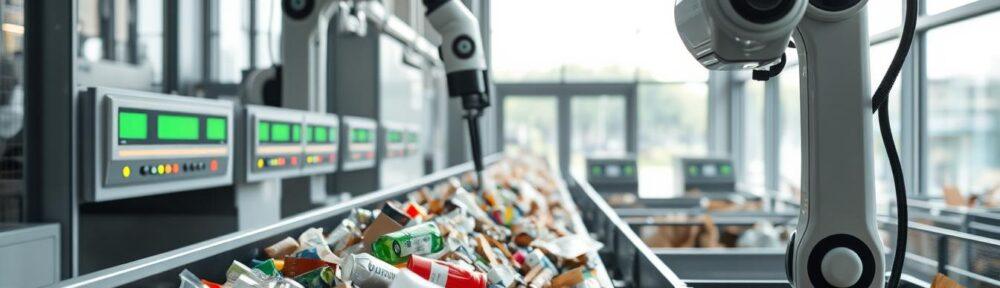
The waste management world is changing quietly. At the center are smart machines that can see, learn, and decide. These AI systems are moving us from manual work to smart automation.
These systems use advanced imaging and learning to quickly spot materials. They can sort plastics, metals, and paper on moving belts. This increases the amount and quality of materials we can reuse.
This change is more than just sorting. It’s part of a big shift in how we manage resources. The aim is to turn waste into valuable resources with unmatched efficiency.
Current State of Recycling Technology
Our recycling systems are facing a huge challenge. Landfills are full, and oceans are filled with plastic. We create over 2 billion metric tons of waste each year worldwide. This number is expected to double by 2050 if we don’t change.
Our recycling rate is only 19% globally. In the U.S., each person throws away about 1,800 pounds of waste yearly. Yet, we recycle less than 24% of our waste. This shows a big problem with our recycling technology and how we process waste.
The main issue is old methods. Most places use single-stream recycling, or “single-bin” collection. It’s easy for people but leads to contamination. Food on paper and glass in plastic makes it all unrecyclable, ending up in landfills.
Sorting waste is mostly done by people on moving belts. It’s dirty, dangerous, and not very efficient. Mistakes happen, and valuable recyclables get lost. Plus, people often don’t know what can be recycled, making things worse.
The damage to our environment is huge. Landfills are full, leaking harmful chemicals. Millions of tons of plastic waste harm marine life and enter our food. The old way of waste management is failing us all.
This situation is urgent for both business and the planet. We need new ways to sort waste, not just manual sorting. The need for AI and robotics to fix this problem is clear.
AI-Powered Sorting Systems
Imagine a sorting line where every piece of waste is identified in seconds. This is AI waste sorting. These systems use advanced sensors and machine learning to see trash in new ways.
At the heart of this technology is computer vision. Cameras capture images of items on a conveyor belt. Special software then analyzes these images in real time.
The real magic happens with sensors. Near-infrared (NIR) and hyperspectral imaging let the AI see into an object’s molecular structure. This way, it can tell a black plastic food tray from a black plastic bottle.
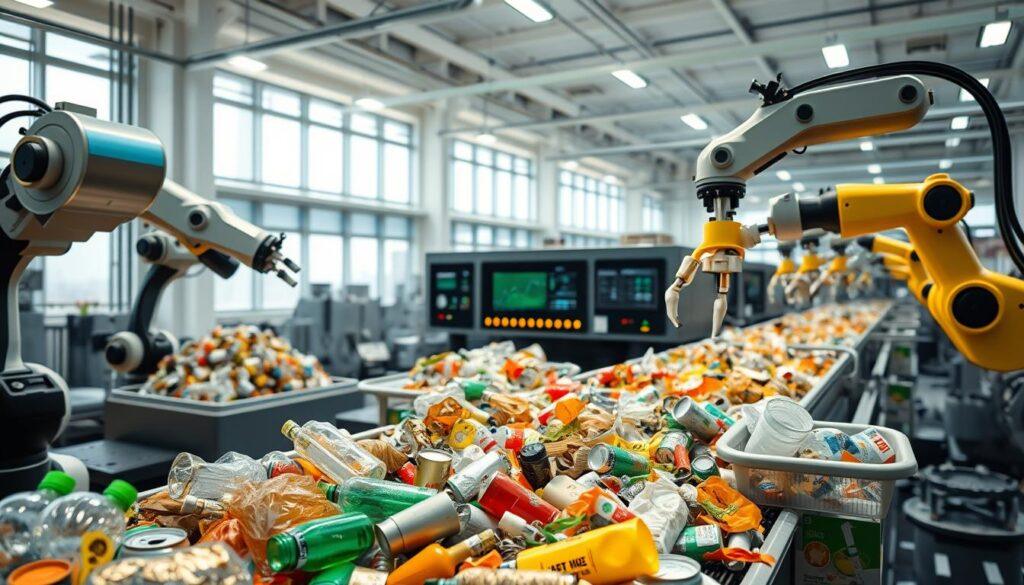
The data from these sensors feeds a brain that keeps learning. The machine learning model has been trained on millions of images. It learns to recognize materials, shapes, and even specific brands.
The results are impressive. An AI-powered robot can process over 1,000 items per hour. This is much faster than a human. Accuracy also jumps to 99%, cutting down errors by up to 70%.
This improvement tackles a big recycling problem: contamination. By correctly identifying and diverting non-recyclables, these systems can reduce contamination by almost 40%. This leads to cleaner, more valuable material bales.
Real-world examples show how powerful this technology is:
- Greyparrot AI software can sort waste into 111 distinct material categories, far beyond traditional methods.
- Glacier’s robots sort over 30 categories and expertly handle difficult items like toothpaste tubes and chip bags.
- A Columbia Engineering project uses AI-enabled cameras on the Hudson River to monitor and classify floating debris, proving the technology’s versatility.
The economic benefits are clear. Facilities see a 60% increase in operational efficiency. They can process more material with fewer workers, producing a purer product. AI waste sorting is now a key technology for profitable recycling.
Robotic Waste Processing
AI isn’t just about thinking; it’s also about doing. Industrial robots are changing how we handle waste. They combine smart software with strong mechanical abilities.
These robots are the backbone of automated recycling. They have special grippers and vision systems. This lets them pick and place materials quickly and accurately.
Robots work non-stop, day and night. They increase work hours by more than 50%. This means they can handle more waste than humans can.
Robots are also key in handling dangerous materials. They keep workers safe from toxic e-waste and sharp objects.
Using robots can make workplaces safer. Facilities see injury rates drop by up to 35%. This is a big win for using waste sorting robots.
Companies like Molg show how robots can help. They use AI robots to take apart complex electronics. These robots can safely handle batteries and separate circuit boards.
Robots have advanced sensors and AI. They can handle different shapes and materials. This includes everything from plastic bottles to sharp metal pieces.
The benefits are clear. Automated recycling robots take on tough tasks. This lets humans focus on other important jobs. The result is a safer and more efficient recycling process.
Chemical Recycling Breakthroughs
To achieve a true circular economy, we need to change materials’ chemical makeup. This innovation tackles waste that mechanical recycling can’t. It turns waste into valuable resources, ensuring every molecule is tracked.
Pyrolysis is a key technology. It heats materials like plastics and tires to 400–800°C without oxygen. This process breaks down waste at a molecular level.
The results are valuable resources:
- Fuel oil that can be refined into new plastics or fuels.
- Syngas used to power the process itself.
- Char with industrial uses.
This creates a real closed-loop system for hard-to-recycle waste. For example, Recycling Technologies’ RT7000 machine can process up to 7,000 tons of plastic yearly. It turns plastic back into a feedstock for making new products.
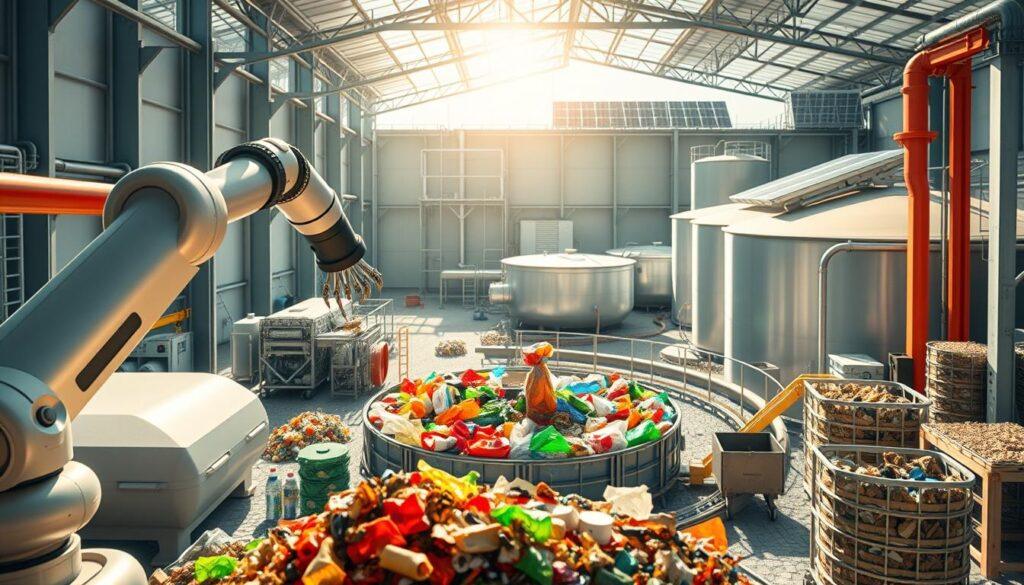
Material science also offers solutions: bioplastics. Made from renewable resources like corn or algae, they are often biodegradable and have a lower carbon footprint.
But, bioplastics face challenges. They can be pricier than traditional plastics and need special facilities to break down. Here’s a comparison:
| Feature | Traditional Plastic (e.g., PET) | Bioplastic (e.g., PLA) |
|---|---|---|
| Source Material | Fossil fuels (petroleum) | Renewable resources (plants) |
| End-of-Life Option | Recycling (mechanical/chemical) or landfill | Industrial composting or chemical recycling |
| Carbon Footprint | Higher (from extraction) | Lower (captures CO2 during growth) |
| Current Cost | Lower, established market | Higher, scaling challenges |
Technology also ensures accountability in the circular economy. Blockchain creates a permanent digital record for waste streams. Every step, from collection to reuse, is documented.
This transparency stops fraud and verifies recycling claims. It lets companies prove their supply chains are sustainable. It makes the closed loop idea real and trackable.
Pyrolysis, advanced bioplastics, and blockchain traceability are key. They are not just small steps but major breakthroughs. They help us recover value from waste, design better materials, and trust the system. This is how we build a strong, transparent, and circular economy.
Economic Impact & ROI Analysis
The economic impact of recycling technology goes beyond just the cost of equipment. It changes how businesses spend money and make money. This analysis helps business leaders see the value in making big investments.
Starting up requires a lot of money. You need to buy AI robots, smart sensors, and upgrade your systems. Leasing one robot can cost as much as hiring two workers for a year. You also have to pay for technical help, training, and setting up the system.
But the benefits are worth it. Businesses save a lot of money right away. For example, Alameda County Industries cut their labor costs by 59% with AI systems. This wasn’t just about cutting jobs. It was about making workers more efficient and increasing output by 60%.
This efficiency means businesses can do more with less. They make more money from the materials they recycle. They also waste less, saving on landfill costs.
Another big savings is in logistics. Predictive analytics help plan better routes for waste collection. This cuts down on fuel, vehicle wear, and pollution. Smart bins also help by only being emptied when full. Some places have seen up to a 50% cut in collection costs with these smart bins.
This changes how businesses think about waste. They can sell high-quality materials to manufacturers. This makes a stable supply chain for the circular economy. Businesses can get better deals for their clean materials.
But there’s a common misunderstanding about jobs. Automation might replace some jobs, but it also creates new ones. Experts say there will be 15% more jobs in recycling by 2028. These jobs are better and more skilled, like maintaining robots and analyzing data.
The table below shows how recycling technology changes finances:
| Financial Metric | Traditional System | AI-Powered System | Impact |
|---|---|---|---|
| Labor Cost | High & Variable | Reduced by ~60% | Major Operational Saving |
| Processing Efficiency | Manual Speed | 60%+ Increase | Higher Throughput |
| Material Purity/Value | Lower, Contaminated | High, Market-Grade | New Revenue Stream |
| Logistics & Collection | Fixed Schedule | Dynamic, Optimized Routes | Up to 50% Cost Reduction |
| Landfill Dependency | High Tipping Fees | Significantly Reduced | Direct Cost Avoidance |
This change helps the circular economy. It makes recycling materials better and more reliable. This reduces the need for new resources. It makes the economy more sustainable and resilient.
The case for investing in recycling technology is strong. The costs are upfront, but the benefits last long. Savings in labor, efficiency, new revenue, and avoiding costs make it a smart choice for any business.
Future Technology Roadmap
The future of waste management technology is moving fast. Experts say AI in waste management will grow by 22% each year until 2030. Companies like Bollegraaf and Greyparrot are updating thousands of facilities with new vision systems.
New AI waste sorting tech is breaking records. Systems like AMP ONE’s air-jet and the Antfarm X1 can sort thousands of items every minute. They’re setting the stage for fully automated recycling plants.
The dream is a complete system. It will mix AI waste sorting, robots, and chemical recycling into one smart system. The aim is to create a loop where materials are used over and over again.
But, solving the plastic problem is more than just tech. Experts like Professor Zoran Kostić say we need to cut down on plastic use and make policies that work. We must also design products that can be recycled easily.
Businesses that get this integrated plan will lead the way. Keeping up with these technologies gives them an edge in creating a green, efficient operation.