
A big change is happening on our roads and in the economy. The move to electric vehicles is creating a huge new industry. Experts say this market will grow to $147.6 billion by 2030.
This change isn’t just about making cars. It’s about building the essential parts for electric cars to become common. This fast growth means there’s a huge need for skilled workers.
Big government programs are driving this growth. The National Electric Vehicle Infrastructure (NEVI) program is key. It gives billions to states to build a national charging network.
This program turns big plans into real jobs. Utility make-ready programs also play a big role. They help pay for the electrical work needed for new charging spots.
Together, NEVI funding and make-ready incentives make a solid base for businesses. They make investing safer and ensure projects can last. For those looking ahead, this means great career opportunities are being made now.
Role Map: sales/site host, civil/elec design, installers, network ops, reliability eng
Building a public EV charging station is a complex task. It needs many specialized talents. Each person plays a key role from start to finish.
From the start to the end, a successful project needs clear roles. The effort needed varies for different charger types and jobs.
Sales Professionals & Site Host Relations
This role starts the project. Sales people find and agree with property owners, or site hosts. These can be retail centers, workplaces, or city facilities.
They negotiate how money will be shared, explain utility benefits, and check if the site is right. Their work is the base for all technical steps.
Civil & Electrical Design Engineers
After a site is chosen, design engineers make the plan. Civil engineers plan the physical layout and the electrical setup. They make sure it meets local rules and is accessible.
Electrical designers focus on the power. They figure out the power needs, plan for upgrades, and design the wiring. Their plans must follow the National Electrical Code (NEC).
Installation Crews & EVSE Installers
Here, plans turn into reality. The installation team includes construction workers, concrete pourers, and trenching experts. The EVSE installer is the electrician who installs the charging unit and makes the final electrical connections.
They know a lot about high-voltage systems and specific hardware. DC Fast chargers need more electrician time than Level 2 stations. This is because they have heavier electrical parts and more complex connections.
Network Operations Center (NOC) Technicians
After it’s installed, the charger connects to a network. NOC technicians monitor and manage it remotely. They use software to check the charger’s status, handle payments, and fix simple problems.
Their goal is to keep the charger working all the time. They solve problems before drivers notice them. They work with field teams for repairs.
Reliability & Maintenance Engineers
These engineers focus on keeping the station running well. They look at failure data, manage spare parts, and plan maintenance. Their work keeps the station reliable.
They also handle complex remote checks and plan for updates. This role is key to a reliable network.
| Job Function / Role | Level 2 Charger (Estimated Days) | DC Fast Charger (Estimated Days) | Primary Responsibilities |
|---|---|---|---|
| Project Management & Planning | 3-5 | 5-8 | Permitting, scheduling, vendor coordination |
| Electrical Contractor & EVSE Installer | 2-4 | 6-10 | Wiring, unit mounting, final electrical hookup |
| Civil Construction & Trenching | 1-3 | 3-7 | Concrete work, conduit laying, site restoration |
| Utility Coordination & Inspection | 2-4 | 4-8 | Grid interconnection, city/county final sign-off |
The table shows DC Fast Chargers need more work, mainly from electrical teams. Knowing this helps people see where they fit. It shows how each role is important for a successful project.
Careers in EV infrastructure rely on teamwork. From sales to reliability engineers, each role is vital for a green future.
Codes & Standards: NEC, NFPA, ADA, OCPP, UL listings
Industry standards like the NEC and OCPP are more than just rules. They are the blueprint for safe and efficient charging networks. Knowing these standards sets professionals apart from just installers. It builds trust and ensures projects last.
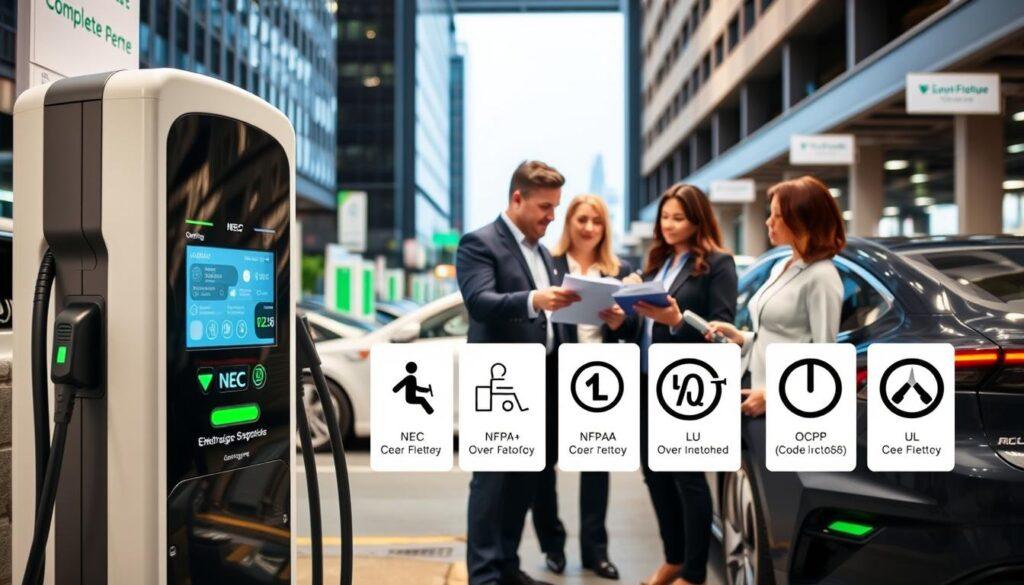
These codes are the language of the EV industry. They make sure chargers work the same everywhere. For pros, knowing this is essential.
States like California and Nevada require EVITP-certified electricians for public chargers. This shows how important standards, safety, and skilled labor are.
Here’s what every pro needs to know:
- National Electrical Code (NEC), Article 625: This is key for EV safety. It covers circuit sizing, overcurrent protection, and more. Following the NEC is mandatory for safety.
- NFPA Standards: The National Fire Protection Association gives important guidelines. These are critical for installations in garages or enclosed areas. They help prevent fires and ensure safety for first responders.
- Americans with Disabilities Act (ADA): Public chargers must be accessible. ADA rules cover screen height, connector force, and wheelchair space. Ignoring these can lead to big legal and financial issues.
- Open Charge Point Protocol (OCPP): This ensures chargers from different makers work together. OCPP is key for network operations and design. It prevents being stuck with one vendor and allows for growth.
- UL Listings: UL certification means a product is safe. It’s tested for electrical safety and more. Using UL-listed equipment is a smart move to avoid problems and ensure reliability.
Understanding these standards is a key skill. It affects design, equipment choice, and installation. Knowing codes well can make a big difference in the business case for EV infrastructure by reducing risks and ensuring projects last.
These standards shape the industry. They ensure safety, accessibility, and network smoothness. For those leading in this field, knowing these rules is what truly shows expertise.
Fieldwork & Safety: lockout/tagout, PPE, trenching, permitting steps
Building EV chargers turns designs into real places. This work follows strict safety rules and steps. Moving from plans to the site is where the real work starts.
It involves a lot of electrical and construction work. Success depends on safety and working with local authorities. This section explains the important steps on the ground. We focus on safety and moving projects forward.
Cultivating an Unshakeable Safety Culture
Before starting, a safety mindset is key. High-power DC fast chargers have real risks. Electrical and construction dangers are there. A safety plan is the first thing on site.
Lockout/Tagout (LOTO) is very important. It makes sure dangerous energy is off before work. Each worker has their own lock and tag. This stops the system from being turned on while work is done.
Proper Personal Protective Equipment (PPE) is the last defense. For electrical work, this includes:
- Insulated gloves and sleeves rated for the voltage.
- Arc-rated flame-resistant clothing.
- Safety glasses and hard hats.
- Hearing protection for noisy areas.
Regular safety talks keep these rules alive. They change with the day’s tasks, like trenching or panel work.
The Phases of Physical Site Development
The build follows a clear order. Each step prepares for the next. Rushing or skipping steps can cause big problems.
Trenching and Concrete Work start the foundation. Trenches are dug for power and data cables. Then, concrete pads are poured for the charger cabinets.
Electrical Installation is the main technical work. Electricians run heavy wire and install the charger. All connections must be checked and tightened.
Navigating the Municipal Permitting Maze
No work starts without the right permits. The permitting process checks if the project meets local rules. It’s a key part of site development.
The steps vary by area but follow a pattern. Knowing this helps avoid delays.
| Permitting Step | Responsible Party | Typical Documentation Required | Purpose |
|---|---|---|---|
| Application Submission | Project Manager or Contractor | Site plans, electrical diagrams, equipment specs | Formal request for construction approval |
| Plan Review | City/County Building Department | Review for code compliance (NEC, ADA, zoning) | Ensure design meets all safety and legal standards |
| Fee Payment | Project Financier | Payment of calculated permit fees | Fund the municipal review process |
| Inspections (During/Final) | Municipal Inspector | Field verification of trench depth, wiring, installation | Verify work matches approved plans and codes |
| Certificate of Occupancy/Use | Building Department | Final approval document | Legal authorization to operate the charging station |
Good communication with the permitting office is key. Submitting complete, clear documents first time speeds up review. Many delays come from incomplete applications.
Fieldwork turns ideas into real things. A focus on safety and a systematic approach to permits and construction are key. Mastering this is essential for EV infrastructure professionals.
Uptime & Operations: SLAs, remote diagnostics, spares
Building an EV charging station is just the start. Its real value comes from how well it works every day. This means focusing on keeping it running smoothly.
Success is measured by clear goals. Uptime is key, often shown as a percentage of time it’s working. SLAs set these goals, like 99% uptime, and what to do if they’re not met.
Key Performance Indicators and Service Level Agreements
There’s more to success than just uptime. A good plan tracks many metrics. These uptime KPIs show how well the station is doing and if users are happy.
| Operational KPI | What It Measures | Industry Benchmark |
|---|---|---|
| Uptime % | Station availability for charging | >97% |
| Session Success Rate | Percentage of initiated charges that complete successfully | >95% |
| Mean Time to Repair (MTTR) | Average time taken to restore a station after a fault | |
| Energy Delivery | Total kWh dispensed over a period | Varies by site |
The Commissioning Process
Before it opens, a station goes through commissioning. It’s not just turning it on. Every part is checked, from electrical to payment systems. It’s tested to make sure it works right.
Proactive Maintenance with Remote Diagnostics
Waiting for a station to fail is not a good plan. Modern stations have remote diagnostics. This lets operators check on stations and fix problems before they happen.
Managing Spare Parts for Rapid Response
Even with good monitoring, parts can break. Having the right spare parts quickly is key. Keeping common parts on hand helps fix problems fast. This keeps stations running without long downtime.
Doing well with EV stations means looking at everything together. Uptime KPIs, commissioning, remote tools, and spares all work together. Getting this right makes sure stations work well and help the electric shift.
Certification Paths: electrician licenses, manufacturer trainings
To become a top EV infrastructure pro, you need to follow a clear path. This path includes getting industry certifications and special training. These steps show employers you have the skills for tough jobs.
Getting certified is now a must for many technical jobs. It’s not just a plus anymore.
Foundational Licenses: The Electrician’s Ticket to Work
For most jobs, you start with a state electrician license. This is the first step. A Journeyman or Master Electrician license shows you know the National Electrical Code (NEC) and local rules. This is key for EV charger work.
Without this license, you can’t pull permits or sign off on work. It’s your main ticket for legal and safe electrical work.
Industry-Standard Credential: The EVITP
The Electric Vehicle Infrastructure Training Program (EVITP) is a top certification. It teaches about EV supply equipment, from site checks to setup. It’s a must for many jobs.
Many grants and utility deals need EVITP-certified electricians. This makes the certification very valuable for those in the public sector or big projects.
Specialized Manufacturer & Network Training
Knowing specific systems is highly valued. Charging station makers and network managers offer special training. These courses teach how to work with certain chargers and networks.
For a CPO/MSP with many stations, hiring certified techs saves time and boosts repair speed. This training is a big plus.
The perks of this training are clear:
- It matches what employers need.
- You can earn more with these skills.
- It keeps you secure with companies using your skills.
For those wanting to become certified installers, focus on training from big players. This makes you a top pick for CPO/MSP jobs.
| Certification Type | Key Features | Best For |
|---|---|---|
| State Electrician License | State-mandated; covers NEC compliance; required for permitting. | All electricians and installers; foundational for legal work. |
| EVITP Certification | Industry-developed standard; covers full project lifecycle; often required for public funds. | Electricians seeking work on utility, municipal, or large commercial projects. |
| Manufacturer-Specific Training | Proprietary hardware/software focus; issued by OEMs or network operators. | Technicians aiming to work directly for a specific CPO/MSP or authorized service provider. |
The best pros have it all. They have a state license, EVITP for broad skills, and special training. This mix makes them stand out in the EV field.
Sample Timeline from Site Prospect to Go-Live
A typical EV charging station project takes several months. It goes from finding a site to making it ready for use. This process combines technical, regulatory, and operational knowledge.
The journey has many stages that overlap. A delay in one can affect the whole timeline. Here’s a realistic timeline for setting up a commercial Level 2 or DC fast charging station.
Phase 1: Site Identification & Feasibility (Weeks 1-4)
This first phase is about finding and checking a location. Sales teams or site hosts look for places with good traffic, electrical power, and zoning. They do a quick site visit with design and utility teams.
They do a load analysis, estimate costs, and get a letter of intent from the owner. This phase is the start and checks if the project can work before spending a lot.
Phase 2: Design & Engineering (Weeks 5-10)
Civil and electrical engineers lead here. They make detailed plans that follow NEC, NFPA, and ADA rules. They choose the right equipment and design the layout for safety and easy use.
They create a complete construction drawing set. This is needed for the next step: getting permits.
Phase 3: Permitting & Utility Coordination (Weeks 7-14)
This phase is often the longest and most unpredictable. They send the design package to local departments. They also start working with utility companies for new services or upgrades.
Getting a new service involves applying, waiting for a study, and getting a cost estimate. Being patient and communicating well is key because timelines vary a lot.
Phase 4: Construction & Installation (Weeks 11-18)
With permits, installers and construction teams start work. They follow strict safety rules. They dig trenches, install conduits, do concrete work, and put up the charging equipment.
This phase turns plans into real infrastructure. A project manager keeps everything on track and safe.
Phase 5: Commissioning & Go-Live (Weeks 17-20)
When construction is done, the final steps begin. The utility company connects the site and turns it on. Then, network and reliability teams take over.
They set up the chargers, test them, connect the station to the network, and check payment systems. After testing, the site is ready for public or fleet use.
The table below shows this sample timeline and key tasks:
| Phase | Typical Duration | Key Activities | Primary Teams Involved |
|---|---|---|---|
| Site & Feasibility | 3-4 weeks | Location vetting, load analysis, LOI | Sales, Site Host, Design |
| Design & Engineering | 5-6 weeks | Create construction drawings, spec equipment | Civil/Electrical Engineers |
| Permitting & Utility | 6-8 weeks | Submit plans, secure approvals, utility agreement | Project Management, Design |
| Construction | 6-8 weeks | Trenching, concrete, hardware installation | Installers, Construction Crews |
| Commissioning | 2-3 weeks | Utility interconnect, testing, network integration | Network Ops, Reliability Engineers |
This timeline from site prospect to go-live shows how EV infrastructure projects work together. While times can change, knowing this sequence is key to managing projects and growing in this fast-paced field.
Job Search: contractors, CPOs, utilities, fleets
Start your job search by focusing on four main groups leading the EV infrastructure charge. Each group offers a unique work setting, priorities, and growth opportunities. Knowing where you fit best helps streamline your search and sets you up for success.
Installation & Electrical Contractors
These firms are the ones doing the hands-on work. They handle everything from digging trenches to installing charging stations. If you love working with your hands and seeing projects come to life, this is for you.
Starting as an installer or electrician’s apprentice is common. With time, you can move up to roles like foreman or project supervisor. Senior positions involve managing big projects and working with clients.
Charging Point Operators (CPOs)
CPOs manage the public charging networks you use. Companies like Electrify America and ChargePoint fall into this category. They focus on the tech side, customer experience, and keeping the network running smoothly.
This path is great for those interested in tech and customer support. You could be a NOC technician, software developer, or member support specialist. Leadership roles include operations management and product development.
Electric Utilities
Your local power company is key. They plan the grid, manage demand, and create special EV charging rates. They need people who understand electricity and how EVs fit into it.
Jobs at utilities are stable and mix field and office work. You might be a distribution planner, smart grid engineer, or EV program manager. It’s about integrating EVs into the energy system on a big scale.
Corporate & Fleet Operators
Big companies with lots of vehicles are switching to electric. They build their own charging stations to support their fleets. Their focus is on saving money, being efficient, and meeting sustainable reusable water bottles goals.
Jobs here blend facilities management, logistics, and sustainability. You could be a fleet electrification manager or charging infrastructure coordinator. This path lets you see the business benefits of EVs and manage assets for a large organization.
| Employer Type | Primary Focus | Typical Entry Roles | Career Path Trajectory |
|---|---|---|---|
| Installation Contractors | Physical build-out, construction timelines | Electrician, Installer, Field Technician | Field Supervisor → Project Manager → Operations Director |
| Charging Point Operators (CPOs) | Network uptime, software, customer service | Network Ops Tech, Support Specialist | Team Lead → NOC Manager → Director of Operations |
| Electric Utilities | Grid integration, load management, rate programs | Distribution Engineer, Program Analyst | Project Lead → Program Manager → Senior Planner |
| Corporate Fleets | Internal deployment, TCO, sustainability reporting | Facilities Coordinator, Fleet Analyst | Infrastructure Manager → Director of Fleet Operations |
To find the right job, think about what excites you most. Do you like building things, working with software, integrating with the grid, or solving business problems? Tailor your resume and networking to fit your chosen area of the EV infrastructure world.
Salaries & Growth
Understanding your earnings and future prospects is key in planning your EV infrastructure career. Salaries vary based on your role, experience, and where you work.
Salaries show the wide range of opportunities. Starting jobs like EV charging site hosts or installation assistants can pay around $45,000. More skilled roles, like electricians with EVITP certification, or civil design engineers, can earn between $70,000 and $95,000. Senior positions in network operations or project management can go over $120,000 a year.
The job market is growing fast. Meeting EV infrastructure goals will create tens of thousands of jobs over the next decade. This growth ensures a stable future for those in this field.
Choosing a career in EV infrastructure is a smart move. It offers clear salary paths and growing opportunities. The mix of technical skills and positive growth makes it an attractive choice for the future.