
Imagine your next power outlet isn’t just for charging. It’s a money-making machine. We’re moving into a time where fast charging stations are as valuable as office spaces. The right spot can make you rich, while the wrong one can lead to financial ruin.
This isn’t just about charging cars. It’s a mix of city planning, energy policy, and business strategy. It’s like creating a new set of rules, right now.
NEVI funding is like the railroad grants of old. It’s starting a new era in infrastructure. The ones who succeed will know how to find the best spots, play regulatory games, and understand what people want.
This is your guide to the energy revolution. We’ll see what makes some networks thrive while others fail.
Charging Network Types (Depot, Workplace, Multifamily, Public DC Fast)
Ever notice how your neighborhood coffee shop operates differently than an airport Starbucks? That’s charging infrastructure in a nutshell – same product, completely different business models. Let’s break down the four charging archetypes that make this ecosystem tick.
Depot charging is the industrial workhorse of the EV world. Think school bus fleets, Amazon delivery vans, or municipal vehicles returning to their nests each night. These installations are the 24/7 diners of charging – predictable, high-volume, and built for reliability over glamour.
The economics here revolve around operational efficiency. Fleet managers care about uptime, not profit margins. But watch out for those demand charges – they’ll bite you harder than a caffeinated barista if you’re not careful with load management.
Workplace charging plays a different game entirely. This is the captive audience model – employees parked for 8+ hours with nowhere else to go. It’s the corporate cafeteria of EV infrastructure: convenient, predictable, and fantastic for employee retention.
Here’s where site host ROI gets interesting. Companies aren’t building these stations to become energy retailers – they’re employee perks with hidden benefits. Better sustainability scores, tax incentives, and that warm fuzzy feeling of being forward-thinking.
Multifamily charging might be the toughest puzzle in the game. Apartment dwellers can’t run extension cords from their 15th-floor windows (though some try). This is urban infrastructure meets real estate economics – a delicate dance between property values, resident satisfaction, and actual profitability.
The secret sauce? Treat it like amenity space. That swimming pool never turned a profit directly, but it sure made units easier to rent. Smart property managers understand that charging stations are the new pools – minus the chlorine smell.
Now let’s talk rock stars: public DC fast charging. These are the Michelin-starred restaurants of the charging world – high-cost, high-reward installations where minutes matter more than hours. You’ll find them at grocery stores, highway rest stops, and shopping centers where dwell time is measured in coffee breaks.
The economics get wild here. Utilities love to hit these sites with brutal demand charges, while operators chase volume like it’s last call at a bar. Getting the site host ROI right means balancing electricity costs with customer convenience fees – it’s part art, part science, and entirely stressful.
Each charging type operates on its own economic calculus. Depot charging worries about fleet operations. Workplace charging focuses on employee benefits. Multifamily deals with property values. Public DC fast chases retail margins.
Understanding these differences isn’t just academic – it’s what separates the professionals from the amateurs in this rapidly evolving landscape. Because in the charging game, not all electrons are created equal, and neither are business models.
Site Selection and Permitting: Where Dreams Meet Reality
Finding the perfect spot for EV charging stations is like solving a Rubik’s Cube while riding a rollercoaster. You need the right mix of infrastructure, accessibility, and timing. If you miss one, your great idea might fail.
Choosing the right site is more than counting cars. It’s about understanding people’s behavior, electrical needs, and rules all at once. Get it right, and you’re building the future. Get it wrong, and you’re just building expensive parking spots.
Power: The Electrical Reality Check
Before dreaming of big charging hubs, ask: can the local grid handle your plans? Many sites fail when faced with electrical reality.
Make-ready programs can help. These programs cover the costs of electrical upgrades for EV charging. They’re like financial steroids for your dreams.
Key power factors include:
- Existing electrical capacity at the site
- Distance to utility substations
- Transformer upgrade needs
- Time for utility approval
Traffic: More Than Just Cars Passing By
EV charging needs a smarter approach than just counting cars. It’s about why they might stop.
Our data shows surprising patterns. Shopping centers beat office parks for midday charging. Grocery stores outdo gas stations for charging time. Old metrics don’t apply anymore.
Dwell Time: The Goldilocks Principle
Charging sessions must match human behavior. Too short, and drivers won’t stay. Too long, and they’ll look elsewhere.
The perfect time? 30-45 minutes for DC fast charging. This fits grocery shopping, coffee breaks, or quick meals. Our data shows this time turns casual visitors into regular users.
ADA: Accessibility Isn’t Optional
Ignoring people with disabilities undermines futuristic tech. ADA compliance is legal, good business, and basic humanity.
The Americans with Disabilities Act sets clear standards for charging station design. Ignore them, and you risk costly retrofits later. Proper planning from the start saves thousands.
| Site Factor | Ideal Scenario | Red Flags | Data-Driven Insight |
|---|---|---|---|
| Power Capacity | Existing 400A service | Requires new substation | Make-ready programs reduce costs by 40-60% |
| Traffic Patterns | 15,000+ daily vehicles | High-speed thoroughfare | Slower traffic corridors convert better |
| Dwell Time | 30-45 minute activities | Quick in/out locations | Grocery anchors outperform standalone sites |
| ADA Compliance | Level terrain, wide paths | Steep slopes, narrow access | Proper planning adds |
The permitting process is like navigating quicksand. Local rules vary a lot, and getting utility approval can take months. Using make-ready programs can help.
Successful site selection mixes data with real-world knowledge. It’s where spreadsheets meet pavement, and the EV revolution happens – one charging station at a time.
Hardware and Software Stack (Chargers, OCPP, Payments, Cybersecurity)
Welcome to the heart of EV charging technology. Here, hardware and software work together. It’s not just about buying chargers; it’s about creating a working system.
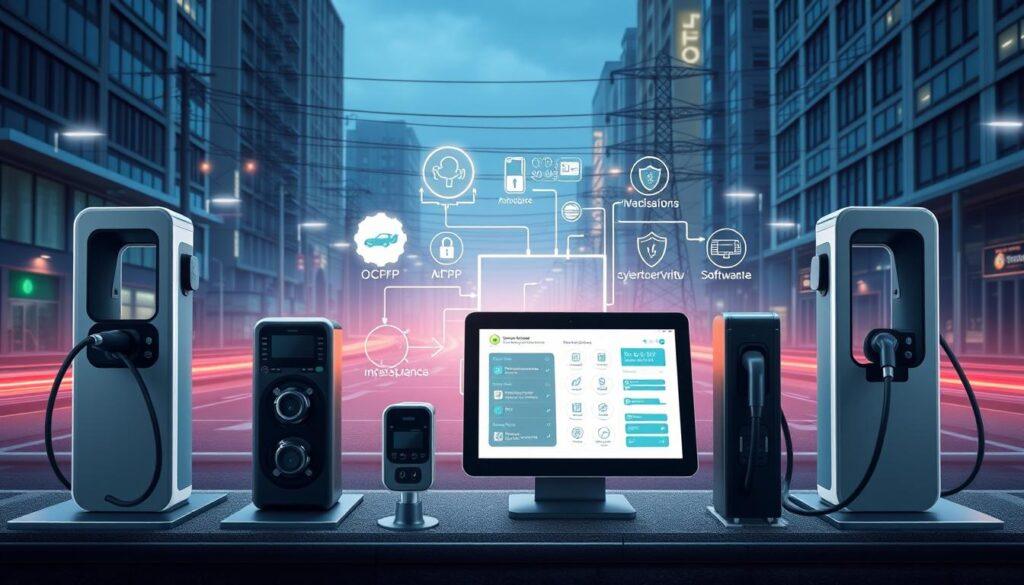
Chargers
Chargers vary greatly in quality. You can find cheap ones that break quickly or expensive ones that last long. Quality matters a lot in charging systems.
When picking a charger, consider these key points:
- Durability: Look for chargers built to withstand the weather.
- Uptime: Choose ones that rarely break down.
- Power delivery: Make sure they deliver power consistently.
- Future-proofing: Pick chargers that can grow with technology.
Here’s a comparison of charger types based on industry data:
| Feature | Budget Tier ($3,000-5,000) | Mid Tier ($6,000-9,000) | Premium Tier ($10,000-15,000+) |
|---|---|---|---|
| Warranty Period | 1-2 years | 3-4 years | 5+ years |
| Mean Time Between Failures | 6-12 months | 18-24 months | 36+ months |
| OCPP Compliance | Basic 1.6J | Full 1.6J & 2.0.1 | Full 2.0.1 + Future-ready |
| Network Connectivity | 4G only | 4G + Ethernet | 5G + Ethernet + WiFi |
OCPP
OCPP is the key to avoiding vendor lock-in. It’s a universal language for chargers to talk to management systems. It ensures all systems work together smoothly.
The latest OCPP 2.0.1 brings big improvements:
- Enhanced security that keeps hackers out
- Smart charging that helps manage the grid
- Better diagnostics that tell you what’s wrong
- Architecture that adapts to new needs
Without OCPP, your charging system won’t work well. Make sure your hardware supports at least OCPP 1.6J. OCPP 2.0.1 is the best standard now.
Payments
People need to pay for charging. Payment systems have evolved a lot. They now offer many ways to pay, like mobile apps.
Modern payment systems should handle:
- Contactless card payments
- Mobile app payments with real-time billing
- Subscription plans for regular users
- Security standards like PCI DSS
The best payment systems are easy to use and secure. They should work without any hassle, even in bad weather.
Cybersecurity
Chargers can be a weak point for hackers. We need to protect not just money but also our charging network from attacks.
Key cybersecurity steps include:
- Regular updates and patches
- Encrypted data transmission
- Network segmentation to keep chargers safe
- Monitoring for unusual activity
A hacked charger can cause big problems. It could even join a botnet attack. The risks are high.
Building a good hardware and software stack is important. It’s about finding the right balance between cost, performance, and readiness for the future. Cutting corners can lead to more problems and costs later. Choose wisely for a reliable charging network.
Grid and Utility Coordination: The Art of Electrical Diplomacy
Dealing with utilities is like trying to win over a king who controls all the power. You need to bring your best ideas and hope they like them. It’s not always easy.
Getting the grid to work with you is a mix of engineering and diplomacy. You offer smart charging as a gift and share your analysis to show you’re ready. If you mess up, your project could take forever.
Interconnection: The Utility Tango
Applying for interconnection is like asking the king for permission to build. It’s a big deal. If they say yes, you’re good to go. But if they say no, you’re stuck.
The costs can vary a lot. Sometimes it’s affordable, other times it’s too expensive. The timeline is unpredictable. Knowing what the utility wants is key.
DR: Getting Paid to Not Use Power
Demand response programs are a win-win. Utilities pay you to use less power when it’s busy. It’s like getting a big discount for being smart about energy.
These programs turn your charging stations into helpers for the grid. You’re not just using power; you’re giving back. This can really help your relationship with the utility.
Load Management: The Art of Electron Juggling
Load management is for the pros. It’s like managing a busy bar where everyone gets their drink, but not all at once.
Good load management includes:
- Dynamic power allocation based on real-time usage
- Priority charging for premium customers or time-sensitive needs
- Scheduled charging during off-peak hours
- Temperature-based power adjustment for battery health
Adding distributed energy resources takes load management further. Solar panels, batteries, and vehicle-to-grid tech make your site a mini-power plant.
| Strategy | Cost Impact | Timeline Effect | Utility Reception |
|---|---|---|---|
| Basic Load Management | Low | Minimal | Generally Positive |
| Advanced DR Participation | Medium | 3-6 months | Very Positive |
| Full DER Integration | High | 6-12+ months | Case-by-Case |
| Microgrid Development | Very High | 12-24 months | Mixed to Negative |
The table shows that more advanced strategies lead to better relations but longer waits. Pick based on your project’s patience and budget.
Remember, utilities respect projects that understand grid limits. Showing up with solid load management plans and analysis shows you’re prepared. They might be tough, but they appreciate smart people.
Financials and Incentives: The Art of EV Charging Alchemy
Welcome to the financial circus where government grants, utility incentives, and market economics perform a delicate balancing act. In the EV charging world, money doesn’t just grow on trees—it requires strategic planning, incentive stacking, and a dash of financial wizardry.
Think of it as a three-legged stool: federal funding provides the foundation, utility programs offer stability, and creative revenue models deliver the profit. Get this balance wrong, and your charging business collapses faster than a crypto exchange.
NEVI: The Government’s Billion-Dollar Bet
The National Electric Vehicle Infrastructure program represents the largest transportation investment in history. With $5 billion allocated through 2026, NEVI aims to create a national charging network along highway corridors.
But here’s the catch: NEVI funding comes with more strings than a puppet show. Stations must meet rigorous reliability standards, provide 97% uptime, and support CCS connectors. The application process feels like preparing a tax return while riding a roller coaster.
Successful applicants typically receive 80% cost coverage for equipment and installation. The remaining 20% requires matching funds—perfect opportunity to layer additional incentives.
Utility Programs: The Silent Partners
While NEVI grabs headlines, utility programs often deliver the real financial magic. These initiatives vary wildly by region, creating a patchwork quilt of opportunities.
Most utilities offer “make-ready” programs covering significant portions of infrastructure costs. Some provide demand response payments for reducing load during peak times. Others offer special EV charging rates that make electricity cheaper than bottled water.
The smart money stacks these programs like a financial Jenga tower. Combine NEVI with utility incentives and local grants, and suddenly your 20% match becomes negative investment.
Revenue Models: Beyond Selling Electrons
Here’s the uncomfortable truth: selling electricity alone won’t make you rich. The profit margins resemble those of a lemonade stand in winter. Smart operators diversify revenue streams like a hedge fund manager.
Successful stations combine energy sales with premium amenities, advertising, and membership programs. Think of it as a convenience store that happens to sell electrons.
The real game-changer? Vehicle-to-grid (V2G) technology. This emerging capability turns EVs into mobile batteries that can sell power back to the grid during peak demand. It’s like finding out your car can moonlight as a power plant.
V2G represents the holy grail of revenue models—potentially generating more income from energy arbitrage than from actual charging. The technology remains complex, but the financial potential could revolutionize the entire economics of EV infrastructure.
| Revenue Source | Potential Margin | Implementation Complexity | Scalability |
|---|---|---|---|
| Energy Sales | 15-25% | Low | High |
| Session Fees | 20-40% | Medium | Medium |
| Advertising | 60-80% | Medium | Medium |
| Membership Programs | 30-50% | High | High |
| V2G Services | 40-200% | Very High | Low (Currently) |
The financial landscape for EV charging resembles a sophisticated puzzle. Master the pieces—NEVI funding, utility incentives, and diverse revenue models—and you might just strike gold. Miss the connections, and you’re left selling electrons at Walmart prices.
Remember: in the EV charging game, the real profit isn’t in the electricity—it’s in the financial engineering that surrounds it.
Operations and Uptime: The Service Economy Goes Electric
Building charging stations is like winning the Super Bowl. But keeping them running is a decade-long challenge. With 97% uptime, that means 263 hours of downtime per station each year. That’s over ten full days where your investment sits idle.
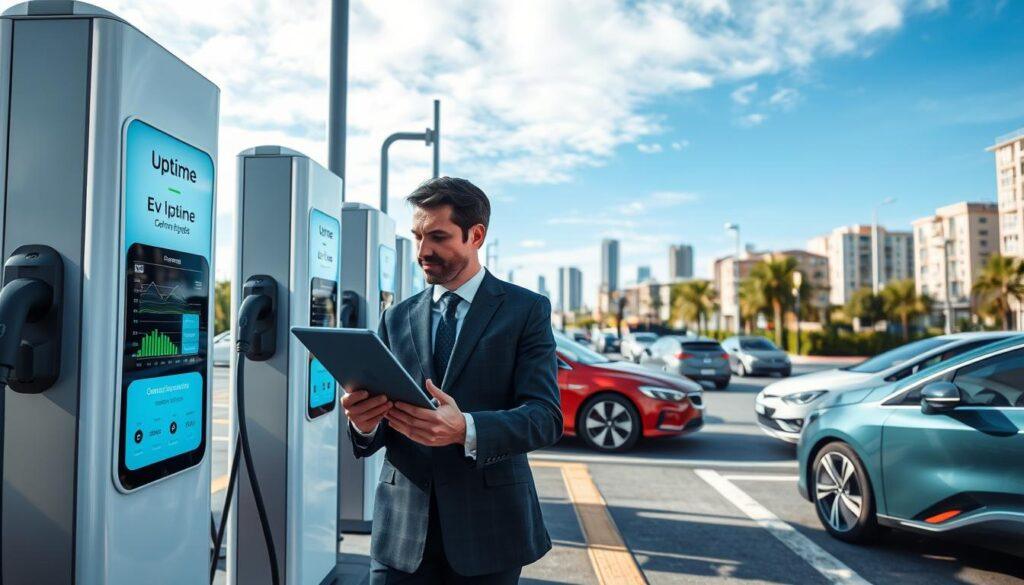
Operations isn’t just about avoiding failures. It’s about fixing them fast. Think of it as digital healthcare for your charging system. Every minute of downtime costs money and hurts user trust.
Remote Monitoring: Your Digital Central Nervous System
Remote monitoring systems are the heroes of EV infrastructure. They watch over everything, from power quality to payment processing. These systems are always on, catching issues before they affect users.
The best use predictive analytics to prevent problems. They can spot issues like connector failures weeks early. Power quality monitors also detect grid problems that could affect many stations. It’s like having a health forecast for your charging network.
Field Service: Technicians Don’t Grow on Trees
When something breaks, you need help fast. Field service logistics are key to success. The best networks have regional teams or local partners for quick responses.
Consider the math: a four-hour repair with a three-hour wait means seven hours lost. Smart operators geographically cluster their service teams to meet uptime SLAs that matter to customers.
Spare Parts: The Art of Strategic Hoarding
Spare parts management is a strategic game. Too much stock wastes capital, too little means lost revenue. The goal is to find the right balance.
- Critical components that fail most frequently (connectors, screens, payment readers)
- Regional depots for faster access
- Vendor agreements for emergency shipments
- Regular rotation of perishable components
The best operators treat spare parts as investments, not expenses. Having the right part nearby can make all the difference in meeting uptime goals.
In the EV charging world, operations is everything. Your network’s reputation depends on its reliability. That reliability is built one fixed station at a time.
Equity and Reliability Standards
Equity in EV charging isn’t about charity. It’s about avoiding the mistakes of the past. It’s about creating infrastructure that truly serves everyone. Businesses that get this are already leading the way.
Think about ADA requirements. Many see them as just rules to follow. But they’re about making sure everyone can use the stations. Proper signage, clear paths, and easy-to-reach charging cables are key.
Looking at charging access in different areas shows a big difference. Rich neighborhoods use stations a lot, while poorer ones don’t. This is because of how well stations are kept up.
Professional networks keep stations running 98% of the time. They use remote checks and have spare parts ready. Amateur efforts can only manage 70% uptime. This creates “charging deserts” where stations don’t work.
Smart businesses are making equity a key part of their strategy. They focus on serving whole communities, not just the rich. This approach brings more users, more money, and stronger support for growth.
| Standard Type | Amateur Operation | Professional Network |
|---|---|---|
| Uptime Guarantee | 70-80% (unmonitored) | 98%+ (remotely monitored) |
| ADA Compliance | Minimum requirements | Exceeds requirements |
| Maintenance Response | 72+ hours | 4-hour service guarantee |
| Community Engagement | None | Active partnerships |
The table shows how reliability is more than just tech. It’s about trust in the community. Stations that work well build trust, while failures erode it.
Businesses that focus on equity do better financially. Stations that are easy to use get more visitors. Reliable networks save on customer service costs. Happy communities support growth.
This isn’t just about being kind. It’s about being smart. The best charging networks will be those that combine tech skill with social responsibility. The rest will be lessons in business school.
KPIs and Reporting Framework
If you’re not tracking your EV charging performance, it’s like having an expensive decoration. Those sleek charging units might look great, but without the right KPIs, they’re just fancy decorations.
Utilization rates show if people use your charging stations. It’s like comparing a busy restaurant to an empty one with nice decor. Are your stations busy when it’s peak hours, or are they just sitting there unused?
Energy throughput shows how much power you’re moving. It’s not just about saving the planet; it’s about making money from your setup. Low throughput means you’re not making enough from your hardware.
Customer satisfaction is key for repeat business. Happy EV drivers come back and tell others. But unhappy drivers leave bad reviews that scare people away.
| KPI | Definition | Target Range | Business Impact |
|---|---|---|---|
| Utilization Rate | Percentage of time stations are actively charging | 15-25% | Direct revenue correlation |
| Energy Throughput | Total kWh delivered per station daily | 100-200 kWh | Determines operational profitability |
| Customer Satisfaction Score | User rating from charging sessions | 4.0-5.0 stars | Drives repeat usage and referrals |
| Average Session Duration | Typical charging time per vehicle | 45-75 minutes | Affects station turnover rate |
| Revenue per Session | Average income per charging event | $8-15 | Core financial performance metric |
Competitive analysis shows who’s leading the market. Your reporting framework should compare you to local stations. Are you beating them on price, availability, or user experience? This helps with pricing and marketing.
Energy consumption patterns show how efficient you are. They reveal peak usage times, seasonal changes, and charging habits. Smart operators use this to set better prices and encourage off-peak charging.
The best operators treat their KPIs like daily reviews. They know which metrics really matter and which just look good on reports. Your data should guide your decisions, not just decorate reports.
Creating a strong reporting framework means you’re not guessing about your performance. You’re making smart choices based on real data, customer feedback, and market position. That’s how you turn charging hardware into a successful business.
Case Studies and Checklists
Ever wonder what happens when grand theories meet real-world challenges? Let’s look at electric vehicle charging systems that actually work. We’re talking about real-world examples with valuable lessons.
Seattle’s plan is a dream for urban planners. They linked charging stations with public transit and mixed-use areas. This created a network that helps everyone.
Chicago took a different route. They focused on key areas and commercial spots. Their plan made charging easy in places people already go.
Both cities found something interesting. The best stations weren’t the fastest. They were the most convenient ones. Location is key.
Now, let’s get practical. Here’s a checklist for building infrastructure:
- Do a thorough site analysis before starting
- Work with local utilities early on
- Plan for growth from the start
- Use strong monitoring systems
- Have maintenance plans ready before opening
These examples show what leads to success. Good planning beats fancy tech. Getting the community involved is more important than speed.
The lessons from Seattle and Chicago are clear. Electric vehicle infrastructure is more than just tech. It’s about understanding people and cities.
To avoid being a cautionary tale, follow what works. Study successes in similar places. Then, adapt those lessons for your situation.
Remember: the best charging systems put people first, cars second. That’s the secret to success, not failure.
Careers and Certifications
The EV revolution is more than just about charging cars. It’s creating a new world where old trades meet new tech. It’s like the dot-com boom, but we’re building real, important infrastructure.
EVITP certification is the top choice for electricians in this field. It’s not your grandpa’s electrical work. EVITP covers power distribution and software integration. It shows who can really make EVs work.
Electricians without EVITP might watch from the sidelines. The field needs special skills, not just basic wiring. It involves grid integration, load management, and keeping systems safe from hackers.
Project managers in this field are like engineers, policy experts, and fortune tellers. They deal with utility connections, government incentives, and changing rules. It’s about setting up systems for our future cars.
This field offers great jobs that can’t be sent overseas. Every charging station needs local experts for setup and upkeep. For those who get certified and keep up, the EV industry offers solid careers with growth.