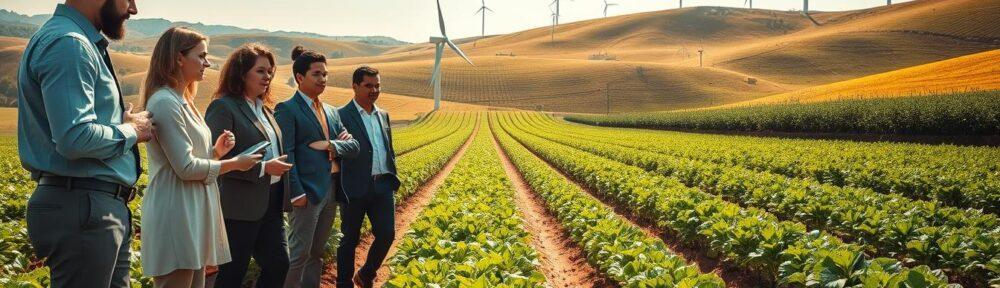
A big change is happening in how we grow food. Technology is teaming up with ways to make land healthy again. This mix is opening up meaningful and skilled careers.
This isn’t just a trend. It’s the future of farming. Reports show tech and green practices are changing the whole field.
New jobs are being created, not just in farming. Tech is connecting people to the earth. In fact, 38% of young folks are now interested in working in agriculture.
For business folks and entrepreneurs, this is a great chance. It links digital skills with tangible environmental impact. The future combines innovation, sustainability, and career growth.
Why Food Systems Are Critical for Climate
The way we manage our land and produce food is a big problem for the climate. The global food system, from farm to fork, is a huge cause of environmental change. It’s responsible for about a quarter of all greenhouse gas emissions worldwide.
This makes agriculture a key player in solving the climate problem, not just a victim. Conventional farming methods often make things worse. They use a lot of synthetic fertilizers, intensive tilling, and grow the same crops over and over.
These practices release carbon stored in the soil into the air. They also harm soil health, reduce biodiversity, and waste a lot of water. This cycle uses up resources and releases more emissions.
On the other hand, regenerative and tech-enabled farming works with nature. Practices like cover cropping, reduced tillage, and managed grazing help soils absorb carbon. This is called carbon sequestration. It turns farms into carbon sinks. Technology helps manage these practices well.
| System Aspect | Conventional Agriculture | Regenerative & Tech-Enabled Agriculture |
|---|---|---|
| Carbon Impact | Net source of emissions | Potential for net sequestration |
| Soil Health | Degrades over time | Improves and builds organic matter |
| Water Use | High, often inefficient | Optimized through data and soil management |
| Biodiversity | Low (monocultures) | High (diverse crops & ecosystems) |
| Economic Driver | Commodity yield alone | Yield plus ecosystem service markets (e.g., carbon credits) |
This shift creates real economic value. That value depends on trust and proof. This is where carbon farming MRV becomes essential. MRV stands for Measurement, Reporting, and Verification. It is the process that shows how much carbon a farm can pull from the air and store in the soil.
Without strong MRV, carbon credits and other ecosystem payments are not trustworthy. Sustainable Farm Managers are key in this fight. They work to reduce environmental impact. They use new tools for tracking carbon and soil health.
MRV makes environmental stewardship a proven asset. It links farm practices to global carbon markets. This creates a strong financial reason for farmers to use regenerative methods. The data shows the climate impact and helps farmers improve their operations.
In short, modern food systems are key for the climate because they offer a chance to cut emissions and remove carbon from the air. This makes jobs in this field more than just work. They are essential for solving the climate crisis.
Role Landscape: sensor/IOT techs, agronomists, data scientists, farm ops, field service
Agriculture has changed a lot. It’s no longer just about driving a tractor. Now, it’s a mix of technology, science, and hands-on work. This change has opened up many new career paths.
These careers fall into three main areas: Technologists, Scientists, and Operational Integrators. Each group is important in making farms work well and sustainably.
The Technologists: Data Gatherers and System Architects
These people handle the tech that makes farming precise. A Precision Agriculture Technician is a key example. They set up and keep sensors, drones, and GPS equipment working.
They need to know about electronics, mechanics, and coding. Another important role is in GIS and remote sensing. These experts make detailed field maps and analyze data to find hidden patterns.
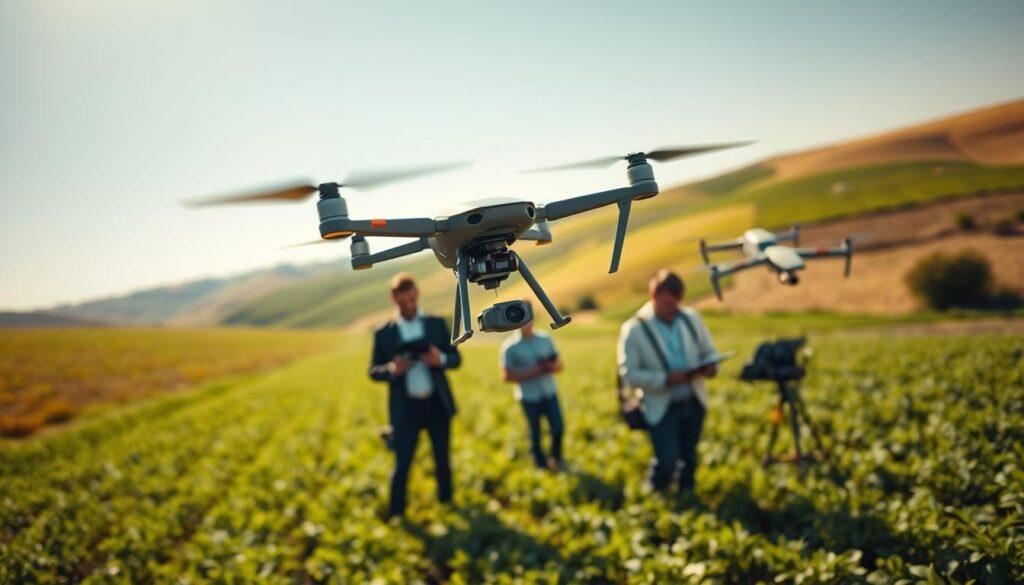
The Scientists focus on biology and chemistry. Agronomists and Soil Health Experts turn data into useful insights. They know a lot about plants, soil, and microbes.
A Sustainable Farm Manager uses this knowledge to make smart decisions. They use data to plan crop rotation, cover cropping, and organic amendments. Their goal is to increase yields and improve the land.
The Operational Integrators: Managers and Field Executors
These roles connect planning with action. Farm Operations Managers manage the daily tasks and people. Field Service Technicians carry out the plans.
They use the plans made by scientists and technologists. This could mean spraying a specific area or collecting soil samples based on digital maps.
Collaboration in Action: A Real-World Example
Working together is key. Imagine a GIS map showing a problem area. A Data Scientist or Agribusiness Analyst analyzes this data with sensor readings.
They share their findings with an Agronomist. The agronomist finds a nutrient issue and suggests a solution. Then, the Field Service Technician gets a task on a tablet. They use a drone or equipment to apply the fix only where needed.
This smooth process from data to action is what modern farming is all about. It needs a team with different skills working together for a common goal.
Tools: GIS/remote sensing, drone ops, farm mgmt software, soil labs
A new set of tools is changing how we farm. From satellites to soil sensors, these technologies help us follow regenerative agriculture. They give us the tools to see, think, and record our work.
For those working in agriculture, knowing these tools is key. They make the job possible.
GIS and remote sensing give us a view from above. They use images from space and planes to check on land health. They spot problems like water issues and pests early.
Platforms like Farmonaut help with crop monitoring. They send data on how crops are doing. This helps farmers make smart choices and save resources.
Drone Operations: High-Resolution Scouting
Drone operations add detail to satellite views. With special cameras, drones collect detailed data. They’re great for checking fields, irrigation, and plant health.
Drone pilots play a big role. They gather data that helps farmers make better decisions. For example, they can find where crops need more nutrients.
Farm Management Software: The Central Nervous System
All this data needs a place to live. Farm management software is that place. It combines data from many sources into one place.
The software helps with everything from managing supplies to planning. It’s the control center for farm operations. It turns different data into a clear plan.
Soil Labs: Ground-Truth Diagnostics
Even with digital tools, we need to check against real-world data. Soil labs do this. They analyze soil chemistry, biology, and carbon.
Soil lab results confirm what we see from above. They’re key for farms focused on soil health. They show how well the soil is doing and guide improvements.
Here’s how these tools help different farm roles:
- Data Scientist/Analyst: Uses GIS maps and satellite analytics to build predictive models.
- Agronomist: Interprets drone imagery and soil lab reports to prescribe treatments.
- Farm Operations Manager: Runs the entire workflow through farm management software.
- Field Service Technician: Uses GPS and data from drones to execute precise field tasks.
This toolkit creates a cycle of action and feedback. It measures, analyzes, and guides action. This cycle drives climate-smart, regenerative farming.
Regenerative Practices & Verification (MRV)
For carbon markets and sustainability certifications to work, every ton of sequestered carbon must be verified. This is where regenerative agriculture meets rigorous science. It’s no longer enough to simply adopt better practices. Farmers and land managers must now prove their environmental impact.
Regenerative agriculture aims to restore soil health, biodiversity, and watersheds. It turns farms into active carbon sinks. The core philosophy is to work with natural systems, not against them.
Several key practices form the foundation of this approach:
- Cover Cropping: Planting crops like clover or rye during off-seasons protects soil from erosion. It also adds organic matter and fixes nitrogen naturally.
- Reduced or No-Till: Minimizing soil disturbance preserves its structure and microbial life. This significantly reduces carbon loss and improves water retention.
- Managed Grazing: Rotating livestock through pastures mimics natural herd movements. It stimulates plant growth and promotes even manure distribution, enriching soil fertility.
These methods offer clear ecological benefits. They boost soil organic matter, increase biodiversity, and improve water cycles. Yet, their transformative power for climate change hinges on one critical element: credible measurement.
Enter MRV—Monitoring, Reporting, and Verification. This framework is the backbone of credible carbon farming MRV and ecosystem service markets. It provides the trust and transparency needed for farmers to get paid for their stewardship.
MRV turns qualitative improvements into quantifiable data. Sustainable Farm Managers rely on this data to implement techniques and use carbon footprinting tools. The growing demand for sustainability certifications makes MRV expertise invaluable.
| MRV Pillar | Key Activities | Tools & Technologies | Outcome |
|---|---|---|---|
| Monitoring | Continuous data collection on soil carbon, crop health, and emissions. | Soil sensors, satellite imagery, drone surveys, on-farm IoT networks. | Raw, time-stamped data sets showing changes over time. |
| Reporting | Organizing data into standardized formats for carbon registries or certifiers. | Farm management software, carbon accounting platforms, GIS. | Formal reports that quantify carbon sequestration and other ecosystem benefits. |
| Verification | Independent, third-party audit of the reported data and methodologies. | Protocols from organizations like Verra or the Soil Carbon Initiative; auditor site visits. | Issuance of verified carbon credits or sustainability certification. |
Technology is the engine of modern MRV. Remote sensing and farm management software, covered earlier, are essential. They make continuous, cost-effective monitoring possible at scale.
This drive for verification is also creating novel hybrid systems. Agrivoltaics—combining solar energy production with agriculture—is a prime example. These dual-use systems require specialized oversight.
This is where the agrivoltaics technician role emerges. These professionals must understand both photovoltaic system maintenance and crop management. They ensure solar panels and plants coexist productively.
Ultimately, MRV professionalizes environmental stewardship. It moves regenerative agriculture from a philosophy to a verified, investable asset. The agrivoltaics technician symbolizes this new, tech-integrated future for farm operations.
Agrivoltaics: safety, O&M, vegetation mgmt jobs
Imagine a field where crops grow in the shade of solar panels. This is agrivoltaics, a mix of farming and tech. It’s not just about saving land. It’s creating new jobs that didn’t exist before.
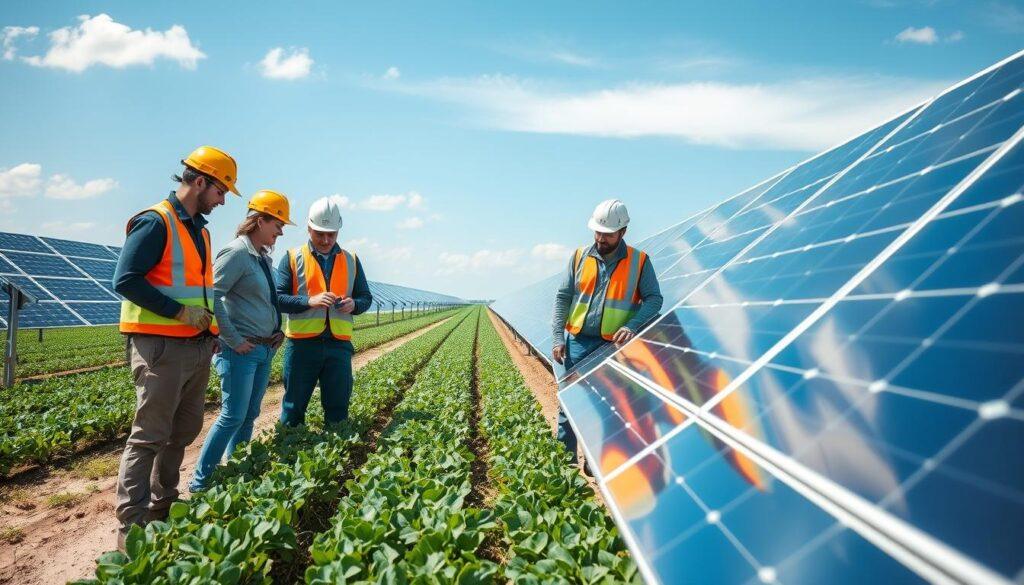
These jobs are not just for solar installers or farmers. An agrivoltaics technician needs to know both worlds. They must ensure safety in a place with high-voltage panels and moving farm equipment. They create rules to keep workers safe from electrical and farm dangers.
Operations and maintenance (O&M) is different here. Panels need to be clean and work well, but they’re surrounded by plants. Technicians check energy output and make sure panels don’t harm crops. They solve problems and adjust to new situations all the time.
Vegetation management is another new role. It’s not just about removing plants. It’s about choosing the right plants to help both solar panels and crops. They pick plants that help with energy and farming. They use data to make smart choices, improving both solar farm and land health.
This innovation links to controlled environment agriculture (CEA). Both use tech to grow food better. While CEA uses vertical farms, agrivoltaics uses outdoor space. Skills from one area can help in the other, opening up more career paths.
The growth of agrivoltaics shows we can find new jobs by solving big problems. For those who love tech and the outdoors, being an agrivoltaics technician is a chance to shape the future of food and energy.
Entry Paths: internships, farm fellowships, bootcamps
The world of controlled environment agriculture is looking for new talent. It offers hands-on training programs to get you started. You don’t need a family farm to begin. Today’s paths focus on building skills quickly and connecting you with innovators.
Starting with a degree in agriculture, biology, or engineering is a good start. But, the real learning happens outside the classroom. There are three main ways to start your career:
- Structured Internships with agribusinesses and tech firms.
- Immersive Farm Fellowships on regenerative operations.
- Accelerated Bootcamps for tech skills like data analytics or drone operations.
Corporate and Startup Internships give you a peek into AgriTech’s business side. Big names in farming and tech offer internships. You might work with data or help with marketing. Startups in robotics or bio-inputs offer diverse roles. Both paths boost your resume and network.
Farm Fellowships offer deep, hands-on learning. You’ll work with growers on soil, water, and crops. These are common on regenerative ranches and organic farms. For those interested in controlled environment agriculture, vertical farms or greenhouses are great places to learn.
Bootcamps and Certifications focus on quick skill-building. A coding bootcamp can lead to ag data science. Courses in drone operation or GIS mapping prepare you for the field. Certificates in Precision Ag or equipment repair are also valuable. They’re perfect for career changers who need to show specific skills.
The key to all paths is proactive engagement. Look for companies that interest you. Contact farms that use the methods you want to learn. The industry needs your enthusiasm and skills. Your first step is closer than you think.
Portfolio Ideas: yield maps, NDVI analyses, soil tests
Creating a portfolio is key to showing off your AgriTech skills. It turns you from a candidate to someone with real experience. Hiring managers love to see real projects that show your skills in action.
Choose projects that are clear, visual, and give actionable insights. Below are three great ideas for your portfolio, the tools you’ll need, and the skills you’ll show off.
| Project Type | Core Tools & Data Sources | Key Skills Demonstrated | Sample Output |
|---|---|---|---|
| Yield Prediction Map | Satellite imagery, AI analytics platforms, GIS software | Spatial analysis, data modeling, predictive analytics | A color-coded map forecasting harvest variability across fields |
| NDVI Health Analysis | Multispectral sensor data from satellites or drones, image processing software | Remote sensing, vegetation index interpretation, problem identification | A time-series map highlighting areas of crop stress or vigor |
| Soil Test Interpretation Suite | Lab soil reports, spreadsheets, geospatial data in GIS | Data synthesis, agronomic recommendation, nutrient management planning | A report linking soil pH, nutrient levels, and proposed amendment strategies |
Crafting a Yield Prediction Map
Begin with satellite data from USDA or Sentinel Hub. Use AI analytics to process yield data and vegetation indices. Your aim is to create a map showing high and low-yielding areas in a field.
This project shows you can transform data into a useful tool. It’s perfect for a Precision Ag Technician, who uses data to improve plant health and resource use.
Conducting an NDVI Analysis
NDVI is a key metric for plant health. For your portfolio, get multispectral imagery. Use free satellite data or drone data if available.
Make a map that shows healthy and stressed vegetation. Explain the reasons for stress, like water issues or pests. This shows your ability to assess field health remotely.
Interpreting Soil Test Results
Don’t just list numbers. Use soil test reports from agricultural services. Mix data like pH and nutrient levels into a visual dashboard or map with GIS.
Most importantly, offer practical advice. For example, suggest cover crops or lime based on the results. This shows your ability to make agronomic decisions, which employers value. For more on soil analysis, check out this guide on comprehensive soil analysis.
Remember, the tools are as important as the analysis. Clearly mention the software you used (e.g., QGIS, ArcGIS, DroneDeploy). Knowing specific GIS platforms or drones data processing is a valuable skill that makes your portfolio stand out.
Employers & Regions Hiring
Looking for a job in regenerative AgTech? Knowing where to find them is key. The job market spans from big tech companies to small family farms. Some places have more job openings than others.
Understanding where jobs are is your first step. This helps you focus your job search. Let’s look at the main types of employers leading this field.
There are many types of employers. Each has its own culture and goals.
- AgTech Corporations & Input Providers: Big names like John Deere, Bayer, and Nutrien make tools and products for farming. They need people for research, sales, and sustainability.
- Technology Startups & Software Firms: Companies like Indigo Ag, Farmers Business Network, and Arable create new tech for farming. They look for software experts, data scientists, and product managers.
- Farm Operations & Cooperatives: Big farms and co-ops need people to work on the ground. Jobs include farm managers, agronomists, and those who focus on sustainable farming.
- Research Institutions & NGOs: Places like universities and The Land Institute do important research. They offer jobs in science, education, and management.
- Government & Public Agencies: The USDA and state agriculture departments hire for jobs in soil health and climate-smart farming. These roles often involve policy, outreach, or technical help.
Where are these jobs? They’re mainly in certain areas. These places have a mix of farming and tech.
Key Geographic Hotspots in the United States
The table below shows areas with lots of AgTech and regenerative agriculture jobs.
| Region | Key States | Industry Focus | Sample Employers |
|---|---|---|---|
| California & Silicon Valley | CA | AgTech innovation, venture capital, specialty crops, carbon markets | Plenty, Pivot Bio, Driscoll’s, California Department of Food and Agriculture |
| The Midwest | IA, IL, NE, MN, IN | Row crop production, equipment manufacturing, bioenergy, supply chain logistics | John Deere (IL), Land O’Lakes (MN), Corteva (IA), The Nature Conservancy (Great Lakes programs) |
| Pacific Northwest | WA, OR | Sustainable forestry, precision horticulture, drone technology, cloud computing for ag | Microsoft (AgTech partnerships), Wilbur-Ellis, Forage (WA), Oregon State University Extension |
| Southwest & High Plains | TX, CO, KS | Water conservation tech, regenerative grazing, cattle operations, solar-agriculture integration | Valley Irrigation (NE), Mad Agriculture (CO), Texas A&M AgriLife Research |
| Northeast | NY, VT, PA | Organic farming, dairy innovation, urban agriculture, local food systems | Cornell University (NY), Stonyfield Organic (NH), USDA Agricultural Research Service (Northeast locations) |
This breakdown helps you know where to look for jobs. The Midwest is key for farming and business. California is a hub for tech startups. The Pacific Northwest combines tech with nature.
How do you find these jobs? Look beyond online job sites. Go to conferences and field days. Also, connect with local extension offices and farmer groups. Many jobs are found through who you know and your passion for regenerative farming.
Your dream job is where your skills meet the right employer and location. Research these areas and companies well. Aim your job search and networking at the places with the most growth.
Compensation & Seasonality
Getting into AgriTech and regenerative systems means understanding the job market well. Big names like John Deere and Bayer are hiring, along with startups like Indigo Ag and Pivot Bio. You can also find opportunities on large regenerative farms, where sustainability practices often extend beyond agriculture into everyday choices, such as using sustainable reusable water bottles to reduce waste in field operations and farm workplaces.
Places like the Midwest, California’s Central Valley, and major tech hubs are where jobs are plentiful. These regions play a key role in advancing modern agriculture and regenerative farming innovation.
Jobs pay differently based on your skills. For instance, Precision Ag Technicians make between $58,000 and $78,000 on average. Your salary can vary depending on experience, location, and role responsibilities. Data scientists and software developers can earn more, especially in technology-focused regions.
Some jobs have busy seasons, such as field work during planting and harvest periods. However, roles in data analysis, software support, and research remain steady throughout the year. The global growth of agribusiness continues to create stable career opportunities.
Working in AgriTech and regenerative systems is highly promising. It combines technical expertise with a passion for sustainable food systems. This fast-growing field needs people ready to help shape the future of farmin