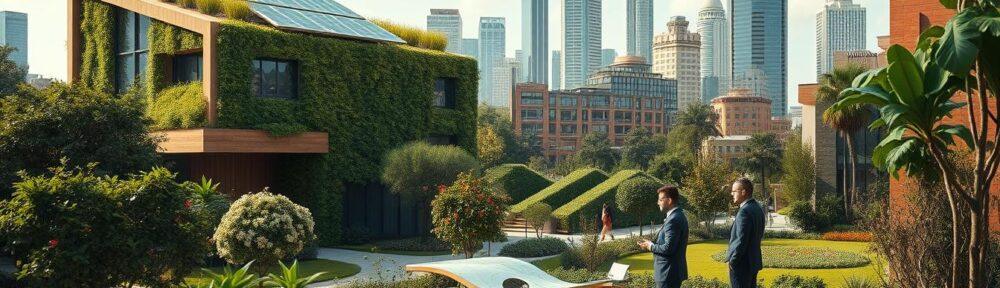
Let’s cut through the greenwash, shall we? Modern sustainability isn’t just about adding solar panels to big houses.
It’s a big change. Our world is a big problem for the climate. This movement has grown from a dream to a must-do in business.
It’s driven by money, rules, and people who get it. Green building is now mainstream. It’s not just a trend; it’s how we build now.
We’ve moved past just doing less harm. Now, we aim for buildings that are smart and care for people. They save energy and make us feel good.
This big change is explored in the evolution of sustainable architecture trends. It’s not just a belief; it’s creating a huge market overview and talent demand for new skills.
Forget the old days. This is about buildings that talk to the land. They start a conversation with it.
Top 10 Trends
Forget the boring checklists; the new architectural playbook reads like a sci-fi novel crossed with an environmental manifesto. We’re moving beyond simple green badges. This is a full-scale operating system update for the built world. Strap in. Here are the ten forces reshaping your skyline, your utility bill, and frankly, your conscience.
- The Holy Grail: Net-Zero Energy Buildings
This isn’t just about slapping on some solar panels and calling it a day. Net-zero is the endgame. Buildings are becoming their own power plants. Think biogas digesters turning cafeteria waste into electricity, or advanced geothermal systems tapping the earth’s constant temperature. The goal isn’t offsetting. It’s independence.
- Water-Wise Architecture: The Liquid Asset
In an era of “Day Zero” headlines, every drop is a currency. Modern design harvests rain, recycles greywater from showers and sinks, and uses landscaping that doesn’t beg for a hose. It’s a closed-loop system where a building drinks from the sky and purifies its own waste.
- Circular Construction: What’s Old is New Again
What if a building’s end-of-life was just its next chapter? Circular construction demolishes the “take-make-waste” model. It designs for disassembly. Materials are chosen so they can be unbolted, not demolished, and fed back into the supply chain. It’s the ultimate revenge on the landfill.
- The Smart Building Brain Transplant
Our structures are getting an IQ boost via the Internet of Things (IoT) and AI. Sensors monitor everything from occupancy to air quality. Systems learn and adapt, predicting maintenance needs and optimizing energy use in real-time. Your building isn’t just smart; it’s becoming a predictive organism.
What’s a sustainable planet if the air inside makes us sick? Health metrics now rival energy stats. We’re weaving nature back in with biophilic design—living walls, abundant natural light, and materials that don’t off-gas toxins. Indoor Air Quality (IAQ) is the new VIP.
- The War on Embodied Carbon
Operational energy is only half the battle. The real stealth enemy is embodied carbon—the CO2 baked into making and transporting materials. The industry is now armed with Life Cycle Assessments (LCAs) to track this from cradle to grave. The mission? Design out the hidden footprint.
- Bio-based & Recycled Materials Take Center Stage
Concrete and steel are getting some fierce competition. Mass timber sequesters carbon. Mycelium insulation grows in a lab. Recycled plastic finds new life as cladding. It’s a material revolution that’s both high-tech and deeply natural.
- Passive Design & Resource Efficiency
Sometimes the smartest tech is no tech. Passive design uses a building’s orientation, shape, and materials to naturally heat, cool, and light itself. Think deep overhangs, thermal mass, and strategic window placement. It’s ancient wisdom, supercharged by modern simulation tools.
- The Solar Revolution: Every Surface a Power Plant
Solar is shedding its clunky panel image. Building-Integrated Photovoltaics (BIPV) turn entire facades, windows, and roofs into subtle power generators. It’s the ultimate fusion of form and function, pushing more projects toward that net zero finish line.
- Big Data, AI, and the Cloud
The cloud isn’t just for your photos. It’s for your building’s nervous system. Big Data analytics crunch information from thousands of structures, spotting patterns and optimizing performance across entire portfolios. It’s like crowdsourcing the perfect building algorithm.
So, there you have it. Ten threads weaving the new fabric of our environment. This isn’t a random list of top architectural trends of 2025. It’s an interconnected ecosystem. A water-wise design supports a green roof. Smart systems optimize solar intake. Circular principles supply healthy materials. It’s a symphony, not a solo. And it’s playing in a city near you.
Example Projects
Let’s move to the construction site where net-zero dreams come true. Theory is for books. Here, we see the results in the finished buildings.
These projects are living examples of green design. They show us what works and what we learn on the job.
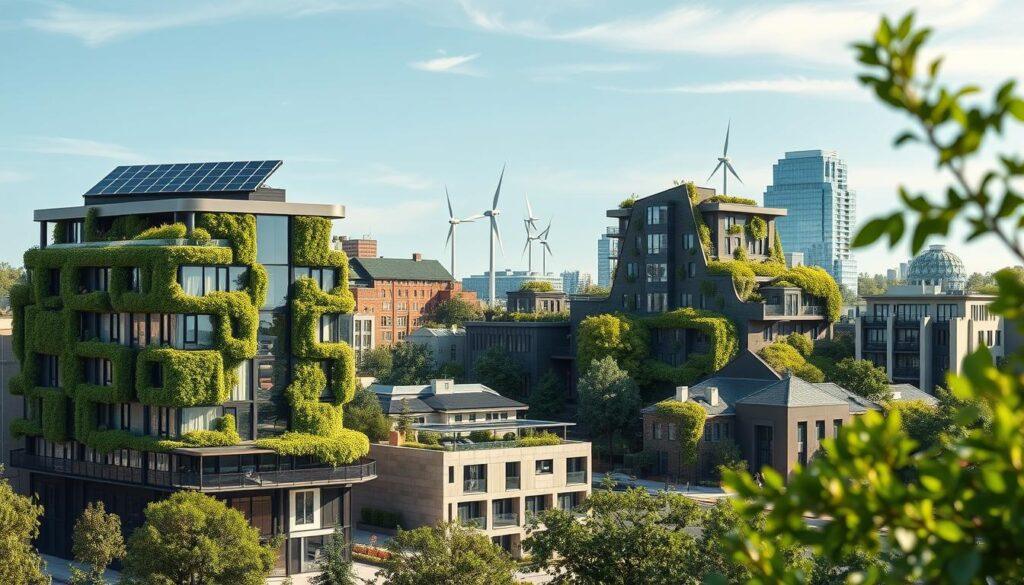
The VanDusen Botanical Garden Visitor Centre in Vancouver is a great example. It doesn’t just sit in a garden; it becomes part of it. Its roof collects rainwater, and it uses natural light.
This is biophilic green design in action. It cuts down on artificial lighting and HVAC needs. The result? A building that teaches as it works.
Now, let’s look at a Pune IT park. It uses an AI system to predict mechanical failures. This cuts down system downtime by 45%.
This isn’t just smart tech. It’s a big change from fixing things after they break. It saves energy and money right away.
In Tamil Nadu, a textile unit solved a big water problem. They used a Zero Liquid Discharge (ZLD) system. This saved them ₹1.2 crore a year.
This shows that caring for the environment and making money can go hand in hand.
In Canada, the idea is the same. The North Bay Regional Health Centre uses geothermal energy. The Exchange Tower and MaRS Discovery District in Toronto are also very energy-efficient.
TELUS Garden in Vancouver has a living wall and recovers rainwater. These projects are part of a growing net-zero network.
CarbonCure in Halifax has a great idea. They mix CO2 into concrete, trapping it forever. This turns concrete into a carbon hero.
So, what do these projects have in common? They all start with a plan that includes green design. It’s not just an extra feature. It’s the main plan.
They save money and help the planet. Lower costs, assets that last, and a healthier bottom line. The message is clear. Net-zero goals are smart business today.
These examples show us how to do it. Now, it’s time for the rest of the industry to start building.
Impacts on the Industry
When an industry built on concrete and steel must now consider carbon and conscience, a revolution starts. This isn’t just a small change; it’s a complete overhaul of the architecture and construction world. The old way of focusing only on cost is being replaced by a new focus on carbon accounting.
Regulatory pressure is playing a big role in this change. Green building codes are now mandatory, not just suggestions. For example, Canada is allowing taller mass timber buildings to encourage low-carbon construction. In India, following CPCB norms is essential for businesses.
This shift is creating a tough competitive landscape. Companies must now highlight their sustainability efforts. Clients want to know how a building will affect the planet and their budget in the future.
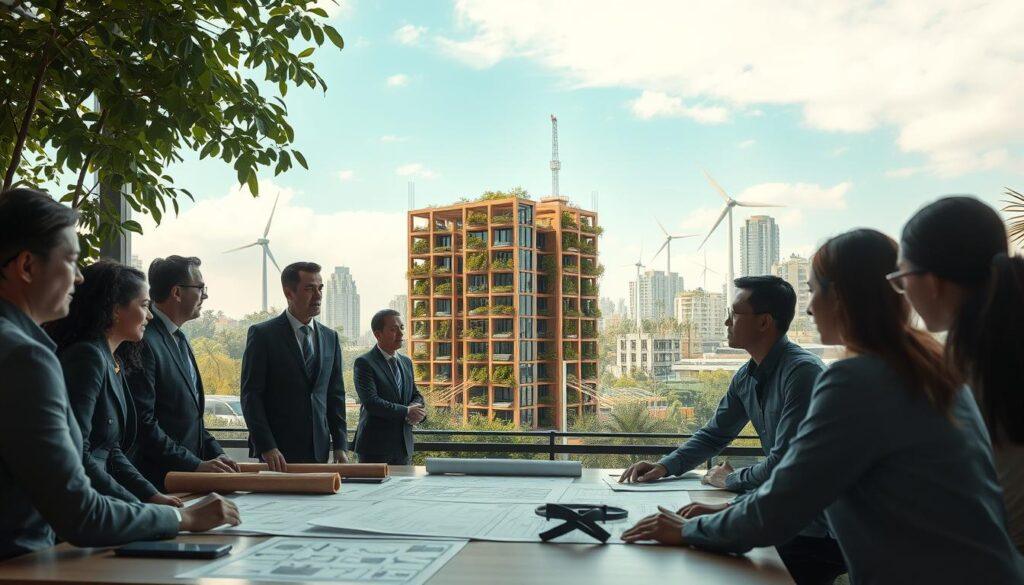
The skills needed in this new world are changing fast. Architects need to understand life cycle assessments and embodied carbon. Contractors must master prefabricated systems and airtight sealing. Developers are learning about ESG financing and green bonds.
This has led to a new group of specialists. We see carbon analysts, healthy materials detectives, and circular economy consultants. Companies like HECS are key partners, providing data that shows the benefits of green buildings.
The business case for green design is strong. There may be an initial cost, but the savings are real. Green buildings save 30–50% on utilities and have higher asset values. Adopting green design is not just right; it’s also smart financially.
The winners in this new world are those who adapt quickly. The losers are those who stick to old ways. The whole supply chain is changing, from draftspersons to CEOs.
This shift is more than a trend; it’s a major change. It’s making everyone think about the environment. For those embracing it, like those using circular economy principles, the future is both green and profitable.
Research & Career Insights
So, you’ve seen the future of construction, and it’s all about being green. Where does that leave you? The research world has moved beyond just proving sustainability exists. Now, it’s about measuring it with great detail.
Tools like the Embodied Carbon in Construction Calculator (EC3) turn vague promises into solid data. Life Cycle Assessments are the new blueprints, tracking a material’s impact from start to finish. The question has changed from “Is it green?” to “How green is it?” across all 17 UN Sustainable Development Goals?
This data-driven approach is key for true net zero goals. For your career, old job titles are getting a green makeover. The most exciting roles blend different disciplines.
Think of architects who write AI for smart buildings or engineers debating mycelium versus concrete. New titles like Building Performance Analyst or Circular Economy Manager require skills from multiple areas.
Educational paths are changing quickly. Specialized master’s degrees are valuable, but so is ongoing learning. Knowing about codes like the Toronto Green Standard is essential. Staying up-to-date in this field is vital for your career.
The most exciting architecture trends are now based on carbon data and circular logic.