
Remember when electric cars were seen as just for the rich? That time is over. Now, global sales have hit 17 million units in 2024. Next year, they’re expected to reach 20 million, making up a quarter of all cars sold.
In America, we’re catching up, but China is way ahead. They’re selling over half of their cars as electric. They’re not just adopting electric cars; they’re leading the way.
This shift isn’t just about new cars. It’s about the whole environmental impact. The key factor is Lifecycle emissions, from making to recycling.
We’ll explore what this big change means for your business, daily drive, and the planet. Knowing EV adoption trends is key to staying ahead of the game.
Why EVs Matter for Climate and Business
Remember when we used to debate between paper and plastic? Electric vehicles have changed that. Now, we’re seeing real change. The shift to electric is the biggest energy change in history.
Global EV adoption has cut oil use by over 1 million barrels a day in 2024. This makes OPEC meetings more interesting and environmental reports less sad. Norway’s oil use has dropped 12% from 2021, showing people choose better options.
For businesses, it’s not just about saving the polar bears. It’s about saving money from oil price swings and rules. The numbers show it’s smarter to switch to electric.
Here are some key benefits:
- Cost predictability: Electricity prices don’t jump like oil does
- Regulatory foresight: Governments are pushing for electric cars
- Consumer preference: 67% of businesses see a positive brand boost from going green
- Operational efficiency: Electric cars need less upkeep and are simpler
The case for EVs has grown from just being good for the planet to being smart for business. Early adopters are gaining an edge, while others are playing catch-up.
This shift is more than just saving the planet. It’s about making operations strong against energy price changes and changing customer wants. Companies that get this are not just going green. They’re making smart choices.
Market Snapshot 2025 (Adoption, Price Parity, Model Availability)
The 2025 EV market is changing fast, with China leading the way. While American car makers are celebrating double-digit adoption, the world is seeing a bigger change. China’s EV market is growing at an incredible rate.
Adoption
China’s EV market is growing fast, while the US is moving slower. In 2024, nearly 50% of new car sales in China were electric. This is much higher than the US’s 10%.
The EV adoption gap is big, not just in numbers. It’s about infrastructure and cultural changes. China built many charging stations quickly, while the US is debating which plug to use.
Price Parity
By 2025, compact EVs will cost the same as gas cars. The TCO for electric cars is already better for most drivers. Now, the upfront cost is also the same.
This is real price parity, not just after incentives. It changes how we buy cars, from fleets to family sedans.
Model Availability
Remember when EV models were few? Those days are over. In 2024, the US saw 24 new EV models.
Now, there are over 110 models in the US. This includes everything from electric pickups to affordable compacts. The selection is vast, matching what consumers want.
The market is mature, not just coming. The question now is which of the many options is right for you.
Battery Tech Roadmap (LFP vs NMC, Solid-State, Sodium-Ion, Second-Life, Recycling)
Batteries are like the lead guitarist and roadies in electric vehicles. They do the flashy work and handle the gritty logistics. The evolution of battery technology is like a chemical revolution, similar to discovering baking soda and vinegar.
Prices have dropped from $1000/kWh in 2010 to $210-230/kWh today. Reaching $100/kWh would make EVs unstoppable. Now, raw material costs are key, making innovation essential.
LFP vs NMC
LFP (lithium iron phosphate) batteries are like the reliable tortoise. They’re stable and cobalt-free. NMC (nickel manganese cobalt) batteries are like the flashy hare. They pack more energy but need careful handling.
Choosing between LFP and NMC depends on your needs. LFP is great for longevity and thermal stability in standard-range vehicles. NMC offers high performance for luxury EVs.
Solid-State
Solid-state batteries are the holy grail of battery tech. They replace liquid electrolytes with solid materials. This promises higher energy density, faster charging, and safety.
China is rapidly growing its solid-state technology manufacturing. When they hit mainstream production, they could change everything from smartphone battery life to electric aviation. It’s like waiting for Godot, but this Godot might actually arrive.
Sodium-Ion
Sodium-ion technology uses something more abundant than lithium – like table salt. It’s the dark horse candidate that could make energy storage affordable worldwide.
Sodium-ion batteries are less energy-dense but use cheaper materials. They’re great for stationary storage where cost matters more than weight. It’s like switching from champagne to prosecco – it gets the job done without the high price.
Second-Life
EV batteries don’t just disappear when they retire. They get second careers that would make any Hollywood comeback story proud. When batteries drop below 70-80% capacity, they’re valuable for less demanding uses.
Second-life batteries are finding new homes in:
- Grid storage systems
- Backup power for commercial buildings
- Renewable energy smoothing
- Remote power applications
It’s the circular economy in action, giving batteries retirement plans better than most millennials will ever see.
Recycling
Recycling is now both environmentally virtuous and economically inevitable. As raw material costs dominate battery pricing, recovering valuable metals makes financial sense.
Modern recycling can recover over 95% of critical materials like lithium, cobalt, and nickel. The industry is moving toward closed-loop systems where today’s EV batteries become tomorrow’s through recycling.
| Battery Type | Energy Density | Cost Projection | Best Application |
|---|---|---|---|
| LFP | Moderate | $$ | Standard range vehicles, storage |
| NMC | High | $$$ | Performance vehicles, luxury EVs |
| Solid-State | Very High | $$$$ (initially) | Premium vehicles, aviation |
| Sodium-Ion | Lower | $ | Stationary storage, low-cost vehicles |
The battery technology landscape isn’t about finding one perfect solution. It’s about having the right tool for the right job. Whether it’s maximum range, safety, or affordability, diversity in battery chemistry is key.
Charging Ecosystem: Where Rubber Meets Reality
Let’s talk about the moment of truth in EV ownership – the charging ecosystem. It’s not just about plugging in. It’s about navigating a landscape where technology, standards, and reliability collide. Think of it as the difference between finding a reliable coffee shop versus settling for instant granules.
Globally, we’re seeing explosive growth with over 600,000 public charging points by 2023’s end. China dominates with 320,000 stations, but here’s the kicker: only 20% are fast chargers. The rest? They’re the slow-and-steady types that make tortoises look impatient.
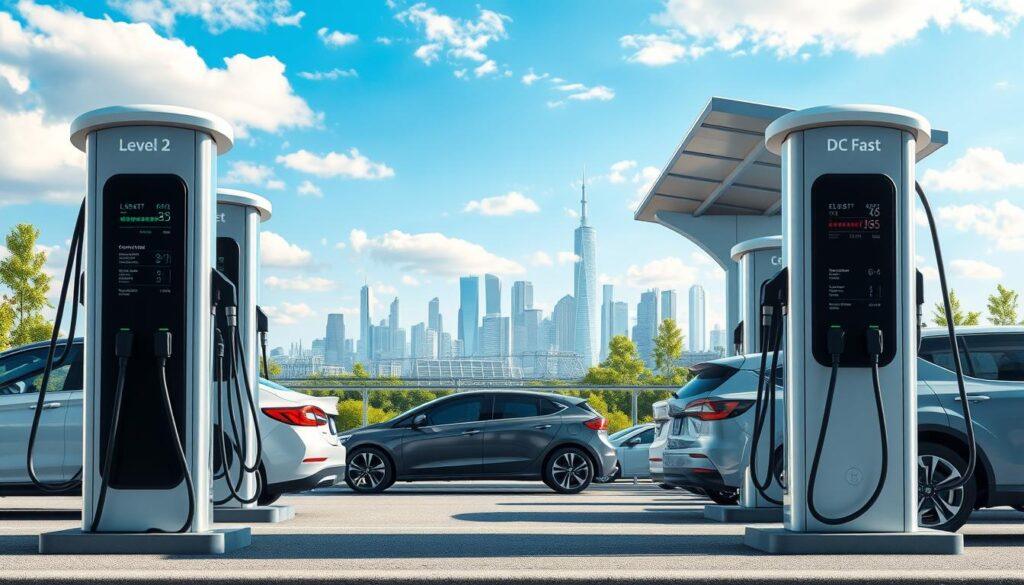
Level 2 vs DC Fast: The Tortoise and The Hare
Level 2 charging is your reliable dinner date – it takes time but delivers satisfaction. We’re talking 4-10 hours for a full charge, perfect for overnight sessions or workplace parking. It’s the comfortable sweater of EV charging.
DC Fast charging? That’s your speed-dating experience. 20-30 minutes for 80% charge, perfect for road trips and emergency top-ups. But like speed dating, sometimes you get rejected by incompatible connectors or temperamental equipment.
Standards: The Format Wars Redux
Remember Beta vs VHS? That was child’s play compared to NACS vs CCS. North American Charging Standard (NACS) and Combined Charging System (CCS) are battling for supremacy like two tech giants in a high-stakes game of thrones.
NACS (Tesla’s standard) is gaining momentum with Ford, GM, and others jumping ship. CCS remains the established player with broader European support. It’s the Apple vs Android of EV charging – both work, but your choice depends on your ecosystem loyalty.
Uptime: The Reliability Revolution
Nothing kills EV adoption faster than broken chargers. Uptime isn’t just a metric; it’s the difference between adoption and abandonment. Imagine pulling up to a gas station where 30% of pumps are permanently out of order – that’s the current reality for many EV drivers.
Network operators are realizing that reliability matters more than density. Because what good is a charging station every mile if none of them work when you need them?
OCPP: The Universal Translator
Open Charge Point Protocol (OCPP) might sound like bureaucratic alphabet soup, but it’s actually the secret sauce making charging networks communicate. Think of it as the UN translator for EV infrastructure – allowing different systems to talk without needing marriage counseling.
This open standard enables interoperability between charging stations and management systems. It’s why you can (theoretically) use one app across multiple networks instead of carrying seventeen different membership cards.
| Charging Type | Power Output | Time for Full Charge | Best Use Case |
|---|---|---|---|
| Level 1 (AC) | 1-1.8 kW | 40-50 hours | Emergency backup |
| Level 2 (AC) | 7-19 kW | 4-10 hours | Home/work charging |
| DC Fast Charging | 50-350 kW | 20-45 minutes | Road trips & quick top-ups |
Choosing between charging types isn’t about superiority – it’s about context. Your fast charging needs on a cross-country trip differ dramatically from your daily commuting pattern.
The future isn’t about one standard dominating another. It’s about creating an ecosystem where different solutions coexist peacefully – much like how both coffee shops and instant coffee survive in our caffeine-addicted world.
Grid Integration: When Your EV Starts Paying Rent
The way we talk about EVs has changed. We’re no longer just worried about powering them. Now, we see them as a source of power. It’s like your car can help with household chores.
By 2030, EVs will need more electricity than ever before. We need smart systems that manage charging. This way, charging won’t break the bank.
Load Management: Because Blackouts Are So 2003
Load management is all about saving money. Smart systems check the grid and prices in real-time. They charge your car when it’s cheapest.
These systems are smarter than dating apps. They look at your driving habits and the grid’s needs. You save money and help the grid stay stable.
Solar panels are like superstar athletes. Add battery storage, and you have a 24/7 power source. EVs can store solar energy during the day.
This combo makes solar energy work all day. Your EV stores energy when it’s cheap. Then, it uses it when it’s expensive. It’s a smart financial move.
Microgrids: The Neighborhood Watch for Electricity
Microgrids are like energy communities. They can work on their own, even when the main grid fails. They have their own power and backup systems.
When storms hit, microgrids keep the lights on. EVs in these systems can power important places. Hospitals and Starbucks can stay open during outages.
V2G/V2B: Your Car as a Mobile Power Bank
V2G technology makes your EV a two-way energy device. It sends power back to the grid when needed. It’s like your car has a part-time job.
V2G systems pay EV owners for their energy. Utilities save money, and everyone wins. The fossil fuel industry loses.
V2G technology turns EVs into grid resources. Office parks and shopping centers can power themselves. The possibilities are endless.
| Technology | Primary Function | Cost Savings | Grid Benefit |
|---|---|---|---|
| Smart Charging | Time-based load shifting | 30-50% charging cost reduction | Peak demand reduction |
| Solar+Storage | Renewable energy optimization | 60-80% energy cost savings | Grid stabilization |
| Microgrids | Localized energy independence | Outage cost avoidance | Grid resilience |
| V2G Technology | Bidirectional energy flow | Revenue generation | Peak shaving |
The future of grid integration is about using what we have wisely. With V2G systems, we’re not just charging cars. We’re building a better, more efficient energy system.
TCO and Procurement: Where Math Meets Motivation
Let’s dive into the financial side of fleet electrification. The upfront costs might seem high, but the long-term savings are worth it. This makes the procurement process very interesting.
CapEx/OpEx: The Tale of Two Wallets
Electric vehicles play a financial game. The initial costs might worry your accountant, but the ongoing expenses are more appealing.
Battery prices need to hit $100/kWh for electric vehicles to be cost-effective. We’re getting closer to this goal every quarter. Also, maintenance costs are dropping fast.
No more oil changes are needed. Electric cars have fewer parts, making them easier to maintain. It’s like switching from a mechanical watch to a digital one – less upkeep, same timekeeping.
Incentives: The Government’s Sweet Serenade
The IRA is more than just history class. It offers IRA incentives that can really help businesses.
The US Clean Vehicle Tax Credit can give up to $7,500 right away. Plus, 27 states offer extra incentives. It’s like finding discounts for your entire shopping list.
Leasing Models: The Subscription Revolution
Nearly half of US EVs sold in 2024 were leased. Why? It’s because technology changes fast, like your morning coffee getting cold.
Leasing lets you get new cars as technology improves. It’s like having the latest smartphone without buyer’s remorse. You always have the newest features.
| Cost Factor | ICE Vehicles | Electric Vehicles | Advantage |
|---|---|---|---|
| Fuel/Mile | $0.12-0.15 | $0.03-0.05 | 75% savings |
| Maintenance/Year | $1,200-1,800 | $600-900 | 50% reduction |
| Incentives Available | Limited | Federal + State | Up to $15,000 |
Your fleet electrification strategy needs careful financial analysis. The numbers are clear – they just need the right interpretation.
Policy and Compliance Landscape
Navigating EV policy is like playing chess with a master who keeps changing the rules. You think you know the game, but then new rules are added.
The EU’s CO2 standards are tough, like a sauna. These rules are not just suggestions. They are strict, with big fines for not meeting them.
In the US, the Clean Vehicle Tax Credit changes fast. The rules are tricky, making it hard to know if you qualify.
China’s dual-credit system is strict. It’s not just a suggestion to go electric. It’s a must for car makers.
Import tariffs in the US change often, affecting Chinese car makers. What’s free one day might cost a lot the next. This makes planning hard.
ZEV declarations are spreading fast, from California to the world. These rules affect car makers everywhere.
Compliance is complex, like a UN diplomat’s job. One mistake can cost a lot. Companies need to be very careful.
To succeed, companies must understand policy changes quickly. They need to be as smart about rules as they are about new car tech.
Fleet Transition Playbook
Switching to electric vehicles isn’t like updating your phone. It takes careful planning, like a chess master’s first move. Here’s a four-phase plan to help you succeed in fleet electrification.

Assess
Before buying EVs, understand your current operations well. This isn’t about guessing. It’s about making data-driven decisions.
Start with these key assessments:
- Vehicle usage patterns: Track mileage, idle times, and route types
- Charging infrastructure audit: Check existing facilities and power capacity
- Total cost analysis: Compare current costs to EV expenses
- Driver readiness: See how your team feels about change
Choosing the right vehicles for your routes is key to fleet oil displacement with EVs.
Pilot
Think of your pilot program as a first date with EVs. Start with 2-3 vehicles that match your common use cases.
Real-world data is essential for proving cost savings. Track everything:
- Charging behavior and patterns
- Maintenance requirements and costs
- Driver feedback and acceptance
- Actual energy consumption vs. estimates
This phase is where theory meets reality. It’s where you’ll find out charging infrastructure is critical.
Scale
Scaling your fleet electrification is like coordinating a Broadway musical. You’ve proven the concept – now it’s time to build the orchestra.
Key scaling considerations include:
- Phased vehicle replacement schedule
- Charging infrastructure expansion timeline
- Utility coordination for power upgrades
- Spare parts and maintenance training programs
This isn’t about buying more vehicles. It’s about building an ecosystem for electric mobility at scale.
Train
Your mechanics might need to learn more about software than wrenches. Your drivers need to understand regen braking. Training is an investment that prevents costly mistakes.
Essential training components include:
- EV-specific maintenance procedures
- Charging equipment operation and safety
- Driver efficiency techniques
- Software management systems training
Proper training turns apprehension into excitement. It transforms your team into electric mobility champions.
Fleet electrification isn’t a trend. It’s a financial imperative. Companies that master this playbook will lead the transition. Others will watch from the rearview mirror.
Careers and Skills Outlook
If your resume doesn’t mention “battery whisperer” or “charging infrastructure guru,” it’s time to update it. The EV revolution is creating more jobs than Detroit did in its prime. But these jobs need coding skills more than they need hands-on experience.
Battery production is now the main focus. Companies are looking for battery technicians who know electrochemistry inside out. These jobs pay more than traditional auto mechanics could ever dream of.
Installing charging infrastructure is creating jobs at an incredible rate. Electricians who know about smart grid integration are in high demand. They earn more than plumbers, making them the stars of the trade.
Software skills are now essential in automotive jobs. Mechanical engineers who can’t code are like blacksmiths in today’s world. The industry needs people who know both Python and how engines work.
The shift to new skills is happening quickly. Old automotive training programs are struggling to keep up. Tech bootcamps, on the other hand, are adding EV modules fast.
Stay updated or risk becoming outdated quickly. The EV job market values continuous learning. Those who don’t adapt will be as useful as a carburetor in a battery-electric car.
Case Studies and Lessons Learned
Imagine the world’s top EV success stories as thrilling tales, not just tech guides. Norway made gas cars expensive, while China turned EV making into a huge race.
Norway’s 88% EV rate isn’t just about loving nature. They made gas cars costly and used their water power. This cut oil use sharply.
China took a different path: making EVs on a massive scale. They showed that making lots of EVs lowers prices and boosts sales.
In America, creative leasing deals moved more cars than ads ever could. New markets are jumping over traditional setup steps.
The key takeaway? Lifecycle emissions are more important than just the cost. Norway’s clean energy makes EVs truly green. But places relying on coal face a harder challenge.
Every country’s EV journey is unique. Success depends on timing, setup, and understanding lifecycle emissions.
Risks and Mitigation
Before jumping into the electric revolution, remember this: every new technology has risks. The EV transition isn’t just about switching to charging stations. It’s about avoiding pitfalls that could leave your business stuck.
Supply chain vulnerabilities are a big issue. Your electric fleet could be affected by global tensions or lithium shortages. To avoid this, spread out your suppliers like you would with investments.
The charging infrastructure reliability is another problem. A broken charging station can kill EV enthusiasm fast. To fix this, have backup plans for charging like you’re preparing for the end of the world.
Policy uncertainty makes government incentives unreliable. Today’s tax credit might not exist tomorrow. So, don’t rely too much on these incentives.
Lastly, technological obsolescence is a big risk. What’s cutting-edge today might be outdated tomorrow. To avoid this, don’t put all your bets on one technology and stay flexible.
| Risk Category | Specific Risk | Impact Level | Mitigation Strategy |
|---|---|---|---|
| Supply Chain | Lithium shortage | High | Diversify suppliers across regions |
| Charging Infrastructure | Station reliability | Medium-High | Install backup charging options |
| Policy Environment | Incentive changes | Medium | Base decisions on fundamentals, not incentives |
| Technology | Battery obsolescence | Medium-High | Lease vehicles instead of buying |
The key to successful EV adoption is planning ahead. Prepare for the worst, hope for the best, and have backup plans. In the world of electric transport, change is certain, so be ready for it.
12-Month Action Plan and Tools
The EV market is growing fast, with a 25% increase expected in 2025. This is your last chance to get on board. Now, prices for electric cars are matching those of gas-powered ones, thanks to Tesla, Ford, and Rivian.
Start by checking your fleet in Months 1-3. See which cars can switch to electric first. Then, from Months 4-6, find partners for charging stations. You’ll need Level 2 for overnight and DC fast for long trips.
Use the time from Months 7-9 to grab any remaining incentives. Don’t wait too long, as they won’t last. From Months 10-12, start small pilot programs with more electric models.
There are tools available today. Use ChargePoint and Electrify America for charging networks. Geotab helps with fleet analytics. Your excuses are running out, just like old smartphones.
This isn’t about being early. It’s about not being left behind. The electric car revolution is happening now, and you need to join in.