
Most of us start with good intentions when it comes to waste management. But, like New Year’s resolutions, these plans often end up in the trash.
Zero waste isn’t about being perfect. It’s about changing our habits with simple, effective principles.
Communities in San Francisco and small Italian towns have shown us what’s possible. They’ve moved from thinking “disposal” to “redesign.” The 5 R’s are more than just a catchy phrase; they’re a guide to living sustainably in a world filled with waste.
Refuse plastic straws like they’re bad dates. Reduce your use of things like you’re curating a minimalist art show. Reuse items with the creativity of MacGyver. Recycle as a responsible backup, and Rot (compost) because even food scraps deserve a better fate.
These principles are the base of zero waste principles & practices adopted globally. It’s not about getting rid of all trash. It’s about changing how we view and use things.
Urban Implementation
Imagine cities competing in a dystopian Olympics where the goal is to make the most landfill waste. By 2050, waste in cities will grow twice as fast as the population. No one wants to win this race.
But, cities are turning into perfect places for sustainable living tests. They have both problems and solutions all in one spot. This is where big changes happen.
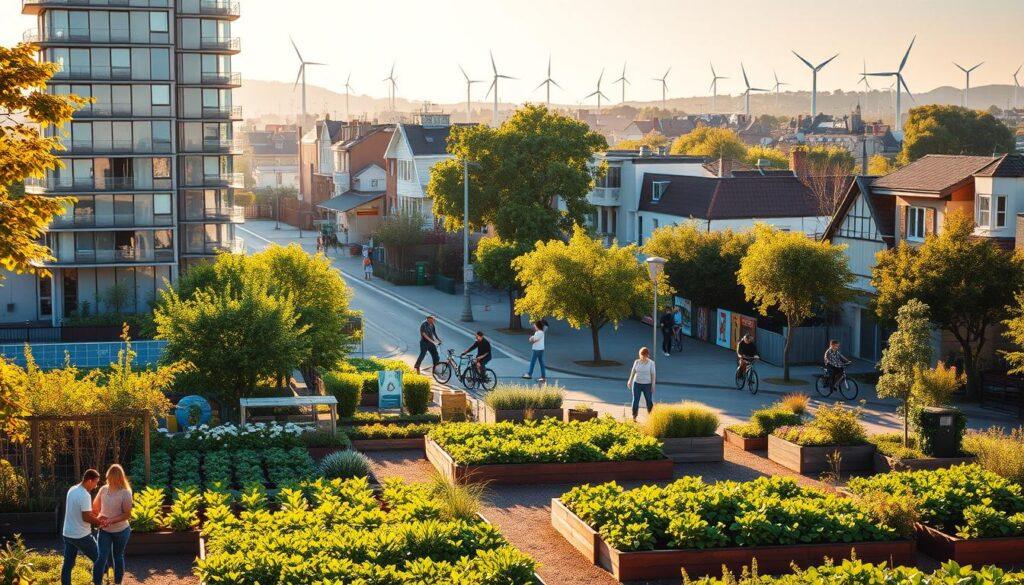
Food waste is a big issue. When it breaks down in landfills, it releases methane, a bad gas for the planet. But, cities like Wellington are changing this. They use curbside composting to turn waste into fertilizer for gardens.
Recycling in cities is as simple as ordering food online. Good recycling programs make it easy to do the right thing. They make sustainability a breeze.
Community events make recycling fun. Swap meets are like block parties, not chores. They help people connect and use less stuff.
Local businesses are leading the way in sustainability. They get rewards for composting and donating food. This builds trust with customers who care about the planet.
Cities like Vancouver show how zero waste goals can change a city. Their plans show that cities can make a big difference.
Here’s how different urban strategies compare to old ways of managing waste:
| Strategy | Traditional Approach | Zero Waste Model | Community Impact |
|---|---|---|---|
| Food Waste | Landfill disposal | Compost conversion | Creates community garden resources |
| Recycling | Single-stream mixed | Multi-stream sorted | Higher quality materials for reuse |
| Business Participation | Voluntary programs | Incentive-based systems | Economic benefits plus environmental |
| Public Education | Occasional campaigns | Integrated community events | Builds lasting behavioral change |
| Methane Capture | Limited implementation | Systematic extraction | Converts waste to energy |
The table shows that good urban strategies do more than just reduce waste. They make communities stronger and economies better.
Urban sustainable living is real and happening now. Cities are learning to see waste as resources, not garbage. The city is becoming a circular economy.
Challenges and Solutions
Urban waste management is more than just trash cans and recycling bins. It’s a battle between convenience and sustainability in our cities. Our cities face cultural habits, economic realities, and outdated infrastructure.
Let’s look at the main challenges:
- Cultural resistance: People prefer convenience over sustainability.
- Economic constraints: Small businesses find sustainability too expensive.
- Infrastructure limitations: Our waste systems are outdated.
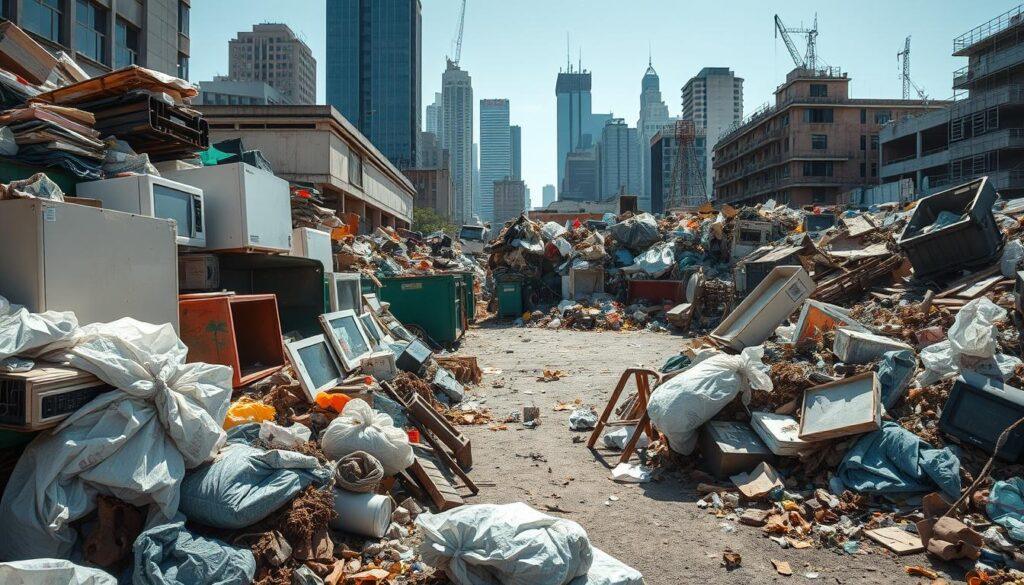
Electronic waste is another big problem. Old smartphones are full of toxic materials. Plastics also escape our systems, ending up in oceans.
Now, let’s talk about the solutions:
| Challenge | Solution | Impact Level |
|---|---|---|
| Cultural Habits | Behavioral nudges & education programs | High |
| Economic Barriers | Tax incentives & scalable infrastructure | Medium-High |
| E-waste Management | Manufacturer take-back programs | Critical |
| Plastic Pollution | Circular economy models | Transformative |
We need to make zero waste the norm, not a luxury. We should make sustainable choices easy. Educational programs can turn people into waste-warriors.
We should invest in recycling facilities like public utilities. Imagine if recycling got the same funding as football stadiums. That would be a big change.
Developing nations face big challenges with waste, but we can find global solutions. Smart policies can create jobs while cleaning our cities. We don’t need to be superheroes to make progress.
The goal is to make sustainable waste management automatic. We’re all tired of seeing our cities treated poorly.
Success Stories
While many cities see zero waste as a dream, some are already living it. These aren’t just ideas or tests. They’re real examples that show change is possible when we value trash.
Capannori, Italy, is a great example. Officials saw trash as a resource, not a problem. They achieved a 40% reduction in waste through recycling and composting. They completely changed their waste system.
San Francisco aims to be waste-free by 2030. They see landfills as outdated. Their secret is mandatory composting and recycling for everyone.
Christchurch, New Zealand, focuses on community. They built programs that feel like neighborhood projects. This shows that people want to help when it feels like a team effort.
These cities show different ways to succeed:
- Capannori shows the power of redesigning systems
- San Francisco proves policy can drive change
- Christchurch shows community efforts can work
These cities understand that zero waste is about making progress, not being perfect. They’ve moved from talking to doing. They show that changing culture comes before changing infrastructure.
The key lesson from these cities? Zero waste is more than an idea. It’s a reality when communities work together. They’ve turned waste management into a chance for growth. This might be their greatest achievement.
Policy Support
Let’s face it, sustainable living needs more than just good intentions. It’s like expecting politicians to stop fundraising – it’s not realistic. Policy is key to making big changes.
New Zealand’s Waste Minimization Act of 2008 made landfilling as old as dial-up internet. It wasn’t just about rules. It was about making sustainable choices easy.
Good policy means recycling is the norm, not just an extra effort. It’s about tax breaks that make green living smart business. It’s about governments and innovators working together to reduce waste.
Without strong policies, sustainable living is just a hobby for a few. Policy turns it into a reality for everyone. It’s the difference between hoping for change and making it happen.
The hard truth is, voluntary efforts only go so far. Real change needs policy backing it up. When sustainable living is easy, cities really change.