
Let’s be honest – when you’re stuck in that middle seat, you might not think about eco-friendly flights. But, the aviation industry has been working hard on a comeback story.
I’ve been following this closely, like it’s the final season of your favorite show. The numbers are impressive. Over 360,000 commercial flights have used sustainable aviation fuel at 46 airports, mostly in the US and Europe.
The industry’s carbon emissions are 2% of global totals. But, they’re growing 3-4% each year. It’s like someone eating a salad then eating three bread baskets.
The goal of reaching net-zero by 2050 seems big. But, remember, we put humans on the moon. The real question is if we can make green flights happen fast enough.
SAF 101 (Feedstocks, Pathways, Certification)
Welcome to the world of sustainable aviation, where old waste becomes new fuel. It’s like Doc Brown’s DeLorean, but we use “hydroprocessed esters and fatty acids” instead of banana peels. Turning waste into fuel is a remarkable achievement in aviation.
Feedstocks
The ingredients for sustainable aviation fuel are quite unique. We use everything from municipal solid waste to fats and oils. Yellow grease, for example, might sound strange, but it’s safe for flying.
We also use jatropha, camelina, and algae. It’s amazing how we’ve turned waste into fuel. But, will future generations understand why we burned food waste to fly to sustainability conferences?
Pathways
The real magic happens in the conversion pathways. Here, science turns raw materials into fuel. Fischer-Tropsch synthesis, for instance, transforms biomass into syngas through thermal conversion.
The HEFA pathway breaks down triglycerides with great precision. ATJ converts cellulosic alcohol into fuel. And PtL uses renewable electricity to produce synthetic fuels.
Certification
The ASTM D7566 certification ensures only safe fuels are used. It sets standards for aviation turbine fuel, with blend limits from 10% to 50%.
Each pathway is tested to meet ASTM D7566 specs. This ensures they are as safe and effective as regular jet fuel. The certification process is strict, keeping pilots safe.
Currently, seven pathways are approved under ASTM D7566. Each has its own blend limits. The standard is constantly updated to reflect the latest in sustainable aviation fuels.
Electric and Hybrid Aircraft, eVTOL
Electric aircraft are changing the game in aviation. Imagine planes that are as quiet as a whisper. This is like switching from big gas-guzzlers to electric scooters for your commute.
Heart Aerospace found that electric motors cut maintenance costs by 90% compared to traditional turboprops. This means big savings and less pollution. But there’s more to the story.
eVTOL technology is like flying cars from sci-fi movies. These electric planes aren’t just ideas anymore. They’re flying over traffic jams, making travel faster and quieter.
NASA thinks hydrogen fuel cells could be a big leap forward. The problem is storing enough energy without huge batteries. Hydrogen offers a solution, with the range and practicality batteries lack.
| Aircraft Type | Noise Reduction | Maintenance Savings | Current Range |
|---|---|---|---|
| Traditional Turboprop | Baseline | 0% | 1000+ miles |
| Hybrid Electric | 40% quieter | 60% lower | 500 miles |
| Full Electric | 70% quieter | 90% lower | 200 miles |
| eVTOL | 85% quieter | 75% lower | 100 miles |
Electric planes make short trips cheaper. Airlines could fly more often between cities without annoying noise complaints.
Regulations are a challenge, but the FAA is working on rules. It’s a classic story of innovation: first ignored, then laughed at, then changing the game.
The future of flying is electric, efficient, and quiet. For an industry known for loud engines, the biggest change might be the quietest one.
Airport Readiness (Storage, Blending, Charging, Safety)
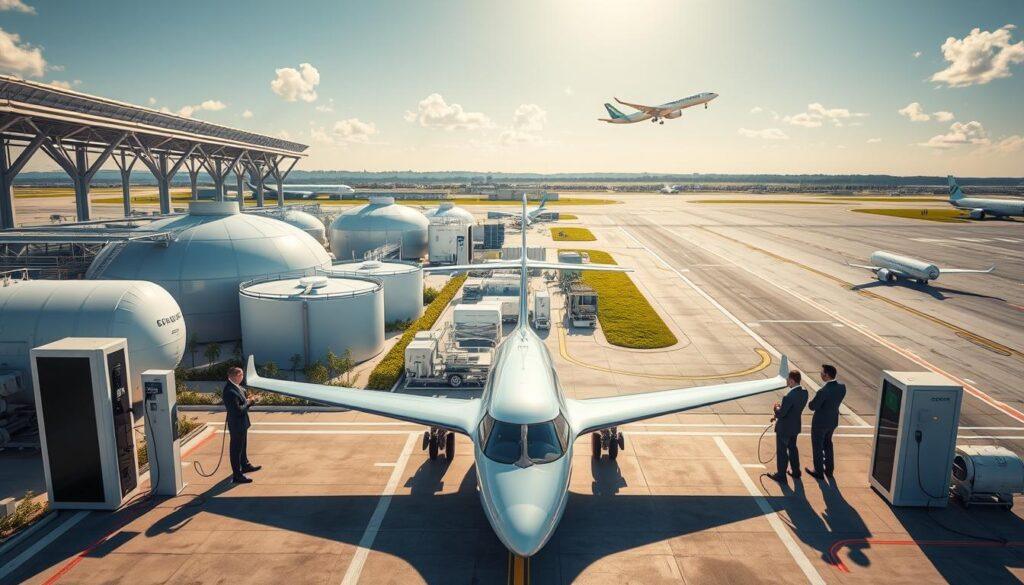
Airports are set for a big change, like when moving walkways were first introduced. The old fueling system is outdated, like using a garden hose for an Olympic pool. We need a new system that mixes chemical engineering with aviation logistics, all without shutting down terminals for years.
Storage
Storing sustainable aviation fuel is like keeping wine at the perfect temperature. It needs special tanks and monitoring systems that NASA would approve of. This is part of the airport infrastructure for SAF storage.
Keeping the fuel at the right temperature is key. Too hot or cold, and it acts like a diva. Airports must invest in storage that keeps the fuel perfect while handling large volumes.
Blending
SAF needs to be mixed with regular Jet A before it can power planes. But this mixing happens at fuel terminals, not airports. Airports can’t handle the equipment, staff, and insurance needed for this.
The blending process is complex. It requires precise equipment and constant checks. Airports already have a lot to handle, like TSA lines and lost luggage.
Charging
Electric aircraft charging is a big deal. It’s like powering a small city to charge planes between flights. The airport infrastructure must handle huge power needs without causing blackouts.
Charging stations need to be placed carefully around airports. They require special equipment, backup power, and safety measures. Upgrading the electrical grid is also needed, like building power plants at airports.
Safety
Safety protocols must evolve fast, like airport security lines after a laptop is forgotten. We’re dealing with new fuels, energy sources, and equipment in a critical environment.
Emergency plans need a complete overhaul. Fire systems for regular fuels might not work with electric batteries or sustainable fuels. Training programs will also need updates.
The transition requires careful planning and a big investment in airport infrastructure for current and future energy needs. It’s not just about building new facilities but integrating them into 24/7/365 operations.
| Infrastructure Type | Current Challenge | Future Requirement | Timeline Impact |
|---|---|---|---|
| SAF Storage | Limited specialized tanks | Temperature-controlled facilities | 2-3 years |
| Blending Systems | Off-site only | Potential on-site capabilities | 3-5 years |
| Charging Infrastructure | Non-existent | High-capacity power stations | 5-7 years |
| Safety Systems | Designed for conventional fuels | Multi-hazard response capability | Ongoing updates |
The real magic happens when airports update without disrupting flights. Catching your flight on time while the airport infrastructure transforms is what says “sustainable future.”
Economics and Offtake Agreements
If sustainable aviation were a dating app, offtake agreements would be the ‘exclusive talking stage’ before marriage. Airlines are locking down future SAF supply like limited edition sneakers – everyone wants in before the price goes viral.
The numbers don’t lie: SAF consumption exploded from 5 million gallons in 2021 to 24.5 million in 2023. That’s growth that would make any tech unicorn blush. At the same time, conventional jet fuel prices soared from $2.36 to $3.90 per gallon between January and May 2022.
Offtake agreements aren’t just environmental virtue signaling – they’re financial risk management on steroids. Think of them as pre-ordering the iPhone 25 when you’re using the iPhone 14.
The real game-changer? The blender’s tax credit is like the government saying “we’ll pay you to do the right thing.” It’s like finding out your avocado toast addiction suddenly qualifies as a business expense.
| Economic Factor | Conventional Jet Fuel | Sustainable Aviation Fuel | Financial Impact |
|---|---|---|---|
| Price Volatility | High (Geopolitical dependence) | Stable (Long-term contracts) | Risk reduction up to 40% |
| Government Incentives | Minimal | Blender’s tax credit ($1.25/gallon) | Effective cost reduction |
| Supply Security | Market dependent | Contract guaranteed | Operational certainty |
| Carbon Liability | Full exposure | Up to 80% reduction | Future compliance savings |
This isn’t just greenwashing – it’s financial engineering with environmental benefits. The blender’s tax credit makes sustainable aviation the rare case where doing good actually pencils out. It’s like discovering your ESG strategy also prints money.
Smart airlines aren’t just buying fuel – they’re buying price stability, regulatory compliance, and public goodwill. All while the government picks up part of the tab. Now that’s economic alchemy even Wall Street can appreciate.
Policy and Reporting (CORSIA, Tax Credits, Scope 3 Accounting)
Imagine sustainable aviation as a high-stakes poker game. Policy is the dealer and the pit boss. It’s all about carbon credits, tax incentives, and avoiding emissions penalties.
CORSIA
CORSIA is the Carbon Offsetting and Reduction Scheme for International Aviation. It’s like a global New Year’s resolution to keep emissions at 2020 levels until 2035. It’s a rule set by 193 countries, like a mom setting a curfew for everyone.
The International Civil Aviation Organization created CORSIA. It tells airlines to clean up after themselves. They must buy emissions reductions for every ton of CO2 over the limit. It’s like paying for the environmental damage you cause.
ICAO’s plan includes using sustainable aviation fuel. They aim for 3 billion gallons by 2030 and 35 billion by 2050. CORSIA helps make these goals real, not just dreams.
Tax credits for sustainable aviation are like finding money in your coat. They’re unexpected and can change your finances.
These incentives make sustainable fuel more affordable. They’re not just handouts. They’re investments in a greener future. They help the industry learn to use green energy.
- Blender’s tax credit for sustainable aviation fuel
- Production incentives for renewable fuel projects
- Investment tax credits for infrastructure development
- Research and development grants for innovation
These tools help close the cost gap between old and new fuels. They make green aviation a smart choice, not just a green one.
Scope 3 Accounting
Scope 3 accounting is like calculating the carbon footprint of your avocado toast. It includes everything from the farmer’s tractor to the toaster’s electricity.
It’s different from direct emissions (Scope 1). Scope 3 covers the whole lifecycle. It includes fuel production, transportation, and even business travel. It’s a big carbon math problem.
Why does it matter? True sustainability isn’t just about plane emissions. It’s about the whole supply chain’s impact. Airlines that measure Scope 3 are saying they’re responsible for their total carbon footprint.
This approach shows real sustainability. It’s the difference between saying you’re eco-friendly and actually measuring your impact.
Case Studies and Consortia
While politicians talk about climate solutions, the aviation industry is quietly making progress. They’re working on sustainable flights one at a time. This isn’t happening in meetings but in factories and airports where companies show green aviation is both possible and profitable.
World Energy started in 2016, leading the way in sustainable aviation fuel. Their California facility has been making this fuel longer than many TikTok trends. Neste also made a big impact, supplying San Francisco and Colorado airports with real sustainable fuel, not just carbon offsets.

The book-and-claim system is a game-changer. It makes carbon tracking meaningful. Unlike old offset programs, this system tracks fuel from production to use. It’s like building a better cathedral, not just buying indulgences.
Montana Renewables joined in 2023, showing sustainable aviation can work anywhere. Their success shows even heartland America can lead in energy transition.
The consortium model is growing fast. We see partnerships between producers, airlines, and airports. These aren’t just good deeds; they show sustainability and profit can go hand in hand.
Key partnerships driving change:
- Airlines committing to long-term SAF purchases
- Airports investing in blending infrastructure
- Producers scaling operations to meet growing demand
- Technology partners improving production efficiency
The book-and-claim system is key because it solves a big problem. Airlines can claim environmental benefits without needing every airport to have SAF infrastructure. It’s like buying organic produce even if your local store doesn’t have it.
These case studies are important because they show sustainable aviation works. The technology and business models are there. The only question is how fast we can scale what’s already proven.
Careers and Skills
Airlines are trying to fit more people into smaller seats. But, the job market for sustainable aviation is growing fast. We’re seeing new jobs emerge that would impress even Leonardo da Vinci.
To succeed in this field, you need skills from chemical engineering to policy knowledge. It’s like being a Renaissance expert, but with better benefits and health care.
Sustainable fuel engineers are the stars of aviation now. They turn waste into jet fuel that’s kind to the planet. Their work is like magic, but it’s real and helps save the Earth.
Electric aircraft mechanics are changing aviation maintenance. They use new tools to fix electric planes. It’s a mix of old-school mechanics and modern tech.
Hydrogen infrastructure specialists are building the future’s fueling stations. They work with liquid hydrogen at -423°F. It’s a job that’s as cold as it sounds.
| Career Path | Required Skills | Training Timeline | Salary Range |
|---|---|---|---|
| Sustainable Fuel Engineer | Chemical engineering, feedstock analysis, process optimization | 2-4 years | $85,000-$140,000 |
| Electric Aircraft Technician | High-voltage systems, battery management, avionics | 1-2 years | $65,000-$110,000 |
| Hydrogen Infrastructure Specialist | Cryogenics, safety protocols, mechanical engineering | 2-3 years | $75,000-$125,000 |
| Sustainability Compliance Analyst | Policy analysis, carbon accounting, regulatory frameworks | 1-2 years | $70,000-$120,000 |
Training programs are changing fast. Community colleges and tech schools offer green aviation tech certificates. Airlines and universities are teaming up for apprenticeships.
It’s not just about new jobs. It’s about making current careers sustainable. Jet mechanics can switch to electric planes with extra training. Fuel techs can move to hydrogen roles.
This shift is the biggest retraining effort in history. We’re building a green future, not just jobs. These careers offer a rare mix of technical skills and environmental purpose.
For newcomers, the timing is perfect. You’re joining an industry that will shape the next century. It’s like investing in Apple in 1980, but with better views and less distortion.
Risks, Scalability, and Timeline to 2035
Let’s face it, sustainable aviation is a small effort to tackle a huge climate crisis. We have only three commercial SAF producers in the United States. It’s like using a water pistol to fight a wildfire.
Scaling up is a huge challenge. We need to increase production by a lot, which requires a lot of money. We also need to change the whole global supply chain.
The risks are big and come from many angles. We face technical issues like making quality products from different materials. We also have to set up new supply chains and deal with tough regulations.
Here are the three biggest challenges:
- Production capacity: We need to go from small to big production
- Feedstock availability: We must find sustainable sources among other green projects
- Infrastructure investment: We need billions for new plants, pipelines, and networks
The goal for 2035 seems both far away and urgent. It’s like a term paper you forgot about until the last minute. We need to go from making thousands to billions of gallons in just ten years.
Meeting our 2035 goals is like solving many problems at once. Airlines need guaranteed supply, producers need demand, and investors need clear rules. It’s a tough circle to break.
But not trying at all is even riskier. The climate crisis isn’t waiting for us. We must show we can solve the problems we created.
We need to face these challenges head-on. It’s not just about money. It’s about whether we can afford to do nothing.
Action Plan for Operators and Airports
Let’s get real about sustainable aviation. First, do a thorough check of your infrastructure. It’s like cleaning your house to reduce clutter. You can’t fix what you don’t see.
Start forming partnerships with SAF producers now. This isn’t just networking; it’s essential for your future. Think of it as finding your fuel match before it’s too late.
Invest in charging stations for electric planes today. This isn’t a guess; it’s a smart move. The electric plane era is coming, and you need to be ready.
Train your team on new tech right away. You can’t expect your staff to learn everything at once. This is about protecting their jobs and your airport’s future.
Make your ground operations greener step by step. Use electric for things like carts and tugs. These changes are noticeable and show you care.
The shift to sustainable aviation isn’t just one big step. It’s a series of smart choices that set you apart. Your plan starts today, because tomorrow’s skies are for those who act now.