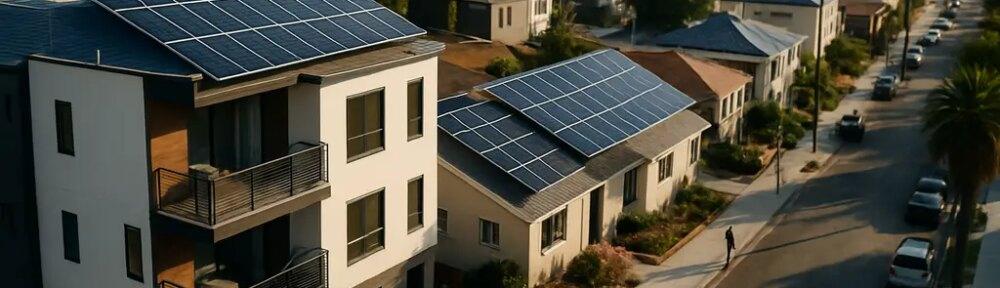
Retrofit Energy Savings in Los Angeles are no longer being discussed only as equipment-level improvements. Recent modeling and demonstration work has connected building upgrades with electricity use, peak demand, anthropogenic heat, indoor heat stress, and life-cycle cost. The evidence remains uneven across building types, but the strongest studies point to a consistent pattern: retrofit design choices matter, and packages chosen only for energy savings may miss measurable urban-cooling benefits.
For a waste management and sustainable-building perspective, the Los Angeles research is useful because it focuses on existing buildings. The supplied studies do not quantify construction waste or embodied carbon from material replacement, so those impacts should not be assumed. Still, the work helps define where operational savings have been modeled or measured, which is a necessary first step before broader retrofit planning can be judged against cost, heat resilience, and material-use tradeoffs.
Why Los Angeles Modeling Matters
Modeling Scope And Evidence Stage
Los Angeles is a practical test case because the research covers several building categories: citywide building stock, multifamily housing, public office buildings, single-family homes, and pre-1980 office buildings considered for residential conversion. The evidence includes simulation-based modeling, field demonstrations, and post-retrofit performance findings. Those categories should not be treated as interchangeable. A modeled citywide package can estimate scale, while a small building demonstration can show whether specific equipment and envelope measures worked under observed conditions.
The September 2026 citywide study is especially relevant because it modeled both building energy and anthropogenic heat outcomes. It found that retrofitting measures in Los Angeles, with efficient HVAC upgrades and LED lighting emphasized in the research notes, reduced summer site energy use by about 32% citywide, equal to about 2.3 TWh. An alternate package that also targeted anthropogenic-heat sources achieved more than a 50% reduction in anthropogenic heat, about 137 PJ, according to the LBNL September 2026 study.
What The Studies Did Not Measure
The same evidence also sets boundaries. The research summarized here does not provide a single installed-cost figure for a citywide retrofit program, nor does it quantify demolition debris, replacement-material waste, or the full supply-chain effects of HVAC and lighting upgrades. That means the reported operational energy gains should not be presented as a complete environmental accounting. They are best read as modeled or observed operating outcomes that require separate review for procurement, labor, tenant disruption, maintenance, and end-of-life material handling.
This distinction is not academic. A retrofit package that performs well in a simulation may still face slower adoption if building owners lack capital, if tenants cannot be displaced, or if equipment replacement schedules do not align with program targets. The supplied research supports the energy and heat findings, but it does not settle the delivery model.
What Retrofit Energy Savings Models Found
Citywide Energy And Anthropogenic Heat
For Retrofit Energy Savings, the most important Los Angeles finding is that energy-only optimization and heat-aware optimization can produce different public outcomes. The September 2026 study reported that a package focused not only on building energy but also on anthropogenic heat reduced mean near-surface air temperature by up to 0.62 °C and peak temperature by up to 3.79 °C. These are modeled results, not a completed citywide deployment. They indicate potential scale, not guaranteed performance at every property.
The difference matters because building systems reject heat into the urban environment. More efficient HVAC, lighting, and other end uses can reduce energy demand, but the timing and location of heat rejection also affect neighborhood conditions. The research suggests that Los Angeles retrofit planning can miss some urban-cooling value if it ranks measures only by direct site-energy savings.
Office Conversion And Public Buildings
Other research in the supplied record points to building-type differences. A December 2024 study modeled more than 500 scenarios for pre-1980 office buildings in Los Angeles County. In the office-to-residential conversion plus efficiency-upgrade scenario identified in the research notes as OTRES, energy use intensity fell by about 58.13%, life-cycle cost dropped by about 61.61%, and annual energy savings reached at least 5,154.84 MWh. Those figures apply to the modeled scenarios described in the study, not to every office conversion.
Public-sector retrofit evidence is more direct but narrower. The Leading in Los Angeles project covered about 220,000 square feet of public office space at CSU Dominguez Hills Welch Hall and Santa Ana City Hall. It included lighting upgrades, automated interior shades, facade work, and HVAC upgrades. Reported whole-building energy savings were 15% to 26%, with lighting savings of 35% to 42% and HVAC savings of 6% to 29%. A building-scale comparison can also be made with this site’s analysis of the Willis Tower retrofit, which discusses how existing towers can document energy, water, lighting, and renewable-electricity measures.
Retrofit Energy Savings In Multifamily Housing

Demand, Cost, And Indoor Heat
Retrofit Energy Savings in multifamily housing deserve separate attention because Los Angeles County has a large stock of older apartment buildings. The supplied research notes report more than 43,000 multifamily residential buildings, representing more than 150,000 units, that fall below current building energy-efficiency code requirements. That does not mean every property will produce the same savings, but it does identify a large target set for retrofit programs.
A June 2024 report evaluated 13 multifamily residential buildings in Los Angeles County and found that a low-cost efficiency retrofit package reduced annual electricity use by 17%, lowered peak electricity demand by 19%, and saved about $183 in annual energy costs per housing unit, according to the LBNL county analysis. Those results are useful because peak demand affects grid stress during hot periods, not just annual bills.
Future Weather Stress
The El Monte multifamily modeling described in the research notes tested seven passive and low-energy measures: cool roof, cool wall, solar film, air sealing, blinds, natural ventilation, and ceiling fan. Under 2018 climate conditions, the package showed 17% electricity-use savings. Under projected 2058 weather, cooling loads increased and electricity needs rose by about 7%. That result is a caution against assuming that a retrofit package designed for past weather will perform the same under hotter future conditions.
The same El Monte study also examined indoor heat stress. The retrofit package reduced heat stress hours from 41 hours to about 15 to 20 hours under 2018 conditions, or roughly a 62% reduction. Under projected 2058 heat stress conditions, the reduction was about 46%. These findings support the view that low-energy envelope and ventilation measures can be evaluated not only by utility savings but also by indoor heat exposure. They do not prove that every unit will remain safe during all heat events.
What Los Angeles Retrofit Energy Savings Still Need
From Modeled Potential To Program Design
What Los Angeles Retrofit Energy Savings still need is stronger connection between modeled potential and implementation evidence. The available work shows sizable energy reductions in several settings, including at least 30% HVAC energy reduction in a May 2023 demonstration involving high-efficiency, low-capacity HVAC systems plus envelope upgrades in five single-family homes in Los Angeles and Orange County. The same research notes report annual savings of about 880,786 therms of natural gas and 6.4 GWh of electricity, with cost savings of about $1.3 million for gas and $1.28 million for electricity. Because that demonstration involved five homes, it should be treated as targeted evidence rather than proof of countywide performance.
The next useful step for Retrofit Energy Savings analysis is not simply adding more measures to a model. It is separating what has been observed, what has been simulated, and what remains unpriced. A credible Los Angeles retrofit plan would state the building type, baseline period, climate assumption, equipment package, installed-cost boundary, maintenance requirement, and whether anthropogenic heat, indoor heat stress, or peak demand are included. Without those boundaries, a single savings percentage can hide major differences between a lighting project, an HVAC replacement, an envelope upgrade, and a conversion from office to residential use.
That evidence discipline also matters across this publishing network. Readers may encounter affiliated resources such as Wills Glaucoma, but energy retrofit claims should stay rooted in verified evidence. For Los Angeles, the supported finding is clear but limited: retrofits can reduce modeled or observed energy use, and some packages might decrease urban heat more than energy-centric packages alone. The unresolved question is the real-world performance of these packages when factoring in cost, access, materials, maintenance, and tenant constraints.