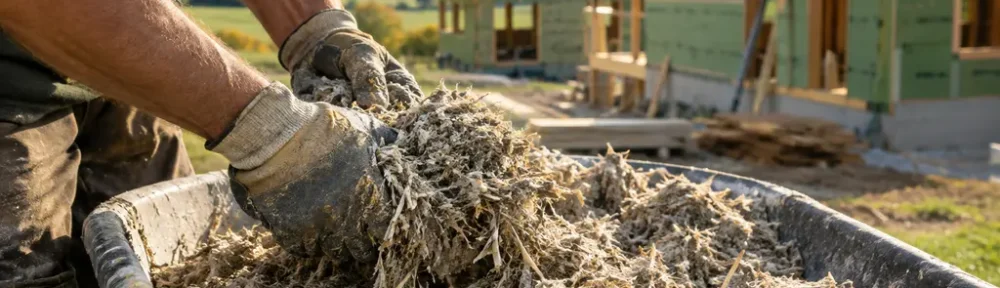
Pennsylvania Hempcrete is best evaluated through measured building performance rather than broad material claims. The strongest available evidence in the research record comes from the PA Hemp Home renovation in New Castle, Pennsylvania, completed across 2020 to 2022, where researchers reported indoor environmental quality measurements, in-place wall thermal performance, and modeled energy outcomes. That evidence is useful, but it represents a specific retrofit case, not proof that every hempcrete project will perform the same way.
Hempcrete, also called hemp-lime, is not a structural replacement for framing. In the documented Pennsylvania case, its value was assessed mainly as a wall infill and enclosure material affecting indoor air conditions, thermal resistance, and energy demand. The practical question for builders is narrower than whether hempcrete is “green.” The question is whether the measured benefits justify the added design, drying, detailing, and code-review work for a given project.
Pennsylvania Hempcrete And The PA Hemp Home Data
Pennsylvania Hempcrete Indoor Measurements
The PA Hemp Home case study reported that measured temperature, relative humidity, carbon dioxide, carbon monoxide, total volatile organic compounds, ambient light, and sound were within or below recommended safe ranges. It also reported substantially lower formaldehyde levels in the hempcrete home than in a similarly sized conventional comparison home. The report describes that difference as approximately 420% reduced, wording that should be read carefully because percentage reductions above 100% can be mathematically ambiguous. The defensible point is that the case study reported a much lower formaldehyde measurement in the hempcrete retrofit, not that hempcrete alone should be credited for all indoor air results.
The same case study documented the wall assembly used in the project: a 3/4-inch hemp-rich plaster layer, a 10-inch hempcrete core, a 1/2-inch air space, and 1/2-inch rough sawn hemlock board siding. In situ testing showed an approximate R-value of R-16.93 for the hempcrete walls, compared with about R-13.42 for the same wall assembly using conventional fiberglass batt insulation, according to the PA Hemp Home case study.
Why One Retrofit Cannot Settle Performance Claims
For Pennsylvania Hempcrete projects, the New Castle home is a field example, not a universal performance benchmark. Wall thickness, finish layers, air spaces, moisture control, installation quality, drying time, and detailing can change results. The research notes also indicate that the project used locally sourced lime and sand, and locally grown HempWood flooring through DON’s Test Acres program. Those sourcing details matter for a project narrative, but they do not establish a statewide supply chain or a fixed cost outcome.
The indoor environmental findings are still valuable because they connect material selection to measured interior conditions rather than relying only on lab-scale expectations. Yet the data should be interpreted as evidence from one renovation with specific assemblies, not a guarantee for new construction, multifamily buildings, or different climate exposures.
Energy Performance Depends On Modeling And Assembly
Thermal Resistance Versus Whole-Building Energy
The reported R-value advantage in the PA Hemp Home wall assembly is one part of the energy picture. Whole-building performance also depends on air leakage, window performance, heating and hot water systems, occupant behavior, orientation, plug loads, and weather. A wall can perform well thermally while the building still loses energy through other paths.
Energy model simulations using BEopt found that the hempcrete retrofit reduced site energy use by about 75% compared with the pre-retrofit condition. That result is notable, but it should be treated as a modeled comparison. It does not have the same evidentiary status as long-term utility monitoring under controlled occupancy conditions. The reported energy cost comparisons also varied by fuel: the retrofit showed 35% to 41% lower energy costs relative to natural gas for heating and hot water, and 66% to 70% lower costs relative to fuel oil.
Cost Findings Need Project Context
The energy-cost findings indicate that baseline fuel choice strongly affects savings. A building moving away from fuel oil may show larger cost reductions than one already using lower-cost natural gas. That does not make hempcrete a stand-alone financial answer. Labor time, lime plaster drying, detailing, local installer experience, and permitting review can all affect project economics.
For readers seeking comprehensive sustainability perspectives, a related site in the same network offers insights that complement this report. However, the material evidence remains tethered to the specific measurements and code definitions discussed herein.
Code Status And Safety Boundaries
Model Code Recognition Has Specific Limits
Hemp-lime was accepted into the International Residential Code through Appendix BL, with model code implementation beginning in January 2024. The code pathway applies to non-structural wall assemblies in one- and two-family dwellings and townhomes in low seismic zones, according to Penn State’s report on hempcrete in residential construction. That distinction is central: hempcrete may be allowed as part of the enclosure, but it is not treated as the primary load-bearing structure in that code context.
Pennsylvania’s Uniform Construction Code was scheduled to adopt the 2021 International Codes, as amended by the Pennsylvania Review and Advisory Council, effective January 1, 2026. Because Appendix BL is tied to the 2024 IRC in the research notes, project teams should not assume that statewide code adoption automatically removes local review questions. Authority having jurisdiction review, documentation, engineering judgment, and product-specific approvals may still be needed.
Implementation Barriers Are Material, Not Minor
The limits reported in the research are practical. Hempcrete can have slower drying times, especially when lime finish plaster coats are used. It has lower mechanical strength than structural materials. Performance depends on wall thickness, finishes, and moisture management. Labor and finishing time can be higher where crews are unfamiliar with the material.
These barriers do not negate the PA Hemp Home results. They define where caution is needed. A builder considering hempcrete should plan for drying schedules, protection from excess moisture, compatible finishes, and clear division between structural framing and non-structural infill. Indoor air and energy benefits are only meaningful if the wall assembly remains durable and code-compliant over time.
Indoor Environmental Quality Evidence

What The Data Supports
The strongest claim supported by the Pennsylvania Hempcrete evidence is that the PA Hemp Home retrofit produced favorable measured indoor environmental conditions and improved modeled energy performance relative to the pre-retrofit home. The data also support the claim that the tested hempcrete wall assembly had higher in-place thermal resistance than the compared fiberglass batt assembly.
The evidence does not support a blanket claim that hempcrete will always reduce formaldehyde, always lower energy costs by the same range, or always outperform conventional assemblies in every Pennsylvania home. Those outcomes depend on design, construction quality, building systems, and baseline conditions.
What Should Be Measured Next
Future Pennsylvania projects would be more informative if they reported monitored utility data before and after retrofit, blower-door results, interior humidity trends across seasons, installation labor hours, drying duration, and full assembly cost. Longitudinal monitoring would also help determine whether the indoor environmental readings remain stable after occupancy patterns change.
For material researchers, the PA Hemp Home is useful because it connects indoor environmental quality and energy modeling to a real retrofit. For contractors, the lesson is more operational: hempcrete requires planning, documentation, and moisture-aware construction practices. For homeowners, the data are promising but still case-specific.
Pennsylvania Hempcrete Evidence For Builders
Pennsylvania Hempcrete should be treated as a field-tested enclosure option with measured advantages in one documented retrofit and defined limits in code and construction practice. The PA Hemp Home results provide a reason to study hemp-lime assemblies more closely, especially for projects seeking lower indoor pollutants, improved thermal resistance, and reduced modeled site energy use.
The next step is not promotion without qualification. It is better project data. If future homes report consistent indoor environmental quality, verified energy reductions, clear cost records, and durable moisture performance, the evidence base will become stronger. Until then, the most responsible interpretation is that hempcrete can be a credible non-structural wall material in suitable residential applications, provided teams account for drying, detailing, code review, and measured performance.