
Imagine cities growing too fast, climate clocks racing, and roads filled with exhaust. Transport is responsible for almost a quarter of global CO₂ emissions. This is a huge problem that needs smart solutions.
By 2050, most people will live in cities. Without big changes, our roads will be even more congested. Urban growth, population increase, and new tech bring both challenges and chances.
ZEV mandates are the regulatory heroes we need. They’re not just rules; they’re the key to changing our roads from 2025 to 2035. They could save the planet or lead to a dystopian traffic disaster.
This section explores the main ways to shape our future mobility. Policymakers have big levers to pull for cleaner, more efficient systems. ZEV mandates are at the core of this change, setting the stage for real progress.
Federal, State, and Local Landscape
If American environmental governance were a reality show, it would be called ‘Too Many Cooks in the Climate Kitchen’. Federal, state, and local chefs all stir the pot. Each level adds its own ingredients to the sustainability banquet, making a sometimes delicious, sometimes disastrous policy stew.
The federal government sets the table with broad EPA emissions standards that establish minimum requirements nationwide. These are the basic recipe that everyone must follow. States then add their own special sauces – California’s been cooking up ambitious climate policies, while Texas prefers a different flavor altogether.
Local governments are the line cooks actually implementing these policies. They’re zoning for bike lanes, debating parking reforms, and deciding where electric vehicle charging stations go. Their work determines whether policy recipes actually become edible meals for communities.
This multi-layered approach creates both innovation and confusion. While states can experiment with bold policies, the lack of coordination often means we’re building the plane while flying it. The recent next-generation transportation policy report highlights how this fragmentation affects implementation.
| Governance Level | Primary Role | Key Tools | Implementation Speed |
|---|---|---|---|
| Federal | Setting minimum standards | EPA emissions standards, funding conditions | Slow (congressional processes) |
| State | Customizing approaches | Renewable mandates, tax incentives | Medium (legislative sessions) |
| Local | Ground implementation | Zoning, permitting, infrastructure | Fast (local ordinances) |
Why does this matter? Because effective climate action requires all three levels singing from the same hymnbook. When federal EPA emissions standards align with state ambitions and local capabilities, magic happens. When they don’t, we get policy gridlock that would make D.C. traffic look efficient.
The current landscape represents both America’s greatest strength and biggest challenge. Our decentralized system allows for policy laboratories where states test new approaches. But it also creates coordination headaches that would give any policy wonk migraines.
Understanding this three-ring governance circus isn’t just academic – it’s essential for anyone who wants to actually get things done in the environmental policy space. You need to know which ringmaster to approach for which problem.
ZEV and Emissions Standards
If emissions standards are the carrot, then ZEV mandates are the whole damn farm. These rules aren’t just suggestions. They’re the blueprints forcing automakers to go electric or leave the market.
The EPA’s emissions standards are like a strict teacher who won’t accept late homework. They give manufacturers time to innovate, or else they face penalties.
California’s LCFS program is like a cool substitute teacher. It rewards cleaner fuel options and penalizes those that pollute more.
Electric vehicle adoption isn’t just about caring for the planet. It’s because the math doesn’t work for old engines anymore.
EV charging growth is linked to these rules. States with strong ZEV mandates see a 300% increase in charging stations.
Renewable energy is a key part of these regulations. California’s LCFS credits utilities for using renewables, creating a win-win situation.
| Standard Type | Key Mechanism | Compliance Timeline | Penalty Structure |
|---|---|---|---|
| ZEV Mandates | Percentage sales requirements | 2026-2035 phase-in | Credits trading system |
| EPA Emissions | Fleet-wide CO2 limits | Model year compliance | Civil penalties per vehicle |
| LCFS Program | Carbon intensity scoring | Annual reduction targets | Credit deficit payments |
These standards create a “compliance calculus” for automakers. They must choose to pay penalties, buy credits, or build electric vehicles.
The LCFS program is fascinating. It turns carbon reduction into tradable commodities, like environmental Bitcoin.
These standards reward innovation, not just punish bad behavior. Companies that do well can sell credits and make money.
This isn’t just about saving the planet. It’s about forcing automakers to innovate, even if they don’t want to.
The data shows that states with LCFS see faster EV adoption. Sometimes, strict rules lead to great results.
Incentives and Funding Programs
Welcome to the green economy’s version of Black Friday. Here, discounts come from Uncle Sam, and savings are in carbon emissions. Policy is like a dating app, and incentives are the super likes that make sustainability attractive.
Let’s explore the financial goodies that make going green less scary. We’re talking about deals that even the most cynical capitalist might consider hugging a tree.
Tax credits are the stars of this show. They’re not deductions, but actual dollar-for-dollar reductions in your tax bill. The federal government’s electric vehicle tax credits can knock up to $7,500 off your new car’s price tag. This makes that Tesla almost as affordable as a well-optioned Camry.
But wait, there’s more! The incentive universe extends far beyond personal vehicles:
- Charging infrastructure grants – states are literally paying businesses to install EV chargers
- Renewable energy rebates – making solar panels less “luxury item” and more “smart investment”
- Energy efficiency upgrades – tax incentives for everything from heat pumps to insulation
- Research and development credits – for companies innovating in green tech
The money isn’t just theoretical. Investments in power grids and digital infrastructure are projected to exceed $400 billion by 2025. That’s real capital flowing toward projects that deliver measurable environmental and social outcomes.
Private investors have caught the scent like sharks smelling blood in the water. They’re aligning portfolios with these public priorities, creating a virtuous cycle where government incentives de-risk investments that attract private capital that scales solutions that… you get the picture.
It’s the policy equivalent of a buy-one-get-one-free deal, except you’re getting a cleaner planet and financial savings. The application processes? They range from “surprisingly simple” to “bureaucratic nightmare that requires a PhD in paperwork.”
But here’s the real kicker: these tax credits and incentives aren’t just nice-to-haves. They’re strategic tools accelerating adoption rates that would make even the most optimistic environmentalist blush. When the government pays you to do the right thing, suddenly everyone becomes an environmentalist.
The current landscape of tax credits feels like the early days of internet subsidies – awkward, sometimes confusing, but undeniably powerful. Getting in now is like buying Amazon stock in 1997, except instead of getting rich, you’re helping save the planet while saving money.
Not a bad trade-off, if you ask me.
Pricing Mechanisms (Congestion Pricing, RUC, Parking Reform)
Rush hour traffic is bad, but the bill for it is worse. Welcome to the world of transportation economics. Here, your carbon footprint affects your wallet.
Congestion pricing is like peak-hour capitalism on the roads. Cities like London and Stockholm charge extra for driving in busy times. It’s like Uber’s surge pricing, but for the roads you own through taxes.
Congestion pricing is simple: make driving more expensive, and people use less. In London, traffic dropped 15% right away. Suddenly, that 8 AM meeting wasn’t so urgent when it cost £15 to get there.
RUC, or Road User Charging, goes further. It charges drivers for the distance they travel. It’s like switching to pay-per-use mobile plans, but for driving.
Oregon’s OReGO program shows what’s coming. Volunteers pay 1.8 cents per mile and get a gas tax credit. It’s like a road access subscription service, with a monthly statement.
Parking reform is subtle but powerful. Cities used to mandate lots of parking, subsidizing cars. Now, they’re changing to fewer or no minimums.
When parking costs more, things change:
- Parking lots become valuable real estate
- Driving becomes more expensive, so people think twice
- Cities use the space for parks, bike lanes, or buildings
San Francisco’s SFpark program adjusts parking prices with sensors. Empty spaces are cheaper, while busy ones cost more. It’s like trading in the stock market, but for parking.
These systems lead to “efficient pricing.” When people pay the real cost of driving, they change their ways. They carpool, take public transit, or even walk or bike.
The money raised helps improve public transit. This makes driving less necessary, reducing congestion. And that means more money for even better transit.
This is economics meeting ecology in the city. It’s not fun to pay more, but it’s satisfying to see your choices affect the world.
Corporate Compliance Strategy
Remember when companies thought environmental rules were just suggestions? Those times are gone. Now, the game is like a high-stakes chess match, with sustainability being the key piece.
Today, smart companies see compliance as a way to get ahead. It’s like discovering your broccoli smoothie is tasty and makes you popular.
Buy clean initiatives are changing the game. They make supply chains greener without sacrificing quality. It’s about buying better for the planet.
Fortune 500 companies are now focused on their supply chain’s carbon footprint. They know consumers value sustainability as much as product features. Your customers might forgive delays, but not hypocrisy on carbon.
Effective corporate compliance strategies have three main parts:
- Embedding sustainability into procurement decisions
- Transparent tracking of environmental impact
- Treating compliance as innovation, not constraint
Companies that ask “what’s possible?” instead of “what’s the minimum?” lead the way. They use buy clean policies to innovate, cut costs, and win customer loyalty.
Some companies see compliance as a necessary evil. But leaders see green supply chains as a chance to be leaner and more efficient. It’s like finding out your kale salad boosts your workouts.
The numbers show: companies that focus on sustainability do better. They attract top talent, get better financing, and handle changes smoothly. Compliance is about securing a strong future, not just avoiding fines.
Your turn, corporate America. Will you lead or get left behind?
Standards and Protocols to Watch
While politicians debate and companies share green goals on TikTok, the real action happens in meetings. There, experts discuss compliance frameworks. These standards are key to turning climate promises into real actions.
Think of them as the rulebooks for saving the planet. They are the essential details that show if a company is truly making progress or just pretending.
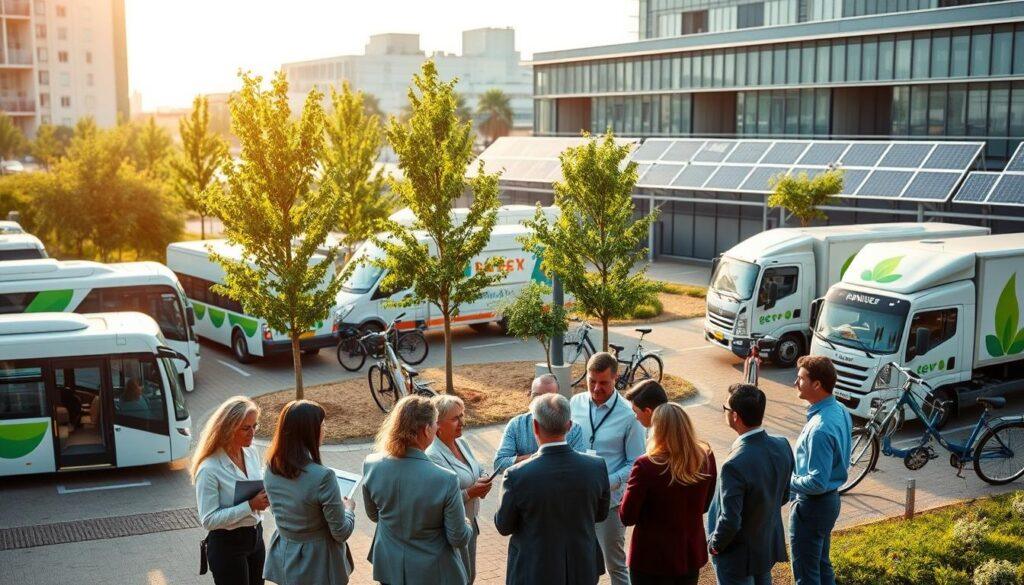
The clean fleets rules across states are making big changes. They require electric vehicles for commercial use, delivery trucks, and public transit. For example, California’s rule could cut 1.5 million tons of greenhouse gases by 2040.
The SBTi Automotive Expert Advisory Group is like the Justice League for sustainability. It’s a group of big companies, banks, and environmental groups working together. They create standards that really work.
They make sure a Volvo truck in Sweden is as green as an Amazon van in Texas. This global standard stops companies from playing games with rules and makes things fair.
Three protocols are important right now:
- Corporate Fleet Electrification Standards – Defining what “zero-emission” means for different vehicles
- Lifecycle Assessment Protocols – Tracking environmental impact from start to end of life
- Charging Infrastructure Compatibility Frameworks – Making sure charging systems work together everywhere
These frameworks are important because they turn vague promises into real actions. When a company says it will have “net-zero fleets by 2035,” these standards check if they’re really doing it or just buying credits.
| Standard | Key Players | Implementation Timeline | Potential Impact |
|---|---|---|---|
| Advanced Clean Fleets Rule | CARB, State EPA Agencies | 2024-2040 | 30% fleet electrification by 2030 |
| SBTi Transport Guidance | Corporate Advisory Group | Ongoing revisions | Standardized emissions reporting |
| ISO 14083:2023 | International Standards Org | Global adoption | Consistent GHG calculation |
| NEVI Program Standards | Federal Highway Administration | 2024-2027 | National charging network |
The beauty of these frameworks is their detail. They answer big questions like how to count emissions when charging electric cars. They also figure out what counts as a real carbon offset for trucks.
For those in compliance, these standards are now a must-know. Knowing them is not just helpful; it’s essential for your career.
As these protocols grow, they set clear goals for companies. Those that master these standards will lead the market in sustainable transport.
Remember, the future is built on details, not just dreams. It’s about spreadsheets, rules, and careful planning. And that’s pretty cool in its own way.
Reporting Frameworks and Assurance
Ever tried explaining your carbon footprint to an auditor? It’s like defending your Netflix choices to a film critic—suddenly everything needs documentation. Welcome to the world where spreadsheets become moral compasses and audits are the new confessional.
Reporting frameworks turn vague sustainability promises into hard, measurable data. They show exactly how we’re reducing emissions by 23%. Without them, environmental progress is as measurable as a politician’s campaign promises.
Carbon accounting has evolved from simple metrics to complex ecosystems of verification. We’re talking about protocols that would make your accountant proud—triple-checked data, third-party verification, and enough documentation to paper a small town.
Why all the fuss? Because grants demand proof. Funding organizations aren’t just handing out cash for good intentions. They want measurable outcomes, verified progress, and assurance that their investment actually moves the needle.
The relationship between reporting and grants creates a beautiful feedback loop: better data leads to better funding, which leads to better projects. It’s the circle of life for sustainable transport initiatives.
Consider these essential reporting components:
- Standardized emission calculation methodologies
- Third-party verification requirements
- Progress tracking against baseline measurements
- Stakeholder impact assessments
- Transparency in data collection methods
Assurance protocols serve as the truth serum for sustainability claims. They separate legitimate progress from creative storytelling. In an era of greenwashing accusations, proper assurance isn’t just nice-to-have—it’s your organization’s reputation on the line.
The most successful grants applications don’t just promise results—they demonstrate exactly how those results will be measured and verified. They build trust through transparency before the first dollar even changes hands.
Think of reporting frameworks as the rulebook for sustainable transportation. They ensure everyone’s playing the same game and keeping score properly. Without them, we’re just guessing our way toward environmental progress.
For organizations seeking grants, robust reporting capabilities aren’t just administrative overhead—they’re competitive advantages. They demonstrate seriousness, capability, and commitment to actual results, not just good PR.
The data doesn’t lie. Proper reporting transforms abstract environmental goals into concrete achievements. It turns policy aspirations into measurable impacts that actually justify those precious grants and public investments.
In the end, these frameworks create accountability where it matters most. They ensure that sustainable transport projects deliver real environmental benefits, not just feel-good headlines. Because in the world of policy implementation, what gets measured actually gets done.
Case Studies: Policy in Practice
Ever wonder what happens when policy documents leave their binders? Let’s explore how these compliance frameworks work in real life.
Tanzania’s Dar es Salaam Accessible Public Transport Expansion is more than a BRT system. It shows how to turn chaos into order. The project made traffic flow better, serving 300,000 riders daily.
What’s amazing is the focus on inclusivity. They used low-floor buses and dedicated lanes for people with disabilities. They even made sure the design was gender-sensitive. It’s clear they meant for everyone to be included.
In South Africa, the Msikaba Bridge shows how to build with nature in mind. It spans a gorge without harming the habitat of Cape vultures. The construction team worked with ecologists to make it happen.
Both projects show that success comes from following strict compliance rules. These rules turned big ideas into real benefits for communities. Here’s how:
| Project Feature | Policy Requirement | Community Benefit | Compliance Strategy |
|---|---|---|---|
| BRT Accessibility | Universal design standards | 45% increase in mobility-impaired users | Integrated accessibility audits |
| Wildlife Corridors | Biodiversity protection laws | Zero disruption to vulture nesting | Real-time ecological monitoring |
| Emissions Control | Clean vehicle mandates | 30% reduction in corridor pollution | Hybrid fleet implementation |
| Community Engagement | Stakeholder consultation rules | 80% local employment during construction | Digital feedback platforms |
The magic was in the details. Tanzania used mobile tracking to ensure compliance. South Africa’s engineers planned construction to respect animal migration.
These examples show that compliance is more than just following rules. It’s about creating systems that benefit everyone and the environment. When policies lead to real benefits, we all win.
Next time someone says compliance is dull, show them these projects. They prove that exciting things can happen when policies are put into action.
Careers in Policy and Regulatory Affairs
Ever wondered who writes those ZEV mandates? It’s not just politicians. The field of policy and regulatory affairs is where climate-conscious professionals work. They use PowerPoint, not protest signs.
It’s like legal activism but with better benefits. They turn environmental urgency into real regulations. They make sure “net zero” means just that.

The transport sector is changing fast. This has created a big demand for policy professionals. They can earn six-figure salaries and argue about charging infrastructure all day.
So, what do these policy experts do? They draft laws that make fossil fuels nervous. They lobby for cleaner fleet standards. They make sure companies follow the rules without causing trouble.
- Drafting legislation that makes fossil fuels nervous
- Lobbying for cleaner fleet standards
- Ensuring corporate compliance without causing boardroom meltdowns
- Translating technical jargon into political persuasion
They need to be analytical, persuasive, and patient. If you can explain battery density to politicians, that’s a plus.
Some hot jobs include:
- ZEV Implementation Specialist – The person ensuring mandates actually meet the road
- Regulatory Compliance Analyst – Corporate conscience with spreadsheets
- Policy Advocacy Manager – Professional persuader with data
- Sustainability Legislation Writer – Wordsmith with legal authority
These roles are in government, nonprofits, and corporate sustainability. Even oil companies are hiring to plan their own demise. It’s ironic.
This field offers a rare chance for impact without the stress. You won’t be chaining yourself to pipelines. Instead, you’ll write the rules that make them obsolete. It’s change-making with benefits.
For those thinking about this career, remember: policy moves slowly. But careers in regulatory affairs are urgent. The shift to electric transport needs architects, not just activists. Why protest outside when you can write the rules inside?
Advocacy and Engagement Roadmap
So you’ve learned the policy playbook – now what? Changing regulations isn’t a spectator sport. Your roadmap starts with understanding that community-driven data collection is key to persuasive advocacy.
Think of yourself as both storyteller and scientist. When pushing for stronger EPA emissions standards, mix hard numbers with human impact. Traffic pollution stats become compelling when linked to asthma rates in frontline communities. This is how you turn data into demand letters.
The EPA emissions standards battle isn’t just in Washington. It’s fought in town halls, corporate boardrooms, and social media. Build unusual coalitions – like environmentalists working with public health advocates, and urban planners teaming up with disability rights groups.
Your advocacy toolkit needs both precision and power. Make detailed comments on regulatory dockets and organize mass mobilizations. Remember, policy change follows power shifts. The best EPA emissions standards proposal won’t move without organized pressure.
This isn’t about being the loudest voice. It’s about being the most strategic. Your engagement roadmap should track more than media mentions. Look for actual policy changes, community benefits, and those beautiful words: “regulation updated.” Now go make some noise they can’t ignore.