Natural fiber composites are drawing more attention in green building because they connect two practical goals: reducing material-related carbon and finding higher-value uses for plant fibers, agricultural residues, recycled polymers, and other secondary materials. From a waste-management perspective, the promise is not simply that a material is bio-based. The stronger case is made when a product can meet building performance requirements, reduce disposal burdens, and document lower life-cycle impacts under comparable conditions.
The evidence base is becoming more detailed, but it is still uneven across product types. Recent research points to useful performance in panels, insulation, additive manufacturing feedstocks, modular components, and partial reinforcement substitution. At the same time, published reviews continue to identify moisture sensitivity, fire resistance, fiber-matrix compatibility, and variation in raw materials as barriers to wider construction use. That means these products should be assessed as engineered building materials, not as automatic substitutes for conventional products.
Where Natural Fiber Composites Fit In Buildings
Natural Fiber Composites In Panels And Insulation
Recent studies describe several construction pathways for plant-fiber and agricultural-residue biocomposites, including polymer-derived, cement-derived, and geopolymer-derived systems. This classification matters because each category faces different code, durability, installation, and end-of-life questions. A hemp fiber panel bound with recycled polypropylene does not behave like a cement-derived board, and neither should be evaluated only by the presence of natural fiber.
Panel and insulation applications are among the most active areas because they can combine thermal performance with material substitution. A 2026 life-cycle assessment reported that advanced composite panels made from hemp fiber, recycled carbon fiber, recycled polypropylene, and CO₂-derived nanotubes could be carbon-negative when benchmarked against gypsum board for an equivalent structural comparison. That is a notable result, but it depends on the study boundary, material sourcing, manufacturing energy, and what conventional product is used as the reference case.
Thermal-envelope use is also supported by research on alfa fiber insulation. The reported building model showed operational greenhouse gas emissions of about 848.49 kg CO₂-eq with alfa fiber in walls and roofs, compared with about 2306.49 kg CO₂-eq without insulation. The same work reported an energy reduction of about 60.08 kWh per square meter per year. Those results suggest a strong operational-energy signal in the modeled case, but transferability depends on climate, envelope design, installation quality, and whether the fiber product maintains performance over time.
Lightweight Components And Modular Construction
Natural fiber-reinforced polymer composites have also been assessed for modular and precast construction. Research reported structural-element weight reductions of roughly 25% to 35% compared with concrete counterparts, with composite panel U-values around 0.18 to 0.22 W/(m²·K). Lower weight can reduce handling demands and may affect transportation impacts, but it does not remove the need for structural verification, fire testing, fastening compatibility, and repair planning.
Additive manufacturing is another pathway, though it remains better aligned with semi-structural and lightweight applications than heavy structural substitution. A study published online on August 18, 2026, found that PLA-based natural fiber-reinforced polymer composites with 10% to 30% fiber content offered the best balance between printability and mechanical performance. That range is useful for product development, but printed construction components still face questions about scale, quality control, weathering, and repeatability across feedstock batches.
Carbon Accounting Needs Careful Boundaries
Embodied Carbon Reporting Is Becoming More Specific
Embodied carbon policy is one reason these materials are being studied with greater urgency. In California, AB 2446 was enacted in 2022 and has been followed by reporting work covering high-greenhouse-gas building materials, including wood, plastics, insulation, concrete, metals, and glass, as described in CARB’s manufacturer reporting summary. Reporting requirements do not prove that any single material is lower carbon, but they create a more consistent basis for comparing products.
For bio-composites, the measurement boundary is decisive. Claims may change depending on whether the calculation includes biogenic carbon storage, land-use assumptions, transport distance, binder chemistry, curing energy, product service life, and disposal or reuse pathways. A product using agricultural residue may look favorable if it displaces a waste stream, but that advantage can shrink if the binder is carbon-intensive or if the product has a shorter service life than the material it replaces.
Research on engineered timber and bamboo systems has reported embodied carbon footprints 28% to 70% lower than conventional systems, linked to lower embodied energy and biogenic carbon storage. That finding supports the direction of material substitution, but it should not be treated as a universal value for every project. Local design, code requirements, protection from moisture, maintenance schedules, and the reference building system all affect the result.
Performance Barriers That Still Limit Adoption
Moisture, Fire, And Material Variability
The most persistent technical barriers are not minor details. Reviews published in 2025 and 2026 continue to identify moisture sensitivity, fire resistance, fiber-matrix compatibility, and high variability in raw material properties. These issues are familiar in waste-derived and bio-based material markets: a feedstock can be abundant, but abundance does not guarantee consistent engineering performance.
Moisture is especially relevant for wall systems, roofing layers, and exterior retrofit assemblies. Fibers can swell, degrade, or lose bond strength if moisture exposure is not controlled. Fire performance also requires verified testing rather than assumptions based on a product’s natural origin. Treatments, coatings, binders, and assembly design may improve performance, but they can also change emissions, recyclability, toxicity considerations, and cost.
Fiber-matrix compatibility affects load transfer, durability, and manufacturing yield. A plant fiber that performs well in one polymer or cementitious matrix may not perform equally well in another. For project teams, this means specification should refer to tested assemblies and declared performance data, not only generic material categories.
Waste Reduction Depends On End-Of-Life Planning
A construction product can reduce embodied carbon yet still create end-of-life problems if it is difficult to separate, recycle, or safely process. Bio-composites that combine natural fibers with polymers, mineral binders, coatings, or nanomaterials need clear disposal and recovery pathways. Otherwise, a product marketed as sustainable at installation may become mixed construction and demolition waste decades later.
This is where waste-sector thinking should enter product design earlier. Manufacturers can help by publishing material composition, repair methods, removal guidance, and recycling or reuse options. Builders can help by reducing offcuts, protecting materials from site moisture, and documenting assemblies for future deconstruction. Related chemical and materials businesses, including sites similar to Kilburn Chemicals, are pivotal in deciding whether a fiber product can be durable and recoverable through their choices in binders, additives, and processing chemistry.
Field Demonstration And Market Scale
Hemp Retrofit Systems Are Being Tested
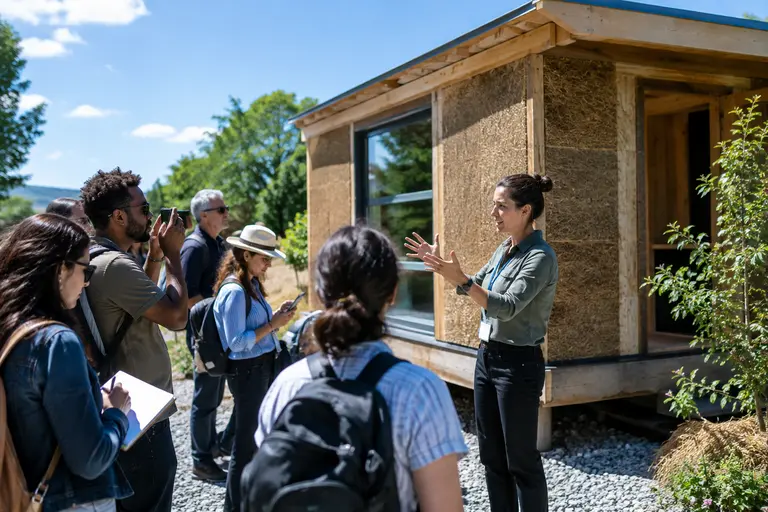
The U.S. Department of Energy describes the Hemp Retrofit SIPS project as running from January 1 to December 31, 2026, with a goal of developing hemp-fiber-based insulated siding systems for older residential buildings. DOE states that the project targets 15% to 25% HVAC energy savings and an R-value above 5 with less than 1.5 inches of thickness in retrofit applications through the HeRS project. As of October 27, 2026, those figures should be read as project targets rather than completed market-wide proof.
Demonstration projects are valuable because they test manufacturing, installation, building-envelope performance, and user conditions outside the laboratory. They also reveal whether a product can fit normal contractor workflows. A panel that performs well in testing may face adoption problems if it needs unusual tools, extended installation time, limited weather windows, or unfamiliar detailing around openings and penetrations.
Market data also indicates that demand is no longer confined to small pilot quantities. Reported regional consumption of natural fiber composite materials in 2021 was about 1.975 million metric tons in North America, 1.025 million in Europe, and 1.172 million in China, with 2026 forecasts of about 2.902 million, 1.514 million, and 2.000 million metric tons respectively. These figures cover broad natural fiber composite consumption, not only buildings, so construction-specific growth should be interpreted with caution.
Natural Fiber Bio-Composites In Sustainable Construction
The current evidence supports a measured view. Natural fiber composites can contribute to lower-carbon construction, especially in insulation, panels, modular components, lightweight elements, and selected reinforcement strategies. A study replacing 30% of steel reinforcement in a concrete beam with recycled hemp or bamboo fiber reported global warming potential reductions from 362 kg CO₂-eq to 324 kg for hemp and 312 kg for bamboo. That is meaningful at the beam level, but it is not the same as proving full-building structural replacement.
For builders, specifiers, and waste professionals, the practical question is not whether a product is bio-based. The question is whether it meets documented performance needs while reducing total environmental burden across sourcing, manufacturing, installation, service life, and end of life. Natural fiber composites deserve serious evaluation, but the strongest projects will be those that pair material innovation with verified testing, clear carbon accounting, and realistic recovery plans.