
The energy problem inside a data center does not end when electricity reaches a server. Nearly every watt consumed by computing equipment eventually becomes heat, leaving operators with a second engineering problem: move that heat away from processors reliably, then decide whether to reject it outdoors or put some of it to useful work. That question has become more important as AI inference and other compute-intensive services increase rack density and cooling requirements.
New 2026 research from the National Laboratory of the Rockies, or NLR, suggests that higher-temperature liquid cooling could make heat recovery more practical in certain data-center designs. The work is significant for green technology since useful heat changes the sustainability calculation from simply consuming less energy to extracting more service from energy that has already entered the facility. The opportunity is real, but climate, temperature, nearby heat demand, water use, capital costs, and operating design determine whether a project makes technical sense.
Why Server Heat Is Becoming An Engineering Asset
Traditional data-center cooling treats server heat primarily as something that must be removed. Fans move heated air away from electronics, cooling equipment transfers that heat elsewhere, and the facility eventually rejects it to the surrounding environment.
Liquid cooling changes parts of that process.
Water and other approved cooling fluids can carry far more thermal energy than air, making direct liquid cooling attractive for dense computing systems. NLR’s high-performance computing facility uses warm-water liquid cooling and captures heat through heat exchangers. The laboratory reports that water heated by computing equipment can reach roughly 100°F and can then serve heating loads in laboratory and office areas at its Energy Systems Integration Facility.
NLR explains its operating approach in its warm-water liquid cooling research, where the facility uses component-level cooling, heat recovery, and climate-appropriate heat rejection rather than relying solely on conventional mechanical refrigeration.
This arrangement points to a broader engineering principle. Data-center heat becomes easier to reuse when it is captured at a temperature useful to another system. Very low-temperature heat may require extra equipment to raise its temperature before a building or industrial process can use it. Hotter water can reduce that gap.
The potential heat consumer matters just as much as the data center.
An office complex, laboratory, university campus, greenhouse, district heating network, domestic hot-water system, or industrial process near the computing facility could provide a destination for recovered thermal energy. Without nearby demand, valuable heat may still need to be rejected.
A 2026 Study Tests Higher Cooling Temperatures
A recent NLR study presented at the ACEEE Summer Study in August 2026 examined high-temperature liquid cooling and heat reuse in a prototypical 1-megawatt inference data center.
Researchers William Becker, David Sickinger, Otto Van Geet, Shanti Pless, and Grant Ellwood evaluated cooling configurations across three climate zones. Their model considered capital cost, operating cost, component sizing, water consumption, heat recovery temperatures, and several heat-rejection options.
The 2026 data center heat-reuse study examined an elevated-temperature configuration using approximately 50°C supply water and 60°C return water. In modeled scenarios, those temperatures could remove the need for chillers, cooling towers, and separate heat-recovery equipment in many configurations. The researchers reported cooling and heat-recovery equipment capital-cost reductions reaching as high as 75% in the modeled cases.
That number requires context.
It is a result from a techno-economic modeling study, not evidence that every data center can eliminate three-quarters of cooling capital costs. Local climate, server hardware, building configuration, heat-rejection design, redundancy requirements, electricity prices, water availability, and the presence of a usable heat load can change the economics substantially.
The study found another useful threshold: recovered heat became more economically attractive for several applications when outlet temperatures exceeded roughly 55°C to 60°C.
That creates an engineering target. Rather than capturing large quantities of heat at temperatures too low to use efficiently, designers can explore cooling architectures that preserve a higher-grade thermal output.
Digital Demand Eventually Becomes Physical Heat
The environmental impact of digital services can feel abstract from a user’s perspective. A search request, AI inference task, streamed video, transaction, live-statistics query, or online account interaction appears to happen entirely inside software.
At infrastructure level, each workload requires physical computation.
Aggregate activity across AI platforms, streaming systems, commerce, ticketing, cloud applications, and sports services eventually contributes to server utilization and thermal output. A reader visiting a page such as Heritage Sports reviewed by real users sees a web service, yet the underlying transaction still depends on servers, storage, networking equipment, and cooling infrastructure somewhere in the delivery chain.
No individual page request creates a meaningful sustainability problem by itself. Scale changes the equation.
The International Energy Agency’s Energy and AI analysis projects global data-center electricity consumption at around 945 TWh in 2030 under its base case, roughly double current levels. Accelerated servers associated mainly with AI adoption represent a large share of the projected increase.
The IEA reported in 2026 that data-center electricity use increased 17% during 2025, with AI-focused facilities growing faster. Efficiency per AI task continues to improve, yet growing adoption and more compute-intensive applications can offset those gains at facility and system scale.
Heat reuse cannot erase that electricity demand. It can improve the amount of useful service obtained from energy already consumed.
That distinction is central to credible sustainability measurement.
Heat Recovery Has To Be Designed Around A Real Consumer
A technically impressive heat-recovery system has limited value if no one needs the heat when the data center produces it.
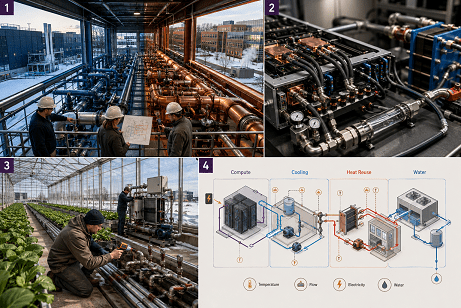
Data centers tend to operate continuously. Building heating demand varies by hour, season, occupancy, and climate. A district heating system in a cold region may offer a strong thermal match during winter. A nearby facility needing process hot water may provide steadier demand. A warm climate with little heating demand may produce a weaker case.
The Department of Energy’s energy-efficient data center design guide places heat recovery after component-level efficiency. DOE recommends reducing energy consumption inside the computing and facility systems first, then finding practical uses for recoverable heat.
DOE identifies several favorable conditions for heat reuse: a nearby heat consumer, compatible temperature requirements, supportive ownership or contractual arrangements, and a project structure that makes the recovered energy useful rather than merely measurable.
Redundancy remains part of the design.
A data center cannot depend on a neighboring office building to absorb its heat every hour of the year. Computing equipment still needs reliable cooling if the heat consumer shuts down, reaches temperature limits, or needs less thermal energy than expected. A successful system needs an alternate heat-rejection path.
This is why heat reuse belongs inside mechanical-system design rather than sustainability marketing.
Water Use Can Change The Best Cooling Choice
Energy is only one resource affected by cooling architecture.
Evaporative cooling towers can achieve efficient heat rejection, yet they consume water through evaporation and require blowdown to control mineral concentrations. Water availability can make an otherwise efficient cooling design unattractive in a dry or water-stressed location.
DOE uses water usage effectiveness, or WUE, to relate annual site water consumption to IT energy use. Its guidance on data center cooling water efficiency describes several strategies involving operating temperatures, economizers, cooling-tower management, direct liquid cooling, and hybrid heat-rejection systems.
The sustainability tradeoff can shift from site to site.
A cooling configuration that lowers electricity demand may consume more water. A dry-cooling approach may reduce water demand yet require different equipment or operating conditions. Reverse-osmosis treatment can allow some cooling water to be reused, but the treatment process consumes energy and creates new maintenance needs.
Industrial water reuse creates another option. The U.S. Environmental Protection Agency’s updated 2026 industrial water reuse resources identify data-center cooling as one application where treated municipal wastewater or suitable reclaimed process water can replace some freshwater demand.
A credible green data-center project needs to track those resource exchanges rather than optimizing one sustainability metric in isolation.
MRV Determines Whether Heat Reuse Delivers What Was Promised
Measurement, reporting, and verification become central once waste heat is treated as an energy resource.
Operators need measurements for IT electricity consumption, cooling-system energy, water consumption, coolant temperatures, flow rates, heat transferred to external loads, and the energy that the recovered heat replaces.
That final point is easy to overlook.
Delivering thermal energy to a nearby building does not automatically equal the same amount of avoided fossil-fuel or electrical consumption. The baseline heating system, distribution losses, heat-pump requirements, seasonal operating conditions, and controls all affect the real result.
Metrics such as PUE, WUE, and energy reuse effectiveness can help operators separate computing demand, facility overhead, water consumption, and recovered energy. None tells the complete sustainability story alone.
Good MRV makes the system auditable.
Operators should be able to show where thermal energy was measured, what temperature and flow conditions existed, how much heat reached the receiving system, what equipment would otherwise have supplied that heat, and how operating changes affected the comparison.
This evidence protects heat-reuse projects from greenwashing claims built around theoretical recovery capacity rather than measured performance.
Why Higher-Temperature Cooling Deserves More Field Testing
The August 2026 NLR work gives data-center designers a useful research direction: raising liquid-cooling temperatures may improve heat usability, reduce dependence on mechanical cooling equipment in suitable climates, and lower water demand in certain configurations.
The next question is how those modeled benefits perform across more real facilities.
AI inference centers, high-performance computing sites, edge facilities, enterprise data centers, and hyperscale campuses do not share identical thermal loads or reliability requirements. Heat consumers differ just as much. A campus laboratory has a different thermal profile from an apartment district, greenhouse, hospital, or industrial plant.
That variation means high-temperature liquid cooling should be evaluated as a systems-engineering option, not a universal sustainability formula.
The strongest projects will connect computing hardware, liquid cooling, water strategy, heat recovery, nearby demand, backup heat rejection, and MRV from the design stage.
Data centers will continue producing heat whenever they compute. Green technology has an opportunity to treat part of that thermal output as a resource rather than an unavoidable waste stream.
Whether that opportunity produces measurable environmental value depends on what happens after the heat leaves the server.