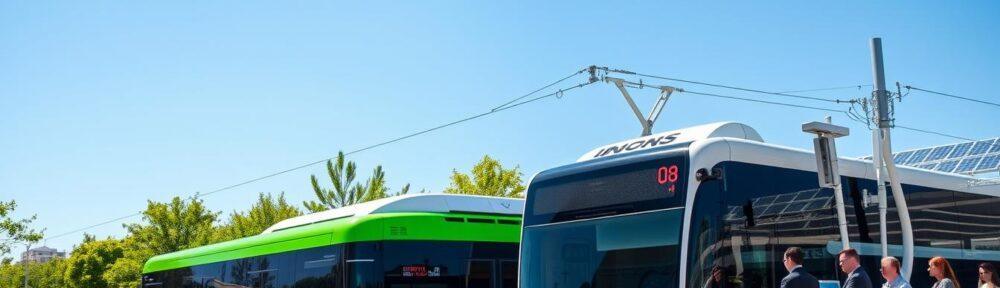
Why are cities from Montgomery County to Mumbai suddenly obsessed with e-bus fleets? It’s not just about looking good for the cameras—though let’s be real, that environmental street cred doesn’t hurt.
Diesel buses idling outside schools pump carcinogens at kid-level while burning cash fast. Electric buses are the quiet, efficient cousins. They show up with good manners and even better ROI.
Montgomery County’s experience proves it: lifetime emissions drop 62%—equal to removing 3,500 cars yearly. And when you add maintenance and fuel savings? The math gets as satisfying as a well-timed meme nod.
This shift isn’t just eco-friendly—it’s financially brilliant. For deeper insights into how utilities can back this movement, explore strategies for supporting electric transit infrastructure.
System Planning: The Art of Not Running Out of Juice
Planning an electric bus system is like trying to assemble IKEA furniture blindfolded. You think you know what you’re doing until you’re left with extra screws and a wobbly future. It’s where dreams of zero emissions meet the cold, hard reality of physics and municipal budgets.
Route Analysis: More Than Just Drawing Lines on Maps
Route analysis isn’t just about connecting dots on a map. It’s about understanding the city’s circulatory system. Montgomery County didn’t just look at maps – they studied the why behind every turn.
Their Ride On extRa and Flash services became living laboratories. They tracked how real people move in real time. Because let’s be honest – a route that looks good on paper might actually be the transportation equivalent of a Netflix series that gets canceled after one season.
Duty Cycles
Duty cycle modeling is where the magic happens. Or where the nightmares begin. It’s not just about distance – it’s about hills that make engines weep, traffic patterns that test sanity, and weather that laughs at your range estimates.
Think of it as fortune-telling with math. Will your bus make it up that hill in January with the heat blasting? Duty cycle modeling gives you answers before you’ve wasted millions on the wrong equipment.
Charging Strategy
Charging strategy separates the pros from the amateurs. Depot charging? Essential. On-route charging? The secret weapon. Montgomery County’s MCPS depot infrastructure became the backbone, while strategic on-route charging stations acted as safety nets.
It’s about creating a charging ecosystem that’s more reliable than your favorite coffee shop’s Wi-Fi. Because nobody wants to explain why the 5 PM bus became a stationary art installation.
| Charging Type | Best For | Cost Factor | Flexibility Score |
|---|---|---|---|
| Depot Charging | Overnight operations | High initial investment | Low |
| On-route Charging | High-frequency routes | Moderate infrastructure costs | High |
| Opportunity Charging | Layover points | Variable depending on location | Medium |
The county treats their transition plan as a living document – government speak for “we’re smart enough to know we don’t know everything.” It evolves as real-world data punches theory in the face. Because in the world of electric transit, the only constant is change. And the occasional flat battery.
Procurement and Financing Models
Buying buses used to be like picking out a new car. You’d test drive, look at features, and even debate cup holders. But now, electric bus buying is more like a financial challenge. It’s about navigating funding obstacles with skill and precision.
The game has changed a lot. Agencies now see financing as a puzzle to solve. They use new models that make old ways seem outdated.
Buy vs Lease
Buying or leasing electric buses has its own set of challenges. Buying means a big upfront cost but gives you full control. Leasing spreads out costs but has its own set of rules.
Electric buses last longer and cost less to run than diesel ones. This changes how you think about costs. Agencies can save up to 30% in the first year.
Key consideration: Battery warranties. Most makers promise 70-80% battery life after 8-10 years. This affects both the purchase price and lease deals.
Bus-as-a-Service
Bus-as-a-Service (BaaS) is like Netflix for public transit. It offers a monthly subscription for all your transit needs. You get vehicles, charging, and maintenance in one easy payment.
Montgomery County Public Schools used BaaS and saved money right away. They didn’t pay upfront, just for using the buses. It’s like leasing but better.
The best part? You don’t worry about maintenance or new tech. The provider handles all that. You just get reliable, clean transport.
Grants
Getting grants used to be hard. Now, it’s a strategic game. The FTA Low-No program gives out millions for green projects. But agencies don’t stop there.
They use grants, state incentives, and more to cover costs. Maryland Energy Administration offers big help. The key is to plan ahead and apply on time.
Successful agencies always look for grants. They don’t wait until the last minute.
| Financing Model | Upfront Cost | Long-term Risk | Best For |
|---|---|---|---|
| Direct Purchase | High | Medium | Agencies with capital |
| Traditional Lease | Low | High | Short-term needs |
| Bus-as-a-Service | None | Low | Most agencies |
| Grant-Funded | Variable | Low | Strategic planners |
The AlphaStruxure partnership in Montgomery County shows smart thinking. They offered a microgrid solution at no upfront cost. It included everything you need for electric buses.
This isn’t just about money. It’s about finding the right mix of funding. The best plans use different models to create a perfect solution. They might use grants for buses, BaaS for charging, and operating funds for upkeep.
The key is to think outside the box. The best electric bus plans mix different models. They make sure you get all the benefits without the surprises.
Depot and Facility Design
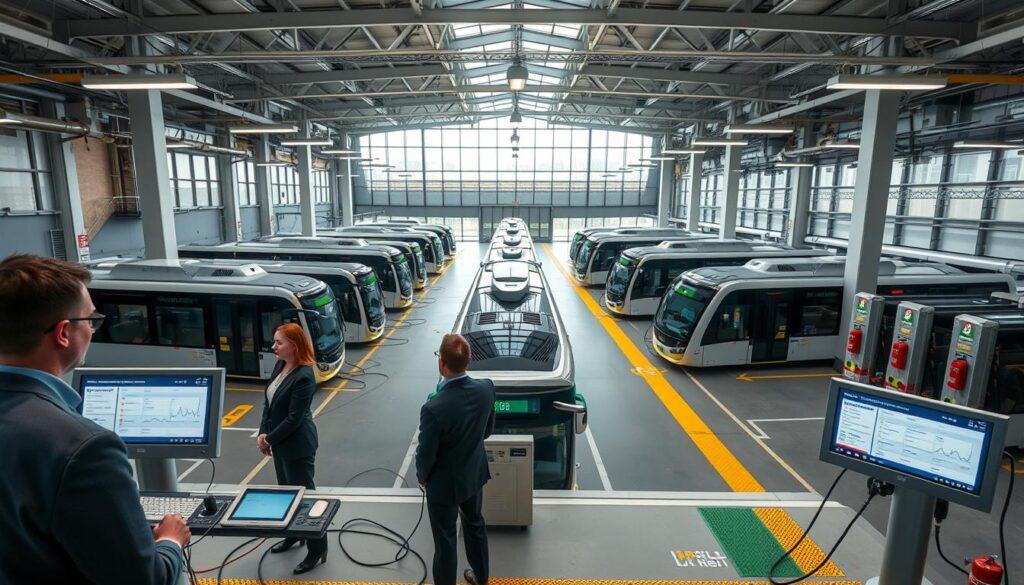
Designing an electric bus depot is like planning a spaceship landing and a Broadway show at the same time. It needs enough power for a small city, the space planning of Tetris, and safety that rivals a nuclear submarine.
Power Needs
Forget about just adding a few outlets. We’re talking about power needs that dwarf rock concert venues. The Brookville Smart Energy Depot’s 6.5 MW microgrid with solar canopies and battery storage could power a music festival.
Montgomery County’s Bethesda depot has 45 fast chargers that draw more power than some neighborhoods. This is not just charging infrastructure – it’s electrical engineering on steroids.
Layout
Creating the perfect depot layout is like making a Swiss watch and playing chess at the same time. Those charging cables are not your grandma’s extension cords – they’re thick enough to trip a football team.
Every square foot is important when you’re dealing with:
- Bus parking with military precision
- Charging station placement that minimizes cable spaghetti
- Emergency access routes wide enough for fire trucks
- Maintenance bays that don’t become obstacle courses
Safety
Safety protocols have evolved from “don’t spill diesel” to sophisticated electrical management systems. We’re dealing with enough electricity to make Frankenstein’s monster look like a static shock from a doorknob.
Modern depot charging systems include:
- Real-time electrical monitoring that’s more thorough than a TSA pat-down
- Automatic shutdown protocols for faults
- Ground fault protection that’s more sensitive than a food critic
- Worker training that makes electricians feel like brain surgeons
Firefighting
Water and electricity have a complicated relationship, like two celebrities who can’t decide if they’re dating or feuding. Lithium-ion batteries add dramatic tendencies that would make Shakespeare proud.
Specialized suppression systems understand that these fires aren’t your grandfather’s garage blaze. We’re talking about thermal runaway events that require:
| Fire Type | Traditional Response | Electric Vehicle Response |
|---|---|---|
| Electrical Fire | Water (risky) | Class C extinguishers |
| Battery Thermal Runaway | More water (worse) | Specialty suppressants |
| Combination Fire | Panic | Pre-planned protocols |
The right charging infrastructure includes fire suppression that’s smarter than your average bear and more specialized than a Michelin-starred chef. Because when lithium-ion batteries decide to misbehave, they don’t do it quietly.
Operations and Maintenance
If electric buses were a rock band, operations would be the road manager. They make the tour happen, while others get the credit. This is where planning meets reality, without the diesel fumes and with fewer mechanical issues.
Scheduling
Remember trying to charge your phone at a festival? Now imagine coordinating 50 electric buses with NASA precision. Traditional scheduling gets a shock.
Schedule optimization is now about working with the electrical grid. It’s like playing Tetris with charging windows and route demands. Montgomery County’s Ride On system showed this during the pandemic, keeping buses running when everything else failed.
- Charging windows versus service hours
- Peak electricity rates avoidance
- Route energy consumption patterns
- Emergency response scenarios
Telematics
Forget simple GPS tracking. We’re talking about energy management systems that predict range better than your weather app. These systems monitor battery health and driver efficiency.
Modern telematics turn data into useful information:
- Real-time energy consumption monitoring
- Predictive maintenance alerts
- Driver behavior analysis
- Charging station status updates
Spare Ratio
The spare ratio calculation changes. It’s no longer about how many buses might break down. It’s about how many might need emergency charging during peak hours. This is a new kind of math.
Traditional spare ratios are around 20%. With electric fleets, you balance:
- Charging infrastructure availability
- Battery degradation rates
- Peak service demands
- Maintenance downtime patterns
Training
Mechanics become battery whisperers, and drivers learn the accelerator isn’t an on/off switch. MCPS turned diesel specialists into electric experts.
Training covers:
- High-voltage system safety protocols
- Battery management systems
- Regenerative braking techniques
- Emergency response procedures
Yard management becomes a strategic ballet. Charging sequence, vehicle positioning, and energy distribution need a conductor who loves electricity.
The beautiful part? Electric operations achieve reliability that would make Swiss trains jealous. Fewer moving parts, predictable energy needs, and smart schedule optimization create a system that hums quietly.
Rider Experience and Accessibility
Remember that awkward first date where you tried to talk over a jackhammer? That’s what traditional buses are like. Electric buses change everything. The silence is the first thing you notice – no loud engine, no grinding gears. It’s smooth and quiet, like a library.
Then, you can actually hear yourself think. Or have a conversation without shouting. It’s like going from a flip phone to a smartphone. Once you experience it, you can’t go back.
The real magic is in the amenities. We’re talking WiFi that actually works – not that pretend “connected-but-can’t-load-anything” stuff. USB ports that charge your phone faster than your wall outlet at home. And bike racks so easy to use, you don’t need an engineering degree.
Montgomery County’s Flash service has already moved over 500,000 riders in this new reality. But here’s the smart part: accessibility isn’t an afterthought. It’s the main event.
City Post smart kiosks give real-time info in nine languages. Knowing when your bus arrives shouldn’t need fluency in bureaucratic nonsense. These aren’t just transportation upgrades – they’re mobile community infrastructure that respects its users.
| Feature | Traditional Bus | Electric Bus | Impact on Riders |
|---|---|---|---|
| Noise Level | 85-90 dB (jackhammer range) | 60-65 dB (normal conversation) | Reduced stress, easier communication |
| Air Quality | Diesel exhaust fumes | Zero emissions | Better breathing, cleaner environment |
| Technology | Limited or no connectivity | Reliable WiFi & USB charging | Productive travel time |
| Accessibility | Basic compliance | Multi-language real-time info | Inclusive for all riders |
| Ride Quality | Jerky acceleration | Smooth, linear power | More comfortable experience |
For seniors and disabled riders, the lower floors and smoother acceleration are game-changers. The reduced vibration means less pain for those with mobility issues. The quiet operation reduces sensory overload.
This isn’t just about getting from point A to point B. It’s about dignity. It’s about creating public spaces that don’t punish you for using them. Electric buses transform transit from a necessary evil into something approaching… pleasant.
Who knew public transportation could actually respect your time, your devices, and your eardrums? It turns out the future of transit isn’t just electric – it’s actually civilized.
Equity and Community Benefits
Forget ESG buzzwords – transit electrification grants deliver real justice where diesel exhaust hits hardest. These aren’t just ideas for the future. They bring immediate health improvements to communities that have suffered from pollution for decades.
Imagine this: asthma rates near schools drop within months of electric buses arriving. Fewer emergency room visits for breathing problems. Lower cancer risks from no diesel particles. This is real in communities that have switched to electric.
Montgomery County’s Targeted and Specialized Mobility Grant Program shows how smart policy works. They use grants to help disabled, seniors, and low-income residents. This makes clean transportation accessible to all.
The data is clear. Schools near bus routes see asthma-related absences fall by up to 14% after switching to electric. Emergency room visits for asthma attacks also drop. We’re not just cleaning the air – we’re saving lives and keeping kids in school.
| Community Impact | Diesel Buses | Electric Buses | Improvement |
|---|---|---|---|
| Asthma rates near schools | 18% higher than average | 4% higher than average | 14% reduction |
| Emergency room visits (respiratory) | 27 per 1,000 residents | 19 per 1,000 residents | 30% decrease |
| Healthcare costs per capita | $4,200 annually | $3,500 annually | $700 savings |
| School attendance rates | 89% average | 93% average | 4% increase |
These grants show real progress in public policy. They’re not just for political points. They give communities the breathing room they need. It’s a win for the environment, economy, and health.
Smart cities know pollution hits some areas harder. With targeted grants, they can fix these issues. This leads to healthier communities, stronger economies, and real equity.
This approach makes clean transportation a must for public health. It’s not just being woke. It’s about facing the health problems that have been there for years.
KPIs, Reporting, and Verification
Welcome to the electric transit reality show. Here, data is king and numbers are the truth. What gets measured gets managed, and what gets verified gets funded. We’re not just talking about on-time performance anymore. We’re in the ESG big leagues.
Your KPIs are like the confession cam for your transit system. They show the real difference between success and failure. The best operators track everything from carbon emissions to maintenance savings.
Let’s look at some real numbers that matter. Montgomery County has reduced emissions by 160,000 tons over 25 years. That’s like taking 35,000 cars off the road forever. Their performance reporting is key to getting state and federal funding.
The smartest agencies focus on three key areas:
- Carbon accounting that converts kilowatt-hours to actual tons of CO2 saved
- Energy efficiency metrics comparing power consumption to passenger miles
- Maintenance cost differentials that prove electric beats diesel on total cost of ownership
Verification is about showing real results, not just numbers. Montgomery County’s reports build trust with stakeholders. They’ve heard too many empty promises before.
The reporting requirements are like a season of The Bachelor – complicated but rewarding. Federal grants demand detailed performance tracking. State programs want verification that’s so thorough, it could pass a congressional hearing.
The secret is to treat your data like it’s going to be subpoenaed tomorrow. Transparency is not just good; it’s strategic. Agencies that win funding have reports so detailed, even skeptics become believers.
Your KPIs should tell a story that convinces even the most skeptical board member. That’s how you turn data into political power and reports into victories.
Case Studies
Ever wonder what happens when electric transit theory meets real-world practice? Sometimes reality wins with spectacular results that even the most optimistic projections didn’t see coming.
Let’s examine four Montgomery County implementations that prove electrification isn’t just possible – it’s already working at scale with measurable outcomes that silence the skeptics.
The Brookville Smart Energy Depot stands as America’s largest solar bus charging project. This microgrid marvel doesn’t just power buses – it withstands grid outages like a superhero waiting for its moment. Think of it as the Batman of charging infrastructure: prepared for anything, powered by the sun, and quietly impressive.
Then there’s the MCPS electric school bus deployment. This program shows how creative financing can overcome budget constraints that typically stall electrification. They basically created a subscription model for clean student transportation. Who knew school buses could be as innovative as your Netflix account?
The operational success stories continue with Ride On’s extRa service. Celebrating five years of efficient service along Route 355, this system proves that electric buses can handle high-frequency routes without breaking a sweat. It’s the quiet overachiever that just keeps delivering.
Then we have the Flash rapid transit system. Moving 1,800 daily riders with frequency that puts some subway systems to shame, Flash demonstrates that electric transit isn’t just environmentally friendly – it’s operationally superior. The numbers don’t lie, and neither do the satisfied passengers.
| Project | Innovation | Scale | Key Metric |
|---|---|---|---|
| Brookville Depot | Solar microgrid charging | Largest in US | Grid outage resilience |
| MCPS School Buses | Subscription financing model | Multiple schools | Budget constraint solution |
| Ride On extRa | High-frequency electric service | Route 355 corridor | 5 years successful operation |
| Flash System | Rapid electric transit | 1,800 daily riders | Subway-level frequency |
These aren’t hypothetical scenarios or pilot programs waiting to prove themselves. They’re real-world examples operating today, in four different contexts, with results that speak louder than any theoretical debate about electric transit viability.
The data from these case studies provides something rare in transportation planning: actual evidence. When you can point to multiple successful implementations across different use cases, the conversation shifts from “if” to “when” and “how.”
Montgomery County’s electric transit case studies offer a blueprint that other municipalities can adapt. The lessons learned here transcend local geography and become universal principles for successful electrification. Sometimes the future arrives quietly on electric wheels, and it’s already here.
Workforce Development and Certifications
Remember when mechanics just needed strong arms and drivers just needed good reflexes? Those days are gone faster than a Tesla’s 0-60 time. Electric transit isn’t replacing jobs – it’s upgrading them for the digital age.
The wrench-wielding mechanic of yesterday now navigates diagnostic software that would make a Silicon Valley engineer proud. The gear-shifting bus operator has transformed into a range management expert who understands regenerative braking like Tesla owners understand autopilot.
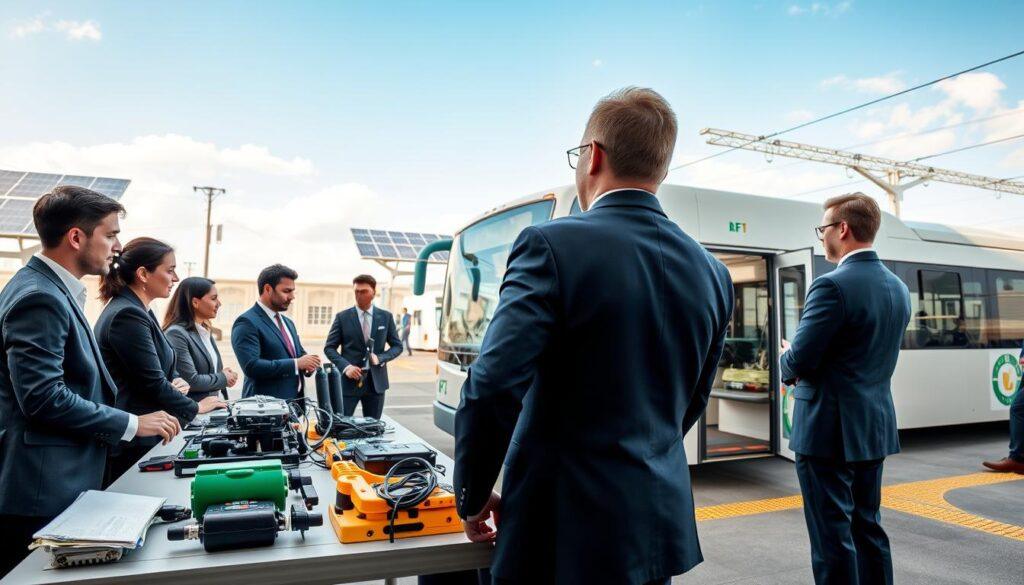
Montgomery County’s career pathways show this evolution in action. James DelaCruz didn’t get displaced by technology – he rode the electric wave from bus operator to Chief of Central Communications. That’s not job elimination; that’s career acceleration.
The certification requirements tell the real story. High-voltage system training isn’t your grandfather’s mechanic program. It’s more complex than most electrician certifications and pays well. These aren’t jobs that can be outsourced to another country – they require hands-on expertise with cutting-edge technology.
Here’s what modern transit workforce training looks like in practice:
| Traditional Role | Electric Evolution | Certification Requirements | Salary Impact |
|---|---|---|---|
| Diesel Mechanic | High-Voltage Technician | EV Specialist Certification | +28% average |
| Bus Operator | Range Management Specialist | Advanced Telematics Training | +15% average |
| Maintenance Supervisor | Energy Management Analyst | Charging Infrastructure Certification | +32% average |
| Parts Manager | Battery Systems Coordinator | Lithium-Ion Safety Certification | +24% average |
MCPS didn’t fire their mechanics – they sent them back to school. The Montgomery County Department of Transportation created advancement pathways that turn wrench-turners into tech-savvy problem solvers. Their training programs now include:
- High-voltage safety protocols that would make an electrical engineer nervous
- Battery management systems that require more computing power than your smartphone
- Charging infrastructure maintenance that’s part electrical work, part IT support
- Telematics diagnostics that look more like coding than traditional repairs
This isn’t workforce displacement – it’s workforce evolution. The jobs pay better, require more sophisticated skills, and can’t be automated away. The mechanic who once changed oil filters now optimizes energy consumption algorithms.
The driver who once memorized routes now manages regenerative braking patterns to maximize range. These are 21st-century skills with 21st-century paychecks.
Proper workforce training turns technological disruption into career advancement. It’s not about replacing people with machines – it’s about upgrading people to work with smarter machines. The future of transit employment isn’t fewer jobs; it’s better jobs.
Implementation Checklist
Your electric transit rollout needs a solid plan, not just a note. Start by analyzing routes for energy-draining hills. Duty cycle modeling is key to your success.
When buying, think like you’re playing cards. Grants should be stacked high. Depot design must balance power needs with flow. And don’t forget about those charging cables—they’re a tripping hazard.
Training your workforce is essential before the first bus arrives. Mechanics should learn on simulators, not real buses. Phased implementation, like Montgomery County’s growth from 14 to 70 buses, is wise.
MCPS’s use of multiple depots shows how to handle complexity. Pay attention to construction and procurement timelines. They’re more important than you think.
Lastly, be flexible. Even NASA plans for contingencies. Your electric future is waiting, but don’t skip any steps.