Welcome to the future, where buildings are not just structures but heroes in the fight against climate change. Imagine a world where your home doesn’t just consume energy but actively contributes to a greener planet. Sounds like a plot twist from a sci-fi movie, right? Well, it’s happening now, thanks to innovative technologies.
District and community initiatives are stepping up, transforming how we think about energy consumption. With a blend of smart strategies and cutting-edge solutions, these efforts are decarbonizing our buildings at an impressive scale. But what does this mean for you?
In a nutshell, it’s about reducing our carbon footprint while enjoying the comforts of modern living. Who wouldn’t want to live in a space that’s both eco-friendly and efficient? As we dive deeper into this topic, let’s explore how these systems work and why they matter.
Heat pump basics COP EER source sinks and thermal batteries
Understanding heat pumps is key to a sustainable future for our buildings. These devices use geoexchange to tap into the Earth’s underground temperature. This provides efficient heating and cooling. Imagine a heating system as reliable as your morning coffee.
The Coefficient of Performance (COP) and Energy Efficiency Ratio (EER) are important. They measure how efficient a heat pump is. A higher COP means you get more for your energy. The EER shows how well a cooling system works.
Why do these numbers matter? Using air-source units alone is like heating your house with a hairdryer in a polar vortex. Ground source heat pumps are like thermal batteries, using the Earth as a steady 55-degree savings account. This is not just about saving energy; it’s a way to change how we think about energy.
The U.S. Department of Energy says communities are starting to see the value of district geothermal systems. This is a big change for urban, suburban, and rural areas. Instead of heating each house separately, we can use our natural resources together.
Let’s treat the ground like a battery, not a place to bury our carbon sins. To learn more about HVAC innovations that save energy in green buildings, check out this article on HVAC innovations.
District loops ambient water networks with building side heat pumps
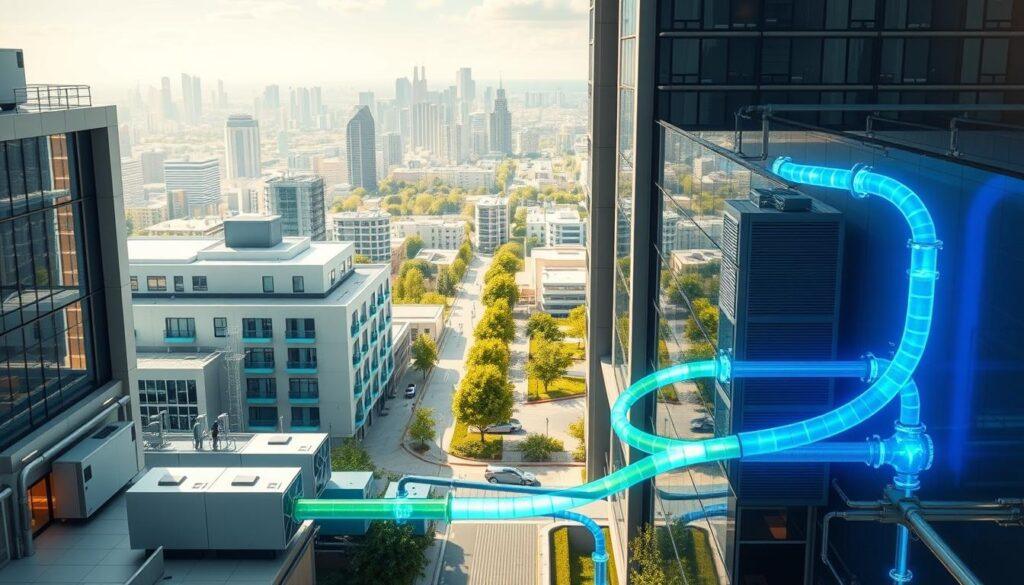
Think of ambient temperature loops as a social network for heating systems. Instead of competing, buildings work together. They share a water loop that goes through neighborhoods, providing thermal energy for all.
The Thermal Energy Network (TEN) is a big change. It sends thermal energy to connected buildings through pipes. Each building uses ground-source heat pumps to join the network, making heating and cooling better.
Imagine heating your home like streaming a show. Ambient temperature loops let buildings use a low-grade network for on-demand heating. It’s like having a “Netflix of heating” without the need for lots of fossil fuel equipment.
These networks also help buildings use renewable energy without stressing the grid. It’s a good deal for everyone: buildings get efficient heating and help make energy more sustainable.
Borefield design vertical horizontal energy piles seasonal storage
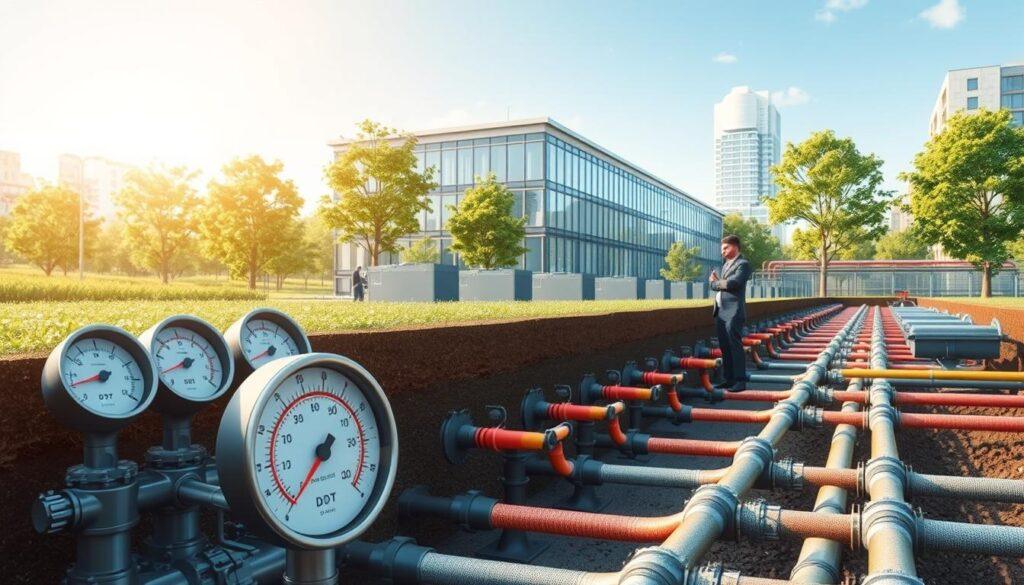
Borefields are key to geothermal systems, combining nature and human innovation. We have two main choices: drilling vertically or horizontally. Each method has its own benefits and challenges.
When designing borefields, we consider land, thermal conductivity, and cost. Vertical systems need less land but cost more due to deeper drilling. Horizontal systems are cheaper but require more land, a problem in cities.
Energy piles are a unique part of borefield design. They support buildings and act as heat exchangers. It’s like your foundation is also a geothermal system!
Seasonal storage is a big deal in geothermal systems. It stores summer heat for winter use. This cuts energy costs and boosts efficiency. Think of it as using summer’s heat to warm your home in January.
Let’s look at some examples:
| Location | System Type | Key Features |
|---|---|---|
| Ann Arbor, MI | Looped Geothermal | Efficiency improvements, rooftop solar, battery storage |
| Nome, AK | Direct-Use Geothermal | District-scale system for food storage heating and cooling |
| Various Locations | Energy Piles | Foundations that serve dual purposes |
In summary, borefield design is vital for geothermal systems. By choosing between vertical and horizontal drilling, using energy piles, and storing seasonal heat, we can meet our energy needs sustainably.
Retrofits for schools campuses hospitals and multifamily economics
Adding ground source heat pumps to buildings is smart and saves money. In Wallingford, CT, a district system will heat and cool over 50% of a 132-unit complex. New York City plans to use this tech in 25% of 5,000 apartments. Carbondale, CO, is working on a net-zero energy district with a school, library, and 20 homes.
Let’s talk about the “three Cs” of thermal perfection: consistent loads, concentrated ownership, and high utility bills. These make retrofitting old schools and hospitals with ground source heat pumps a wise choice. The cost of drilling more holes goes down as the project grows, thanks to economies of scale.
CFOs should care because it’s not just about saving the planet. It’s about keeping costs stable for housing and schools. The initial investment in these systems will save money in the long run, making it a smart choice for leaders.
Let’s look at the numbers. Here’s a comparison of different projects’ costs and payback times:
| Project Location | Units Served | Percentage of Load | Estimated Payback Period (Years) |
|---|---|---|---|
| Wallingford, CT | 132 | 50% | 5 |
| New York City | 5,000 | 25% | 6 |
| Carbondale, CO | 20 | 100% | 4 |
The “appliance-by-appliance” model is expensive and only the wealthy can afford to skip it. By using ground source heat pumps, we’re not just saving energy. We’re creating a more sustainable future.
Controls and metering tenants billing setpoints and demand response
Billing tenants for “coolth” from shared ambient temperature loops is complex. It’s like trying to understand a modern art piece. How do we make sure everyone pays their fair share when energy is shared? The answer is in BTU metering and its challenges.
Consider the following aspects:
- BTU Metering: Accurate measurement is key. Each unit of energy must be tracked carefully to prevent disputes.
- Tenant Billing: Thermal energy billing is different. It needs new rate models that show actual usage.
- Setpoints: The right temperature setpoints are important. They ensure comfort and save energy.
- Demand Response: A good system can adjust to grid needs. It acts like a demand-response asset.
Imagine a utility company adjusting the thermal storage of a hundred buildings. They do this to use a midday solar glut. It’s not just about saving energy; it’s like having a huge battery in real estate.
The Building Decarbonization Coalition suggests new rate models. These models support building decarbonization. They include:
- All-electric and thermal energy rates
- Reforming the “obligation to serve” for gas dual fuel utilities
Construction sequencing drilling noise spoils safety and remediation
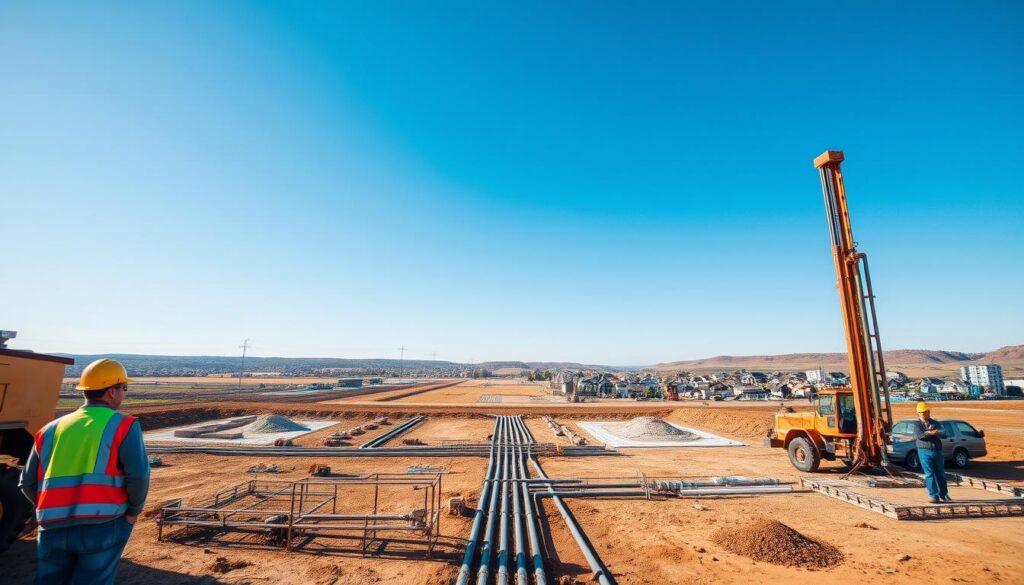
Let’s explore the challenges of building borefields in tough spots. Installing borefields is tough and noisy. Imagine drill rigs making a lot of noise in back alleys.
Managing dirt and rock slurry is key. You don’t want a school playground to turn into a mud pit. Sequencing is important. It’s like a ballet where every move matters.
You can’t start drilling without a plan. This is true in cities or remote places like Nome, AK. The success of a geothermal project depends on the drilling team’s skill. They must avoid gas mains and other obstacles.
Safety and fixing problems are not just extra steps. They are essential. Ignoring these can lead to lawsuits. In Nome, where the ground is frozen, every step is critical. It’s not just about drilling holes; it’s about keeping the ground safe for the future.
To understand the challenges better, here’s a table:
| Consideration | Description | Challenges |
|---|---|---|
| Sequencing | Order of operations for drilling and installation | Potential noise complaints and disruptions |
| Noise Management | Strategies to minimize noise during drilling | Community relations and scheduling |
| Spoil Handling | Managing dirt and rock slurry effectively | Environmental impact and disposal |
| Safety Protocols | Ensuring worker and community safety | Compliance with regulations |
| Remediation | Restoring site post-construction | Long-term environmental monitoring |
In conclusion, building borefields is tough. But with careful planning, it can lead to a sustainable future. Geothermal projects can be heroes of energy efficiency when done right.
Policy incentives utility ownership models and IRA credits
In the world of geoexchange, policy incentives and utility models are key. President Biden’s Justice40 aims to give 40% of federal investment benefits to disadvantaged communities. This is not just kindness; it’s a smart move to upgrade our energy systems.
The Inflation Reduction Act (IRA) has changed the game for geoexchange. It’s not just a nod to renewables; it’s a big push for new ideas. But the real debate is at the state level, where utility ownership models are being discussed. Should gas utilities own thermal networks? If not, could they become outdated assets?
Let’s break this down:
- Utility Ownership Models: The debate on whether gas utilities should switch to thermal energy is key. This could be a smart move for a fair transition.
- Obligation to Serve Reform: Changing this rule is vital for utilities to fit into the new energy world.
- Justice40 Mandates: These rules are pushing projects in places like Shawnee, OK, and Chicago’s South Side. They aim to fix past wrongs, not just make the grid better.
Looking at these points, it’s clear that matching utility investments with climate goals is essential. The Building Decarbonization Coalition supports policies for utilities and cities to run thermal networks. This is key for a green future.
In conclusion, the mix of policy incentives, utility models, and IRA credits is a turning point in our energy shift. By going with these changes, we can create a fair and green energy world for all.
Workforce drillers HVAC techs controls engineers and commissioning agents
What good is a ground source heat pump if no one knows how to install or maintain it? The truth is, without skilled workers, these systems are useless. We lack drillers who know about thermal conductivity, HVAC techs who handle refrigerants, and controls engineers who speak Python and piping.
This isn’t just a workforce problem; it’s a survival issue for the industry. We need to lead with workers by working on policies for lasting jobs in decarbonization. It’s not just about filling spots; it’s about growing a workforce that can adapt and succeed in this new energy world.
Think about the commissioning agents—the unsung heroes of HVAC. They make sure systems work as they should, turning theory into practice. Their role is vital, yet often ignored. We must push for their recognition and support their education.
Turning gas fitters into pipe-fusion experts shouldn’t leave them without a job. Instead, we should give them the skills to move heat, not just molecules. If we don’t invest in this workforce, ground source heat pumps will be a luxury for a few. And the planet can’t afford that kind of luxury.
Case studies K–12 campus retrofit and new master planned community
Let’s explore two real-world examples where geothermal technology meets community needs. First, we have the ambitious retrofit project in Ann Arbor, MI. This project is a marvel of modern engineering. It connects an elementary school, a mental health facility, and 262 households with a looped geothermal system.
In contrast, the master-planned community in Carbondale, CO, takes a different approach. Here, geothermal heat pumps support a net-zero energy district. They cool and heat school offices, a library, 20 affordable housing units, and a center for nonprofits. It’s like laying down ambient temperature loops right alongside sewer pipes before the first foundation is even poured.
But let’s not overlook Middlebury, VT, where another geothermal system is set to meet at least 50% of the heating and cooling needs for a new affordable housing development. These projects show that geothermal technology scales effortlessly, whether you’re retrofitting or building from scratch.
Both case studies showcase the versatility of geothermal systems. The Ann Arbor retrofit is a heroic act of thermodynamic surgery. Carbondale’s new build achieves net-zero with almost smug ease. These examples prove that the transition to sustainable energy is not just theoretical but a practical reality that can be achieved across diverse settings.
Roadmap for city planners and utilities
City planners and utility leaders face a big challenge. They must act fast to meet the 2050 net-zero goal. The first step is to find thermal opportunity zones. These are areas needing new gas mains or upcoming projects.
It’s not about randomly digging holes everywhere. It’s about planning wisely.
They need to focus on electric, gas, and thermal energy systems working together. Funding for projects like Framingham, MA, can show how to do it right. These projects help overcome legal hurdles and build trust with the community.
Building strong relationships with local groups is key. It’s important to talk openly and listen well. This way, everyone can work together as the gas system shrinks.
Ambient loops and borefields can update old infrastructure. This prevents a messy collapse that hurts the most vulnerable.
This roadmap is more than a plan; it’s a call to action. City planners and utilities can lead in sustainable energy. Let’s take on this challenge and make our communities green leaders.