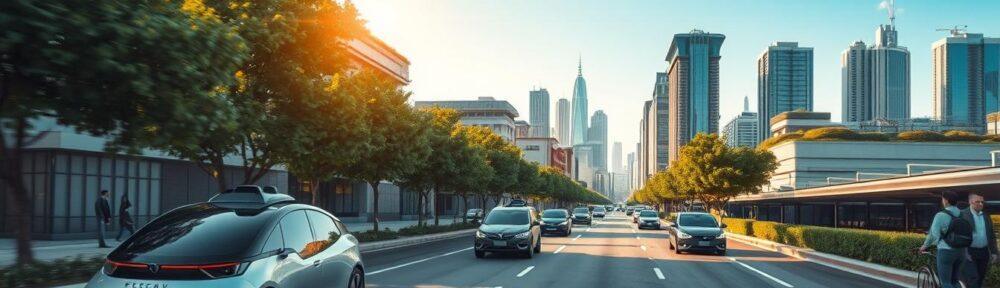
Remember when Silicon Valley promised us flying cars and personal jetpacks? What we’re actually getting is something far more practical—and potentially planet-saving. Instead of sci-fi fantasies, we’re witnessing the rise of incredibly smart, slightly cautious cars. These cars might just engineer a greener future while navigating our morning commute.
The real magic isn’t in removing the driver. It’s in removing human error. Our lead-footed acceleration, distracted braking, and generally inefficient driving habits waste energy on a massive scale. Autonomous systems replace this chaos with cold, calculating efficiency.
Think about it: algorithms don’t get road rage. They don’t accelerate toward red lights. By using predictive analytics and energy-optimizing controls, these machines smooth out traffic flow and reduce wasteful fuel consumption. This creates a cascade of environmental benefits that goes far beyond just getting from point A to point B.
I’ve been digging into the data from pilot projects, and the potentials are staggering. We’re looking at a future where mobility is not only driverless but significantly cleaner. The transition raises fascinating questions about how green self-driving cars actually are and what a truly optimized transportation system could achieve.
Forget dystopian robot narratives for a moment. The quieter revolution is in the code—the algorithms quietly maximizing every joule of energy. This isn’t just about getting a car to drive itself. It’s about driving an entire industry toward sustainability.
Fleet Electrification: Ride-Sharing Services, Autonomous Taxis, and Shared Mobility Models
Why own a car that’s mostly parked? You could use a service that offers clean, driverless rides when you need them. This isn’t just a dream; it’s the smart move in the green autonomous transport world. Self-driving cars and electric power are a perfect team, making things more efficient.
Think back to your last Uber ride. Now, forget the driver’s cost, which is a big part of what you pay. Electric cars are cheaper to run than gas ones. They also need less maintenance.
We’re moving from owning cars to using them like a service. This change makes transportation cheaper and more convenient. Places like Greenwich are testing electric, self-driving shuttles. They show it works well in real life.
Using shared autonomous electric vehicles is good for the planet too. They’re always moving, so they use resources better. This means fewer cars are built, which saves resources. And, they don’t idle in traffic, which cuts down on pollution.
Let’s compare the old and new ways. The old way is broken and wasteful. The new way is smart and efficient.
| Model | Key Cost Driver | Asset Utilization | Primary Environmental Impact |
|---|---|---|---|
| Traditional Ride-Hailing (e.g., Uber/Lyft with Driver) | Human labor (60-80% of fare) | Moderate (car is used but driver needs breaks) | High per-mile emissions from gas/hybrid fleet |
| Private Electric Vehicle Ownership | Upfront purchase, insurance, parking | Very Low (~5%) | Manufacturing footprint high; operational emissions low |
| Autonomous Electric Fleet (MaaS) | Electricity, maintenance, fleet management software | Very High (50-70%+) | Low operational emissions; optimized routing reduces congestion |
The table shows the big advantage. Without a driver, electric cars make more sense. They’re cheaper to run than gas cars. This will make the whole ride-sharing industry go green.
What does this mean for your city? Fewer parking lots could become parks or homes. Traffic might flow better because AI helps avoid jams. The autonomous electric vehicle is more than a car. It’s a way to make cities better, cleaner, and less crowded. The future is coming, and it’s quiet and green.
Traffic Flow Optimization: AI-Driven Route Planning and Congestion Reduction Algorithms
The ‘phantom traffic jam’ is soon to be a thing of the past. It’s caused by a single driver’s brake tap. If you’ve ever been stuck in a jam, you’ll love how machines can move better.
Human drivers are emotional and competitive. They create traffic jams. But, autonomous vehicles can move like a school of fish, smoothly and efficiently.
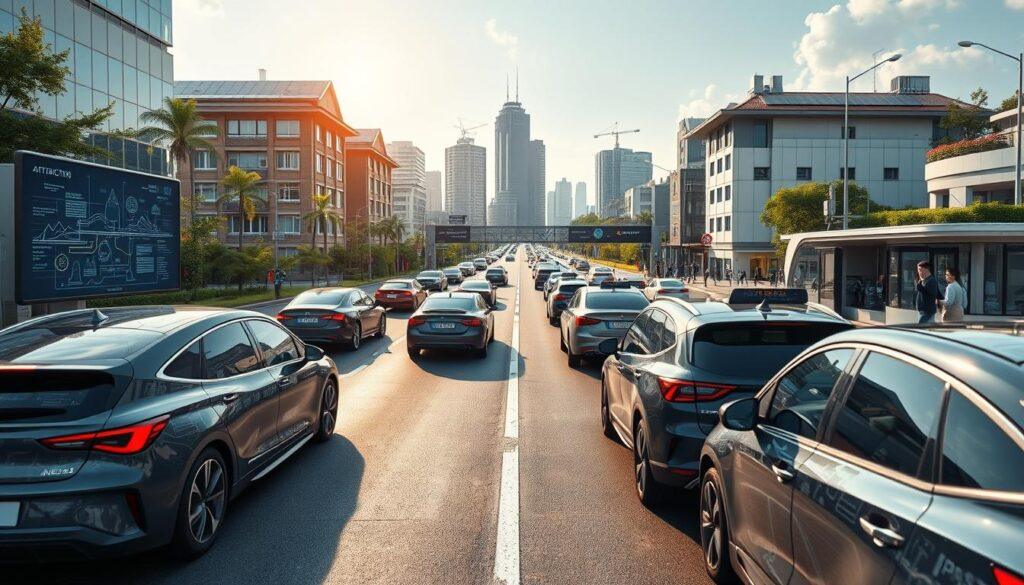
This isn’t just about one car finding a shortcut. It’s about a centralized AI controlling the whole city. Each car shares its info with the network. This way, the system finds the best flow for everyone.
Waseem Sayegh says this is a big step in reducing traffic jams. It makes driving smoother for all.
Imagine an intersection without traffic lights. AVs talk to each other and the city, smoothly passing through. They adjust their speed to avoid stops.
This smooth motion is key to saving energy and reducing pollution. It means less fuel waste and fewer emissions.
The AV environmental impact is huge. Cleaner air and less pollution are the results. It’s all about making traffic flow better.
This is self-driving car sustainability at its best. It turns traffic into a collective puzzle. The city breathes better, thanks to smart cars.
Energy Efficiency Algorithms: Predictive Driving, Regenerative Braking, and Battery Optimization
Imagine a self-driving car saving energy by solving calculus problems in real-time. This is the heart of self-driving car sustainability. It’s all about saving every joule of energy.
Human drivers often waste energy by braking hard and accelerating fast. But, an autonomous vehicle is a total energy saver. It uses energy efficiency algorithms to cut down on waste.
This isn’t just cruise control. It’s like having a crystal ball for driving. The AI uses maps, traffic data, and terrain info to predict the road ahead.
It knows about red lights and hills before they happen. So, it slows down early, saving energy. This smart driving cuts down energy costs a lot.
Regenerative Braking: Turning Stop Signs into Power Stations
Electric vehicles can turn braking into energy. Humans often brake too late and hard, losing energy as heat. But, an autonomous system brakes perfectly, saving energy.
It brakes smoothly, capturing energy and charging the battery. This is key to eco-friendly AV technology. It turns waste into useful energy.
Battery Optimization: Playing the Long Game
The life of an EV’s battery is critical. An autonomous vehicle takes care of its battery like a best friend. It uses smart battery optimization to keep the battery healthy.
It avoids fast charging when it’s too hot or cold. It might even slow down on hot days to protect the battery. This extends the battery’s life, helping the environment.
| Algorithm | How It Works | Human Driver Comparison | Sustainability Impact |
|---|---|---|---|
| Predictive Driving | AI analyzes road ahead (hills, traffic, lights) to perfectly modulate speed, minimizing acceleration and hard braking. | Reactive. Accelerates toward red lights, brakes hard. “Jackrabbit” starts. | Reduces energy waste by 10-20%, lowering emissions and electricity consumption per mile. |
| Regenerative Braking | Precisely times braking to maximize kinetic energy recapture, feeding electricity back to the battery. | Inefficient. Often brakes late and hard, losing most kinetic energy as heat. | Recaptures up to 70% of braking energy, directly extending driving range and reducing grid demand. |
| Battery Optimization | Manages battery temperature, charging speed, and discharge cycles to minimize long-term degradation. | Unmanaged. Often uses fast chargers indiscriminately, ignores battery health for convenience. | Can extend battery lifespan by 25% or more, reducing resource extraction and manufacturing emissions over the vehicle’s life. |
The goal of self-driving car sustainability is in the small details. It’s about turning hills into free charges and jams into rest periods. This isn’t just eco-friendly; it’s smarter driving. The car’s brain is always finding ways to save energy, making your driving greener and your wallet happier.
Urban Planning Integration: Smart Cities, Reduced Parking Needs, and Land Use Transformation
What if the biggest win from self-driving cars isn’t the cars themselves? It’s the city they help rebuild. The AV environmental impact is just the start. The real magic is in the city’s transformation.
We’ve built our world around cars. Cities are designed for parking lots and gas stations. As Guillermo Campoamor says, they need a complete overhaul.
Enter the shared autonomous fleet. Cars in constant use mean less need for parking. Jonathan Valladares says parking lots and garages could shrink a lot. This changes how we use space.
So, what replaces all that asphalt? The possibilities are exciting. City planners have a chance to rethink urban spaces. Valladares suggests using parking lots for parks, housing, or community spaces.
This is where green autonomous transport meets smart city design. Future infrastructure will communicate with cars. Dynamic curb space and smart traffic lights will improve flow.
The environmental benefits are huge. Using land for green spaces cools cities. More parks and walkable communities mean less need for cars. It’s sustainability through subtraction.
Let’s compare the transformation:
| Urban Land Use | Traditional City Model | AV-Integrated Smart City | Primary Sustainability Gain |
|---|---|---|---|
| Central Business District | ~30% dedicated to parking | Dynamic curb zones & green corridors | Reduced heat, increased pedestrian space |
| Suburban Commercial | Seas of surface parking | Mixed-use development & housing | Higher density, shorter trips |
| Residential Streets | Cars parked on both sides | Wider sidewalks & micro-mobility lanes | Safer, cleaner neighborhood air |
| Transportation Hub | Large rental car lots | Consolidated AV fleet hubs | Land reclaimed for public use |
This shift is more than just logistics. It’s a change in how we use space. For decades, cars ruled. Now, it’s time for people to take back the city. This move aligns with sustainable architecture trends that focus on people, not cars.
The real AV environmental impact might be invisible. It’s not just cleaner air. It’s the park where a parking lot once was, the housing where a garage once sat, and a city built for people.
Safety and Sustainability Intersection: Accident Reduction, Insurance Models, and Lifecycle Benefits
The insurance world is on the verge of a big change, thanks to self-driving cars. We often talk about safety and self-driving car sustainability separately. But with AVs, they’re deeply connected.
Think about what happens when a car crashes. It’s not just the traffic jam and insurance talk. There’s also a lot of waste. New parts are made, shipped, and installed.
Now, let’s talk about AVs. Early data shows they cause fewer accidents. This isn’t just about saving lives. It’s also about saving resources.
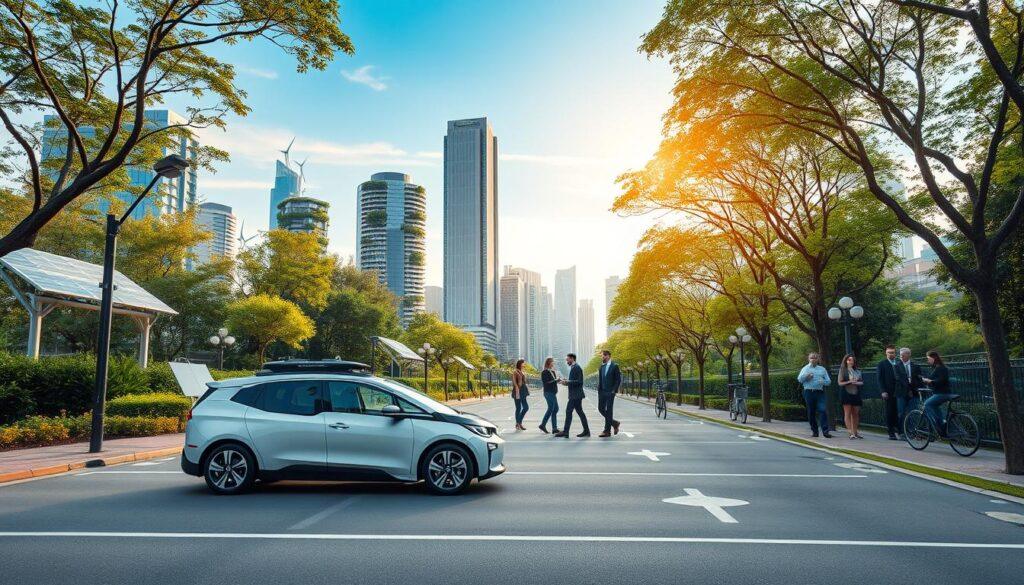
This change also shakes up the insurance world. The old model relies on human mistakes. With AVs, that changes. Potential cost savings could be huge, and insurance could focus on new areas.
AVs also let car designers think differently. They can make cars lighter and more efficient. This means cars use less energy to move.
Let’s look at the whole life of an AV. There’s a cost for the tech upfront. But, it’s worth it for decades of safe driving and lower energy use.
| Aspect | Traditional Vehicle | Autonomous Vehicle (Projected) | Sustainability & Safety Win |
|---|---|---|---|
| Primary Accident Cause | Human error (~94% of crashes) | System failure / edge cases | Dramatic accident reduction reduces resource waste. |
| Post-Accident Resource Flow | High: parts manufacturing, shipping, repair labor. | Very Low: mainly software checks and minor swaps. | Big cut in carbon footprint from industry and logistics. |
| Insurance Model Basis | Driver history, age, vehicle type. | Software reliability, fleet data, cybersecurity. | Lower risk means lower costs and new green investments. |
| Design Flexibility | Limited by safety standards. | More freedom for safety, leading to lighter, more efficient cars. | Lighter cars use less energy. |
| Lifecycle Carbon Analysis | High emissions from use, moderate from making. | Higher making, much lower use and waste. | Long-term net positive AV environmental impact. |
This is about thinking big for the environment. AVs aren’t just cleaner cars. They avoid accidents, reduce waste, and free up space. The ‘safe’ car is also the greener one.
The green car sector is growing fast. AVs bring predictability to the mix. This means safer roads and a more efficient, less wasteful transportation system. That’s the real revolution we’re seeing.
Manufacturing Innovations: Sustainable Materials, Circular Economy, and Carbon-Neutral Production
The green revolution in transport is more than just about emissions. It’s also about what happens before a car moves. The real test of eco-friendly AV technology is in the making, not just on the road. We need to look at the whole life of a vehicle, from start to end.
Car makers are now seeing cars as more than just vehicles. They’re looking at the whole environmental impact. They’re using recycled aluminum and bio-composites for parts. This cuts down energy use and waste.
This change is not just about materials. It’s a big shift in how we think. Pascal BORNET says we should aim to prevent carbon emissions, not just offset them. This means designing systems that don’t waste anything.
For green autonomous transport, this means making cars that can be used over and over. Every part is made to be easily fixed or recycled. This is a big change from old ways of making cars.
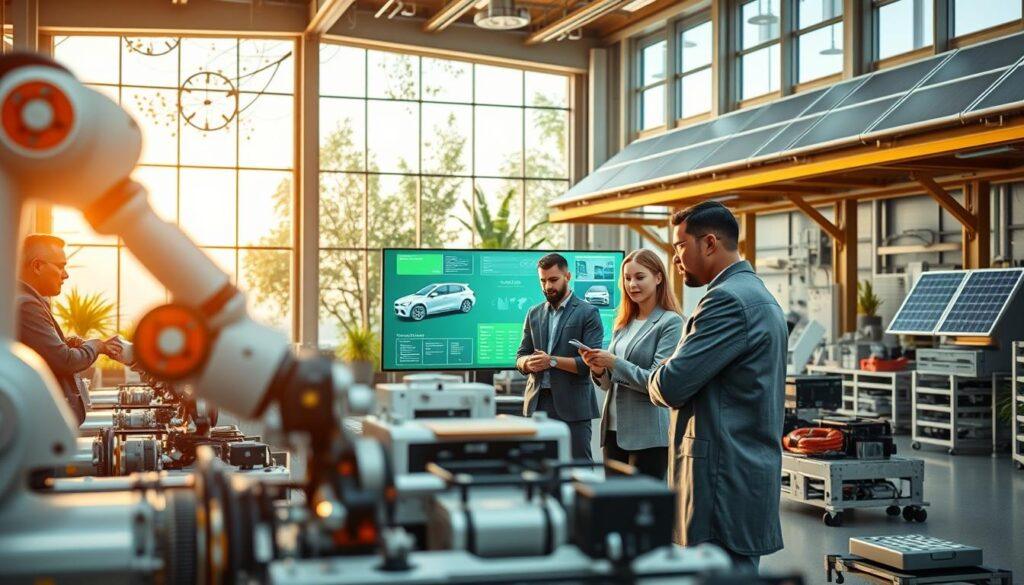
Also, making advanced parts like LiDAR sensors uses a lot of energy. To be truly green, factories need to be carbon-neutral. Companies like Tesla and Rivian are working on this. They want to cut emissions right at the source, not just later.
Let’s compare old and new ways of making cars. The table below shows the big changes in sustainable AV manufacturing.
| Innovation Area | Traditional Automotive Approach | Sustainable AV Manufacturing Approach | Primary Environmental Benefit |
|---|---|---|---|
| Materials Sourcing | Virgin metals, virgin plastics | High-content recycled metals, bio-based polymers | Reduces mining, lowers embodied carbon |
| Production Energy | Grid power (often fossil-fuel based) | On-site renewables (solar, wind), purchase of certified green energy | Eliminates operational carbon footprint |
| Product Design | For assembly speed and cost | For disassembly, repair, and material recovery | Enables circular economy, minimizes landfill waste |
| End-of-Life Strategy | Landfill or downcycling (e.g., shredding) | High-value component remanufacturing, closed-loop material recycling | Preserves resource value, eliminates waste |
The green in green autonomous transport must be real, not just a label. It needs a new way of thinking, a new supply chain, and new factories. When done right, the most sustainable thing about a self-driving car is its ability to be reused. This is how we build a future that’s not just moving, but also sustainable.
Technology Stack Overview: Sensors, AI Processing, and Edge Computing for Autonomous Systems
The future of transport is not magic, but a mix of sensors, silicon, and smart algorithms. Let’s explore the tech behind green autonomous transport. It’s not magic, but a well-designed system that makes it efficient.
The tech stack is like a three-layer cake. The bottom layer is the car’s senses. The middle is the AI brain. The top is the platform where decisions are made. This stack makes sustainability a key part of the design.
An autonomous electric vehicle has more than just a camera. It has many sensors for a superhuman view. LiDAR creates detailed 3D images, radar works in bad weather, and cameras read signs and detect people.
These sensors used to be very expensive. But now, thanks to Guillaume Gerondeau, they’re cheaper and better. This makes green autonomous transport more accessible.
But, raw data is just noise. The real magic happens in the AI brain. Here, deep learning models work fast and smart. Garima Mehta says it goes from seeing things to predicting their actions.
Every second, tons of data are processed. The AI doesn’t just see a cyclist; it knows where they’ll go. This is all about efficient algorithms. Better algorithms mean less energy used, which means more miles per charge.
Where does this thinking happen? In the vehicle’s edge computing system. This system processes most data locally. It’s fast and saves a lot of energy.
Cloud servers use a lot of energy. Processing data locally cuts down on that. It makes each car a small, efficient computer. For autonomous electric vehicles, this is a big win.
A cheaper sensor suite gathers better data. Efficient AI algorithms use that data with little power. Edge computing keeps the work local and saves energy. This cycle makes the tech stack more sustainable.
This means vehicles can go farther on one charge. It means less energy is used for autonomy. It shows that sustainability is built into the tech.
The barrier isn’t sci-fi fantasy. It’s engineering, getting better and cheaper every day. The path to a cleaner, self-driving future is paved with smarter code and efficient chips. Now that’s a revolution you can compute.
Regulatory Landscape: Safety Standards, Environmental Compliance, and Testing Protocols
Before an autonomous electric vehicle can save the planet, it must first pass a gauntlet of bureaucrats, engineers, and lawyers. They argue over what ‘safe’ and ‘green’ even mean. Welcome to the regulatory thunderdome. It’s a space where the idealistic goals of eco-friendly AV technology crash headfirst into the pragmatic need for proven, failsafe systems. No revolution happens in a legal vacuum.
The safety track is the loudest, and for good reason. One high-profile glitch can set public trust back a decade. Regulators aren’t just asking, “Can this car avoid a pedestrian?” They’re probing, “Can its AI handle a sudden blizzard or a cyberattack?” The answer requires a new breed of certification, moving beyond crash tests to algorithm audits.
Then there’s the environmental track. It’s the quieter, more complex cousin. How do you measure the carbon footprint of a decision-making process? Certifying that an AI driver is not only safe but also an energy-sipping virtuoso is the next frontier. This means baking efficiency metrics—like predictive driving and regenerative braking patterns—directly into the approval checklist for autonomous electric vehicles.
Governments are scrambling to build this dual-track framework. The U.K. published a new code of practice for autonomous trials. California has its own playbook. These documents are the first drafts of a new social contract. They aim to answer Jonathan Valladares’s big question: it’s not if autonomous systems will dominate, but “how fast regulations, infrastructure, and human roles will adapt.”
The global approach, though, is far from uniform. The cultural battle between innovation and precaution defines the pace.
| Region/Entity | Primary Regulatory Focus | Testing Philosophy | Notable Framework |
|---|---|---|---|
| U.S. (NHTSA) | Vehicle Safety Performance | Voluntary Guidance, Incident Reporting | ADS Safety Principles |
| State of California | Public Road Deployment & Data Transparency | Permit-Based Real-World Pilots | Autonomous Vehicle Tester Program |
| European Union | Type-Approval & System Safety | Rigorous Pre-Market Certification | EU Automated Vehicles Directive |
| United Kingdom | Innovation-Friendly Safety & Insurance | Code of Practice for Trials | Automated and Electric Vehicles Act |
This table highlights the tension. Silicon Valley’s “move fast and break things” ethos meets Europe’s “test thoroughly and prove everything” approach. The former gets more eco-friendly AV technology on the road faster; the latter aims to ensure it doesn’t cause new problems.
Testing protocols are where theory meets asphalt. Closed courses, like the University of Michigan’s Mcity, simulate every edge case imaginable. Then comes the real-world leap: pilots in Phoenix with Waymo or experiments in Dubai. These are the laboratories proving that the sustainability benefits—reduced congestion, optimized routing—are real and measurable.
So, is this regulatory maze a barrier? Quite the opposite. Thoughtful, robust regulation is the guardrail that keeps the entire autonomous electric vehicles project from careening off a cliff. It ensures that the promised green benefits—cleaner air, quieter cities, conserved energy—are realized without catastrophic detours. The path forward isn’t about choosing between safety and sustainability. It’s about writing rules smart enough to demand both.
Professional Opportunities: Autonomous Vehicle Development, AI Engineering, and Sustainable Transportation Planning
Where do you fit in the grand redesign of our streets? The move to self-driving cars is more than tech. It’s a career boom for those who care about the planet. Roles range from coding and engineering to sustainable planning.
Urban designers and policy analysts will make cities smarter and greener. They’ll integrate AVs into the city’s infrastructure. This is where the real magic happens.
Yes, automation will change jobs. Jonathan Valladares wonders if we’re ready for this change. The answer is to learn new skills. The green job market is growing, with many opportunities.
Jobs in eco-friendly AV tech pay well. From renewable energy to civil engineering, salaries are high. Getting certified or working on projects shows your skills.
The transport industry is looking for people who understand code, concrete, and green tech. It’s not a question of if you should join. It’s where you’ll start.