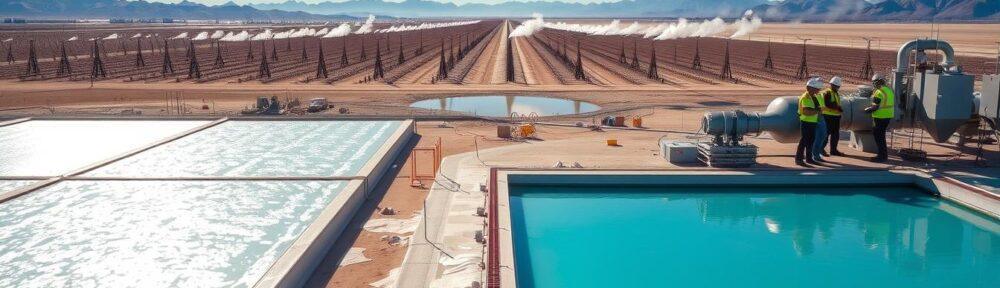
Imagine the key to our clean energy future lies in hot, salty water a mile down. It’s not the glamorous hero we thought it would be.
For years, we’ve used these brines for power. It’s a reliable, always-on source with a small footprint. But researchers found something more. The same water is full of important minerals, like lithium.
This is more than just a coincidence. It’s a big change. We can get energy and materials from one system. It’s like the universe’s ultimate multitasker.
The excitement is high around Salton Sea lithium in California. The earth gives us heat and minerals at the same time.
Direct lithium extraction DLE technology makes it all possible. It’s like a molecular sieve that gets the valuable minerals quickly and cleanly. No more waiting for years for the water to evaporate.
That hot water is more than just a power source. It’s a key resource. This deal makes energy experts and EV CEOs take notice. The game is definitely changing.
Co‑production economics
Imagine if your power plant could also make money. Welcome to co-production. It’s not just adding more income streams; it’s turning clean energy into financial magic. Traditional geothermal plants sell electricity. But, if you extract lithium from the brines, you get a second income source.
That research quote says it all: “Extracting lithium from geothermal brines offers the country a unique opportunity to pair electricity generation with the retrieval of a domestic source of a critical mineral.” This partnership benefits both sides. The geothermal plant gets a new income stream. The lithium market gets a clean, domestic source. The hot water used isn’t just for turbines; it’s a valuable asset.
Let’s look at how it works. Traditional brine management is a cost. You pump it, use the heat, and reinject it. But co-production changes this. The same brine is used to make lithium carbonate, key for EVs. Now, the costs of pumping and processing are split between two products.
This changes the brine management equation from waste to mineral harvesting.
The numbers get very interesting. Imagine a table with two columns, both better than one:
| Revenue Stream | Traditional Geothermal | Co-production Plant |
|---|---|---|
| Electricity Sales | Primary Income | Primary Income |
| Lithium Carbonate Sales | $0 | Secondary Income |
| Shared Operational Cost Base | 100% on power | Split between power & lithium |
| Project Profitability | Moderate | Potentially High |
This isn’t just about cheaper lithium. It makes the entire geothermal proposition more attractive. A drop in electricity prices? The lithium revenue helps absorb the shock. It turns a clean power plant into a clean power and materials refinery. This is a more compelling story for investors.
Does this create new jobs? Absolutely. We’re talking about more than just drillers. This model needs chemical engineers, process technicians, and supply chain managers. It builds a diverse and stable local economy around the geothermal resource. The plant is more than a power station; it’s a mini-industrial hub.
So, does this make geothermal the top renewable energy source? It definitely puts on a better show. By adding mineral extraction to energy generation, it tackles geothermal’s high upfront costs. The added lithium revenue can improve payback periods and attract investors. It’s not a silver bullet, but it’s a powerful tool.
The real genius is in the synergy. The same systems serve two purposes. The high-skilled jobs created are in engineering and chemistry, not just manual labor. It’s a smarter, more integrated way to use resources. In a world needing both clean power and critical minerals, co-production is not just clever economics; it might be essential.
DLE Technologies
If traditional brine extraction were a heist movie, it would be slow and boring. But then, direct lithium extraction comes along, changing the game.
DLE is like a high-tech heist. It doesn’t need big evaporation ponds. Instead, it uses special agents to grab lithium ions from brine.
This method is a game-changer. It works in hours, not months. Old methods look outdated and slow compared to DLE.
The good news for the planet is huge. DLE has a smaller footprint than traditional factories. It also saves a lot of water, using about 99% less per ton.
This isn’t just an improvement. It’s essential for making lithium extraction work. Say goodbye to waiting around for ages.
Sorbent, ion‑exchange, solvent extraction
The direct lithium extraction DLE toolkit offers a trio of chemicals, each with its own strengths. It’s not a single solution but a team of experts, each skilled in different areas. This approach promises to extract lithium more efficiently and with less harm to the environment than old methods.
Let’s look at our three contenders. First, sorbent materials. These are like molecular Velcro for lithium ions. They’re made of materials like metal-organic frameworks or clays that lithium ions love. The brine flows through, and lithium sticks, while other minerals pass by.
The design of these materials is key. They need to be selective, durable, and quick. When it works, it’s beautiful. But, if not, it can lead to fouling, where other minerals block the process.
Next, we have ion-exchange. This method is like a swap meet. Resins hold onto other ions, waiting to trade them for lithium. When lithium comes along, they make a deal, and lithium stays on the resin. Later, a different solution convinces lithium to leave, leaving a concentrated lithium solution.
The beauty of this method is that it’s reversible. The challenge is finding resins that don’t get too picky about who they trade with. Some brines have ions that resins prefer over lithium, causing problems.
Lastly, we have solvent extraction. This method uses a different liquid to pull lithium from the brine. The two liquids mix, lithium moves to the new liquid, and then they separate. The lithium-rich liquid is then treated to release the lithium.
This method has been used for other metals for a long time. It works well with high lithium concentrations. But, it uses organic chemicals, which can be a concern for the environment.
So, who wins in this molecular contest? The answer is “it depends.” The type of brine you’re working with determines the best method. A sorbent might work in one place but not another.
The choice also depends on economics. Sorbents are simple to operate. Ion-exchange works well in certain conditions. Solvent extraction is best for high concentrations. The best direct lithium extraction DLE technology is the one that works well in the real world.
This isn’t just about chemistry. It’s about making it work fast, cheaply, and without problems. Companies that understand this will be the ones to succeed in extracting lithium from geothermal brine.
Plant Integration
So, you’ve got your fancy extraction machine. The lab tests look great. Now, the real test is making it work well with the power plant next door.
This isn’t just adding something to your garage. It’s like doing open-heart surgery on a running engine. Plant integration is where theory meets real-world challenges.
Think of flow rates, temperatures, and pressures working together perfectly. How do you remove brine after it makes power but before you inject it back? The timing must be precise.
Heat exchange is key. Waste energy, and your profits will disappear fast. The Department of Energy saw this problem and started a prize in 2021 to solve it.
Good brine management makes facilities work together. One facility’s waste becomes another’s gain. When done right, it’s amazing engineering.
We see this at an integrated facility in California. The plan shows how power and mineral extraction can share resources without problems.
Get integration wrong, and you’ve wasted a lot of money. Get it right, and you’ve made something very efficient. The difference is in engineering and smart brine management.
Heat, power, steam balance
This section is all about the complex balance of energy in a geothermal plant. It’s like trying to do two things at once. Every bit of energy is tracked, from BTUs to psi.
Imagine a geothermal plant as an orchestra. The flow of heat, steam, and power is like the musicians playing together. Adding a Direct Lithium Extraction (DLE) process is like rewriting the music. The goal is to get electricity and a valuable mineral from one source.
But, a geothermal plant is a closed system. It’s all about the balance of pressure, temperature, and flow. Adding a DLE process is like adding a new appliance. It must not disrupt the system.
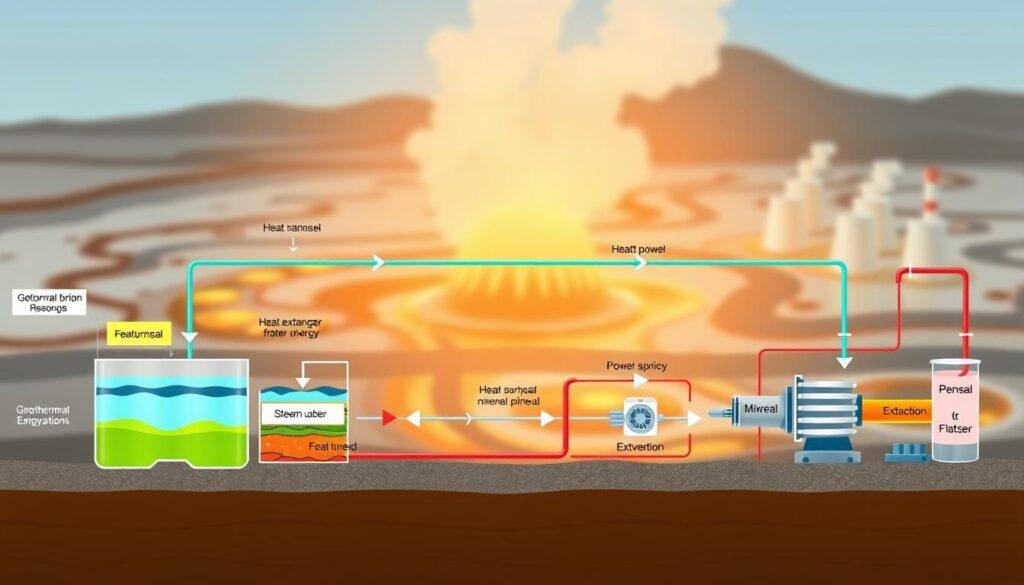
The big question is: can we use waste heat for lithium extraction? Or will it harm the plant’s main function? This affects how well the plant works.
The brine from the ground is hot. It turns to steam, spins a turbine, and makes power. The leftover brine is usually sent back underground. This waste heat could be used for DLE, saving energy.
But, using this heat for DLE means less heat for the reservoir. This is a high-risk move for the plant’s long-term health.
To see how delicate this balance is, let’s look at some numbers. The table below shows the energy flows in a standard plant and one with DLE.
| Energy Flow | Standard Geothermal Plant | Plant with Integrated DLE | Impact of DLE |
|---|---|---|---|
| Heat Input (MW) | 120 | 120 | No change, but distribution shifts. |
| Steam Flow (kg/s) | 50 | 45 | DLE uses some steam for heating. |
| Power Output (MW) | 35 | 33 | Small reduction due to parasitic loads. |
| Net Plant Efficiency (%) | 29.2 | 27.5 | Efficiency dip is the key metric to watch. |
See that net plant efficiency drop? That’s the cost of adding DLE. Getting this balance right is key to success.
Managing this balance requires advanced control systems. It’s about constantly adjusting to keep everything in balance. The plant’s system must be like a chess master, always thinking ahead.
Successful brine management means treating energy balance as a dynamic system. Every decision affects the outcome. In geothermal energy, where margins are tight, this is critical.
This isn’t just about being smart. It’s about being financially viable. The balancing act is real, and the stakes are high.
Water & Environmental Safeguards
The term “sustainable” is often used loosely. It’s time to focus on real actions, not just words.
We’re doing a deep environmental review. It’s like a forensic audit for the Earth’s health. The key is brine management. We aim to reinject the fluid underground.
This keeps the ground stable and prevents subsidence. It’s a rare advantage for mines.
Water usage is another critical area. Traditional solar evaporation uses a lot of water. But, direct extraction is much more water-efficient, using only a small amount in a closed system.
This audit isn’t about giving a free pass. We’ll also check air quality and mineral handling. Our goal is to have a clear, honest report, not just a greenwashed headline.
Brine reinjection, air quality
In the world of geothermal lithium projects, the environmental review looks at two key areas. It checks what goes back into the earth and what comes out into the air. This isn’t just about following rules. It’s about understanding the project’s environmental smarts.
The first area is brine reinjection. This isn’t just about getting rid of waste. It’s about taking care of the system. After we take out the valuable minerals, we put the leftover fluid back into the earth.
This does three important things:
- Minimizes water loss: It keeps the underground water pressurized, which is important in dry areas.
- Mitigates geological risk: It keeps the ground stable, preventing it from sinking.
- Closes the circle: It’s a big step towards a circular economy for underground fluids.
Good brine management through reinjection turns waste into a key part of the operation. It answers the big question: how to extract resources without harming the environment.
The second area is air quality. Any big project gets checked, and DLE plants are no exception. The review asks: what’s released into the air?
Potential air pollution comes from support systems, not the main DLE process:
- Fugitive emissions from handling chemicals (like acids or regenerants).
- Smoke from backup power units or steam generators.
- Dust from handling materials, but much less than a big mine.
The goal isn’t to compare to a perfect, zero-impact scenario. That’s unrealistic. The real question is: how does a modern, well-run DLE facility compare to the real alternatives?
Those alternatives are often big, fossil-fuel-based mines or huge evaporation pond fields. The environmental review shines a light on this comparison.
Modern permits don’t just set limits. They require constant monitoring—real-time data on emissions and air quality. There are proven technologies to keep things clean, like scrubbers and closed-loop systems. The review makes sure these are part of the plan and budget from the start.
So, when you see news about permits and reviews, don’t just see red tape. See it as a detailed check of a project’s plan to protect the earth and keep the air clean. That’s the goal. And if met, it changes what responsible resource extraction means.
Supply Chain & Markets
Forget spy novels. The real geopolitical thriller is playing out in global supply chains. Imagine a critical mineral suddenly becoming key to national security. It becomes a chess piece in an international power game.
The official line? “Lithium has been identified as a material essential to the economic or national security of the United States.” This isn’t just talk. It’s a declaration of economic war or a serious effort to bring a strategic industry back home.
Now, a homegrown hero emerges. In California, a new kind of extraction is starting. It uses closed-loop systems to tap geothermal brines. This isn’t your grandfather’s mining.
But can this domestic contender really compete? The global market is tough. Giants in South America produce from vast salt flats. Australian mines are huge.
The new player must show it can keep up. It’s not just about making lots of product. It’s about security, sustainability, and setting a new standard. The race is for market share and the future of critical material sourcing.
EV demand, offtakes
If you thought the scramble for toilet paper in 2020 was intense, you haven’t seen automakers fighting over lithium supply contracts. They’re in a corporate hunger games for battery-grade lithium. The stakes? Nothing less than survival in the electric vehicle era.
Global demand for lithium is soaring, making a sustainable and scalable supply a top priority. Every major car company has pledged to go all-electric. They need lithium, and they need it yesterday. It’s not just about buying minerals—it’s about securing their future.
Enter the offtake agreement. It’s like a corporate prenup for the lithium marriage. It’s a long-term contract where a buyer agrees to purchase a future production stream. For producers, it’s financial security. For automakers, it’s supply certainty. Without one, financing a major project like Salton Sea lithium extraction is nearly impossible.
Who’s buying? The usual suspects, plus some surprising newcomers. Traditional automakers like GM and Ford are locking down supply for their EV divisions. Tesla continues its voracious appetite. Even tech companies are eyeing the market for energy storage. The bidding war has begun.
Not all lithium is created equal in today’s market. There’s a growing premium for “green” or “local” lithium. Batteries sourced from geothermal brines in California carry an ESG badge that Wall Street loves. This isn’t just marketing—it’s a tangible price advantage that makes projects more viable.
| Offtake Agreement Type | Typical Duration | Key Features | Example Buyers |
|---|---|---|---|
| Fixed-Price Contract | 5-7 years | Price locked in, maximum security for producer, risk for buyer if market falls | Legacy automakers, battery giants |
| Market-Price Linked | 3-5 years | Price floats with index, shares market risk, common in volatile markets | EV startups, tier-2 manufacturers |
| Tolling Agreement | 7-10 years | Buyer provides raw brine, pays for processing, maximizes control over quality | Specialty chemical companies |
| Equity-Linked Deal | 10+ years | Buyer takes equity stake, deepest partnership, aligns long-term interests | Strategic investors, sovereign funds |
The projected output from California’s geothermal fields could feed the gigafactories of the American Southwest. We’re talking about creating a domestic battery supply chain from brine to battery. This isn’t just geology—it’s economic nationalism with a green tint.
What does this mean for local economies? Every signed offtake agreement translates to secured financing. Secured financing means breaking ground on extraction facilities. Those facilities create high-paying technical jobs in regions that desperately need economic diversification.
The beautiful irony here is that the same geothermal plants once seen as niche power sources could become lithium powerhouses. They’re positioned to supply the very industry that’s killing fossil fuels. It’s a poetic, profitable full circle that even Hollywood couldn’t script better.
So the next time you see an electric vehicle silently glide by, remember the frantic corporate chess game happening behind the scenes. The race for lithium isn’t just about cars—it’s about who controls the energy future. And right now, the Salton Sea lithium projects hold some very interesting cards.
Community & Jobs
This is where the rubber meets the road, far from boardrooms and engineering labs. A project can be technologically brilliant and financially sound. But if it fails the community test, it fails completely.
For regions with industrial histories, promises of jobs have a long and sometimes hollow legacy. We’ve all heard the grand announcements. We’ve seen the ribbon-cutting ceremonies. Then comes the quiet disappointment when reality doesn’t match the rhetoric.
This section moves beyond vague promises to concrete analysis. What kinds of positions are we actually talking about? Are they temporary construction gigs or long-term operational careers?
What’s the real plan for local hiring and training? How does the community share in the economic benefits through royalties or community funds?
We’ll approach this with the skepticism of a local reporter. We’ll apply the analytical framework of an economist. Because getting this right isn’t just about optics—it’s the true measure of a project’s sustainability.
Training pipelines
Building a geothermal lithium plant without training is like opening a restaurant without cooks. You’ll have a kitchen but no one to use it. The promise of jobs is empty if the community lacks the skills.
Think about it. A top-notch control room is useless if no one nearby knows how to operate it. The answer isn’t just hiring; it’s building. We need to create paths from local colleges to the facility gates.
We need more than generic vocational programs. We need curricula for a new, hybrid industry. Partnering with schools is an investment in human capital. It gives the community a real stake in the future.
So, what’s a top pipeline look like? Let’s explore:
- Chemists & Process Technicians: They need to know lithium extraction chemistry, not just chemistry. They must understand sorbents, ion-exchange resins, and solvent extraction for geothermal brines.
- Plant Operators: These people manage the balance between geothermal power and lithium extraction. It’s a dual-system task.
- Maintenance Specialists: They’re trained on the unique equipment of co-production facilities. It’s not standard factory maintenance.
- Environmental Monitors: They ensure brine reinjection meets standards and air quality is pristine. They protect the “green” in green lithium.
Successful models exist if we look. The semiconductor industry worked with schools like Austin Community College in Texas. The aerospace sector has strong ties with technical programs in Washington state.
For “Lithium Valley” to thrive, the plan is clear. It starts with advisory boards and industry experts designing programs. It continues with apprenticeships that turn theory into practice. The goal is a career, not just a job.
The economic benefits are real. A trained technician earns a good salary, buys homes, supports local businesses, and sends kids to school. They become community pillars, not just employees.
This isn’t just about community relations. It’s about building a resilient, homegrown workforce. When new technology comes, you want your team to learn it, not a contractor from out of town.
The training pipeline is the bridge between promise and reality. It turns “we’ll hire locally” into a real list of skilled professionals ready to build an industry.
Case Studies
Theory is great. PowerPoint presentations are lovely. But what about actual proof? You know, that pesky thing called reality?
Enter California’s Salton Sea. Think of it as the world’s most unconventional petri dish. This geothermal hotspot isn’t just a scientific curiosity—it’s a living laboratory where billion-dollar concepts meet their maker.
The playbook is being written in real-time here. It started with a landmark resource assessment from Lawrence Berkeley National Lab, supported by the DOE’s Geothermal Technologies Office. Announced in February 2022 and published in November 2023, it was the opening bell.
Then came the catalyst: the American-Made Geothermal Lithium Extraction Prize. This wasn’t just funding; it was a challenge to the smartest engineers on the planet. “Show us what you’ve got.”
So who answered the call? What technologies are they betting on? And are the early results promising or just more hype? Consider this your backstage pass to the most promising pilots. Let’s separate the signal from the noise.
Salton Sea pilots
Forget lab coats and whiteboards; the real test for geothermal lithium is happening under the punishing sun of California’s Imperial Valley. This is where the theory of co-production meets the hardscrabble reality of engineering, permits, and desert heat. The media spotlight on the Salton Sea lithium was intense, but now the question is simple: can anyone make it work at scale?
The answer is being written by a small group of companies running high-stakes pilot projects. Each is a multi-million-dollar bet on a specific technological path and business model. Let’s pull back the curtain on the key players turning “Lithium Valley” from a catchy headline into an industrial reality.
Controlled Thermal Resources (CTR) is perhaps the most audacious. They’re not just testing a direct lithium extraction DLE system; they’re building an entirely new, integrated geothermal power and lithium facility from the ground up. Their “Hell’s Kitchen” project aims to be a first-of-its-kind operation. The gamble? By controlling the entire process, they hope to optimize both energy and lithium recovery from the start. It’s a moonshot strategy—high risk, but potentially a high-reward blueprint for the future.
Then there’s Berkshire Hathaway Energy, which already operates ten geothermal plants in the area. Their pilot, run by BHE Renewables, is a classic example of leveraging existing assets. They’re retrofitting direct lithium extraction DLE technology into their current brine flow. The strategy is less about reinventing the wheel and more about adding a lucrative new product line to a steady business. It’s the corporate, asset-heavy approach. Their publicly stated challenge? Perfecting the extraction process without disrupting the reliable geothermal power generation that pays the bills.
Other contenders, like EnergySource Minerals and Lilac Solutions, are focused on proving their proprietary extraction technologies. For them, the Salton Sea is the ultimate demo site. Success here is a powerful sales pitch for licensing their tech to brine operators worldwide. Their milestones are measured in lithium carbonate purity and extraction efficiency percentages. The challenge is scaling their modules to handle the brutal, mineral-rich soup that is Salton Sea brine.
So, what have we learned from these frontline experiments? The table below cuts through the press releases to compare the core approaches.
| Project / Company | Core DLE Technology Focus | Integration Strategy | Key Reported Milestone / Public Challenge |
|---|---|---|---|
| CTR – Hell’s Kitchen | IONiX (ion-exchange) based system | Greenfield, fully integrated geothermal & lithium plant | Secured major offtake agreement; facing complex financing and first-of-a-kind construction timelines. |
| BHE Renewables | Proprietary sorbent-based extraction | Retrofit into existing geothermal infrastructure | Demonstrated lithium production from operational brine; optimizing for continuous operation without power loss. |
| EnergySource Minerals (ILiAD) | Patented ion-exchange process | Modular plant attached to geothermal facility | Claimed high recovery rates & purity; scaling module durability for aggressive brine chemistry. |
| Lilac Solutions | Ion-exchange bead technology | Technology provider partnering with resource holders | Successful pilot results with multiple brine types; proving economic viability at full commercial scale. |
The collective takeaway from these Salton Sea lithium pilots is that the devil is in the integration. The core direct lithium extraction DLE chemistry might work in a beaker, but can it run 24/7 for years alongside a power plant? Can it be economical after accounting for water use, waste management, and energy inputs? These projects are answering those questions, one gritty, sun-baked day at a time. The dream is alive, but it’s getting its hands dirty.
Risk & Policy
Every gold rush has its claim jumpers and every frontier its dragons. Welcome to the part of our story where we confront them head-on.
The technical risks are real. Will the extraction technology perform at commercial scale? Geological uncertainties loom like shadows. How will decades of resource removal affect what lies beneath?
Then there’s the financial rollercoaster. Market prices for critical minerals can swing wildly, turning today’s bonanza into tomorrow’s bust. It’s enough to make even seasoned investors sweat.
But the real maze? Policy. It’s a tangled web of local, state, and federal requirements where a single permit delay can derail years of work. The environmental review process alone can feel like running an obstacle course blindfolded.
Yet for every regulatory stick, there’s a carrot. Federal incentives, in recent legislation, can dramatically improve project economics. Understanding this landscape isn’t just helpful—it’s essential armor for the battles ahead.
Permits, royalties, IRA incentives
So, what’s the secret to making geothermal brine into battery gold? It’s not just about the tech. It’s about permits, royalties, and IRA incentives. Think of it as a big hurdle every lithium project faces.
First, you need permits. The environmental review is your first step. You’ll deal with water rights, air quality permits, and seismic studies. It’s a long process, but it’s necessary.
Then, there are royalties. Who gets paid when lithium is extracted? On public land, it’s the public. Good royalty structures help fund schools, fix roads, and create jobs. It’s a way for the community to benefit.
Lastly, the IRA provides financial help. The Inflation Reduction Act offers tax credits. But, projects must meet certain standards to get the most help. This ensures good jobs are created.
These three elements—regulation, revenue, and incentives—shape the industry. Get the environmental review right, share the wealth, and use IRA incentives for quality jobs. That’s how you create something lasting.