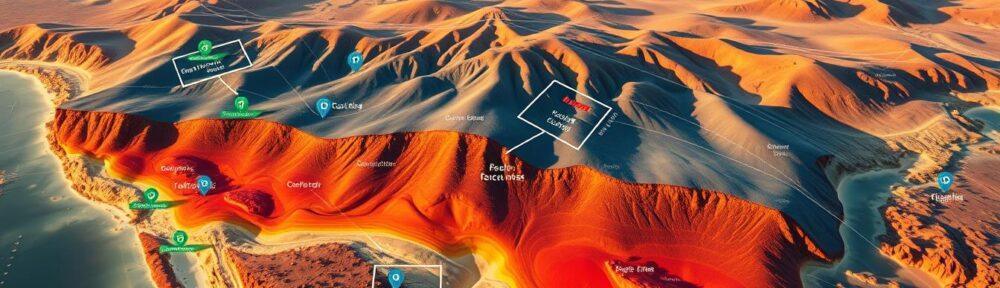
For over a century, we’ve seen Earth’s heat as a rare treasure. We needed special keys like volcanic hot springs to unlock it. Our search was limited by where these keys were found.
The truth is, we’ve been looking for the wrong key. A 2005 MIT report showed the U.S. has 100,000 times more geothermal energy than we use each year. This isn’t a shortage; it’s our imagination that’s limited.
By 2022, geothermal energy made up only 0.2% of our energy use. The Department of Energy’s Commercial Liftoff Report shows a bright future. It paints the country with endless possibilities.
This isn’t just about finding new resources. It’s about creating new ways to use them. Hot rock is everywhere, waiting for us to tap into it. We just need the right tools.
Welcome to the era of enhanced geothermal systems. It’s like moving from waiting for lightning to building a whole power grid.
FAQ
Q: What is directional drilling?
A: Directional drilling is a technique used in oil and gas exploration to drill wells at precise angles and depths. It allows for the exploration of complex geological formations and the extraction of oil and gas from previously inaccessible areas.
Q: How does directional drilling work?
A: Directional drilling involves the use of specialized drilling equipment and techniques to control the direction of the wellbore. The drilling process involves the use of mud motors, mud pumps, and downhole tools to navigate through the subsurface and reach the desired target.
Q: What are the advantages of directional drilling?
A: Directional drilling offers several advantages, including the ability to access complex geological formations, reduce the environmental impact of drilling, and increase the efficiency of oil and gas extraction. It also allows for the exploration of previously inaccessible areas.
Q: What are the challenges of directional drilling?
A: Directional drilling poses several challenges, including the need for precise control over the wellbore, the risk of encountering unexpected geological formations, and the complexity of the drilling process. It requires specialized equipment and expertise to navigate through the subsurface.
Q: What are the environmental considerations of directional drilling?
A: Directional drilling has environmental considerations, such as the risk of groundwater contamination and the impact on local ecosystems. Proper drilling practices and regulations are in place to mitigate these risks and ensure the safe and responsible extraction of oil and gas.
Q: What are the future prospects of directional drilling?
A: The future prospects of directional drilling are promising, with advancements in technology and the increasing demand for oil and gas. Directional drilling will continue to play a vital role in the exploration and extraction of oil and gas reserves, enabling the efficient and responsible extraction of these valuable resources.
Stimulation & Flow Paths
If the hot rock is the ore, then stimulation is the mining process. We’re not just drilling holes anymore. We’re engineering underground plumbing networks in solid granite.
The goal? To transform a monolithic slab of earth into a sprawling, connected web of fractures. Think of it as a man-made aquifer, or better yet, a subterranean radiator. This is fracking’s more sophisticated, precision-obsessed cousin.
The real magic happens at sites like the Department of Energy’s FORGE in Utah. It’s the ultimate proving ground. Here, engineers test how to reliably create and sustain these heat-exchange systems miles below our feet.
Precision is everything. We’re not blasting willy-nilly. We’re using pressurized water to gently shear existing micro-fractures apart. The entire operation is monitored in real-time by fiber-optic nerves that listen to the rock’s whispers.
The result isn’t a random crack. It’s a designed circuit. The flow path is engineered.
Fervo Energy’s Project Red in Nevada was our “Kitty Hawk” moment. It proved you could drill horizontally, stimulate the rock, and achieve commercial flow. For the first time, it showed we could build the reservoir, not just find it. That changes everything.
Hydraulic and thermal
Welcome to physics class, where we learn about geothermal power. Convection and conduction are key terms here. They help us extract energy from the earth.
Understanding power density is essential. It shows how much electricity you can get from hot rock. Three main factors affect this:
- Fluid enthalpy: This is the heat your fluid can carry. It’s like the cargo capacity of a truck.
- Mass flow rate: How fast you can pump fluid through the system. It’s like the traffic flow on your geothermal highway.
- Cycle efficiency: How well your plant converts heat into electricity. Even the best ingredients need a good chef.
Now, let’s talk about how to get heat into the fluid. You have two main ways, each with its own challenges.
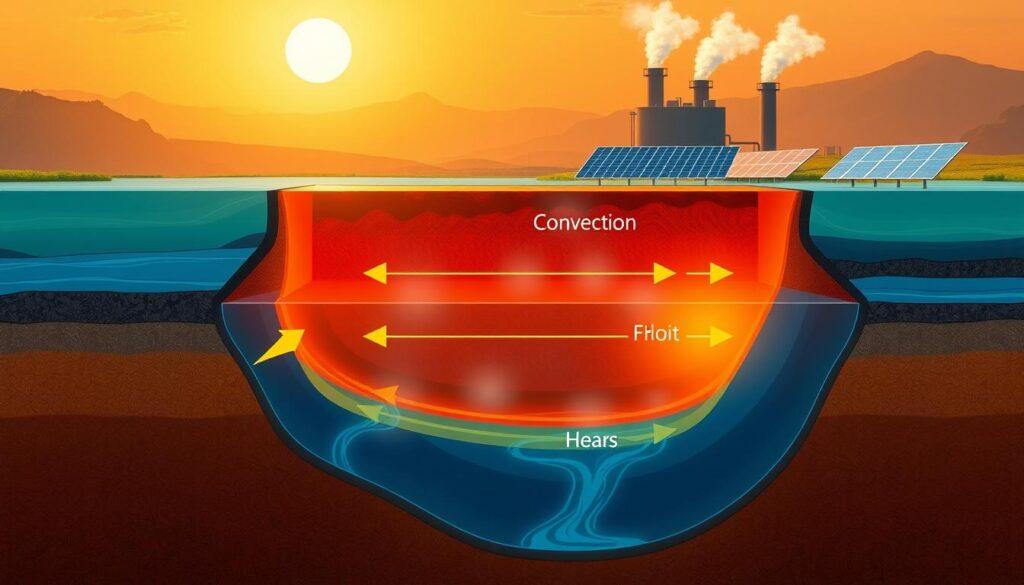
In an open-loop EGS system, we use convection. The fluid touches the hot rock, flowing through fractures like water through a sponge. The rock heats the fluid directly.
This method is efficient when it works. Heat transfer is quick because there’s no middleman. But, it has hydraulic problems. You need to manage pressure and flow paths, and avoid seismic issues.
Hydraulic control is key. Too much pressure can create unwanted fractures. Too little, and your paths collapse. It’s like keeping water pressure in a skyscraper, but with granite pipes two miles down.
The Conduction Compromise: Closed-Loop Systems
The closed-loop system uses conduction. The fluid stays in a pipe, and heat slowly moves through the wall to it. This avoids hydraulic problems but has thermal ones.
Conduction is slower and less efficient. Heat travels through solid material instead of fluid. So, you need lots of piping to collect heat.
Engineering faces a trade-off. Do you manage a fractured reservoir (hydraulic route)? Or drill kilometers of piping (thermal route)?
It’s like choosing between a complex subway system (open-loop convection) and a long hallway (closed-loop conduction). One offers efficiency with complexity; the other simplicity but at a larger scale.
Most EGS projects use convection for its higher power density. But, drilling tech improvements make conduction more appealing for its predictability and lower seismic risk. The challenge now is making drilling cheap enough to make the project work.
This debate is not just theoretical—it decides if a geothermal project succeeds or fails. Choose wrong, and you face unstable reservoirs or expensive heat exchangers. Get it right, and you unlock a reliable energy source.
Closed‑Loop Designs
If Enhanced Geothermal is about hacking the Earth’s plumbing, then closed‑loop geothermal is about installing your own. It’s like jailbreaking a system versus building one from scratch.
Imagine a huge, U-shaped pipe buried deep in the Earth. The fluid, often a special refrigerant, goes down one side, gets hot, and then comes back up the other. It’s a closed system, where nothing leaks out.
This setup is great because it doesn’t lose water. It doesn’t get clogged by minerals. And it’s very safe because it doesn’t pressurize the rock.
This idea is called the “underground radiator.” Companies like Eavor have made it their own, called the “Eavor-Loop.” They use special connections to grab more heat.
The coolest part is the thermosiphon effect. Cold fluid is heavier, so it sinks. This makes the hot fluid rise, creating a natural flow. Often, it works without needing a pump.
The downside is the cost. You need to drill a lot. But for places where fracking is not allowed, like cities or national parks, this is a good choice. It’s a last resort for geothermal energy.
Working fluids, heat exchangers
What if I told you the most valuable thing coming out of a geothermal well isn’t electricity? It’s a plot twist worthy of a heist movie. The working fluid—that humble courier of heat—has become the star of the show.
In closed-loop systems, engineers get creative. They might use CO₂ or specialized hydrocarbons instead of water. Why? Better thermal properties. Lower pumping costs. It’s like choosing a sports car over a sedan for a cross-country race. The fluid itself becomes a performance enhancer.
But let’s talk about the open-loop superstar: geothermal brine. Calling it “hot water” is like calling the internet “a bunch of wires.” It’s technically true but misses the revolution entirely. This brine is a liquid ore.
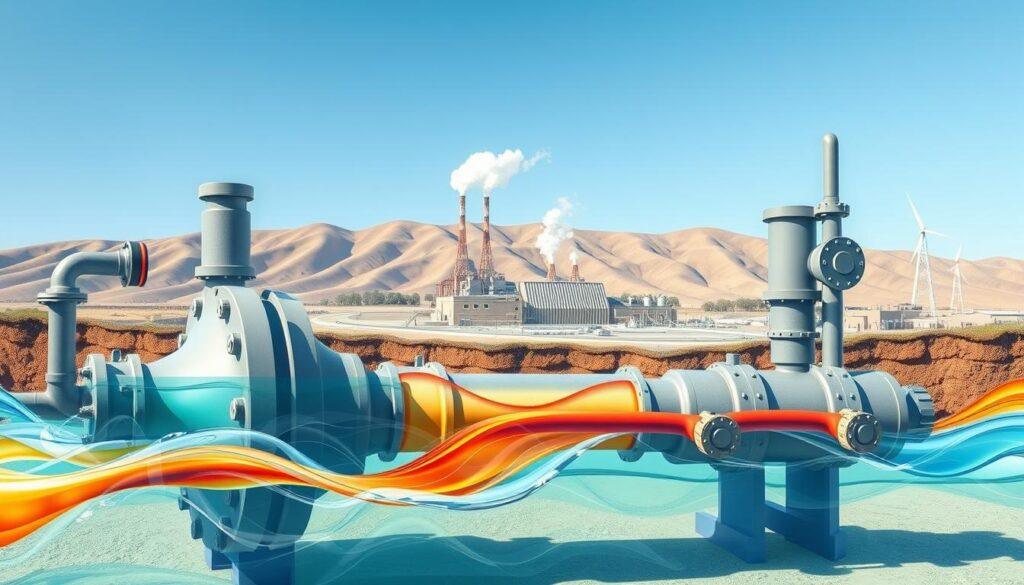
Companies like Fervo are playing a different game. They’re looking beyond kilowatt-hours. Their cheat code? Direct Lithium Extraction (DLE). Here’s how it works. As hot brine flows to the surface plant, specialized filters pluck lithium ions straight from the stream. The brine gets reinjected. The lithium gets sold.
Suddenly, your power plant moonlights as a critical mineral mine. The economics do a backflip. Revenue from lithium can subsidize electricity production so dramatically that the effective Levelized Cost of Energy (LCOE) approaches zero. Think of it as geothermal’s side hustle paying the rent.
The heat exchanger transforms. It’s no longer just a power block component. It becomes a revenue junction. A single-stream utility morphs into a dual-commodity factory. This isn’t just engineering. It’s alchemy.
DLE vs. Traditional Mining: The Geothermal Advantage
Traditional lithium mining looks like a dystopian movie set. Vast evaporation ponds. Heavy land use. Chemical processing. DLE from geothermal brine is the elegant alternative. It happens within existing infrastructure. No new mines. Minimal environmental footprint.
| Feature | Direct Lithium Extraction (Geothermal) | Traditional Lithium Mining |
|---|---|---|
| Land Use | Uses existing well pads & plants | Requires massive new mining operations |
| Water Impact | Closed-loop; brine is reinjected | High freshwater consumption & contamination risk |
| Production Time | Months (integrated with power gen) | Years (permitting & construction) |
| Carbon Footprint | Very low (geothermal is baseload renewable) | Significant (heavy machinery, transport) |
| Community Impact | Adds revenue to local power projects | Often faces local opposition & displacement |
The table tells a clear story. Geothermal DLE isn’t an add-on. It’s a fundamental rethinking of resource extraction. The brine was already being pumped for energy. Now we’re just reading the fine print on what else it contains.
This synergy makes projects like those by Fervo financially bulletproof. When lithium prices soar, the power plant’s economics improve. When electricity demand peaks, the lithium operation hums along. It’s a hedge built into the geology itself.
The implications are huge for American energy independence. The U.S. has massive geothermal and lithium resources. This technology kills two birds with one very hot stone. It turns enhanced geothermal systems into strategic mineral assets.
So next time you hear “working fluid,” think bigger. It’s not just a heat courier anymore. It’s a lithium delivery service. A revenue stream. A geopolitical tool. The humble pipe just became the most interesting part of the energy transition.
Superhot Rock
Forget about small improvements. We’re entering a new era with superhot rock energy. It’s a game-changer.
Drill deep, and you reach a special zone. Water changes here, becoming supercritical at 374°C and 221 bar. It’s not just liquid or steam. It’s a superhero fluid with incredible energy and flow.
The benefits are huge. One well could produce 30-50 megawatts. That’s five to ten times more than usual. The world has thousands of gigawatts of this energy. It could replace fossil fuels.
But there’s a challenge. Rock gets soft at these depths, and regular drill bits melt. The answer seems like science fiction. Quaise Energy uses gyrotrons to vaporize rock with energy beams.
Imagine using a lightsaber instead of a pickaxe. No parts to break. Just a clean path to the energy below. This is the big leap we’ve been waiting for.
Materials, well integrity, power cycles
Superhot rock energy is put to the test in the engineering lab. Standard oilfield steel fails at 400°C, becoming brittle. Advanced materials like titanium alloys from aerospace or fiberglass-lined tubing from deep-sea oil rigs are the real game-changers. They fight off corrosion and scaling from harmful substances like H2S and silica.
Well integrity at these extreme conditions is a unique challenge. It’s not just about stopping leaks. The cement sheath must stay strong, and the casing must withstand high pressure and temperature without buckling. This calls for a complete overhaul of well construction methods.
The surface plant also needs a transformation. A traditional steam turbine might work with perfect superhot steam. But the real breakthrough could be using supercritical CO2 in a Brayton cycle. This system promises higher efficiency, turning harsh heat into more electricity.
Cracking these challenges—materials, well integrity, power cycles—is the final hurdle. It turns a lab curiosity into a valuable asset. The aim is a 24/7, carbon-free grid powered by Earth’s own heat. The vision is clear. Now, we need the tools to make it happen.