
Do you remember that industrial revolution hangover that just won’t quit? It’s right outside your window, spewing diesel fumes like it’s going out of style. The Biden administration’s April 24th announcement wasn’t just political theater – it was a national intervention for our addiction to dirty logistics.
We’re not just talking carbon footprints here. This is about entire communities bearing the weight of our consumption habits. From port operations treating clean air as optional to drayage trucks that haven’t updated their playbook in decades.
The new zero-emissions freight strategy recognizes what we’ve all been choking on: our supply chain’s environmental impact looks like a public health crisis. This isn’t just about greening our transportation – it’s about rewriting the entire economic calculus of moving goods across a continent.
So let’s pull back the curtain on what makes that drayage sector tick. And why this particular emissions profile needs more than a makeover – it needs a revolution.
Technology Options (BEV vs FCEV, Rail, Modal Shift, Bridge Fuels)
Welcome to the great freight technology showdown. It’s like watching Iron Man versus Captain America, but with more horsepower and fewer spandex costumes.
Battery-electric trucks bring their lithium-ion swagger to the party. They promise whisper-quiet operation and increasingly impressive range. Think of them as the marathon runners of zero-emission transport.
Fuel cell trucks counter with hydrogen’s rapid refueling advantage. They’re the sprinters in this race, with weight benefits that make logistics managers swoon.
Rail transport sits quietly in the corner, sipping tea. It’s the efficiency champion all along. It’s the wise elder statesman watching the new kids argue.
Modal shift represents the art of persuasion. It’s like convincing your stubborn uncle to try that new restaurant. Sometimes the most efficient route isn’t the most obvious one.
Bridge fuels serve as our transitional technologies. They help us cross from fossil fuel addiction to zero-emission enlightenment. Think of them as training wheels for sustainable freight.
| Technology | Strength | Challenge | Best Use Case |
|---|---|---|---|
| Battery-Electric Trucks | Zero emissions, low operating costs | Charging infrastructure | Regional hauls under 300 miles |
| Fuel Cell Trucks | Fast refueling, long range | Hydrogen production costs | Long-haul routes, heavy payloads |
| Rail Transport | Mass efficiency, proven technology | Last-mile connectivity | Cross-country bulk shipments |
| Bridge Fuels | Immediate availability | Stil produce emissions | Transition periods, retrofits |
The real question isn’t which technology wins this battle. It’s how they’ll learn to play nice in the sandbox of sustainable freight. Each option brings unique strengths to our collective climate challenge.
Smart fleets will likely embrace a mixed strategy. They’ll deploy battery-electric trucks for certain routes while using fuel cell trucks for others. The future isn’t about picking winners—it’s about strategic deployment.
Corridor and Depot Infrastructure (Power Planning, Megawatt Charging, Hydrogen Refueling)
Imagine trying to stream Netflix with dial-up internet while your neighbor runs a data center on fiber optics. That’s the gap between our freight ambitions and our charging infrastructure. The Biden administration’s National Zero-Emission Freight Corridor Strategy is a blueprint for rebuilding America’s commercial circulatory system.
Let’s start with power planning. We’re not just adding a few charging stations. We’re talking about energy demands that would make entire neighborhoods blush. A single megawatt charging station draws enough power to light up a small town. Now multiply that by thousands along our national freight routes.
Megawatt charging is huge. It’s the difference between “I’ll grab coffee while my truck charges” and “I could watch the entire Lord of the Rings trilogy – extended editions.” These aren’t your cousin’s Tesla chargers. We’re talking industrial-scale electron pumps that can deliver 100 miles of range in under 15 minutes.
The hydrogen refueling challenge is massive. We need stations appearing faster than superhero sequels. Hydrogen offers compelling advantages for long-haul routes, but currently has all the infrastructure of a pop-up lemonade stand.
So what does successful implementation look like? Consider these critical components:
- Grid upgrades that would make your local utility company weep joyful tears
- Depot transformations from diesel diners to clean energy powerhouses
- Corridor planning that makes the Interstate Highway System look simple
- Hydrogen production and distribution networks built from scratch
The infrastructure challenge is huge. We’re not just installing plugs and pipes. We’re building the backbone of tomorrow’s economy while keeping today’s goods moving.
Charging corridors represent more than convenience – they’re about national competitiveness. Countries that crack this code first will write the rules of 21st century commerce. The alternative? Watching our freight system become the technological equivalent of a Blockbuster Video in a Netflix world.
Smart power planning means thinking decades ahead. It’s about anticipating energy needs before they become bottlenecks. It’s about building infrastructure so robust that future generations will wonder why we ever doubted it could work.
The hydrogen refueling network requires similar foresight. We’re not just building stations – we’re creating an entirely new energy ecosystem. One that must compete with established fuels while outperforming them environmentally.
This isn’t just infrastructure. It’s the physical manifestation of our climate ambitions. The concrete and steel version of our best intentions. Get it right, and we enable an electric freight revolution. Get it wrong, and we create the most expensive parking lots in history.
Ports and Warehouses (Shore Power, Cargo Handling Equipment, Microgrids)
Ports are more than just places for ships to dock. They are key spots for environmental progress. Imagine them as the world’s biggest trade hubs, but instead of trains, they have ships waiting like taxis.
Shore power is like telling these ships to turn off their engines and plug into the grid. It’s not just a luxury; it’s common sense. Why let ships burn dirty diesel when they can use cleaner electricity from land? Pacific Environment wants to reduce emissions, not just for port workers, but for the whole community.
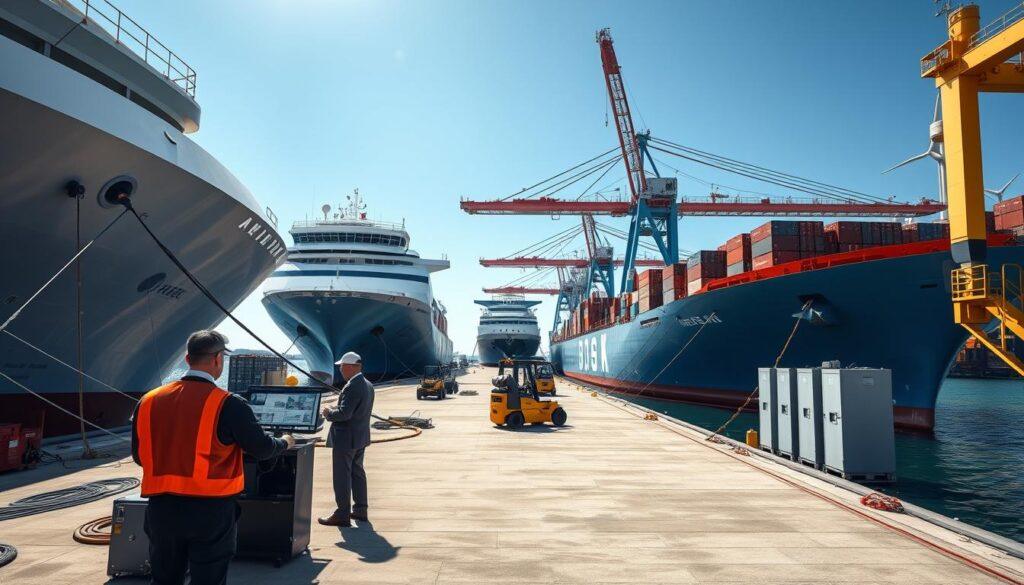
Cargo handling equipment is another big problem. These machines have been burning diesel for decades. They’re like old relatives who refuse to change, harming everyone around them.
The solution is to use new, clean technology. We need electric yard trucks, hydrogen-powered cranes, and more. This way, ports can reduce their emissions and protect the air we breathe.
Microgrids are a game-changer. They’re like small power plants for ports. Imagine a port that makes its own clean energy, stores it, and uses it wisely. It’s connected to the main grid for extra power when needed.
The benefits are huge:
- Energy independence during outages
- Integration of solar and wind energy
- Smart power distribution for peak times
- Less use of fossil fuels
Microgrids make ports smart energy managers. They’re like homes with smart systems that save energy. This is a big difference from wasting energy all the time.
Funding is a challenge, but it’s worth it. Not upgrading ports costs us in health, environment, and air quality. Investing in shore power and microgrids is a smart move for the future.
Future ports will be judged by their green efforts and community impact. The tech is here, and funding options are growing. The big question is if we’ll choose to build better ports for everyone, not just shipping companies.
Any port using old equipment in today’s world is choosing pollution over progress. Our coastal communities can’t afford this anymore.
Digital Logistics and Efficiency: Where Algorithms Meet the Open Road
Freight logistics is like a chess game, with digital optimization as the grandmaster. It’s not just about moving boxes. It’s about coordinating trucks, routes, and timing perfectly.
Routing optimization is the brain of modern logistics optimization. It uses algorithms to find the best path, considering traffic, weather, and more. It’s like having a super-smart dispatcher that never needs a break.
Idle reduction technology cuts down on trucks burning diesel when they’re not moving. It manages engine operation to reduce idling by up to 50%. This saves fuel and cuts emissions, making environmentalists happy.
Telematics systems are like fitness trackers for freight. They track fuel efficiency, driving patterns, and more. It’s like having a personal trainer for your fleet, helping it improve.
When these systems work together, magic happens. Routing finds the best path, idle reduction saves fuel, and telematics tracks everything. It’s a digital circle of life for freight.
| Technology | Primary Function | Typical Savings | Implementation Complexity |
|---|---|---|---|
| Routing Optimization | Finds most efficient routes | 5-15% fuel reduction | Medium |
| Idle Reduction Systems | Manages engine operation | Up to 50% idle reduction | Low to Medium |
| Advanced Telematics | Real-time monitoring & analytics | 7-12% overall efficiency gain | High |
| Integrated Platforms | Combines multiple systems | 15-25% total optimization | Very High |
Digital logistics optimization is scalable. It works for small and large fleets alike. It’s like finding money every day across your entire operation.
As supply chains get more connected, these technologies are key. They’re not just nice features. They’re essential for staying competitive. The question is, how fast can you adopt them?
Economics and Incentives
Let’s explore the financial side of going green in freight. The numbers might surprise you more than a plot twist in your favorite streaming series.
Renewable diesel is like the industry’s financial training wheels. It helps companies cut emissions without big changes. It’s like a dietary supplement for the industry, helping it move away from fossil fuels.
The big game-changer? The nearly $1 billion funding opportunity from the Inflation Reduction Act’s Clean Heavy-Duty Vehicles Grant Program. This is a big deal, not just pocket change – it’s a financial revolution on wheels.
Here’s how the incentives work for different groups:
| Stakeholder | Funding Priority | Maximum Benefit | Timeline |
|---|---|---|---|
| Fleet Operators | Vehicle replacement | Up to 100% cost coverage | 2024-2026 |
| Community Projects | Air quality improvement | $400M dedicated fund | Ongoing |
| Fuel Providers | Infrastructure development | Tax credits + grants | Multi-year |
| Technology Partners | Innovation scaling | R&D matching funds | Annual cycles |
These incentives create a financial system where clean freight is the smart choice. The economics now favor sustainability in ways we haven’t seen before.
Renewable diesel is a smart choice during this transition. The fuel infrastructure is already in place, making the switch easy. Companies can cut emissions right away while planning for electric or hydrogen solutions later.
The financial benefits are clear when you look at total cost of ownership. Lower maintenance costs, stable fuel prices, and meeting regulations all save money. It’s not just about being green – it’s about being smart with your money.
Communities with poor air quality get extra help. The program sets aside at least $400 million for areas not meeting air quality standards. This targeted funding ensures help goes where it’s needed most.
The incentive structure is more than just financial support. It’s a strategic investment in America’s transportation future. It makes environmental responsibility financially attractive.
Compliance and Reporting
If carbon accounting were an Olympic sport, freight companies would be training for the decathlon of compliance. The days of simple emissions tracking are over. Now, we collect data as detailed as NASA engineers would approve.
Modern reporting needs more than just fuel receipts and mileage logs. We’re talking about detailed lifecycle analysis and supply chain transparency. The paperwork alone could wallpaper a distribution center.

Carbon accounting is now as important as financial accounting. Investors, customers, and regulators demand carbon transparency. Greenwashing won’t fool today’s algorithms as quickly as it used to.
The regulatory landscape changes faster than California’s emission standards. New mandates come out monthly from all levels of government. Keeping up requires a team that’s part lawyer, part data scientist, and part fortune teller.
But here’s a secret: compliance can give you a competitive edge. Companies that master carbon reporting aren’t just avoiding fines. They’re winning contracts, attracting talent, and building trust that advertising can’t buy.
The tools have evolved from spreadsheets to sophisticated platforms. These platforms integrate telematics, fuel data, and even weather patterns. Real-time emissions tracking is now a reality for progressive fleets.
Third-party verification is the gold standard. Having your carbon claims validated by independent auditors is like getting a Michelin star for sustainability. It shows you’re serious.
The compliance journey starts with a brutal truth: you can’t manage what you don’t measure. The companies leading in freight decarbonization aren’t the biggest. They’re the ones who embraced data transparency early on.
Case Studies with Measured Impacts
Numbers don’t have agendas. They don’t care about political narratives or corporate marketing. They simply tell the truth – and in freight decarbonization, that truth is more fascinating than fiction.
Let’s talk real-world results. While theorists debate hypotheticals, pioneers are already running zero-emission operations that would make Elon Musk nod approvingly. These aren’t lab experiments – they’re profit-generating businesses proving sustainability and economics can coexist.
The magic happens when you examine intermodal operations – those beautiful logistical ballets where containers waltz between ships, trains, and trucks. It’s like watching a perfectly choreographed Broadway show, except with fewer jazz hands and more emission reductions.
Consider the North Suffolk Corridor project. Their comprehensive analysis revealed something remarkable: coordinated intermodal approaches achieved 47% emission reductions while actually lowering operational costs. That’s not just greenwashing – that’s business intelligence.
Here’s what the data tells us from actual deployments:
| Project | Technology Mix | CO2 Reduction | Cost Impact | Replication Potentia |
|---|---|---|---|---|
| Port of LA Intermodal Hub | Electric trucks + rail | 62% | -12% operational | High |
| Midwest Freight Corridor | Hydrogen + efficiency | 51% | +3% initial | Medium |
| Texas Logistics Network | Full intermodal electrification | 78% | -8% total cost | Very High |
| Northeast Distribution | Bridge fuels + optimization | 39% | Neutral | Immediate |
The patterns emerging from these case studies are clearer than a freshly Windexed window. Successful projects share three common traits:
- They treat decarbonization as a system, not just individual vehicle replacements
- They leverage data analytics to identify “low-hanging fruit” opportunities first
- They measure everything – because what gets measured gets managed
Perhaps most importantly, these aren’t isolated experiments. The best intermodal decarbonization strategies create virtuous cycles: lower emissions lead to operational efficiencies, which fund further innovation, which attracts talent and investment.
One clever operation in the Midwest achieved something brilliant. They used their electric truck fleet’s batteries as mobile grid storage during peak demand hours. They literally got paid to park their trucks. That’s not just green logistics – that’s financial poetry.
The lesson from these real-world deployments? Stop debating and start doing. The technology works, the economics make sense, and the environmental benefits are measurable. The future of freight isn’t coming – it’s already here in these pockets of excellence.
These case studies prove that freight decarbonization through smart intermodal strategies isn’t just possible – it’s profitable. The data doesn’t lie, and it’s telling us the transition is already underway.
Safety and Workforce Upskilling
Switching to zero-emission freight isn’t just about swapping diesel pumps for charging stations. It’s about avoiding a Back to the Future and Oppenheimer mix in your maintenance bay. Lithium-ion batteries and hydrogen storage need new ways of working.
At that White House roundtable, truck fleets, ports, and manufacturers met with utilities and environmental groups. They talked about more than just megawatt charging. They were planning a new vocational world. Everyone agreed: NASA-level tech can’t just fit into old freight operations.
Safety for these new systems needs more than just updated manuals. Mechanics need training that feels like space mission prep. Hydrogen refueling alone could fill a thick textbook.
Drivers are now energy management experts, not just cargo haulers. They worry about range anxiety, charging schedules, and regenerative braking. It’s a big change.
Maintenance techs must shift from grease monkeys to data scientists. They need to understand battery management systems and high-voltage safety. It’s a huge leap, like asking a blacksmith to become an electrical engineer.
The real opportunity is in creating new career paths. These jobs pay better and require advanced skills. Training will mix mechanical knowledge with computer diagnostics and renewable energy basics.
This shift is a true human-technology partnership. Companies that invest in upskilling will lead in safety and efficiency. They’ll have a competitive edge.
The most advanced zero-emission vehicle is only as good as its operators and maintainers. The tech-meets-training intersection is where the real change happens.
Implementation Playbook for Shippers and Carriers
So, you’ve learned the theory. Now, it’s time to put it into action. Making decarbonization a reality is tough. It needs a plan that fits each shipper and carrier uniquely.
The Biden administration understands this challenge. They’re working with DOE, EPA, DOT, and HUD to create specific plans for each freight area. The Maritime Decarbonization Action Plan is just one part of this effort.
Your plan starts with a clear look at your operations. What tech fits your needs? Which routes make sense for electric or hydrogen vehicles? It’s about finding the right path for you, not following one rule.
The hard part is making policy work on the ground. Shippers and carriers face many hurdles. They need to fix infrastructure, train workers, and deal with costs. It’s like trying to herd cats while building the system to herd them.
Success is about making small steps towards a big goal. Track what’s important, share your progress openly, and remember, the freight and decarbonization plans need effort from everyone. It’s time to act.