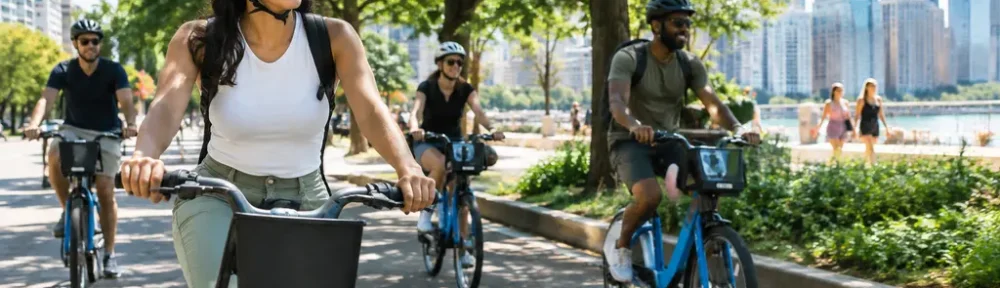
Bike-share heat is no longer a side issue for Chicago’s active transportation planning. A study published on October 1, 2026, using about 2.3 million Divvy trips from May through September 2024, found that departures during extreme-heat hours fell by about 3.8% at low-greenness stations, compared with only 0.2% at high-greenness stations. That difference does not prove that trees alone caused the ridership gap, but it gives planners a measurable signal: station surroundings may affect whether people keep using bike share when heat risk rises.
For those of us who work at the intersection of green transport, street operations, and waste-system innovation, the finding is practical rather than abstract. A bike-share dock is not just a mobility asset. It occupies curb space, competes with loading and waste collection needs, connects to sidewalks and bikeways, and depends on a public realm that remains usable in hot weather. Greener station design will not solve extreme heat by itself, yet the Chicago evidence suggests it can be part of a defensible adaptation strategy.
Why Bike-Share Heat Matters In Chicago
Bike-Share Heat At Low-Greenness Stations
The 2026 Divvy analysis is especially relevant because it used station-level usage during a warm-weather operating period rather than relying only on broad seasonal totals. Chicago already has a strong seasonal pattern: bike-share use tends to peak in July and August and drop sharply during December through February. Another 2026 study of extreme weather and bike-share ridership across climate regions reported that Chicago, classified as a cold-climate city, showed a large increase in ridership from winter to summer.
That seasonal gain can mask a narrower heat penalty. Summer may be the strongest period for ridership, but the hottest hours can still suppress trips. The station-greenness result matters because it indicates that not all hot-weather exposure is equal. Two Divvy stations may sit in the same city and the same season, yet the one with more nearby vegetation appears to retain more departures during extreme heat.
What The Evidence Can And Cannot Show
The study’s figures should be read carefully. A decline of 3.8% at low-greenness stations compared with 0.2% at high-greenness stations is a meaningful operational difference, especially across a large bike-share network. Still, the research described in the available notes does not establish that adding a tree beside every dock would produce the same effect at every site. Station location, trip purpose, rider demographics, network connectivity, shade timing, maintenance quality, and nearby land uses can all affect bike-share demand.
The evidence is strongest as a planning signal: greenery near stations appears associated with smaller heat-related usage losses. For city agencies, that is enough to justify testing greenness as one variable in station siting, bikeway design, and neighborhood heat-resilience planning, while continuing to measure results after changes are made.
Urban Greenery As Heat Infrastructure
Chicago’s heat problem is not limited to transportation behavior. A separate study of tree canopy and mortality over 2011 through 2021 found that neighborhoods consistently losing canopy had higher death rates during hot summer days, with effects reported for several cause categories. Northwestern’s August 2026 release also stated that a hypothetical increase in tree canopy cover of about 0.03% per year, described as roughly 14,000 trees annually, could prevent about 105 deaths per year in Chicago Northwestern reported.
Those public-health findings do not measure Divvy trips, but they align with the transportation evidence in one important respect: tree canopy and greenness are not only aesthetic amenities. They are infrastructure conditions that can influence exposure, comfort, and risk during hot periods. Observational findings from Chicago’s Heat Watch campaign, as described in the research notes, also point in the same direction: canopy, broader vegetation cover, and proximity to water were associated with lower ambient heat, while impervious surfaces were associated with higher heat.
For bike-share planning, that means a shaded dock near a connected route may be more useful during extreme heat than an exposed dock surrounded by hard surfaces. The goal is not to decorate stations after placement decisions are already made. The better sequence is to treat shade, vegetation, and safe route access as part of the station’s operating environment.
Where Planning Should Focus First
Station Siting And Route Continuity
Bike-share networks work best when stations are easy to find, close to destinations, and linked to routes that riders feel comfortable using. Heat adds another condition: whether people can begin and end trips without prolonged exposure on treeless blocks or highly impervious corridors. This is where bike-share heat planning overlaps with protected lanes, greenways, bus stops, sidewalks, and curb management.
The Comprehensive Climate Action Plan for Greater Chicago, published in 2026, included recommendations to expand greenways, protected bike lanes, tree canopy, and green infrastructure as part of heat resilience and active transportation strategy CMAP’s climate plan. That pairing is sensible. A shaded station is less valuable if the first half-mile of the trip forces riders onto exposed, high-stress streets. A protected bikeway is less usable in hot weather if it lacks shade at key access points.
Measured pilots can help separate appealing design ideas from interventions that shift real use. Chicago planners comparing curb layouts, protected bikeways, and cargo or service access can draw from the same evaluation discipline discussed in bike lane pilot evidence: define the metric, measure before and after, and avoid claiming success without observed results.
Equity And Maintenance Conditions
The research notes indicate that Chicago’s South and West sides have lower and more threatened canopy, and that during the heat wave documented on July 2, 2026, scientists observed hotter conditions in neighborhoods with fewer trees. That makes the station-greenness finding more than a network-efficiency issue. If low-canopy neighborhoods also face higher heat exposure, then exposed bike-share docks may underperform precisely where low-cost mobility options are most needed.
Tree planting alone is not enough. Young trees take time to provide shade, and survival depends on watering, soil conditions, protection from damage, and long-term maintenance. Green infrastructure also has to fit with bus operations, loading zones, emergency access, freight movement, snow clearance, and waste collection. Waste collection vehicles, delivery zones, and bike-share docks all use constrained street space; equipment-focused readers can compare transport-adjacent industrial context at Mengo Industries.
- Prioritize greenness audits around high-ridership and high-heat-exposure stations.
- Pair station shade with protected routes rather than treating docks as isolated assets.
- Track maintenance and tree survival, not only planting counts.
- Measure ridership changes by hour, station type, and neighborhood context.
Limits Of The Current Evidence
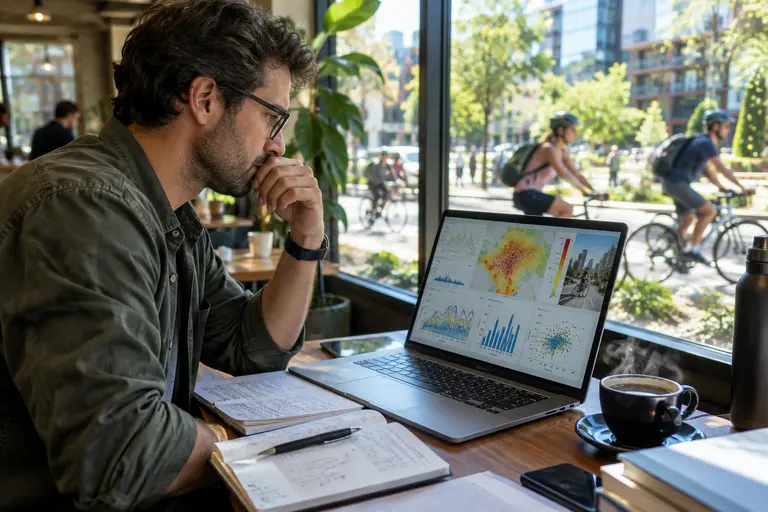
The available research supports a cautious case for greener bike-share environments, not a claim that urban greenery will fully offset extreme heat. The Divvy study used a large trip dataset, but it covered May through September 2024. Heat behavior may differ in later years, under different pricing, with e-bikes versus pedal bikes, or after changes in service areas. The reported 3.8% and 0.2% declines are station-group results, not a universal prediction for every Chicago dock.
Weather effects also interact. The research notes on extreme weather and bike share report that precipitation and wind have consistent negative effects during extreme events, and that extreme heat is among the variables that reduce ridership sharply in cold-climate cities. Greening strategies aimed at heat may not address rain, wind, ice, or winter comfort. A defensible transport plan needs to treat greenery as one intervention among several: protected lanes, safe intersections, maintenance, rebalancing, pricing, lighting, and reliable dock availability still matter.
There is also a scale question. Planting and maintaining enough trees to change canopy conditions requires funding, space, labor, and coordination across agencies and property owners. Some station areas may have underground utilities, narrow sidewalks, poor soils, or conflicts with sight lines. In those places, shade structures, green roofs on adjacent public assets, reflective materials, or nearby pocket plantings may need evaluation, but the research notes provided here do not quantify those substitutes for bike-share outcomes.
Chicago Greenery For Heat-Resilient Bike Share
The strongest case for action is practical: Chicago has evidence that extreme heat reduces Divvy departures more at low-greenness stations than at high-greenness stations, and the region’s 2026 climate planning already links active transportation with canopy, greenways, and green infrastructure. That is enough to support targeted implementation, especially where high heat exposure, low canopy, and mobility needs overlap.
For city agencies and mobility operators, the next step should be measurement-led deployment. Identify stations with repeated heat-hour ridership losses, map surrounding greenness and impervious surfaces, compare nearby route conditions, and test whether shade and vegetation investments are followed by smaller heat-related declines. Bike-share heat will remain a growing operational concern as hot periods affect comfort and safety, but Chicago’s own evidence points to a grounded response: design bike-share stations and routes as part of the city’s heat infrastructure, then verify whether the changes help riders keep moving.