
Do you remember February 2021 in Texas? The lights didn’t just go out. They faded with a frozen whimper. It was more than just bad weather. It was a harsh test for the power system, showing its deep identity crisis.
The National Renewable Energy Laboratory (NREL) offers a clear view. True grid reliability is a two-part challenge. First, you need adequacy—enough power plants ready. Second, you need operating reliability. This means the system can handle shocks without falling apart.
Our goal for clean power is adding more solar and wind. These are inverter-based resources, great but unpredictable. We’re moving from the solid feel of spinning turbines to the digital world of semiconductors.
This change is like switching from a heavyweight boxer to a chess grandmaster. Both are winners, but the game and winning strategies are different. We’re looking at how to make a green network that’s also unshakably robust. New tech like grid-forming inverters and HVDC links might hold the key to stability.
Inertia, stability, congestion
Grid inertia isn’t just science talk. It’s the grid’s muscle memory against sudden changes. It’s like a freight train’s momentum. Once it starts, it doesn’t want to stop. And once it stops, it doesn’t want to start.
For a century, traditional power plants kept this stability. Their huge turbines acted like giant flywheels. They kept the grid’s frequency steady when demand changed or a generator failed.
Now, we have renewable energy. But solar panels and wind turbines don’t have the same inertia. They’re like lightweight objects. This change has left us with a profound stability vacuum.
This loss of stability causes grid problems. First, the grid’s frequency becomes unstable. Without enough mass, small issues lead to big problems.
Second, voltage dips and flickers happen. The lights dim and stutter. This is because renewable energy can’t always provide the quick power that old turbines did.
Third, electrical vibrations build up. These vibrations can damage equipment. For more on why grid inertia matters, the engineering details are interesting.
Then, there’s congestion. Our transmission lines are like I-95 at rush hour. Everyone wants to send power at the same time. Solar-rich Arizona wants to send power to cloudy Washington, and windy Texas wants to supply calm Florida.
The wires can’t handle this. They’re like electron parking lots. This limits how much renewable energy we can use and raises costs. It’s a problem of space and time.
To solve this, we need many solutions. LDES (long-duration energy storage) is one. It acts like synthetic inertia. These systems can store energy for hours or days, helping to keep the grid stable.
The virtual power plant VPP is another solution. It turns many small systems into one big one. Home batteries, EV chargers, and smart thermostats can work together. They can respond quickly to the grid’s needs.
The problem is complex. We need to keep the grid stable without using old power plants. We need to move power without building new towers. The solutions, from new LDES technologies to virtual power plant software, are being developed now. The goal is a smarter, more resilient grid.
Grid‑Forming Inverters
We’re not just talking about upgrades. We’re looking at a complete change in how power systems work. Grid-forming inverters are like visionary teachers who create their own lesson plans. They don’t just follow the grid’s signal; they make it.
NREL says this tech is “essential.” It’s like a digital version of the big, spinning generators we’ve used for a century. They make a stable voltage waveform from nothing, control the system’s rhythm, and offer virtual inertia.
Imagine a city-wide blackout. Today, we need a big, diesel-eating “black start” generator to start again. But tomorrow? A small bank of solar panels and the right storage, with grid-forming smarts, could be the answer. They could light up a neighborhood, then a whole district.
This isn’t just about keeping things stable. It’s the key to a decentralized, strong system. While lithium-ion batteries get all the attention, sodium-ion might be better for these tough tasks.
Sodium-ion is a strong, common material ready for its big moment. Pairing it with grid-forming tech could change how we think about lasting power.
Black start, ride‑through
Forget marathons. The real endurance events happen inside your power lines. Ride-through and black start separate the strong grid assets from the weak ones. They’re the difference between a stumble and a total collapse.
Ride-through is the art of hanging on. Imagine the grid hiccups. A tree falls on a line, causing a voltage sag. A large generator trips, causing a frequency wobble. Early renewable inverters were skittish. They’d see trouble and immediately disconnect, like a guest leaving a party at the first awkward silence. This often made the initial problem worse.
Modern, grid-forming inverters are coded for grit. They’re designed to ride through these disturbances. They provide dynamic support to stabilize voltage and frequency instead of bailing. It’s the electronic equivalent of digging in your heels.
Then there’s the heavyweight champion of resilience: the black start. This is the holy grail. If ride-through is staying upright, black start is rising from the dead. It’s the ability to restart a grid from a state of complete shutdown with no external power source. Talk about a chicken-and-egg problem. You need power to start a power plant.
Today, this mission-critical task falls to specialized fossil-fuel plants. They’re the grid’s emergency jump-starters. But the future looks different, and cleaner.
Picture a hydrogen hub, storing vast amounts of clean fuel. Or a concentrated solar plant, its mirrors focusing sunlight to heat molten salt for thermal storage. These aren’t just batteries. They are long-duration energy reservoirs with inherent inertia.
Couple these physical assets with grid-forming intelligence, and you have a black-start kernel. After a wide-area blackout, these facilities could boot themselves up. They could then begin re-energizing transmission lines and slowly waking up other power plants. It transforms backup power into a full resurrection protocol for a regional grid.
The contenders for this future role are few but powerful. Here’s how they stack up.
| Technology | Black-Start Mechanism | Key Advantage | Primary Limitation |
|---|---|---|---|
| Legacy Fossil-Fuel Plant | Uses diesel generators or stored fuel to crank main turbines. | Proven, fast start-up (hours). | High emissions, finite fuel on site. |
| Hydrogen Energy Hub | Fuel cells or hydrogen turbines generate power from stored hydrogen. | Zero-carbon at point of use, very long duration. | High infrastructure cost; efficiency losses in hydrogen production. |
| Concentrated Solar Power (CSP) with Thermal Storage | Stored molten salt heats a steam turbine without needing immediate sunlight. | Fuel is free (sun), inherent multi-day thermal storage. | Geographically limited, high capital cost, slower ramp than turbines. |
The table reveals the trade-off. Our current solution is fast but dirty. The future options, like hydrogen and advanced thermal storage, offer clean resilience but come with new complexities and costs. The grid of tomorrow won’t just avoid failure. It will be engineered to recover from anything.
LDES Options
Think of our current battery darling, lithium-ion, as a world-class sprinter. It’s explosive and powerful. But ask it to run a marathon, and it’s gasping on the sidelines by mile three.
Our modern grid faces its own marathon: multi-day cloudy, windless spells—the dreaded “dunkelflaute“—or even seasonal shifts in supply. For this endurance race, we need a different athlete entirely. Enter Long-Duration Energy Storage, or LDES.
The LDES locker room is filling up with intriguing contenders. There are flow batteries, acting like giant, rechargeable fuel cells. There’s hydrogen, storing electrons as clean-burning molecules. And there’s thermal storage, bottling sunshine as molten salt to create steam power on demand.
This isn’t about crowning one “best” technology. It’s a strategic puzzle of geography, chemistry, and economics. Picking the right tool for a 10-hour, 100-hour, or 1000-hour challenge is what will separate grids that merely function from those that truly thrive.
Cost/fit matrix by duration
The economics of energy storage are tricky. The longer you need it, the more it costs. It’s not just about buying a battery. You’re hiring for a specific job with a strict schedule.
Think of it as the grid’s version of a dating app. Swipe right for a four-hour date to handle the evening peak? That’s lithium-ion’s world, and it’s good at it. But ask it for a week-long commitment during a wind drought, and the chemistry—and the economics—start to panic.
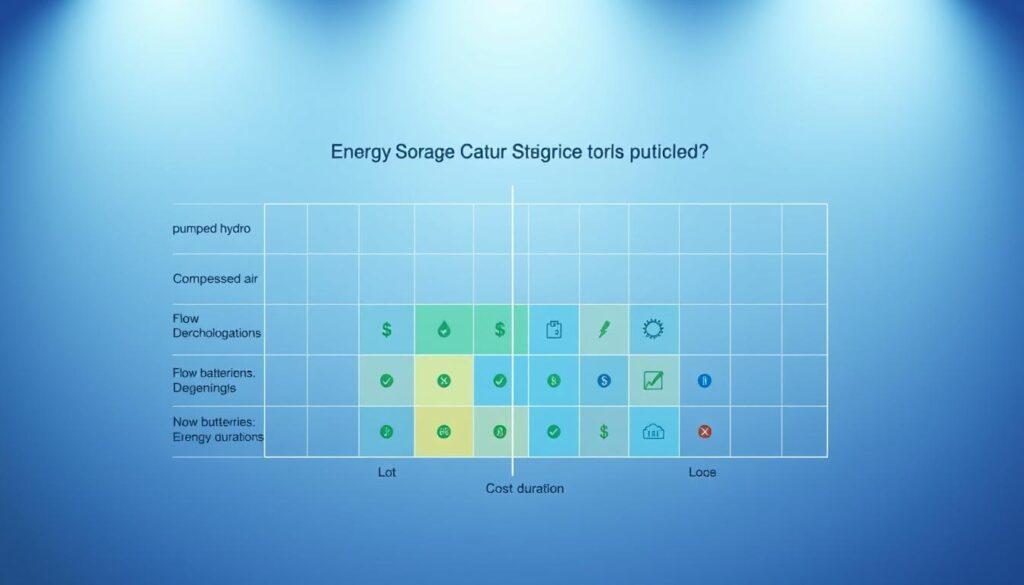
The real puzzle is the cost per kilowatt-hour of storage capacity over time. Lithium-ion packs energy and power into one expensive package. For long durations, that becomes a liability. Other technologies separate the two, making scaling up hours much cheaper.
Let’s break down the contenders. Who fits where?
| Technology | Sweet Spot (Duration) | Cost Driver | Best For Grids That Are… |
|---|---|---|---|
| Lithium-ion | 1 – 4 hours | High $/kWh of storage; cycle life | Solar-heavy, needing daily peak shaving |
| Flow Batteries | 4 – 12+ hours | Low $/kWh for scaling tanks; medium $/kW power | Wind-heavy, facing multi-day lulls |
| Sodium-ion | 2 – 8 hours | Potentially lower material costs; great durability | Daily, heavy-cycling workhorse needs |
| Thermal Storage | 6 – 24+ hours | Location-specific; incredibly low $/kWh for bulk | Co-located with industry or solar thermal plants |
| Green Hydrogen | Days – Seasons | Very low $/kWh at scale; poor round-trip efficiency | Seasonal shifting, ultra-long backup |
Flow batteries are the clever compromise. Their magic is in the separate tanks of liquid electrolyte. Need more hours? Just get bigger, cheaper tanks. The power unit stays the same. This makes them the prime candidate for covering those grim, multi-day periods when the wind just won’t blow.
Then there’s the rising challenger: sodium-ion. It’s not trying to be the life of the party. It aims to be the reliable, cost-effective workhorse. Using abundant materials, it promises to undercut lithium on price for applications that require daily, hard cycling. It’s the technology you install and basically forget about.
Don’t overlook the niche experts. Thermal storage—think molten salt or super-heated rocks—is incredibly location-specific. But where it fits, it’s a champion. The cost per stored kilowatt-hour can be shockingly low, and these systems are built to last for decades, not years.
Deploying the wrong storage is a spectacular waste of capital. It’s bringing a knife to a gunfight. Or, just as foolish, bringing a nuclear reactor’s worth of seasonal hydrogen storage to solve a four-hour afternoon peak. The matrix is brutal, but it reveals the truth. Your grid’s personality—its fuel mix, its worst-case weather—dictates the perfect match.
HVDC & Transmission
Our electrical system uses alternating current, a tech from the 1800s. For today’s needs, we need something like a vascular hyperloop. That’s where High Voltage Direct Current comes in.
HVDC is the quiet, long-haul trucker of electrons. It loses about 3.5% of power per 1,000 kilometers. This is half the loss of traditional AC lines. It’s like the difference between a marathon runner and someone who needs a nap every five miles.
The adoption of HVDC is huge. The global market is expected to grow from $13.3 billion to over $60 billion by 2035. Projects like China’s ±1,100 kV Changji–Guquan line and America’s SunZia project are examples.
But there’s a problem. The converter stations needed for HVDC are complex. They’re controlled by a few big companies like Siemens, Hitachi, and GE. This creates a bottleneck. We’ve made a better mousetrap, but only a few know how to make the spring.
Onshore/offshore corridors
Forget the interstate highway system; the next great American project is in electrons. We’re not just talking about thicker wires. This is about new highways on the map—both on land and under the sea.
Onshore, imagine HVDC corridors as renewable energy expressways. Picture solar power from the Mojave Desert or wind from the Great Plains flowing smoothly to coastal cities thousands of miles away. These aren’t your grandfather’s transmission lines. They’re high-voltage direct current superhighways that lose far less power over distance.
But the real revolution is happening offshore. While we debate pipelines, Europe is building an underwater electrical empire. Their Offshore Strategy targets 300 gigawatts of offshore wind by 2050. That’s not a typo. It’s a staggering amount of power that requires rethinking everything about how we connect it.
The old model—one wind farm, one cable to shore—is as outdated as a dial-up modem. The future is meshed HVDC grids. Think of offshore hubs where multiple wind farms connect to a multi-terminal HVDC network. This underwater subway system for electrons can then route power efficiently to multiple countries based on need and price.
These corridors become the enabling infrastructure for a carbon-free grid. They’re the physical backbone. But here’s where it gets really interesting: these mega-corridors create new nodes of control and complexity.
This massive physical infrastructure intersects with millions of distributed assets—your neighbor’s rooftop solar, the electric bus depot, the smart thermostat in your home. Managing this chaos requires a digital maestro. Enter the virtual power plant.
The VPP doesn’t move electrons physically. It moves them economically. This digital layer ensures the superhighways are used optimally, balancing supply from offshore wind with demand from cities, all while coordinating with local distributed resources.
It’s the perfect marriage of brute-force engineering and elegant software. The HVDC corridors provide the muscle. The virtual power plant provides the brains. One without the other is like building an eight-lane highway with no traffic lights or navigation system.
So while politicians argue over visible infrastructure, the real action is in these invisible corridors. They’re rewriting the rules of energy geography, turning oceans into power sources and deserts into energy exporters. And the virtual power plant sits at the control panel, making sure this incredibly complex machine actually works for everyone.
VPPs & Demand Flexibility
What’s the best way to solve grid problems? It’s not about adding more. It’s about using what we have smarter. It’s like switching from hoarding to minimalism, but for electricity.
Meet the virtual power plant VPP. Imagine a cloud-based conductor, but instead of music, it controls your smart thermostat. It works with school bus batteries, not brass.
This conductor uses software to connect thousands of assets. Your dishwasher, a warehouse’s HVAC, and community solar arrays all play a part. The virtual power plant VPP offers money to change how we use energy.
This makes us active, not just passive users. It’s the opposite of old, top-down ways. Why spend on expensive gas peakers when we can adjust our use?
Demand flexibility is a game-changer. It’s cheaper and quicker. It turns simple devices into key national assets. The grid becomes a dialogue, not a one-way talk.
Residential + C&I
The most powerful grid resource isn’t being built by utilities—it’s already installed in millions of homes and businesses across America. We’re sitting on a distributed goldmine of flexibility, and most of us don’t even realize we’re miners. This isn’t about futuristic tech; it’s about using what we already have, but smarter.
Let’s start with the residential side, where your daily routines could become grid-saving superheroics. Your electric vehicle isn’t just transportation; it’s a mobile battery with a parking problem. Charging at 6 PM during peak demand is like adding fuel to a fire. Charging at 2 AM when wind turbines are spinning freely? That’s grid poetry.
But EVs are just the headline act. Your water heater holds 40-80 gallons of thermal energy, waiting to be scheduled. Your HVAC system can pre-cool your house before peak hours. Even your pool pump has flexibility. Add a behind-the-meter battery, and suddenly your home becomes a micro-grid asset. This is where LDES concepts get personal—storing cheap renewable energy for when you actually need it.
Now shift to Commercial & Industrial, where the scale gets seriously interesting. Data centers consume about 2% of U.S. electricity, but they’re not constant. Non-critical workloads can be shifted. Cooling systems can be optimized. For fifteen minutes during a grid emergency, that server farm could become a virtual power plant.
Factories are even more flexible. Aluminum smelters, chemical plants, manufacturing lines—they can often shift energy-intensive processes by hours without affecting output. Warehouses with rooftop solar and onsite storage are already operating as mini-utilities. This is the sleeping giant of grid services, and it’s starting to wake up.
The hydrogen revolution isn’t just for power plants. Imagine a brewery using hydrogen fuel cells for both backup power and process heat. Or a hospital with a flow battery system that handles daily peak shaving and provides weekly resilience during outages. These aren’t sci-fi scenarios; they’re business decisions happening today.
Monetizing this flexibility requires new thinking. Traditional tariffs punish consumption patterns. We need rates that reward shifting. Markets need to value distributed resources as equals to centralized ones. The technology exists; the economics are catching up.
| Flexibility Resource | Residential Examples | C&I Examples | Grid Value | Monetization Pathway |
|---|---|---|---|---|
| Thermal Storage | Smart water heaters, pre-cooling HVAC | Industrial process heat scheduling | Peak reduction, frequency regulation | Time-of-use rates, demand response programs |
| Electrochemical Storage | Behind-the-meter batteries, EV smart charging | Onsite batteries for peak shaving | Voltage support, backup power | Wholesale market participation, resilience contracts |
| Process Flexibility | Pool pump scheduling, appliance load control | Data center workload shifting, manufacturing scheduling | Load shaping, congestion relief | Interruptible rates, capacity payments |
| LDES Integration | Home hydrogen systems, thermal batteries | Industrial hydrogen fuel cells, flow batteries | Multi-day storage, seasonal balancing | Long-duration storage credits, resilience premiums |
| Generation + Storage | Rooftop solar with battery systems | Commercial solar+storage microgrids | Local energy independence, grid support | Net metering 2.0, community solar programs |
So what’s holding us back? Partly psychology. We’re used to thinking of electricity as something we consume, not something we provide. Partly infrastructure. Our meters and markets were built for one-way flow. But mostly it’s about coordination. A single smart thermostat is cute. Ten million of them, orchestrated? That’s a grid-scale resource.
The beauty of this distributed approach is its resilience. When Texas froze in 2021, the problem wasn’t just power plants failing. It was millions of heaters turning on simultaneously. With smart coordination, we could have staggered that demand. We could have used stored energy in EVs and batteries. We could have shifted industrial processes.
This isn’t about asking consumers to suffer for the grid. It’s about aligning incentives so that what’s good for your wallet is good for the system. Lower bills through smart charging. Revenue from grid services. Backup power during outages. The residential and C&I sectors aren’t just load to be managed—they’re partners in building a cleaner, more reliable grid.
The transition is already underway. California’s SGIP program incentivizes behind-the-meter storage. Texas’s ERCOT market pays for demand response. Corporations are setting 24/7 clean energy goals that require flexibility. The pieces are coming together. The sleeping giant isn’t just waking up—it’s starting to do yoga.
Policy & Markets
Here’s a harsh truth: amazing tech is pointless without the right rules. We can make top-notch grid-forming inverters and flow batteries that last for a century. But if the market can’t pay for them, they’ll just sit in a warehouse.
Our electricity markets were made for a simpler era—think of steady coal plants, not wild weather. They focus on selling megawatt-hours, not the quiet stability a grid-forming inverter gives. They favor short-term projects, making long-term ones like 100-hour flow batteries seem crazy.
So, how do we change this? Policy is key. It’s about making smart “capacity accreditation” that values reliability when the sun and wind are out. It’s about setting tariffs that reward smart thermostats for adjusting demand.
Take the European Union’s effort for multi-vendor HVDC standards. That’s policy fighting against tech monopolies and encouraging real competition. The message is clear: the market needs a rewrite, not just new tech.
Capacity accreditation, tariffs
Think of capacity accreditation as the grid’s annual stress test. But the grading curve is rigged by last century’s rules. It’s about answering a simple question: how much is one megawatt from your wind farm, battery, or demand response program actually worth on the hottest day of the year?
Get this math wrong, and you face two grim futures. You either under-invest in real reliability, risking blackouts. Or you overpay for phantom capacity—assets that look good on paper but vanish when needed. It’s the financial heart of keeping the lights on, dressed in bureaucratic jargon.
This old report card fails new students. Solar and wind get marked down for not working at night or when the wind dies. Batteries get an “A” for a four-hour exam but an “Incomplete” for a week-long crisis. Technologies like hydrogen and thermal storage stare blankly at the test. Their superpower is long-duration, seasonal energy shifting—exactly what a decarbonized grid needs for resilience.
Yet, in today’s “energy-only” markets, they’re like a firefighter paid only when there’s a flame. The business case crumbles. These capital-intensive projects need revenue certainty that recognizes their role as the strategic reserve of a clean grid. The market structure is the problem, not the technology.
The fix requires a two-part rewrite of the rulebook. First, we need smarter capacity accreditation that values duration and reliability, not just peak power. A megawatt that can be guaranteed for 100 hours should be worth more than one for four. This creates the demand signal for hydrogen and thermal storage to show up.
Second, we need dynamic tariffs that turn consumers into assets. Flat rates are a relic. Time-of-use rates must reflect real-time grid stress, rewarding folks who charge EVs overnight. Performance-based rates should pay businesses to dial down power precisely when asked.
Let’s be clear: this isn’t about subsidies. It’s about aligning dollars with physics and policy. The table below shows the mismatch—and the path forward.
| Resource Type | Traditional Capacity Value | The New Reliability Value | Required Market Mechanism |
|---|---|---|---|
| Natural Gas Peaker | High (dispatchable) | Declining (carbon-intensive) | Phased out with carbon pricing |
| 4-Hour Battery | Moderate (short-duration) | High for peak shaving | Energy + Short-duration capacity markets |
| Wind & Solar | Low (weather-dependent) | Moderate, based on historical output during peaks | Probabilistic accreditation models |
| Hydrogen Storage | Near Zero (new tech) | Very High (seasonal, multi-day) | Long-duration capacity contracts / CfDs |
| Thermal Storage | Near Zero (niche) | High (industrial decarbonization, grid support) | Targeted capacity payments + time-of-use tariffs |
This is the unsexy, essential work of building a clean grid that doesn’t collapse. It’s about upgrading the market’s operating system so it can run the apps of the future. Without these changes, we’re just decorating the grid with renewables while the foundation—a market that pays for real reliability—remains cracked.
Scenario Outlooks
So, where does this winding road of tech and policy actually lead? Let’s skip the crystal ball and sketch some scenarios instead.
Think of these as possible futures, not set-in-stone predictions. The EU’s plan sets goals for 2027, 2035, and 2050. Our journey will hit these milestones, whether we’re moving fast or slow.
First, the Base Case. Picture 2030. Progress is steady, but not exciting. Big HVDC lines are built. Grid-forming inverters are common. LDES projects grow a bit. Virtual power plants exist. The system works, but it creaks a bit during the worst week.
Then there’s the Bull Case. Here, tech and politics work together well. A big breakthrough in, say, sodium-ion batteries cuts storage costs. Hydrogen finds its place. Building a multi-terminal HVDC network is easy, like IKEA furniture (with better instructions).
The Bear Case is a warning. Bottlenecks and delays win. Supply chain issues hold up key parts. Regulatory fights slow down changes. We rely too much on variable power. This leads to reliability worries and public anger.
Which path we’re on in fifteen years isn’t set in stone. It depends on the choices we make today.
Base/Bull/Bear for 2030/2035
Scenarios in the energy world are like choose-your-own-adventure books. They show three possible futures for 2035. Each one shows what happens when technology, policy, and economics meet.
This path is the easiest. HVDC technology connects countries point-to-point. Grid-forming inverters are rare and expensive.
A virtual power plant VPP manages 5-10% of flexible load. It’s useful but not a game-changer. Thermal storage is mostly used in concentrated solar power plants.
The grid uses more renewables but relies on natural gas for stability. It’s a cautious step forward, not a big change.
The Bull Scenario (2035): The Accelerated Transition
This scenario is exciting. Europe meets its 2027 goal for a multi-vendor HVDC system. By 2035, affordable multi-terminal systems are growing fast.
The virtual power plant VPP becomes a key part of the grid. It manages everything from EV batteries to smart thermostats.
Seasonal thermal storage goes from theory to reality. District heating systems use it a lot. The idea of a “peaker plant” becomes old-fashioned.
This scenario needs everything to go perfectly. But it shows what’s possible with teamwork.
The Bear Scenario (2035): Fragmented Stagnation
This is a warning story. Progress happens in small pockets. HVDC projects are expensive and rare.
Virtual power plant VPP programs stay in pilot phase. They’re interesting ideas but not real solutions.
Without good long-duration storage, grid managers face tough choices. Calm periods lead to blackouts. Support for energy change fades.
Seasonal thermal storage stays in research papers. The grid becomes less reliable when we need it most.
The Bottom Line
These scenarios are not equally likely. The Bull outcome needs everyone to work together. The Base scenario is just a small improvement.
The Bear scenario shows what happens if we don’t coordinate. The difference between these futures is not just technical—it’s about making it happen. Which path will we take?
Action Plan for Pros
Enough analysis. You’ve read the reports and seen the projections. You’re a utility planner, project developer, or policy maker. Now, the big question is: What do you actually do on Monday morning?
The days of just building more of the same are over. The old ways are no longer enough. You need to be someone who uses technology, builds alliances, and thinks in systems, not just in silos.
First, skills. Your engineers must know power electronics and digital control as well as they know spinning steel. You should hire data scientists who can predict grid stability with the skill of a chess grandmaster.
Second, tools. That old simulation software won’t cut it anymore. You need platforms that can handle hybrid AC/DC systems and the complex dance of today’s grid.
Lastly, partners. No one has all the answers anymore. You’ll be working with tech startups on grid-forming controls, battery chemists on sodium‑ion storage, and transmission experts on HVDC lines. Pilot projects are your new R&D lab.
The pro in 2035 isn’t just an engineer or manager. You’re a systems integrator and a partnership broker. The solo act is over. It’s time for the ensemble performance to begin.
Skills, tools, partners
Building the grid of 2035 is a team effort. It’s a mix of skills, tools, and partners. Imagine it as putting together the perfect team for the energy shift.
You need a special set of skills now. An electrochemist’s knowledge is key to pick the right flow battery. A hacker’s attention to detail is vital for grid security. And a diplomat’s patience is needed to make deals between factories.
Your tools need to be modern. Old planning software won’t cut it in today’s world. You need tools like NREL’s suite, which combines market signals with physical stability. A digital twin of the grid is also a must, acting as a simulator for the future.
Partners are your main strength. No one can do it alone. Utilities and Silicon Valley will work together on control algorithms. Renewable developers and LDES experts will team up for green power. And countries will connect with HVDC cables.
The old grid was built by empires. But the new one will be a network of partnerships. Your network is your grid. So, get ready to sharpen your skills, update your tools, and pick the right partners. The future of energy is counting on you.