
On September 22, 2026, during New York Climate Week, the U.S. Green Building Council published the Decarbonization Blueprint and a Corporate Practice Toolkit for High-Performance Buildings to support lower-carbon existing real estate portfolios, according to Building Design+Construction. The timing matters because existing buildings often carry long equipment lives, incomplete operating data, and procurement habits that can slow emissions reductions even when owners set formal climate targets.
For building owners, the document is best read as an evidence-informed operating framework rather than a single technology prescription. It draws from certified building performance data, gives attention to emissions sources outside routine energy use, and pairs strategy with corporate policy and procurement language. That does not remove the need for project-specific engineering, cost review, maintenance planning, and credible measurement.
What The Decarbonization Blueprint Covers
Why The Decarbonization Blueprint Uses LEED O+M Data
The evidence base is unusually large for a building-performance resource. USGBC’s analysis draws from nearly 11,000 LEED for Building Operations and Maintenance certified projects in 90 countries, covering about 3.8 billion square feet of building space, as reported by Facilities Dive. That scale gives the findings practical weight, but it should not be mistaken for a controlled experiment. Certified buildings are not a random sample of all existing buildings, and owners pursuing certification may already have stronger management practices than the broader market.
In practical terms, the Decarbonization Blueprint uses LEED O+M experience to show where operational carbon reductions have been measured across real buildings. The emphasis on existing buildings is significant. New construction receives frequent attention in green building discussions, yet most commercial floor area in use at any given time already exists. That makes operations, maintenance, capital planning, and procurement central to emissions work.
Beyond Energy: Refrigerants, Transport, And Procurement
The published material did not limit the emissions discussion to purchased energy and on-site fuel use. It highlighted refrigeration leaks and transportation emissions as under-addressed levers. That broader boundary is useful, especially for owners who have already reduced lighting and HVAC waste but still have carbon exposure in maintenance practices, tenant movement, service fleets, logistics, or refrigerant management.
The related Corporate Practice Toolkit included a Corporate Policy Guide and a Corporate Procurement Guide for High-Performance Buildings. Based on the research notes, these resources provide model language and peer examples for embedding decarbonization, resilience, water and energy efficiency, indoor air quality, green certification, and biodiversity into corporate operations and supply chains. For those interested in comparing building operations with industrial material-handling and waste-reduction practices, the site Mengo Industrial offers relevant insights related to sustainability in equipment and materials.
What The Data Suggests And Does Not Prove
Certification Level Patterns
The reported savings figures are material. As of November 2025, LEED O+M projects had achieved an estimated 10.3 million metric tons per year of greenhouse gas emissions savings and 81.8 million metric tons cumulatively across the emissions sources considered. A subset of about 2,965 projects with sufficient data showed average annual greenhouse gas reductions of about 26% compared with a baseline.
The certification-level pattern also matters. Platinum-rated LEED O+M projects were reported to save about 41% annually on average; Gold projects about 28%; Silver projects about 19%; and the lowest certification level about 14%. Those figures suggest a relationship between higher certification level and larger reported emissions savings. They do not prove that certification alone caused the savings. Building age, location, ownership capacity, prior upgrades, tenant behavior, utility mix, and baseline method can all affect the result.
A cautious reading of the Decarbonization Blueprint is that it strengthens the case for structured operating programs. It does not show that every building can reach the same savings level on the same budget or schedule. Owners still need asset-level diagnostics before converting portfolio targets into project lists.
Empire State Building As A Case Example
The Empire State Building case study is useful because it shows what a long-running existing-building program can document. The building, identified in the research as the first LEED v5 Platinum project in New York City, showed a 59% reduction in greenhouse gas emissions since 2007 and a more recent 9.6% reduction in energy consumption relative to its baseline.
That example is instructive, but it should not be generalized too quickly. A landmark office tower has a specific capital structure, public profile, tenant mix, engineering history, and management capacity. Smaller buildings and fragmented portfolios may face different constraints. The lesson is not that all assets can match those numbers. The stronger lesson is that multi-year tracking, defined baselines, and repeated operational improvements are necessary if owners want claims that can withstand scrutiny.
Implementation Barriers For Owners
Baselines, Boundaries, And Metering
Any emissions program begins with a boundary. Owners need to decide which building systems, tenant loads, refrigerants, transportation sources, water impacts, and procurement categories are included in each calculation. Without that boundary, reported improvement can become hard to interpret. A building may reduce electricity use while refrigerant losses or transportation-related emissions remain unaddressed.
Baselines also need discipline. Weather, occupancy, tenant changes, equipment replacements, operating hours, and utility emissions factors can all change performance comparisons. A reduction claim is more credible when the owner can trace it to meter data, maintenance records, refrigerant logs, procurement records, and a stated calculation method. This concern connects with prior coverage of energy-code compliance barriers, where documentation, training, and uneven implementation can limit what policy or rating systems achieve in practice.
Cost, Contracts, And Staff Capacity
The research summary does not provide a uniform cost estimate for applying the framework across existing buildings. That absence is important. Decarbonization work can include low-cost operational corrections, but it can also require controls upgrades, refrigerant transitions, envelope work, electrification planning, tenant coordination, staff training, and changes to service contracts. The cost curve will differ by building condition and by how much work has already been completed.
Procurement language can help standardize expectations, but it cannot replace technical review. Contracts should define what will be measured, who owns the data, how refrigerant or energy records are reported, how indoor air quality and resilience criteria are handled, and what happens if savings are not achieved. For portfolio managers, the practical challenge is turning corporate policy into repeatable scopes of work that facility teams and vendors can actually execute.
Waste, Reuse, And Existing Building Value
Waste Reduction Inside Carbon Planning
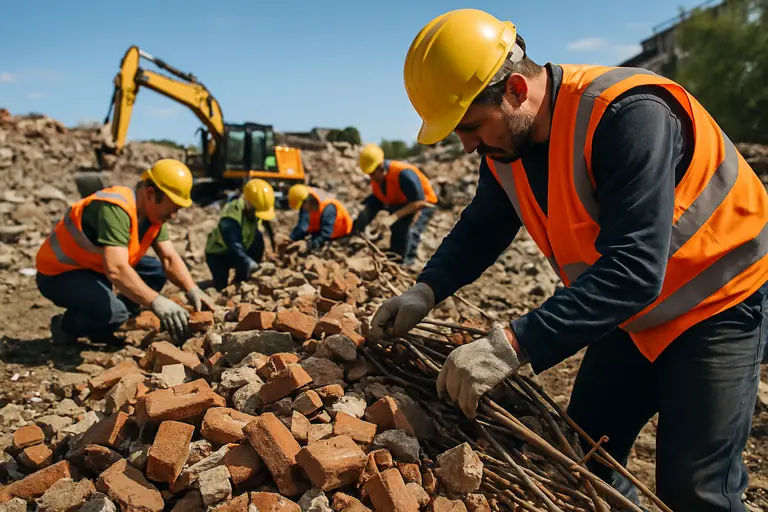
From a waste-management perspective, the most useful shift is the move from isolated efficiency projects toward whole-building life-cycle thinking. Research notes on LEED v5 state that the rating system places greater weight on whole-building life-cycle carbon, including embodied carbon, introduces prerequisites for refrigerant management with low global warming potential, and rewards planning for circularity, reuse, and waste diversion.
That framing matters because existing-building projects can generate avoidable waste when demolition, replacement, and purchasing are treated as separate decisions. Reuse may reduce material throughput in some cases, but it still requires code review, durability assessment, contamination screening where relevant, and documentation. Waste diversion claims also need support from hauler records or project documentation. A percentage written into a sustainability report is not enough without a verifiable chain of evidence.
Procurement And Waste Records
The Decarbonization Blueprint points owners toward a broader operating system: policy, procurement, building performance, and reporting need to align. For materials and waste, that means purchasing teams should understand whether products support reuse, whether packaging can be reduced, whether maintenance contracts require responsible disposal, and whether replacement schedules are based on actual condition rather than routine habit.
This is an area where cautious documentation is better than broad claims. A building team should be able to show what was purchased, what was reused, what was recycled, what was landfilled, and which records support those statements. Where data are incomplete, the report should say so. That level of candor may appear less promotional, but it produces stronger management information.
Decarbonization Blueprint Takeaways For Building Teams
What To Verify Before Claiming Progress
The Decarbonization Blueprint is most valuable when it pushes owners toward measurable building operations rather than one-time announcements. Before public claims are made, building teams should verify several items:
- Whether the emissions boundary includes energy, refrigerants, transportation, procurement, and waste categories relevant to the asset.
- Whether baseline periods are documented and adjusted only through a clear method.
- Whether savings are supported by meter data, maintenance records, procurement files, or certification documentation.
- Whether contracts assign responsibility for reporting, corrective action, and data access.
- Whether building staff have the time and training to maintain the systems that produce the reported savings.
The Decarbonization Blueprint provides a useful structure for existing buildings, especially because it links operational data with corporate practice. Its limits are just as important as its strengths. The reported LEED O+M results show meaningful emissions reductions across a large certified-building dataset, but asset-level outcomes will depend on condition, capital planning, local energy systems, maintenance quality, procurement discipline, and the reliability of measurement. For owners serious about high-performance buildings, that is the practical work now on the table.