
AI waste management is often presented as a route to higher recycling rates, lower contamination, and better circular economy performance. The evidence available by September 17, 2026, supports a more cautious view. Digital tools can improve parts of collection, sorting, and system planning, but the largest barriers are financial, technical, institutional, and environmental. A May 2026 World Bank Group report estimated that uncollected waste, open dumping, and burning cost the world US$361 billion each year in health and environmental impacts. The same report noted that municipalities typically spend 20% to 40% of their total budgets on waste management.
Those budget figures help explain why adoption is difficult. Many cities already face high operating costs for basic collection and disposal. Adding sensors, cloud services, software licenses, robotic sorting, data governance, staff training, and maintenance can compete directly with daily service delivery. For circular economy planning, the question is not whether artificial intelligence can identify materials or optimize routes in principle. The more useful question is whether a specific system can be paid for, maintained, verified, and operated safely under local waste conditions.
Why AI waste management Costs Resist Easy Scaling
Capital cost is the most visible barrier, but it is rarely the only one. Waste systems involve collection fleets, transfer stations, material recovery facilities, landfills, composting sites, informal recovery networks, billing systems, public behavior, and local policy. A model or robotic sorter is only one component inside that chain. If the surrounding system cannot supply clean data, predictable material flows, or stable funding, the technology may underperform even when the hardware works as designed.
AI waste management Budget Exposure
An early 2026 review on circular economy optimization in waste management reported that initial capital costs for AI sorting systems ranged from US$10,000 to more than US$100,000 per installation, depending on sophistication and throughput. It also reported that annual maintenance could add 15% to 25% of the initial investment. These figures should be treated as cost ranges from the literature, not as a price estimate for any single facility.
The broader digital-city cost range is also material. A 2026 OECD smart cities report estimated that large-scale or complex AI solutions in cities, including predictive analytics and decision-making systems, could cost US$80,000 to US$500,000. Smaller, focused solutions were estimated at US$20,000 to US$80,000. For a municipality already spending a large share of its budget on waste services, these figures make procurement sequencing important. A narrowly scoped pilot may be financially safer than a citywide platform, but only if the pilot measures outcomes that can guide a later investment decision.
Maintenance And Throughput Risks
Sorting facilities create a demanding test environment. Waste streams are variable, contaminated, wet, compressed, and often difficult to identify visually. In a 2026 mixed-methods study, NIST reported that robotic sorting systems in material recovery facilities faced robot-specific challenges such as effective gripping and grasping, economic viability concerns, and limited reliability when throughput was high or waste streams were highly mixed NIST robotic sorting study.
That finding is consistent with what facility operators see in practice: model accuracy alone does not determine recovery performance. A system must identify a target item, reach it in time, grip it reliably, place it correctly, and keep operating despite material variation. Downtime, missed picks, false positives, cleaning needs, and maintenance labor all affect the real cost per recovered tonne. Circular economy claims should account for these operating factors, not only the advertised recognition capability of the system.
Implementation Barriers Beyond The Purchase Price
Implementation barriers often appear after procurement. A city may buy hardware but lack consistent data standards, reliable connectivity, cross-department coordination, or staff time for system management. Waste departments may also depend on private contractors, informal workers, or regional disposal agreements that make data ownership and operational control less clear.
Data, Governance, And Procurement
A comparative study of municipal solid waste and circular economy digitalization in the United Arab Emirates and Saudi Arabia, published on May 22, 2026, identified legal, regulatory, and institutional barriers as major constraints. The cited barriers included weak policy frameworks, data protection laws, fragmented infrastructure, and limited public engagement. These are not minor administrative issues. If collection data cannot be shared, material flows cannot be traced, or procurement contracts do not define responsibility for data quality, AI tools may provide dashboards without dependable decision value.
For circular economy programs, data quality also shapes the credibility of impact reporting. Claims about lower landfill use, improved recovery, or reduced emissions depend on consistent measurement boundaries. A related SGTT analysis of AI waste management barriers addresses the risk that sorting gains can be overstated when circular metrics, governance, and data gaps are not resolved.
Municipal Capacity And Funding Gaps
The Global Waste Management Outlook 2024 from the United Nations Environment Programme found that many municipalities could not cover operational expenses for AI or digital technology-enabled systems. The research notes indicate a particular funding mismatch: donor funding often favors disposal or processing plants rather than daily collection, monitoring, and system upkeep. That matters because digital waste systems generate ongoing obligations. Servers, subscriptions, sensors, connectivity, staff training, and equipment maintenance continue after installation.
A study of Cape Town’s municipal waste services, reported in 2026, reached a similar conclusion for that setting. It found that the high upfront costs of cloud infrastructure, AI-based sorting, and IoT-enabled bins exceeded municipal budget capacity, while the lack of dedicated innovation funding made long-term sustainment infeasible. The lesson is not that these tools have no value. It is that financing models must cover the full operating period, not only the launch cost.
Environmental Costs Can Offset Circular Gains
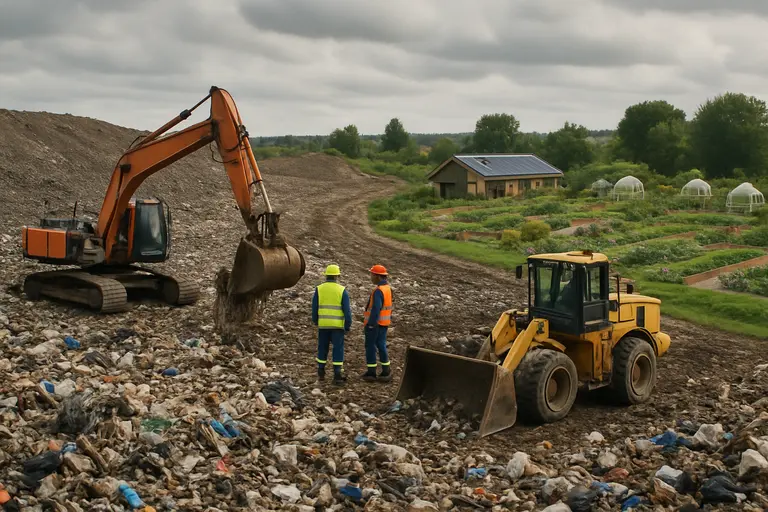
Artificial intelligence also has its own material footprint. The environmental case for applying AI to waste management depends on whether the system’s benefits exceed its energy, hardware, water, land, and maintenance impacts. This balance is site-specific. A tool that reduces electricity use in one operating context may not deliver the same result in another facility with different energy prices, grid emissions, waste composition, or staff capacity.
Energy, Water, And Land Footprints
Preliminary results reported by Veolia and PureControl from about 15 plants during 2025 and 2026 showed nearly 10% reductions in electricity consumption and greenhouse gas emissions, while the AI layer’s own electricity use accounted for less than 1% of those savings. Those findings are useful, but they should not be read as universal performance guarantees. They came from a limited operational base and described preliminary results.
A June 2026 United Nations University report highlighted that AI’s environmental cost includes data centers and hardware, with associated carbon, water, and land footprints, including large water withdrawals and land use UNU AI footprint report. This means waste agencies should evaluate the full resource demand of AI systems before claiming circular economy gains. The calculation should include computing infrastructure where relevant, not only the waste facility’s visible equipment.
Evidence Boundaries For Circular Claims
The 2026 review on circular economy optimization reported projections such as up to 90% reduction in waste quantity, 40% less landfill use, and 15% fewer transportation emissions in some studies. The same research notes indicate that these claims were theoretical projections with limited real-world validation, especially in low-income regions. This distinction is central. A model scenario can be valuable for planning, but it is not the same as measured performance from a citywide waste program.
Clear communication matters because waste technology decisions affect public budgets and public trust. Claims should identify whether evidence is theoretical, preliminary, field-tested, or commercially operating at scale. The same evidence discipline applies across public-interest information resources, including neighboring networks like Wills Glaucoma, where readers benefit when claims stay within verified evidence rather than promotional language.
What AI waste management Needs Before Wider Adoption
For city managers, facility operators, and sustainability teams, the practical path is to evaluate AI systems against local constraints before procurement. A technology that performs well in a controlled facility may still fail if the waste stream is too mixed, the budget cannot cover maintenance, workers are not trained, or data rules are unclear. Circular economy value should be judged by measured recovery, reduced disposal, improved collection reliability, lower verified emissions, or other defined outcomes.
Decision Criteria For Cities
- Define the operational problem first, such as contamination detection, route planning, equipment faults, or material recovery.
- Estimate total cost of ownership, including installation, maintenance, software, connectivity, staff time, and replacement cycles.
- Set a baseline for waste quantities, contamination, landfill use, fleet activity, and energy consumption before deployment.
- Check whether data governance, privacy, procurement terms, and contractor responsibilities are defined.
- Test performance under local waste conditions rather than relying only on vendor demonstrations.
- Report results as measured outcomes, and separate theoretical projections from verified operating data.
Green Career Pathways In Delivery
The implementation challenge also creates a skills challenge. Waste agencies and contractors need people who understand materials management, sensors, data quality, procurement, recycling markets, maintenance planning, and environmental reporting. Green career pathways in this field are likely to sit between operations and analytics. The most valuable roles may not be pure software roles. They may be hybrid positions that can translate facility conditions into measurable technology requirements.
AI waste management should therefore be treated as an applied infrastructure decision, not a stand-alone software purchase. The evidence available in 2026 shows potential benefits, but it also shows unresolved cost, reliability, governance, and environmental footprint questions. Cities that proceed with clear baselines, limited claims, full-cost budgeting, and local performance testing are more likely to identify where AI supports circular economy goals and where conventional service improvements should remain the priority.