
The Net Zero Accelerator offers a useful case study in how green building innovations are tested before broader adoption. As a waste management specialist, I view the program less as a promise of guaranteed emissions cuts and more as a structured initiative to connect pilot-ready companies with building owners, operators, utilities, and public partners. That distinction matters. A technology that performs well in a controlled demonstration setting still needs to prove its cost-effectiveness, durability, safety, procurement fit, maintenance needs, and measurable impact in occupied buildings.
On July 8, 2026, USGBC-California announced 15 companies selected for Cohort 8. That cohort began on June 24, 2026, and was scheduled to run through early December 2026, according to the USGBC-California announcement. Since the cohort had not concluded as of September 2, 2026, its results should be considered developing rather than definitive. The stronger evidence so far pertains to the program model: its repeated cohorts, pilot deployment pathways, and expanding advisor and market network.
How The Net Zero Accelerator Tests Green Building Ideas
Why Net Zero Accelerator Pilots Matter
The Net Zero Accelerator is more than just a showcase for early-stage products. Its goal is to transition companies from being pilot-ready to market-ready. Since its establishment in 2019, over 120 companies across seven cohorts participated before Cohort 8, with more than 60 real pilot deployments involving building owners, operators, utilities, and public partners across California. These figures do not confirm that every technology reduced energy use, carbon, water demand, or waste, but they do demonstrate the program’s success in placing products into settings where performance can be assessed outside of vendor presentations.
This field exposure is vital in buildings because performance significantly depends on installation conditions and user behavior. A low-carbon material must meet project specifications, contractor practices, code constraints, and schedule pressures. A waste solution must integrate with existing hauling contracts, contamination risks, tenant participation, and available space. An HVAC or envelope technology must be compatible with existing equipment, controls, and maintenance staffing. Although pilot programs cannot eliminate these barriers, they can help identify them earlier.
What The 2026 Cohort Includes
Cohort 8’s stated technology focus covers areas such as energy, carbon, waste, and occupant health. The program materials outlined sectors like building envelope improvements, advanced materials, HVAC, platforms, water, and waste solutions. For green building professionals, this mix is crucial because building performance does not pertain to a single-system issue. Operational energy, embodied carbon, water use, indoor conditions, and waste generation intersect across design, construction, procurement, and daily operations.
Applications for Cohort 8 closed on May 28, 2026, after a competitive selection process that attracted dozens of applications from eight countries. Selected companies represented eight U.S. states as well as Canada, Germany, and the United Kingdom, according to the program application page. This geographic diversity indicates that California serves as a testing ground for technologies developed both within and outside the state. This does not guarantee that California deployment will translate seamlessly to other markets, but it can provide evidence under stringent building, policy, and procurement conditions.
Evidence Of Diffusion, Not Proof Of Impact
Prior Cohorts And Pilot Pathways
The most defensible claim regarding the program is its support for diffusion. NZA alumni have served as pilot hosts for real-world deployments, and the program’s Pilot Flight Manuals lay out plans for partner pilots with building owner/operators or utility partners. Cohort 7, spanning 2025 to 2026, included 14 companies, each with a pilot opportunity ready to be scoped. This is significant because many building technologies fail due to a lack of access to representative sites, decision-makers, and feedback from facilities teams, rather than lacking technical merit.
Still, diffusion should not be confused with verified environmental performance. The research record presented here does not include measurable emissions reductions, energy savings, avoided waste tonnage, payback periods, or lifecycle cost results from individual pilots. In the absence of these values, the cautious interpretation is that the accelerator has created market-access conditions for testing. It has not, based on the supplied evidence alone, established a quantified average impact across participating companies.
Why California Is A Useful Test Market
California’s importance as a test market is both economic and regulatory. The program describes the state’s roughly US$3.9 trillion economy as a context where technologies can gain credibility and achieve scale. Its policy landscape aligns with green building innovation. The research notes reference the 2024 Building Standards Code requirement for embodied carbon reductions in large schools and commercial buildings. They also cite SB 253 and SB 261, which mandate emissions reporting by large companies starting in 2026.
These policies can enhance demand for superior measurement, lower-carbon materials, electrification strategies, and building-operation data. They may also increase compliance pressure on owners and developers who may not yet have mature reporting systems. From a waste and materials standpoint, embodied carbon regulations can prompt project teams to scrutinize product declarations, substitution options, and construction practices more closely. While the policy signal is pertinent, technology adoption still relies on price, availability, code acceptance, insurance, contractor familiarity, and owner risk tolerance.
Waste, Materials, And Building Operations
Waste Reduction In The Program Mix
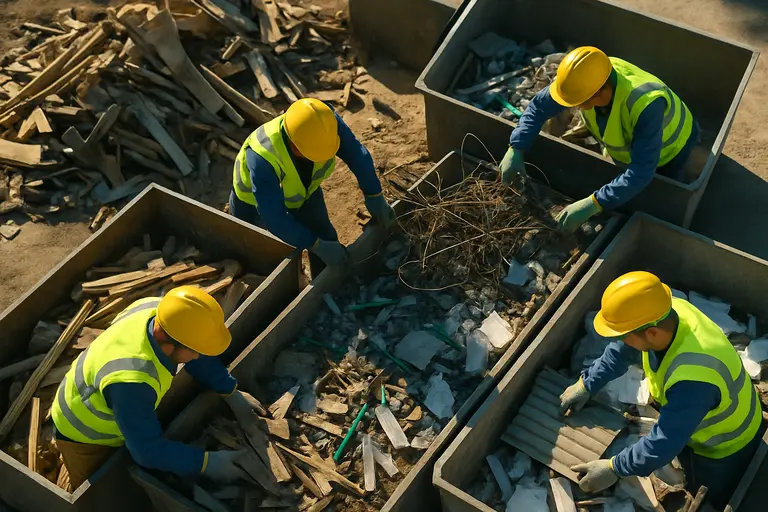
Waste reduction appears as an integral part of the program’s broader building systems scope rather than as an isolated waste initiative. This placement is realistic. In buildings, waste outcomes are connected to design choices, tenant behavior, packaging flows, construction sequencing, demolition planning, and purchasing standards. A promising waste technology must operate within these operational constraints.
For instance, a property management pilot involving waste solutions may need to address contamination rates, hauler requirements, storage rooms, labor time, tenant education, and reporting boundaries. If the pilot involves construction or renovation, the key questions shift toward material separation, reuse potential, documentation, and compatibility with project schedules. Available research indicates that cohort members have operated across sectors such as affordable housing, real estate, property management, office towers, utility territories, and coastal infrastructure. It does not report reductions in waste tonnage, so any claim about improved diversion would require separate project data.
Limits For Cost And Emissions Claims
The participant program fee in 2025 was reported as US$3,000, heavily subsidized relative to the program’s actual cost. This matters when assessing market readiness. Subsidized participation can help small firms reach pilot partners, but it does not prove their products are cost-competitive without support. A credible evaluation would differentiate the cost of the technology, installation, training, monitoring, maintenance, and any program assistance that facilitated the pilot’s execution.
The same caution applies to emissions claims. A material innovation might reduce embodied carbon under one specification but not another. An HVAC technology could save energy in one building but underperform in another with inadequate controls or deferred maintenance. A waste platform might enhance reporting accuracy before reducing disposal. For readers comparing sustainability programs across the broader green-building network, related information at Li Live Steam can provide additional context, but the evidence for each technology should still undergo evaluation at the pilot level.
Net Zero Accelerator Impacts On California Buildings
What Can Be Said As Of September 2, 2026
The most supportable assessment is that the Net Zero Accelerator has established a structured bridge between green building innovators and California deployment partners. Its network, comprising more than 70 green building leaders including advisors, mentors, pilot hosts, and technical experts, offers selected companies access to market feedback that many early firms lack. The distribution of its Pilot Flight Manuals to approximately 80,000 advisors, capital partners, and building-industry decision-makers can also extend visibility beyond a single demonstration site.
For California buildings, the impact is best described as enabling rather than conclusive. The program has facilitated movement from pilot-ready concepts toward market-ready pathways and has done so across categories including energy, carbon, water, waste, health, envelope, materials, HVAC, and platforms. The record highlights diffusion into affordable housing, real estate, property management, utility territories, office towers, and coastal infrastructure.
What remains absent, based on the provided research, is a public set of comparable performance results across pilots. Building owners should request measured baselines, monitoring periods, operating conditions, maintenance records, cost assumptions, and verification methods before considering any pilot as evidence of replicable impact. The Net Zero Accelerator seems a credible mechanism for testing green building innovation in real settings. Its environmental value will be most evident when individual pilots release transparent data on emissions, energy, water, waste, health, cost, and implementation limits.