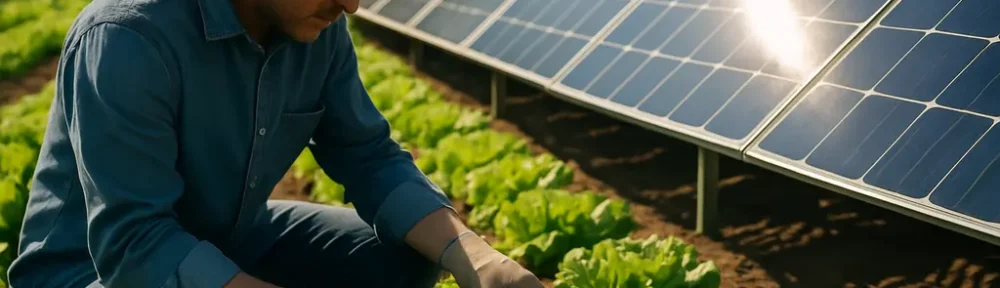
Perovskite Tandem Agrivoltaics sits at the intersection of solar materials research, crop production, and resource efficiency. The core idea is straightforward: place photovoltaic systems over farmland so that land can produce both food and electricity. The harder question is whether newer tandem perovskite devices can improve that balance without creating unacceptable crop losses, durability problems, or farm-level risks.
The evidence base is still developing. Research notes identify a farm-to-fork life-cycle assessment in Nexus dated September 15, 2026. Because that date is after September 1, 2026, the reported values should be treated as date-sensitive record figures rather than retrospective published findings. The linked record reports that retrofitting U.S. lettuce farmland with advanced perovskite tandem agrivoltaic layouts could reduce greenhouse gas emissions by up to 30.9 million tons of CO₂-equivalent per year and save about 8.4 billion cubic meters of water annually, according to the Nexus assessment record.
What The Evidence Says About Perovskite Tandem Agrivoltaics
Perovskite Tandem Agrivoltaics Data Status
The most useful reading of these results is not that one design is ready to replace conventional farming. The better interpretation is that tandem agrivoltaic systems may shift several farm variables at the same time: light reaching crops, irrigation demand, land-use efficiency, electricity production, and life-cycle emissions. Each variable depends on location, crop type, photovoltaic layout, and the technical performance of the cells.
The lettuce-focused assessment described in the research notes gives a clear example of that trade-off. Under full-density layouts, lettuce yields were reported to fall by 40%, while irrigation demand fell by 50%. Less dense or more mobile layouts had smaller crop penalties. Half-density systems were associated with 20% yield reductions and 30% irrigation reductions. Single-axis tracking was associated with 12% yield reductions and 30% irrigation reductions. Dual-axis tracking showed the smallest stated yield penalty, at 5%, with irrigation reductions of 15%.
Reported Water And Emissions Effects
The regional pattern matters. Water savings were described as strongest in water-scarce regions, including California’s Southern Desert and Arizona, where perovskite-silicon tandem agrivoltaic systems could save up to 29.8 cubic meters of water per kilogram of lettuce produced. That figure should not be generalized to all crops or all climates. It is tied to the modeled crop, region, and system design.
Florida was reported to have high emissions reductions per kilogram of lettuce under advanced all-perovskite tandem systems, reaching up to 78.2 kilograms of CO₂-equivalent per kilogram of lettuce. The research notes attribute that high intensity largely to lower agricultural yield in the region, which means more land is required per kilogram of lettuce. This is a reminder that a large per-kilogram environmental value can reflect regional inefficiency as much as technology performance.
Why Cell Stability Still Sets The Pace
What The Nature Sustainability Results Show
Perovskite Tandem Agrivoltaics depends on photovoltaic materials that can function outside the laboratory. Recent perovskite efficiency results are relevant, but efficiency alone is not enough for agricultural infrastructure that may face humidity, heat, dust, storms, maintenance constraints, and long service expectations.
A Nature Sustainability paper reported ambient-air blade-coated perovskite-silicon tandem cells with a certified efficiency of 33.0%. The same study reported single-junction perovskite modules around 26.5% to 26.6% power conversion efficiency, with devices retaining 99.8% of initial power conversion efficiency after 1,200 hours of continuous light soaking, according to the Nature Sustainability study.
Why 1,200 Hours Is Not A Farm Lifetime
Those results are technically significant because they address scalable ambient fabrication, not only small, carefully controlled laboratory preparation. Still, 1,200 hours of continuous light soaking is not the same as verified multi-year field operation over crops. Field conditions introduce stress combinations that controlled tests may not fully capture.
For agriculture, reliability is an economic and operational issue. A module failure over a conventional solar field affects electricity output. A module failure over farmland may also affect shade distribution, access for machinery, crop microclimate, maintenance timing, and farm safety procedures. That makes long-term durability evidence especially important before large claims are made about deployment potential.
Design Choices For Lettuce, Water, And Shade
Layout Is Not A Minor Detail
The lettuce results show why layout can be as important as cell chemistry. Full-density coverage offers larger modeled water reductions, but it also produces the largest reported yield penalty. Tracking designs reduce the shading burden by changing panel orientation, but those systems may involve more hardware, maintenance, and installation planning than fixed structures.
A farmer, developer, or public agency would need to ask which constraint is most binding. In a water-stressed region, reducing irrigation demand may carry high value. In a region where land productivity is the dominant concern, a high shade penalty could be unacceptable. A system that looks beneficial in emissions terms may still fail a farm business case if crop revenue loss exceeds electricity and water-related benefits.
Crop Response Remains Local
Lettuce is useful for modeling because it is a common crop in several U.S. production regions, but it should not stand in for agriculture as a whole. Crop response to shade varies by species, cultivar, growth stage, season, and local climate. The available research notes also mention experiments and simulations involving semitransparent and spectrum-splitting approaches, including cases where crop outcomes improved under controlled conditions. Those findings are interesting, but they do not remove the need for crop-specific field validation.
The most defensible use of the evidence is to treat tandem agrivoltaics as a design problem rather than a single product category. Panel transparency, mounting height, row spacing, tracking, spectral selectivity, irrigation scheduling, and crop selection all affect the result. A high-efficiency cell can still be poorly matched to a farm if the physical system blocks too much useful light or interferes with normal operations.
Scale, Safety, And Workforce Questions

Materials Management And Field Risk
Perovskite devices raise practical questions about encapsulation, module durability, end-of-life handling, and field maintenance. The research supplied here does not provide enough evidence to quantify those risks for a full agricultural installation. That uncertainty should be made explicit, especially because farm settings expose equipment to workers, irrigation systems, soil contact, and weather.
Readers looking for adjacent insights can check related resources from chemical industry research. In the agrivoltaic context, the key point is not chemistry for its own sake. It is whether materials can be managed through manufacturing, use, repair, and disposal in ways that match agricultural safety and environmental expectations.
Career Skills At The Farm-Energy Boundary
This field also points toward a different skills mix for renewable energy careers. Agrivoltaic projects need electrical engineering and solar design, but they also require agronomy, irrigation knowledge, life-cycle assessment, materials testing, structural design, operations planning, and data analysis. A transport connection may arise through farm-to-fork emissions accounting, but the supplied evidence does not quantify transport-specific effects, so that link should be treated as a measurement question rather than an assumed benefit.
- Energy specialists need to understand crop constraints, not only module output.
- Agricultural operators need clear data on shade, irrigation, yield, and maintenance effects.
- Researchers need field evidence that connects cell durability with farm performance.
Perovskite Tandem Agrivoltaics In Agriculture
A Cautious Reading For Farm Decisions
Perovskite Tandem Agrivoltaics has plausible sustainability value because the reported modeling links it with lower irrigation demand, lower greenhouse gas emissions, and dual use of agricultural land. The strongest numbers in the research notes are tied to lettuce systems and specific U.S. regions, so they should not be treated as universal farm outcomes.
The technology is best described as promising but not settled for broad agricultural deployment. The material-efficiency evidence is advancing, and the modeled farm benefits are substantial in some regions. Yet durability, field validation, crop-specific performance, safety management, and economic fit remain open constraints. A careful farm decision would compare system layout, local water scarcity, crop value, expected maintenance, and verified module lifetime before treating tandem agrivoltaics as a sustainability measure.