
NYC Electric Buses are a practical test of how quickly a large transit agency can reduce street-level emissions while keeping service reliable. New York City’s bus system is not a small pilot environment. The MTA bus fleet is roughly 5,700 vehicles, and the research record identifies a 2019 capital commitment of about US$1.1 billion for 500 battery-electric buses and charging upgrades at eight depots. That places the 500-bus addition in a middle stage: commercially deployed technology, but still dependent on procurement timing, charger installation, depot readiness, and vehicle reliability.
The air-quality case is clearest at the tailpipe. Battery-electric buses are zero-emission vehicles in operation, so replacing diesel, hybrid, or CNG buses can reduce pollution emitted directly along bus routes and near depots. The climate case is broader because electricity generation also matters. Research notes for the full MTA transition estimate that converting the full fleet to all-electric buses under the then-current power generation mix would cut about 500,000 metric tons of CO2 equivalent per year, net of added power generation emissions. That figure describes the full fleet, not only the 500-bus purchase.
NYC Electric Buses And The Current Rollout
What NYC Electric Buses Changed In 2024
The rollout had moved beyond concept before 2026. The New York Power Authority reported in September 2023 that 15 electric buses were operating and that 60 more were expected to enter service in 2024, according to NYPA’s 2023 bus update. In May 2024, the MTA and NYPA said that after a recent delivery of 60 electric buses, the next order was scheduled for 205 electric buses in late 2025, with an option for another 265 beginning in 2027 and deployment across 11 depots, according to the May 2024 MTA-NYPA announcement.
Those dates matter because the topic is no longer an upcoming trial as of August 20, 2026. Some vehicles had already been operating, some procurement milestones were scheduled for dates that have now passed, and the 2027 option had not yet arrived within the research timeline. Any fair assessment needs to separate buses already in service from buses ordered, optioned, delayed, or revised.
Procurement Changes In July 2026
The most cautionary development in the research notes came in late July 2026, when the MTA revised a New Flyer order and reduced its electric bus commitment by 85 units, from 380 to 295 standard 40-foot electric buses. The notes say the agency replaced those 85 units with diesel-electric hybrids and cited reliability issues. The affected buses were expected between April and December 2028. This does not erase the zero-emission bus program, but it shows that fleet electrification is constrained by vehicle performance, duty cycles, and operating risk.
For NYC Electric Buses, the critical policy question is not whether electric propulsion can work. It is whether the agency can match vehicles, routes, charging windows, maintenance capacity, and depot electrical upgrades at the scale of daily transit service. A 500-bus program can produce measurable gains, but only if buses are available when service requires them.
Air Quality Signals And Emissions Boundaries
Why Local Pollution Is The Core Benefit
Transit buses operate repeatedly on fixed corridors, often in dense neighborhoods where pedestrians, riders, cyclists, schools, housing, and commercial activity share the same streets. Removing tailpipe emissions from buses can therefore matter near the point of exposure. The research notes cite earlier clean-bus efforts from 2000 to 2014 showing that concentrations of NO and NO2 declined more sharply in areas where bus service shifted toward cleaner bus types, while black carbon declines lagged. That history suggests that bus technology can influence local air-quality measurements, although pollutant-specific results may differ.
The evidence also supports caution. A shift from diesel to electric operation does not remove all transportation pollution in a corridor. Brake and tire wear, other vehicles, building emissions, weather, congestion, and street geometry still affect measured concentrations. A bus electrification program can reduce one defined source, but it should not be described as a complete air-quality solution for New York neighborhoods.
What Full Electrification Models Can And Cannot Prove
Modeling in the research notes estimated that full on-road electrification of medium- and heavy-duty vehicles by 2040 could reduce NO2 precursor emissions by about 97% and PM2.5 by about 27%. The same scenario estimated 248 avoided deaths, 173 avoided childhood asthma emergency-department visits, and US$2.4 billion in health-cost savings in 2040 for New York City. These numbers are useful for scale, but they are scenario results for broader vehicle classes, not observed outcomes from the 500-bus addition alone.
That distinction is central to evidence-based reporting. The 500 buses are a meaningful subset of the MTA fleet, yet they are not equivalent to full medium- and heavy-duty electrification across the city. Measured benefits will depend on which routes receive electric buses, how many diesel miles are displaced, how frequently the buses operate, and whether reliability issues reduce actual electric mileage.
Emissions Evidence For NYC Electric Buses
Carbon Accounting Needs The Power Grid
The climate calculation differs from the street-level pollution calculation. A battery-electric bus does not emit exhaust along its route, but charging demand shifts part of the emissions question to the electric grid. The research notes account for this by citing a projection that a full MTA bus fleet transition would reduce about 500,000 metric tons of CO2 equivalent per year, net of increased power generation emissions. That is a stronger framing than counting only tailpipe reductions.
The air-quality case for NYC Electric Buses is strongest when it is tied to replaced diesel, hybrid, or CNG bus operation. The climate case is strongest when analysis includes electricity generation, charger losses where data are available, depot power demand, and actual vehicle utilization. Without those boundaries, reported reductions can become difficult to verify.
Useful Measurements For Public Accountability
A credible evaluation should track outputs that connect directly to the program rather than relying only on fleet announcements. Useful measures include:
- electric bus miles operated by route and depot;
- diesel, hybrid, or CNG miles displaced;
- charger availability and bus downtime;
- electricity consumed for bus charging;
- route-level changes in pollutants such as NO2 where monitoring allows comparison;
- service reliability before and after deployment.
These measures would not answer every health question, but they would help distinguish procurement progress from emissions performance. They would also make it easier to identify whether benefits are concentrated in a few depots or spread across routes with higher exposure burdens.
Depot Infrastructure, Reliability, And Workforce Skills
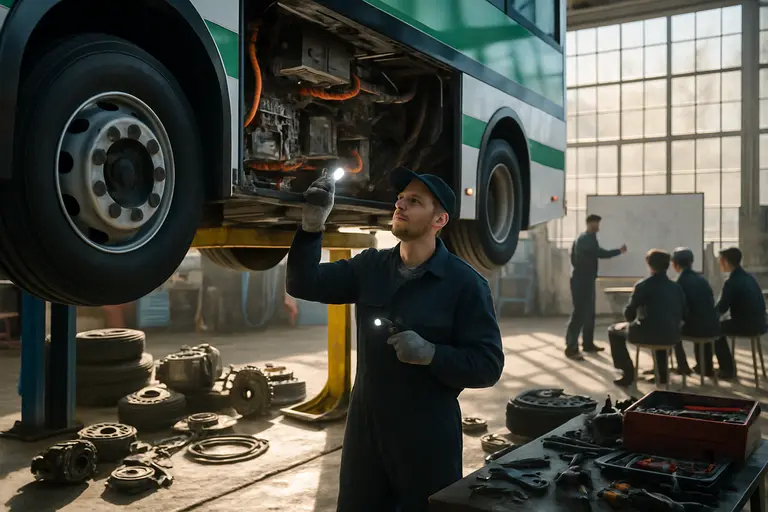
Charging Depots Are Part Of The Transit System
Electric buses require more than vehicle purchases. The 2019 capital plan referenced in the research notes included upgrades at eight depots, while the May 2024 announcement described deployment across 11 depots. That shift shows why charging infrastructure is not a side issue. A depot must support vehicle storage, charging, maintenance, dispatching, and power management without weakening bus availability.
Depot electrification also creates a connection between transportation and building energy management. Large charging loads can affect electrical service planning, equipment rooms, backup strategies, and operating schedules. Readers comparing this with building decarbonization policy can review SGTT’s related analysis of NYC building emissions standards, since both areas depend on measured energy use and clear reporting boundaries.
Career Development Without Inflated Job Claims
The workforce implications should be described carefully. The research notes do not provide verified job counts tied to the 500-bus addition, so claims about employment growth would be unsupported. What can be said is that electric bus deployment requires skills in high-voltage safety procedures, charging equipment, vehicle diagnostics, energy data, depot operations, and power-system coordination.
For students and mid-career workers, the stronger opportunity is skill alignment rather than a guaranteed hiring forecast. Programs that connect transportation electrification with electrical systems, data analysis, and applied maintenance may be more relevant than training focused on vehicles alone. Readers interested in related education pathways can explore Li Live STEAM, a site in the same network focused on STEAM learning.
Safety should also remain bounded by evidence. The supplied research does not provide incident rates, battery safety performance data, or depot safety audits. That means safety claims should be limited to the need for appropriate training and operating procedures, not unsupported statements that electric bus depots are safer or riskier than existing facilities.
What The 500 NYC Electric Buses Mean For New York
A Significant Step, Not A Finished Transition
The 500-bus addition matters because it brings zero-emission buses into normal fleet planning rather than isolating them as a small demonstration. It also matters because New York’s target is a full zero-emission bus fleet by 2040, while non-zero-emission deliveries were expected to run through 2028 because buses have a typical 12-year useful life. That timeline means procurement choices in the late 2020s can influence fleet emissions into the late 2030s.
At the same time, the July 2026 order revision shows that the path is not a straight line. Reliability concerns can slow adoption, and replacing some electric units with diesel-electric hybrids changes near-term emissions expectations. The best interpretation is conditional: the 500-bus program can improve local air quality and reduce climate pollution if electric buses replace enough fossil-fueled bus miles, depots can charge and dispatch them reliably, and the agency reports outcomes in ways that separate planned purchases from actual service.
For New York, the most useful benchmark is not the headline number alone. It is the number of zero-emission bus miles delivered in daily service, the pollution sources those miles replace, and the evidence that riders receive reliable transit while neighborhoods receive cleaner air.