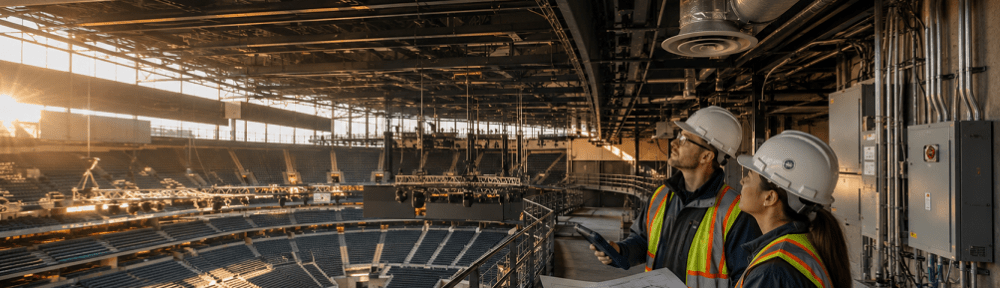
Large sports and entertainment venues create a difficult energy-management problem. Occupancy can move from near-zero to tens of thousands of people within a short operating window, placing sudden loads on ventilation, cooling, lighting, food-service equipment, escalators, digital displays, and other electrical systems. A fixed operating schedule cannot respond efficiently to that variation.
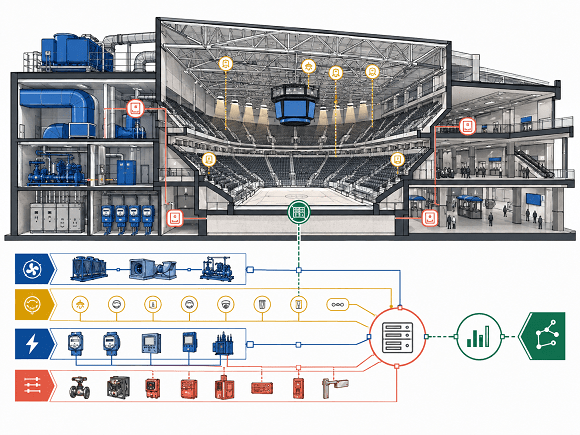
Smart building sensors offer a more measurable approach. Temperature, occupancy, airflow, equipment-status, lighting, and submetering data can give facility teams a clearer picture of where energy is being used and whether building systems are responding to actual demand. The technology does not automatically make a venue sustainable. The value appears when reliable measurements are connected to control strategies, maintenance workflows, and credible sustainability reporting.
That distinction matters in 2026 as building-control research shifts from individual connected devices toward interoperable systems that can detect faults, compare operating strategies, and turn sensor data into repeatable decisions.
Why Venue Energy Demand Is Difficult To Predict
An office building often has fairly recognizable occupancy patterns. Stadiums, arenas, theaters, convention centers, and other event facilities operate differently. A venue may remain lightly occupied during setup, experience a major influx before an event, run close to full capacity for several hours, then empty quickly.

HVAC systems need to react to changing heat loads and ventilation requirements. Lighting demand changes across public areas, service spaces, offices, parking facilities, hospitality areas, and event zones. Equipment may operate on schedules that no longer match actual use.
This is where sensor-based control becomes more useful than simple automation.
The U.S. Department of Energy describes modern building controls as integrated systems capable of coordinating HVAC, lighting, hot water, electrical equipment, and other building components. DOE reports that successful implementation of high-performance controls has demonstrated a 30% reduction in HVAC energy use in commercial buildings, showing why control strategy can matter nearly as much as equipment efficiency itself. Facilities interested in the technical foundation can review DOE’s building controls research.
For a venue, the practical goal is not to run every system at minimum output. It is to match operation more closely to real conditions without sacrificing ventilation, comfort, safety, accessibility, or event requirements.
A temperature sensor by itself provides little value. A network of well-calibrated sensors connected to control logic can show whether cooling demand is concentrated in occupied sections, whether equipment continues operating after spaces empty, or whether a system is consuming energy without producing the expected result.
Sensors Need Measurement Strategy Before Automation
Smart-building projects can become technology purchasing exercises. Facility teams buy sensors, gateways, dashboards, and analytics software, then discover that the collected data does not answer the sustainability questions they actually need to measure.
A stronger approach starts with the measurement objective.
If a venue wants to reduce HVAC energy, it needs data that can connect equipment operation with environmental conditions and occupancy. If the goal is water efficiency, flow monitoring and appropriate submeters become more relevant. If management wants credible carbon reporting, the measurement boundary needs to distinguish purchased electricity, on-site energy consumption, operational schedules, and any other inputs included in the calculation.
The National Laboratory of the Rockies has studied the adoption barriers surrounding commercial-building sensor and control systems. Its research found a major gap between larger facilities and smaller commercial buildings, with cost and implementation barriers limiting adoption. The research also estimates substantial energy-saving potential when sensors and controls are properly optimized. The laboratory’s work on commercial building sensors reinforces an important point: installing connected hardware and extracting measurable operational value are separate stages.
This is especially relevant for older sports and entertainment facilities. Existing building automation systems may contain years of custom naming conventions, separate controllers, equipment replacements, vendor-specific integrations, and undocumented changes.
Adding another dashboard does not solve that fragmentation.
Facility operators need to know which measurements correspond to which physical systems, whether sensors remain calibrated, how often data is recorded, and what action should follow an abnormal reading. A sustainability metric becomes more credible when another operator can trace it back to a defined meter, sensor, operating period, and calculation method.
Sustainability Reporting Needs Clear Digital Boundaries
Sports facilities increasingly sit inside much larger digital ecosystems. Ticketing systems, streaming platforms, mobile applications, social media, analytics services, fantasy sports, advertising networks, and other online services can all surround the same event.
That creates a measurement-boundary problem.
A building team assessing stadium or arena energy consumption should avoid combining unrelated digital activity with the facility’s physical energy data unless the reporting framework explicitly includes those systems. A fan researching tickets, streaming an event, or comparing legacy online sportsbooks may be participating in the broader digital sports economy, but those activities do not automatically belong inside a venue’s operational energy calculation.
The same discipline applies in the opposite direction. A facility should not claim that installing occupancy sensors produced a particular carbon reduction without evidence linking the control change to measured energy consumption.
This is where measurement, reporting, and verification practices become valuable.
A useful sustainability record might establish a baseline period, document the equipment controlled, record operating conditions, compare energy use across similar event periods, and note changes that could distort the comparison. Weather, attendance patterns, event duration, equipment replacement, and building modifications can all affect the data.
This approach is less exciting than a dashboard filled with green indicators, yet it produces better sustainability evidence.
The technology supports the claim. It does not create the claim by itself.
Interoperability Is Becoming The Bigger Technical Challenge
Connecting sensors to building-management software remains one of the hardest parts of scaling smart-building systems.
Commercial buildings are rarely identical. Equipment names, data points, control sequences, HVAC layouts, sensors, and software integrations differ from site to site. A control application that works in one facility may require substantial manual configuration before it can interpret another building.
DOE’s current work on semantic modeling and interoperability addresses this problem by developing standardized ways to describe building components, properties, sensors, actuators, and their relationships. The objective is to reduce the manual point-mapping work required to connect analytics and control applications to individual buildings.
This research has direct implications for multi-venue operators.
An organization managing several arenas, theaters, university athletic buildings, or entertainment properties may want to compare performance across its portfolio. That becomes difficult when every site represents equipment differently.
Common semantic descriptions could make analytics more portable. A fault-detection system would have a better chance of identifying comparable equipment across multiple sites, and operators could spend less time manually translating local control-system terminology.
DOE listed semantic modeling and interoperability among its active building-control project highlights in July 2026, alongside work on the Building Operations Testing Framework, or BOPTEST.
BOPTEST provides simulated buildings and standardized interfaces that researchers can use to evaluate control and fault-detection algorithms before testing them on physical buildings. DOE describes the framework as a way to compare approaches using common models, climates, controls, and performance indicators. The BOPTEST framework illustrates a broader change in green-building technology: performance claims increasingly need repeatable testing methods rather than impressive demonstrations.
AI Can Find Faults, But Operations Still Decide The Result
Artificial intelligence is entering building-management software through fault detection, analytics, forecasting, and control optimization.

DOE’s Better Buildings & Better Plants Initiative highlighted the trend in July 2026 when it announced a September session focused on smart-building software, fault detection and diagnostics, monitoring-based commissioning, AI-assisted analysis, and advanced demand flexibility.
The useful application is narrower than claims that AI will autonomously solve building efficiency.
A model might identify an air-handling unit behaving differently from its historical pattern. Analytics may detect simultaneous heating and cooling or identify a piece of equipment operating outside normal hours. Software could rank faults by estimated energy impact.
Someone still needs to determine whether the sensor is correct, whether the operating condition has a legitimate explanation, whether maintenance is required, and whether a control change is safe.
That makes facilities staff part of the technology stack.
Smart-building projects need technicians who understand controls, networking, HVAC operation, sensor placement, data quality, commissioning, and energy analysis. Green-technology careers in this field increasingly sit between traditional mechanical systems and software rather than exclusively inside one discipline.
For students and professionals interested in sustainable technology, that overlap creates a useful skills direction. Learning how sensors generate data is valuable. Learning how that data maps to physical equipment, operational decisions, and verified energy outcomes is more valuable.
What A Credible Smart Venue Should Measure Next
The strongest smart-building strategy for a sports or entertainment venue begins with a defined operational question rather than a collection of connected devices.
Where is energy being consumed when the building is lightly occupied? Which systems remain active after events? Can ventilation or cooling respond more precisely to occupancy? Are recurring faults visible in building automation data? Can facility managers trace sustainability reports back to real measurements?
Those questions create a practical path from sensors to action.
The next generation of sustainable venues will likely use more connected meters, automated fault detection, interoperable building models, advanced control algorithms, and AI-assisted analytics. The environmental value will still depend on calibration, commissioning, maintenance, measurement boundaries, and staff capable of acting on what the systems reveal.
For green technology, the important metric is not the number of sensors installed.
It is whether those sensors produce evidence that a building is operating better.