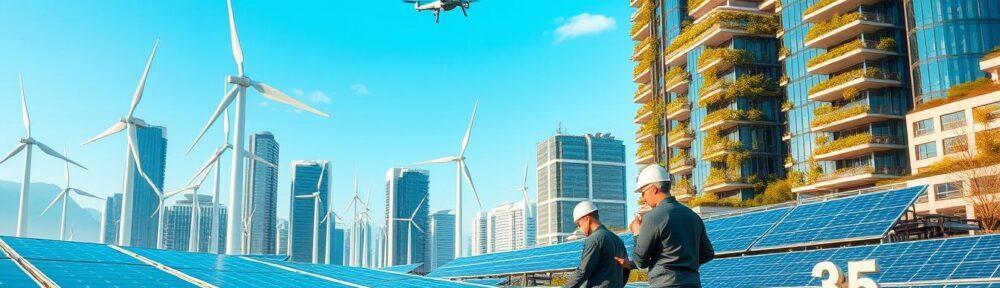
Imagine if someone told you a decade ago that clean energy’s future would rely on a server farm in Northern Virginia. You might have laughed. But now, we’re seeing a big change in our energy world. It’s like our world is moving fast, like a Tesla in ludicrous mode.
Looking ahead, AI, robotics, and clean energy are key. By 2030, data centers might use up to 9.1% of U.S. electricity. This is a big jump from 4% today. With some AI centers needing as much power as 100,000 homes, we have a big challenge. How do we meet this demand while keeping our energy green?
The Inflation Reduction Act has brought new life to U.S. manufacturing. But the big question is: are we too optimistic or pessimistic about the energy shift? The answer depends on whether we push for new tech or wait for slow changes in rules. Get ready; the future is going to be exciting.
Macro Trends: Electrification, DER Growth, Transmission Backlog, and IRA Acceleration
Remember when we just swapped out gas stoves for new ones? Those times are over. Now, data centers use as much energy as 100,000 homes. This change has changed how we manage energy.
Distributed Energy Resources (DERs) are everywhere, making rooftops and parking lots into power plants. It’s both thrilling and chaotic. But, the transmission backlog is slow, like waiting in line at the DMV.
The Inflation Reduction Act (IRA) was seen as a big change. It seemed to speed up the move to renewable energy. But then, the OBBBA cut tax credits for projects starting after July 4, 2026. Wind and solar projects are now affected.
Battery storage keeps tax credits for projects starting by 2035 but faces supply chain risks. The FEOC restrictions make things even harder. Over 75% of green hydrogen projects are now at risk.
Nuclear energy, though, gets full policy support, keeping most IRA credits. This shows mixed signals from federal policy. We have big goals but often pull back when it counts.
In Texas, some data centers are building their own gas power plants. This shows how bad our interconnection infrastructure is. The energy transition forecast is uncertain, and how we handle these trends will shape our future.
AI Applications: Forecasting, Maintenance, Bidding, DER Orchestration, Cybersecurity
Isn’t it ironic that the very technology straining our power grids might also be the one to save them? Welcome to the world of AI for grid operations. Here, algorithms and data work together to boost efficiency and innovation. AI has grown from a new idea to a key player in managing renewable energy.
Let’s look at some important uses:
- Forecasting: AI improves renewable energy forecasting, making it more accurate than ever. It analyzes huge amounts of data to predict energy production.
- Maintenance: Predictive maintenance algorithms are a big deal. They find problems before they happen, keeping things running smoothly and cutting downtime.
- Bidding: AI helps with energy market bidding, finding the best prices. It balances supply and demand for operators.
- DER Orchestration: Managing many distributed energy resources (DERs) is tough. AI makes it easier, treating all resources as one, simplifying tasks.
- Cybersecurity: AI is key in keeping energy systems safe from threats. It protects critical infrastructure from new dangers.
The International Energy Agency (IEA) says AI is more than a tool; it’s a major power demand driver. The big question is, will we use it wisely? AI’s energy use is big, like 130 American homes in a year. But, it could cut global greenhouse gas emissions by 4% to 16% by 2030.
As we face this challenge, there’s hope. AI can make energy grids better and improve forecasting. It’s speeding up clean energy progress. The future looks good, but we need to make sure AI’s benefits are worth its energy use.

Robotics and Autonomy: Drones, Blade Crawlers, Panel Washers, Reservoir Robots
A new era of robotics is changing how we care for renewable energy assets. Imagine drones flying over wind farms, checking turbine blades with great detail. These systems are not just tools; they are changing the game in operations and maintenance (O&M).
Blade crawlers, for example, climb 300-foot structures to inspect them. Panel-washing robots clean solar arrays without human touch. Yes, robots are now key players in solar maintenance.
Reservoir robots also play a big role, checking hydroelectric facilities with great care. They work hard, doing jobs that humans can’t keep up with. We used to worry about robots taking jobs, but now we need them to do the work.
A $130 million investment in robot-assisted assembly for solar parks shows a smart move. It’s not about replacing people; it’s about filling gaps to use more energy efficiently.
The blade crawler doesn’t aim to replace you; it helps because you’re already working too much. Robotics in renewable energy is not just a trend; it’s essential. As we move forward, robotics in O&M will become even more important, making energy more reliable and efficient.
For more on sustainable practices in architecture and more, check out this article.
Supply Chains: Domestic Manufacturing, Critical Minerals, Recycling, and ESG
Supply chains are now key in renewable energy. They’ve moved from just being about numbers to being vital for a green future. Finding and processing critical minerals is tough, thanks to geopolitics.
The policy roadmap for making things in the U.S. is complex. FEOC rules and Section 232 investigations are affecting many areas. For example, there’s a huge 93.5% tariff on Chinese battery graphite.
Solar factories are starting up in America, which is good. But we need better recycling for old panels and batteries. Building the recycling part of the supply chain is just as important.
ESG matters a lot now. We must show that our materials weren’t made with bad labor practices. Our ESG score affects how much money we can borrow, so being open is key.

Changing supply chains in renewable energy is a big challenge. We need to focus on making things in the U.S., securing minerals, and recycling. Let’s aim for a green and fair energy future.
Community Benefits: Siting, Equity, and Just Transition Programs
The energy transition is more than just about power. It’s about the people and places it touches. When we plan for renewable energy, we often forget to listen to local voices. The debate over where to put these projects has grown into a fight for equity and benefit-sharing.
People want to know: what’s in it for them? The answer is clear: real benefits like lower electricity costs, community solar subscriptions, and workforce training programs. These can turn local doubts into support. Yet, Columbia Law School shows that local opposition to renewables is strong and won’t fade quickly.
Just transition programs aim to help those losing jobs in old energy sectors. What happens to coal miners or gas plant workers when their jobs disappear? These are not just policy issues; they’re about people’s lives, homes, and their children’s futures.
States that get community benefits right will lead in the renewable era. Those that don’t will face ongoing opposition. It’s simple: talk to communities, offer real benefits, and watch support grow.
| Community Benefit | Description | Impact on Support |
|---|---|---|
| Lower Electricity Rates | Reduces financial burden on local residents. | Increases community support. |
| Community Solar Subscriptions | Allows residents to invest in local solar projects. | Enhances local investment and pride. |
| Workforce Training Programs | Equips local workers with new skills for green jobs. | Builds a skilled workforce and local economy. |
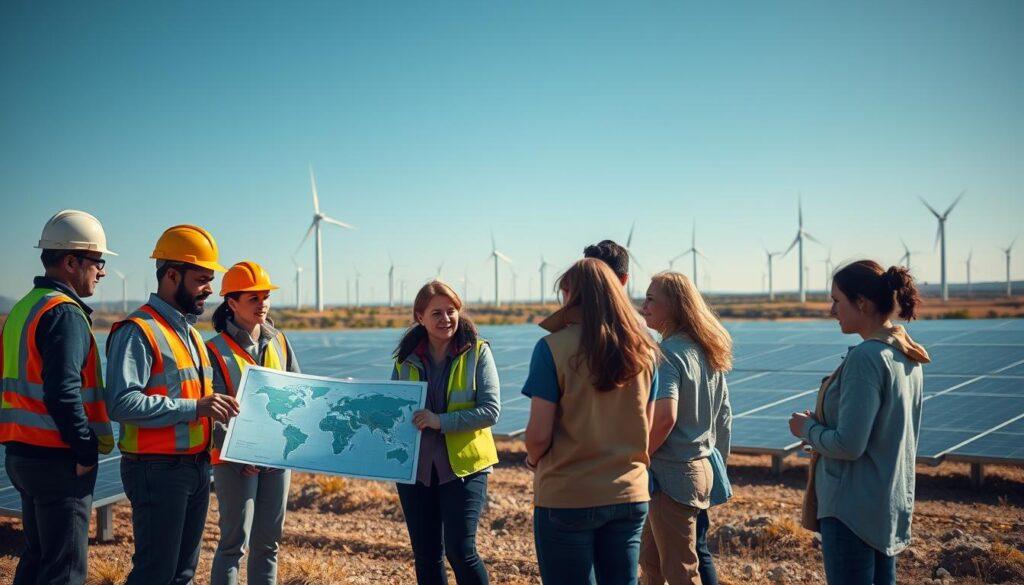
Skills Map: Electricians, Lineworkers, Drillers, Data Scientists, Safety Managers
The clean energy sector is growing fast, and a new skills map is emerging. Roles like electricians, data scientists, and safety managers are in high demand. The IEA’s “Energy and AI” report shows that current workforce strategies are not ready for AI-driven power demand growth.
Electricians and lineworkers are key to the energy sector. They can’t be replaced by software alone. Now, lineworkers who can use drones for inspections are more valuable. This shows how skills in the energy sector are changing.
Drillers, moving from oil and gas to geothermal, are getting big bonuses. This shows the strong competition for talent in renewable energy.
Safety managers are also vital, knowing OSHA rules and battery storage hazards. Their skills are becoming more important as the industry grows.
Data scientists are now in high demand, helping with machine learning and energy system optimization. Without them, the shift to renewable energy could slow down.
The renewable energy workforce needs a mix of old and new skills. Utility HR directors worry about finding people before retirements peak in 2028.
For more insights into the renewable energy workforce, check out this resource.
Education Routes: Apprenticeships, Microcredentials, Remote Labs, and VR
Renewable energy is changing fast, and so are the ways to get into it. The old model of four years of college and then two years of learning on the job is outdated. The renewable sector needs more skilled workers, and fast.
New education paths are emerging to meet this need. Apprenticeships are back and not just for electricians. Now, data science apprenticeships are popping up, teaching people to use AI for grid optimization before they finish their training.
Microcredentials are also gaining attention. These are specific, verifiable skills that show you can do a particular job. This is key in a world where skills matter most.
In rural areas, remote labs are a big deal. They let you practice on virtual equipment that feels real, all from home. This technology breaks down barriers for those in remote places.
VR training is another innovation. I’ve tried a high-voltage simulation, and it’s incredibly realistic. It prepares workers for dangerous jobs safely.
Utilities that adopt these new ways will build a strong workforce. Those waiting for universities to solve their talent problems will keep jobs open for months. The irony is clear: an AI-driven industry needs humans who get AI, and AI can teach them fast.
| Education Route | Benefits | Target Audience |
|---|---|---|
| Apprenticeships | Hands-on experience, immediate application of skills | New entrants to the workforce |
| Microcredentials | Flexible, focused learning | Working professionals looking to upskill |
| Remote Labs | Access to practical training regardless of location | Students in remote areas |
| VR Training | Safe simulation of high-risk scenarios | Workers in hazardous jobs |
Policy Horizon: FERC Interconnection, NEPA Permitting Reforms, and State RPS
Looking ahead to 2035, the path for renewable energy is complex. We need to understand the policy roadmap for our energy future. The FERC Order No. 2222 is slowly letting distributed energy resources into wholesale markets. But, the process is slow, like watching paint dry.
By 2024, places like California and ISO-NE will fully accept distributed energy. But, not all areas will move at the same pace. ERCOT is pushing forward with its DER pilot, but will it be enough?
NEPA permitting reforms are also a big issue. Everyone agrees we need changes, but the details are stuck. Environmental impact statements can feel like a never-ending cycle, making progress slow.
State Renewable Portfolio Standards (RPS) are changing a lot. Ohio has new energy laws, while North Carolina has backed off its climate goal. Colorado is racing to boost clean energy before tax credits end. Nuclear energy is also gaining support, like in the 1970s.
The interconnection queue is now years long, not months. You can do everything for a solar farm, but wait years for approval. The system is struggling to keep up with the energy shift.
| State | Recent RPS Changes | Current Climate Goals |
|---|---|---|
| Ohio | Passed new energy legislation | Revised downward |
| North Carolina | Erased 2030 climate goal | Uncertain |
| Colorado | Expediting clean energy development | Aiming for aggressive targets |
Action Plan for Professionals: Upskilling and Career Pivots
The renewable energy world is changing fast. As professionals, we must keep up or risk falling behind. So, what can you do starting Monday? Let’s break it down into three simple steps.
First, upskill. If you’re in electrical work, learn about data analytics. Knowing SCADA systems can boost your job prospects. Data scientists should also learn about grid dynamics.
Knowing how reactive power works will make your algorithms better.
Next, think about career changes. The geothermal sector wants oil and gas drillers, with great pay. The battery storage industry needs chemical engineers who understand lithium-ion degradation. Utilities in the U.S. are looking for cybersecurity experts who can link IT and OT.
Timing is key. The tax credit phaseout under the OBBBA is near. Projects starting after July 2026 will face a new economic reality. Those who understand this timeline will have an advantage.
The workforce skills gap is a challenge and an opportunity. It’s a chance for those ready to learn the right skills.
Building the future of renewables is an active effort. It requires a pursuit of knowledge and skills. Get the tools you need to succeed in this changing world. The energy transition needs both technical skills and creative thinking.
Be the professional who can handle both. You’ll secure your spot in this exciting future.