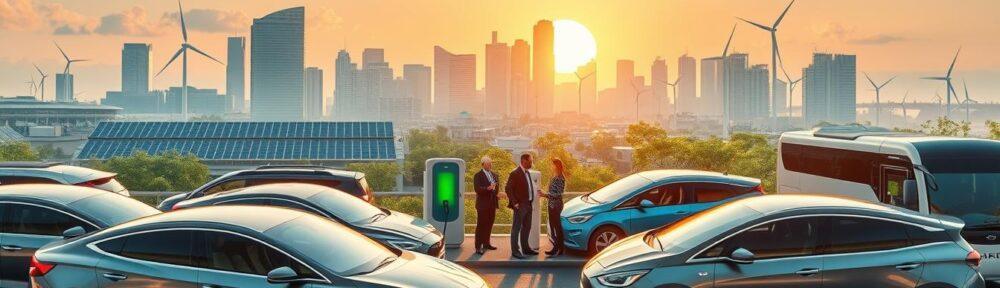
Remember Blockbuster Video? That’s what the internal combustion engine is becoming right now. We’re living through the automotive industry’s streaming moment. The switch to electrons isn’t just a trend—it’s a full-blown cultural rewrite.
The fever chart is spiking. Global sales hit roughly 17 million units last year. That’s a 25% jump, meaning one in five new cars sold now plugs in.
China isn’t just playing this game; it’s writing the rulebook with about 11 million sales. The U.S. market, while smaller at 1.3 million, is scrambling to adapt its playbook. India is the dark horse rapidly gaining ground.
Here’s the kicker: with 58 million on the road, electric vehicles now make up 4% of the global fleet. The most electrified segment? Two and three-wheelers, already at 9% penetration.
The EV industry growth story has moved past the early adopter phase. The tipping point isn’t ahead—it’s in the rearview mirror. This isn’t a slow-motion revolution anymore; it’s hit fast-forward.
Battery Technology Breakthroughs: Solid-State, Silicon Nanowire, and Fast-Charging Innovations
The biggest hurdle for electric car adoption rates isn’t price or style. It’s the fear of being stuck with a dead battery. This fear, known as “range anxiety,” is a major obstacle for EVs.
But, there’s good news. New battery technologies are emerging that could change everything. These advancements promise to make today’s batteries seem old-fashioned.
Solid-state batteries are at the forefront of this revolution. They replace the liquid inside batteries with a solid material. This change could lead to batteries that hold much more energy.
Companies like Stellantis and Factorial are already testing these new batteries. They’re showing cells that can store 375 Wh/kg. This is a huge leap forward, allowing for longer drives on a single charge.
Imagine charging your car from 15% to 90% in just 18 minutes. That’s the future we’re looking at with these new batteries. Samsung SDI aims to create a battery that can go 600 miles with just a 9-minute charge by 2027.
But solid-state batteries aren’t the only game in town. Silicon nanowire technology is also making waves. Silicon can hold more lithium than today’s batteries, but it needs to be made stable. Companies are working on this, making lithium-ion batteries better before we get to solid-state.
The cost of these new batteries is dropping fast. By 2024, lithium-ion battery packs could cost as little as $115 per kilowatt-hour. This falling cost makes electric cars more appealing than ever.
So, who will bring these advanced batteries to our cars? The timeline is clear:
- Solid Power plans to supply enough cells for 800,000 vehicles annually by 2028.
- BYD, a Chinese EV giant, aims to show off a solid-state battery by 2027.
- Every major car maker, from Toyota to Ford, is investing heavily in these technologies.
Here’s a quick look at the key players in the battery revolution:
| Technology | Key Promise | Current Status & Projection |
|---|---|---|
| Solid-State | Ultra-high energy density, superior safety, extremely fast charging. | Prototype phase. Scaling for mass production post-2027. Target: 375+ Wh/kg. |
| Silicon-Anode Li-ion | Significant range boost over current tech, using existing manufacturing. | Early commercial rollout. Acts as a critical bridge technology. |
| Current Li-ion | Established, reliable, and continuously improving in cost. | Industry workhorse. Cost at ~$115/kWh. Incremental gains continue. |
These battery technology advances are more than just specs. They tackle the main concerns of cost and convenience. When EVs can go farther, charge faster, and cost less, choosing an EV becomes a smart economic choice. The battery is the star of the show, and its next chapter is exciting.
Charging Infrastructure Expansion: Public Networks, Workplace Charging, and Smart Grid Integration
While EV designs get all the attention, the real action is in the infrastructure. Charging stations are popping up everywhere, like a modern-day interstate highway system. This is the backbone of the EV industry growth. Without it, even the most advanced electric vehicle is useless.
Across the globe, over 1.3 million new public chargers were added in 2024. That’s a 30% jump from the year before. We’re not just adding plugs; we’re building a smart network. Soon, finding a charging spot will be as easy as finding a phone booth.
Public networks are the most visible part of this electric vehicle market trends. Europe is leading the charge, mandating fast chargers every 60 kilometers on major highways by 2025. The United States is also investing in a nationwide network of 500,000 fast chargers. It’s a race to build a public utility.
The workplace is also becoming a key player. Charging stations are now a top perk, rivaling free snacks and games. They turn parking lots into productivity hubs. Employees arrive ready to work, and companies look good doing it. It’s a win-win for EV industry growth.
The real magic happens when these plugs talk to the grid. This is smart grid integration. Imagine your car charging when the sun is out and selling energy back when it’s needed. It’s not science fiction; it’s vehicle-to-grid (V2G) technology. The socket is now a two-way street.
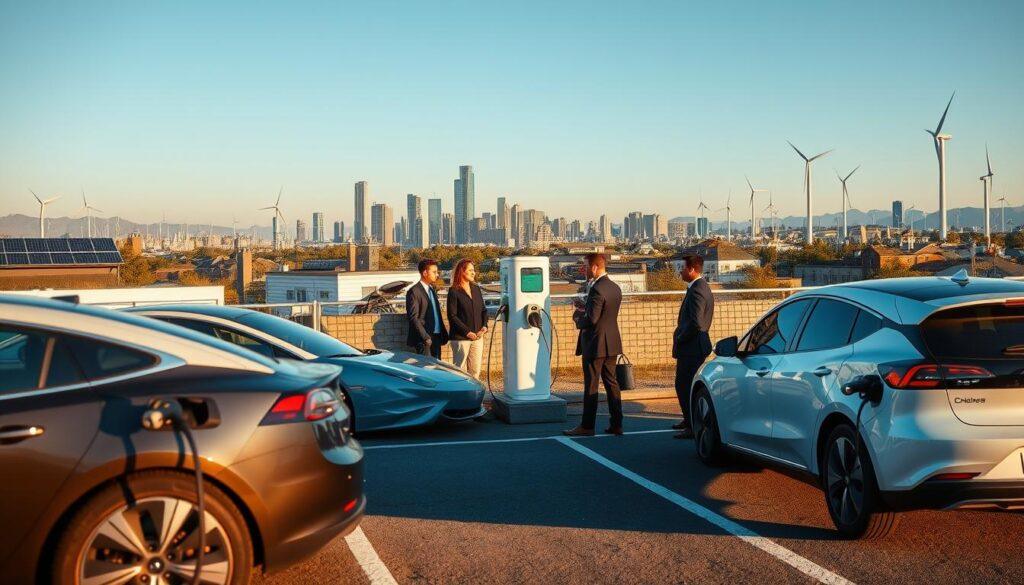
The global scene is interesting. China leads with about 65% of the world’s charging points. It’s all about scale and standardization. Europe uses rules to push forward. America focuses on big funding plans. Each approach shows a different way to win in the electric vehicle market trends.
| Region | Primary Driver | Scale & Ambition | Tech Focus |
|---|---|---|---|
| United States | Federal Funding & Market Competition | 500,000 new fast chargers via national network plan | Ultra-fast charging, interoperability between networks |
| European Union | Top-Down Regulation | Fast chargers every 60 km on core highways by 2025 | Grid stability, renewable integration, cross-border travel |
| China | State-Led Industrial Policy | ~65% of global charging points; dominant market share | Extreme density, cost reduction, export of standards |
The tech race is getting wild. Ultra-fast charging is going beyond 350kW. We’re talking about adding hundreds of miles of range in just minutes. This tackles the last big worry for buyers, making refueling as easy as it is for gas cars.
So, while EVs get all the glory, remember the real power is in the charging infrastructure. It’s a story of cables, contracts, and smart tech. And in 2025, this story is moving faster than ever.
Professional Career Pathways: Engineering, Manufacturing, and Infrastructure Development Roles
The real treasure in the EV gold rush isn’t under the hood—it’s in the LinkedIn profiles being rewritten by it. While headlines fetishize torque and range, a quieter, more profound revolution is redesigning the American workforce. We’re not just swapping engines for motors; we’re trading entire career playbooks.
This shift is creating millions of new positions. Think of it as a whole new industrial ecosystem sprouting from the ashes of the internal combustion engine. The supply chain, from mine to highway, now demands a cast of characters that would make a Silicon Valley HR director blush.
So, where are the EV career opportunities actually hiding? Let’s map the three main frontiers.
The High-Voltage Engineers: Beyond the Battery Pack
Engineering is the obvious launchpad. But it’s far more nuanced than just “electric car engineer.” The core battery technology advances have spawned specialties that sound like sci-fi majors.
You have cell architects designing the internal chemistry of solid-state batteries. Thermal management gurus ensuring your pack doesn’t become a pavement pizza in Phoenix. Then there’s the software wizards coding the battery management system (BMS)—the brain that decides how to charge, discharge, and preserve health.
This isn’t just mechanical engineering 2.0. It’s a mash-up of materials science, electrochemistry, data analytics, and software. The skill set is as hybrid as the vehicles it’s replacing.
The Factory Floor Futurists: Manufacturing’s Digital Pivot
Gigafactories are the cathedrals of this new age. Manufacturing roles are evolving from repetitive assembly to high-tech orchestration. The line worker of 2025 is likely monitoring a digital twin of the production process or programming collaborative robots.
Precision is key. A speck of dust in a battery cell is a disaster. This demands skills in clean-room protocols, laser welding, and advanced quality control using AI vision systems. The job titles? Electro-mechanical technician, battery module assembly specialist, manufacturing execution system (MES) analyst.
It’s less Charlie Chaplin on the line and more Tony Stark in the workshop.
The Infrastructure Architects: Wiring the World
Someone has to build the nervous system that powers all these vehicles. This is where civil engineers, urban planners, and power systems experts find their moment. Charging infrastructure isn’t just about plugging in a post.
It involves grid load analysis, site selection algorithms, and navigating the Byzantine world of utility permits. New roles are emerging: charging station deployment manager, V2G (vehicle-to-grid) integration specialist, and sustainable transport systems planner.
These professionals aren’t just building things. They’re solving the spatial and electrical puzzle of a nation trying to refuel its commute.
| Career Domain | Sample Roles | Core Skills in Demand | Demand Outlook |
|---|---|---|---|
| Battery & Powertrain | Cell Design Engineer, BMS Software Engineer | Electrochemistry, Thermal Modeling, Python/C++ | Extremely High |
| Advanced Manufacturing | Automation Technician, Quality Analytics Engineer | Robotics Programming, Statistical Process Control | Very High |
| Charging & Grid Infrastructure | EV Infrastructure Project Manager, Grid Integration Analyst | Electrical Engineering, Project Management, Utility Regulations |
This table isn’t just a list. It’s a cheat sheet for the next decade. Notice the common thread? Digital literacy. The mechanic with a wrench is now a technician with a tablet.
This skills gap is where platforms like evACAD become critical. They offer targeted training to bridge the knowledge chasm between traditional auto work and the electric future. It’s career GPS for a landscape changing in real-time.
The pivot can feel daunting. Retraining isn’t a gentle suggestion; it’s an imperative. But the upside? You’re not just getting a new job. You’re gaining a front-row seat to the most significant technological retooling in history. The demand is hotter than a supercharger cable on a summer day, and the work actually means something. You’re not selling ads; you’re decarbonizing transport.
So, for the engineer tired of legacy systems, the project manager seeking a meaningful challenge, or the data analyst looking for a physical world to optimize—the charge is literal. The pathways are here. The EV career opportunities are vast, varied, and vitally important. The only question is which electron you want to ride.
Policy and Regulatory Landscape: Government Incentives, Emission Standards, and Market Drivers
The 2025 policy stage for electric vehicles is a global theater of the absurd. Climate urgency and industrial policy dance together, influenced by electoral politics. Technology is the engine, but policy is the fickle director, constantly changing the script. This isn’t just bureaucratic noise. It’s a powerful force that directly affects electric car adoption rates and EV industry growth.
In the U.S., the Inflation Reduction Act is a masterclass in the carrot-and-stick approach. It offers tax credits for buyers and massive production incentives for manufacturers. But, it also has strict rules on where batteries and critical minerals are sourced. This has led to a huge investment in domestic supply chains. Yet, the rules could change with a new administration, causing uncertainty in the industry.
In Europe, the EU uses a different approach. Their 2025 Battery Regulation is a command that demands transparency from mine to recycling plant. It has strict rules on carbon footprint and recycled content. This is like a sustainability passport for every battery cell entering the bloc. Automakers must comply, not just grab subsidies.
China, on the other hand, uses aggressive trade-in subsidies and local government procurement. This is a brute-force method to boost domestic electric car adoption rates. The market responds quickly. India is also creating its own rules, like a “battery passport” framework to track performance and lifecycle. The global rulebook is being written in real-time, by competing authors.

So, how do you make sense of this patchwork? The table below cuts through the political rhetoric to show the hard levers pulling the market. It’s your cheat sheet to the global policy drivers.
| Region | Key Policy / Incentive | Primary Driver | Direct Impact on Adoption |
|---|---|---|---|
| United States | Inflation Reduction Act (Tax Credits, Production Incentives) | Consumer & Manufacturer Subsidies | High; lowers consumer cost, spurs domestic manufacturing boom. |
| European Union | 2025 Battery Regulation (Carbon, Recycling Rules) | Environmental Compliance | Medium-High; mandates cleaner tech, may increase initial costs but ensures long-term sustainability. |
| China | Vehicle Trade-in Subsidies & Local Govt. Targets | State-Directed Market Push | Very High; immediate financial incentive for consumers drives rapid fleet turnover. |
| India | Proposed Battery Passport Framework | Data Transparency & Safety | Emerging; builds consumer trust and lays groundwork for a regulated secondary market. |
The takeaway? While the approaches range from generous payouts to stern commandments, their collective effect is undeniable. They are the single biggest external accelerant for EV industry growth. Even with political U-turns, the private capital now in motion has its own momentum. The high-stakes tango between market forces and government fiat might be messy, but it’s propelling us forward—one confusing, inspiring policy at a time.
Automotive Industry Transformation: Legacy Automakers vs Tesla and New EV Startups
The automotive industry is like a high-stakes poker game. The old guard is learning new rules from a Silicon Valley shark and newcomers. Billions in capital, cultural relevance, and survival are at stake. It’s not just a change in powertrain; it’s a complete rethinking of what a car company is.
Tesla is the clear disruptor. It didn’t just make an electric car; it created a software-centric cult brand that made EVs cool. While others focused on details, Tesla worked on updates. This advantage is now being tested like never before.
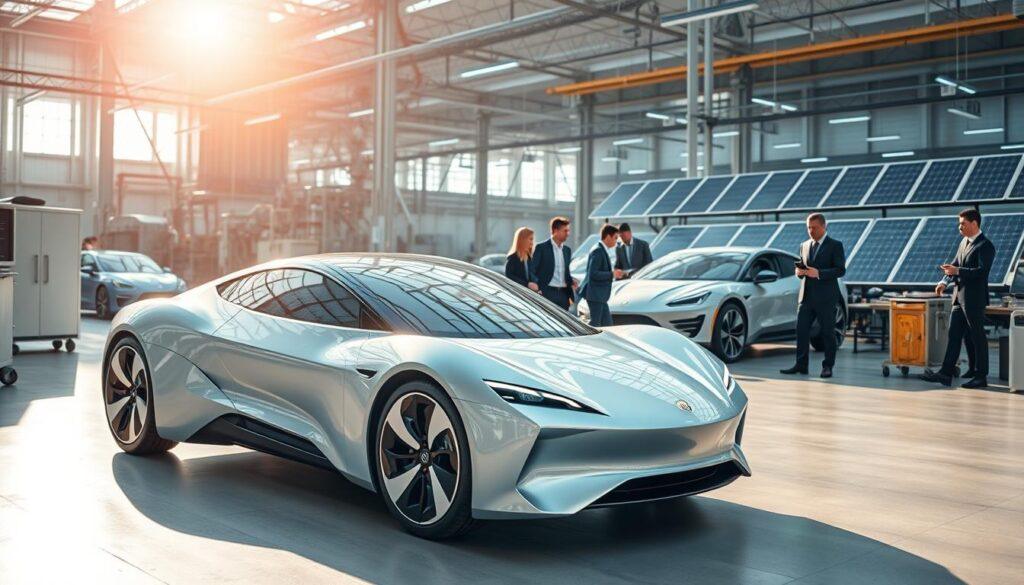
The old guard has launched a financial attack. Stellantis, Volkswagen, General Motors, and BMW are spending hundreds of billions on electric cars. It’s like an all-in bet. But, making a good EV is more than just changing the engine. It’s about design, software, and user experience.
This struggle shapes the electric vehicle market trends. Are giants innovating or just fixing old cars? The truth is complex. Some, like GM, are starting fresh. Others are just adding electric to old designs. The market is deciding.
New EV startups are also changing the game. They include Rivian, Lucid, and Canoo, each with their own unique offerings. They’re quick and agile but also fragile. One bad quarter could be disastrous for them.
This competition is driving progress. Competition is driving innovation at an incredible pace. It’s making cars more affordable. What was once a luxury is now standard. This competition is also creating new EV career opportunities.
The real fight is in the data center. The winning company will be a software leader that makes cars. Tesla knew this from the start. The old guard is hiring coders, and startups are building their identity on tech. The skills needed are changing to electrical, software, and battery chemistry.
So, who will win? It’s not a zero-sum game. The likely outcome is a reshuffled landscape. A few old players will adapt, Tesla will grow, and some startups will become the new leaders. For those interested in electric vehicle market trends, the lesson is clear. For EV career opportunities, the message is even clearer: learn to code and understand energy systems. The journey is just beginning.
Supply Chain Evolution: Critical Materials, Battery Manufacturing, and Recycling Challenges
Every electric vehicle has a story of a global search for minerals. This search is like a big adventure. It involves mining, trade wars, and amazing chemical feats.
“Critical minerals” is a big deal in the world of business. Lithium demand is set to increase fourfold by 2030. This change is huge, reshaping the world’s mineral landscape.
The path from mine to battery pack is filled with challenges. There’s cobalt from the Democratic Republic of Congo, lithium from Chile and Australia, and nickel from Indonesia. Each mineral comes with its own set of problems.
| Critical Mineral | Primary Sources | Key Challenge | 2030 Demand Projection |
|---|---|---|---|
| Lithium | Chile, Australia, China | Water-intensive extraction | Up 400% from 2020 |
| Cobalt | DR Congo, Russia, Australia | Artisanal mining concerns | Up 300% from 2020 |
| Nickel | Indonesia, Philippines, Russia | Deforestation from mining | Up 250% from 2020 |
| Graphite | China, Mozambique, Brazil | Processing dominance by China | Up 500% from 2020 |
Turning these minerals into batteries is a big challenge. Semiconductor shortages have really slowed things down. It’s ironic that tiny silicon chips can stop big car companies.
Europe is trying to make its own battery hubs. This is a smart move to reduce dependence on Asia. It’s about being green and keeping the economy strong.
But there’s a big problem that everyone tries to ignore. Only less than 5% of Li-ion batteries get recycled. We’re creating a huge waste problem while looking for new materials.
Companies like Redwood Materials are working on recycling batteries. They make new batteries from old ones. It’s good for the planet and smart business.
Recycling batteries is becoming very important. As more electric cars are made, we’ll have more old batteries. We can either ignore the problem or find solutions. Redwood and others are choosing to solve it.
These recycling breakthroughs are key to the future of batteries. They fix the biggest problem in the supply chain: what happens at the end. A real EV revolution needs to think about the whole cycle, not just cleaner cars.
We’re solving new problems as we go. The supply chain is like our ongoing journey with progress. We make big steps forward, then work hard to fix the mess we made. The goal is to build a better system around batteries.
The success of electric cars depends on many things. It’s not just about how fast they charge or how much they cost. It’s about getting materials the right way, making batteries efficiently, and recycling them well. The supply chain is the backbone of the EV revolution, even if it’s not always seen.
Grid Integration Challenges: Vehicle-to-Grid Technology and Energy Storage Solutions
The electric vehicle revolution has a secret weapon parked in millions of driveways. It’s a distributed energy network hiding in plain sight. Forget the gas pump; the next frontier is the humble wall socket. Your EV isn’t just a car. It’s a rolling battery pack with untapped power, waiting to join the smart grid.
Enter Vehicle-to-Grid (V2G) technology. This isn’t just about charging your car. It’s about your car charging the grid. Imagine plugging in at night and your vehicle’s software deciding the optimal time to sip power—or even spit some back during a peak demand crisis, putting money in your pocket. It turns every garage into a micro power station.
Why does this matter? Our energy grid is facing its own mid-life crisis. The surge in renewable, but intermittent, sources like solar and wind creates a stability puzzle. The sun doesn’t always shine, and the wind doesn’t always blow. A fleet of millions of EVs, with their massive, distributed battery, can soak up excess solar power at noon and release it back during the evening rush. This is the elegant hack for grid stability.
This vision relies on artificial intelligence acting as a sophisticated traffic cop for electrons. AI-driven smart charging platforms analyze grid load, electricity prices, and your driving schedule. They orchestrate a ballet of charging sessions to avoid overwhelming local transformers. It’s load balancing with a Ph.D.
Playing the enthusiastic tech evangelist, I see a future where your car earns its keep. You become a prosumer—both a consumer and producer of energy. This flexibility is a cornerstone for the next phase of EV industry growth, transforming a possible grid burden into its greatest asset.
Now, for the cautious analyst’s dose of reality. The hurdles are real. Current battery chemistry might not love constant, deep cycling for grid services. Communication standards between cars, chargers, and utilities are a messy alphabet soup. And let’s be honest, will consumers trust their car’s battery to be used as a public resource? The psychology of battery ownership is a whole other thesis.
Yet, the momentum is undeniable. Pilot programs from companies like Fermata Energy and initiatives by utilities are proving the concept. The evolution of the electric vehicle market trends is intrinsically tied to this energy partnership. It connects your personal commute to the national energy strategy, creating a flexible, resilient grid.
This isn’t a side quest. It’s a main storyline. Solving grid integration through V2G and smart charging is what will allow the EV industry growth to scale sustainably. It’s the difference between an electric fleet that strains our infrastructure and one that actively supports it. The future isn’t just electric; it’s bidirectional.
Investment Opportunities: Venture Capital, Public Markets, and Green Technology Funds
Money is flowing into electric cars like never before. The auto industry is changing fast, creating new chances for making money. For investors, understanding this shift is key to seeing our future.
Venture capital is like the wild west, with over $21 billion going to EV startups in 2022. It’s not just about Tesla. It’s about the whole ecosystem, from battery scientists to AI experts. The risk is high, but so is the reward.
For those who prefer less risk, the public markets offer a safer bet. Companies like Tesla and charging infrastructure are traded publicly. There are also green technology funds that offer a mix of investments.
Government funding adds stability. The US is investing $7.5 billion in charging infrastructure. This helps private investors and speeds up growth.
The numbers are impressive. The electric vehicle market is expected to grow from $91.6 billion in 2024 to $205 billion by 2034. This growth is hard to ignore.
| Investment Avenue | Risk Profile | Potential Return | Time Horizon |
|---|---|---|---|
| Venture Capital (Startups) | Very High | Exponential | 5-10 years |
| Public Markets (Stocks/ETFs) | Moderate to High | High | 3-7 years |
| Green Technology Funds | Moderate | Steady Growth | 5+ years |
There are new business models too. EV subscription services are gaining traction. They offer a monthly fee instead of buying a car. This could change how we own cars.
Diversify your investments. The EV industry needs more than just engineers. It needs finance experts and market strategists too. Watching where money goes is key to success.
We’re just starting this journey. By 2034, we’ll see even more innovation and investment. Understanding both the tech and the money is essential. And for those looking into EV career opportunities, remember: those who fund the change often shape it.
Future Projections: 2030 Market Predictions and Emerging Technology Roadmaps
What does the future hold for electric cars by 2030? The numbers show a world where electric cars are the norm. Electric car sales could reach 25-30% of all new cars sold globally. Battery prices are expected to drop to around $80/kWh, making electric cars as affordable as gas cars.
The growth of the electric car industry is huge. The market value for electric vehicles could reach $205 billion. The autonomous car market is expected to generate $1.5 trillion a year. This creates a perfect storm of new technology.
This isn’t just about new cars. It’s about building a whole new world. The need for skilled workers is growing fast, as seen in a recent market overview. Jobs like grid integration specialists and battery recycling engineers are emerging. The future belongs to those who can link new technology to our power systems.
The path forward is clear. Next-generation batteries will allow cars to go 500 miles on a 10-minute charge. Every parking lot will become a power plant. The lines between car makers, tech companies, and utilities will disappear. By 2030, electric cars won’t be a trend. They will be the standard.