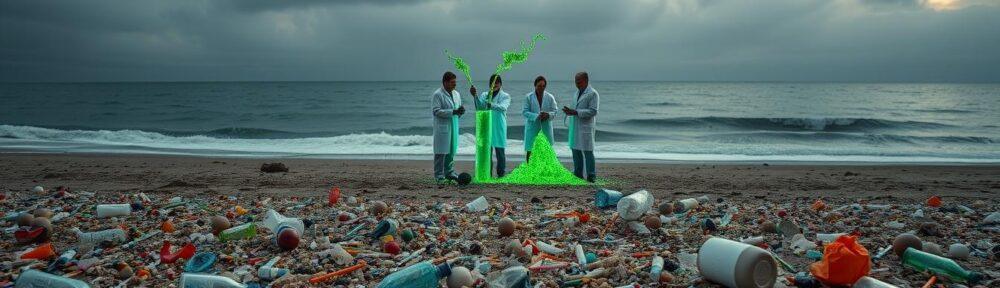
A staggering 130 million tonnes of plastic enters our environment yearly. Experts warn this could jump to 280 million tonnes by 2040. That’s like dumping a garbage truck into our oceans, land, and air every second.
This isn’t just an environmental crisis. It’s a big business risk. The plastic system disrupts supply chains, harms brand reputation, and endangers communities. A growing demand for real sustainability makes this a major corporate challenge.
Microplastics now make up about 13% of all pollution. These tiny particles are everywhere, from deep oceans to our food.
The problem needs a radical solution. Business leaders need more than small fixes. They need Plastic Waste Innovation. Research, like the innovative enzyme technology leading the fight against plastic, shows a new way. These biological tools could help remove microplastics and recover materials on a large scale.
Enzyme-Based Plastic Degradation
Imagine a molecular pair of scissors designed by evolution, capable of snipping apart the stubborn bonds in plastic polymers—this is the reality of plastic degrading enzymes. This approach moves waste management from the mechanical to the biological, providing a precise tool for deconstructing our most persistent pollutants.
The science, known as enzymatic depolymerization, is elegant in its simplicity. Specialized enzymes, such as PETase, target specific plastics like polyethylene terephthalate (PET). They act as biological catalysts, breaking the long polymer chains back into their fundamental building blocks, or monomers. This process is called hydrolysis and it happens under mild temperatures and pressures, a stark contrast to the energy-intensive heat of traditional recycling.
The advantages of this method are compelling for a sustainable future. It transforms plastic waste management into a selective, efficient operation.
- High Selectivity & Minimal Waste: Enzymes target only the specific plastic they are designed for, leading to a pure stream of recovered raw materials. This purity is key for creating new, high-quality plastic, closing the loop effectively.
- Low Energy Input: Operating at near-room temperature drastically reduces the carbon footprint compared to conventional thermal processes.
- Handles Contaminated Waste: Unlike some recycling methods, enzymatic processes can often tolerate labels, food residue, or other colors. This reduces the need for extensive and costly pre-cleaning.
Of course, the path from lab breakthrough to global solution has hurdles. The primary challenges are scaling production of these enzymes cost-effectively and optimizing their speed and stability for industrial use. But progress is rapid. Researchers are engineering more robust enzyme variants and developing integrated systems to make the process economically viable for large-scale true circularity.
This isn’t just a lab experiment; it’s a burgeoning industrial strategy. Companies are now piloting facilities that use enzymatic recycling to produce food-grade plastic from old bottles and packaging. By turning waste back into virgin-quality feedstock, this technology is a cornerstone for advancing the circular economy. The ongoing work, supported by recent scientific studies, continues to refine these biological tools, pushing them toward becoming a standard, scalable weapon in the fight against plastic pollution.
Biodegradable Alternative Materials
Instead of just cleaning up trash, we should focus on making new materials that are better for the planet. We aim to design products that can easily return to nature when they’re no longer needed. This way, we can avoid the problems caused by traditional plastics.
Today, we’re moving beyond old ideas like corn-starch plastics. Now, we’re using things like sugarcane and algae to make our products. This change helps us use less fossil fuel right from the start.
Seaweed is at the forefront of this new era. Companies like Sway are making packaging from seaweed that can easily compost at home. This approach not only reduces waste but also helps ecosystems thrive.

It’s important to know the difference between “green” plastics. Not all are created equal. Making the right choice depends on understanding these differences.
- Compostable: These materials can turn into harmless organic matter in a set time in a composting bin. They usually need industrial facilities.
- Biodegradable: This term means the material can be broken down by microorganisms. But, the time it takes and the conditions are not always clear.
- Durable Bioplastics: These are made from bio-based materials but are meant to last a long time, like in car interiors. They’re not designed to break down quickly.
Advanced biodegradable plastics offer big benefits. They can greatly reduce our need for fossil fuels and lower greenhouse gas emissions. When they decompose properly, they leave no harmful residues.
But, there are challenges to using these plastics. For example, compostable packaging only works if people have access to the right composting facilities. Mixing these new materials with regular recycling can also cause problems.
For businesses, this is both a challenge and an opportunity. It requires investment and creativity in material science. At the same time, it opens up a huge market for sustainable products. Success depends on solving both the material and infrastructure problems.
The journey of biodegradable plastics is more than just finding new materials. It’s about creating a whole new way of making, using, and disposing of products. This is where the next wave of business leaders will make their impact.
Ocean Cleanup Technology Solutions
Ocean cleanup technology is a key defense against the millions of tons of plastic in our oceans. It’s a visible sign of a bigger problem that needs quick and effective solutions. While stopping plastic at its source is the goal, cleaning up what’s already there is also essential.
This field has grown into a complex engineering challenge. It involves two main areas: large systems in the open ocean and river technologies. Together, they tackle both old pollution and new waste. This approach is vital for making real progress.
Open ocean systems are built to last and handle big tasks. They use natural currents to gather and collect debris. Some use floating barriers to guide plastic into a central area. Others have special vessels with advanced tools for collecting waste. The main challenge is working in tough, far-off places while being efficient.
Riverine technology is a strategic point to stop pollution before it hits the sea. It uses nets, barriers, or conveyor belts to catch plastic in rivers. This method is often cheaper than cleaning the ocean and helps prevent pollution.
Funding these innovations is critical to make them bigger. Companies like Circulate Capital invest in these solutions. They show that collected plastic has value. Good ocean cleanup technology must link to recycling, making waste into a resource.
| Technology Type | Primary Focus | Key Advantage | Operational Scale |
|---|---|---|---|
| Ocean-Based Collection Systems | Removing existing plastic from gyres & open water | Addresses legacy pollution; operates in high-concentration zones | Large-scale; often autonomous or semi-autonomous |
| Riverine Interception Barriers | Capturing plastic in rivers before it reaches the ocean | Preventative; highly cost-effective per ton of plastic captured | Focused on major polluting rivers; localized deployment |
| Coastal & Nearshore Cleanup Tech | Cleaning shorelines, harbors, and coastal waters | Protects local ecosystems & economies; often community-driven | Small to medium-scale; versatile deployment |
Seeing these technologies as part of a bigger system is key. Cleanup alone can’t keep up with plastic production. Ocean cleanup technology is a vital action that needs to work with other solutions. Supporting these efforts is a way to tackle the crisis and invest in a circular economy.
Microplastic Detection & Removal
The fight against plastic pollution has moved to a microscopic level. We need technologies that can find and filter tiny particles. These small pieces, called microplastics, are a big threat to our environment and health.
A report by Pew Charitable Trusts shows the problem’s size. It says microplastics will make up 13% of global plastic pollution by 2025. The biggest culprits aren’t plastic bottles or bags. Instead, it’s things like tire dust, paint flakes, and synthetic fabrics. We need new ways to detect and remove these tiny pollutants.
First, we must see what’s invisible. Special sensors, like advanced spectroscopy, can find microplastics in water or soil. This helps scientists and plant operators find pollution hotspots.
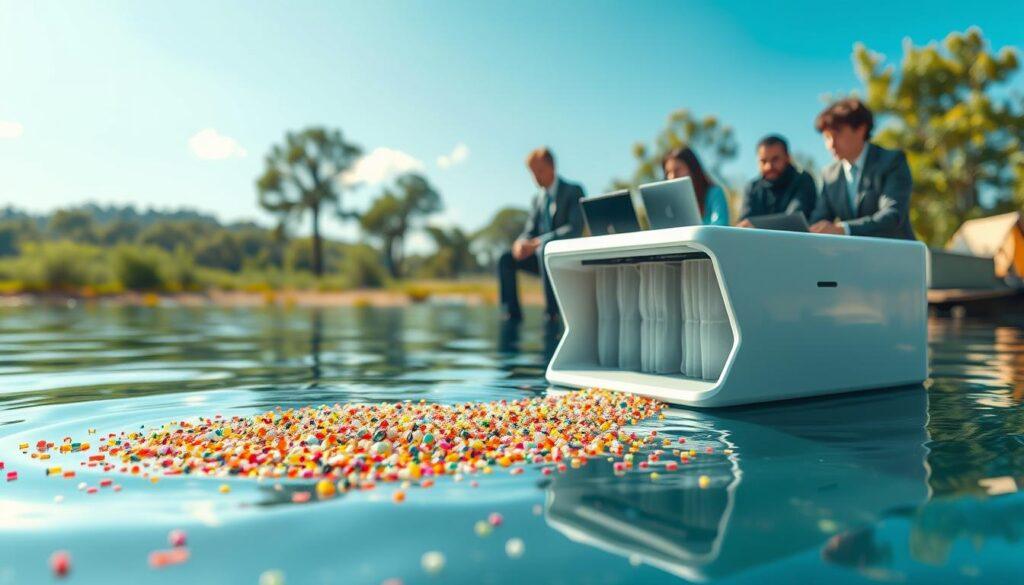
After finding them, we need to separate them efficiently. AI-powered sorting systems are making this easier. They use machine learning and computer vision to sort faster and more accurately. These systems can be used in water treatment and recycling to remove microplastics.
For microplastic removal from water, plants are getting better filters. They’re using membrane bioreactors and rapid sand filtration to catch smaller particles. These systems block microplastics from getting into rivers and oceans.
There’s also a new way to break down microplastics using microbes and enzymes. This method is not yet big, but it’s a promising area for microplastic removal.
Knowing where microplastics come from helps us find solutions. The table below shows the main sources:
| Primary Source | Key Characteristics | Removal Challenges |
|---|---|---|
| Tire Wear | Abraded rubber particles released during driving; a major contributor to airborne and waterborne microplastics. | Extremely diffuse source; requires capture at road runoff points and advanced filtration in stormwater systems. |
| Paint | Flakes and dust from architectural, marine, and road-marking paints. | Particles are often mixed with other debris; removal relies on effective street sweeping and wastewater treatment. |
| Synthetic Textiles | Microfibers shed from clothing like polyester and nylon during washing. | Directly enters household wastewater; solutions include washing machine filters and improved fabric design. |
Dealing with microplastic pollution is complex. It needs new ideas at every step. We must design products that lose less material, install capture systems, and use advanced detection and microplastic removal systems. For business leaders, this is a chance to invest in solving a big pollution problem.
Industry Transformation Strategies
Each technology needs a big plan to really help. The Pew Charitable Trusts has a key “System Transformation” plan. It aims to cut plastic pollution by 83% by 2040.
Switching to reuse and refill is key. Companies like Loop and Algramo show it’s possible. Reuse is behind two-thirds of the pollution drop. This move is a big step for plastic waste solutions.
The economic benefits are clear. This change could create 8.6 million new jobs worldwide. It also opens up trillions of dollars in new markets. We need smart policies to make plastic’s true cost clear. Investing in circular systems is essential.
Waiting too long is expensive. Not acting now means more pollution and lost economic chances. Tackling the plastic problem is a must for our planet. It also boosts business creativity and strength.
We need everyone to work together to solve plastic waste. Industries must rethink their products and methods. The goal is a world where plastic is never waste. This is the best way to grow in the 21st century.