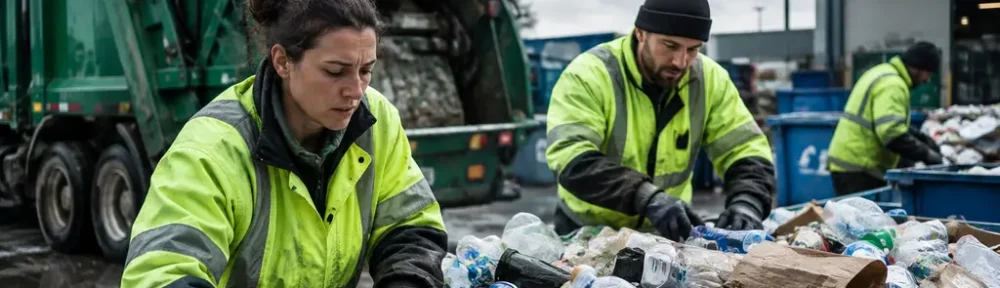
Recycling infrastructure is under pressure because waste volumes are rising faster than many collection and processing systems can adapt. In 2022, global solid waste generation was about 2.56 billion tonnes, and under a business-as-usual scenario it is projected to reach 3.86 billion tonnes by 2050, according to the World Bank’s What a Waste publication. That scale matters for city agencies, hauling systems, transfer stations, sorting facilities, and the transportation networks that move materials through urban areas.
The data does not support a simple story in which public enthusiasm or a single technology can solve the problem. Recent evidence points to several linked constraints: uneven collection access, underfunded processing capacity, weak public confidence, and fast-growing material streams such as electronics. The opportunity is also practical rather than abstract. Better funding, clearer program design, and measured communication can improve performance, but only if cities track what changes and avoid overstating results.
Why Recycling Infrastructure Is Under Pressure
Recycling Infrastructure And Collection Gaps
Recycling infrastructure includes curbside collection, drop-off sites, transfer systems, material recovery facilities, education programs, and downstream processing capacity. Those pieces are not interchangeable. A city can expand household bins and still face low recovery if sorting capacity is limited, contamination is high, or residents do not understand local rules. A region can build processing capacity and still fall short if collection access remains uneven.
The global figures show why collection remains the first constraint. Roughly one-third of global waste is not properly collected or treated, based on the research notes. Collection rates differ sharply by income level: low-income countries may collect as little as 28% of waste, upper-middle-income countries about 61%, and high-income countries close to 100%. Those gaps are not only environmental concerns. They affect how cities allocate vehicles, route labor, site facilities, and manage public space.
The Scale Of Uncollected Waste
Open dumping and missed collection also limit the value of downstream investments. A sorting facility cannot recover material that never reaches the system. In dense urban areas, weak collection can increase pressure on informal disposal points and complicate street management. In lower-density areas, collection expansion can require longer routes and higher operating costs. The research provided does not quantify those transport effects, so they should be treated as operational considerations rather than measured outcomes in this article.
From a waste-management standpoint, the clearest lesson is that access and processing must be planned together. Collection systems create the feedstock for recycling. Processing facilities determine how much of that feedstock can be turned into usable material. Public education shapes whether the feedstock is clean enough to process efficiently.
What The U.S. Numbers Show
A National Goal With A Measured Baseline
The United States provides a useful case because the target is explicit. The U.S. recycling rate across all municipal solid waste is about 32%, and the national goal is to reach 50% by 2030, according to the U.S. Environmental Protection Agency’s recycling rate measurement page. The distance between those figures is substantial, especially given the research note that the country generates around 292 million tons of municipal solid waste annually and that 68–79% is neither recycled nor composted.
The 2030 goal gives policymakers a benchmark, but the benchmark does not identify which local systems need curbside upgrades, drop-off access, new processing equipment, or better outreach. National averages can hide large local differences in program design, housing type, staffing, and market access for recovered materials. That makes city-level measurement essential.
Investment Needs Are Large
The research notes cite an EPA-related estimate that modernizing U.S. systems for packaging materials, including curbside collection, drop-off stations, processing facilities, access, and education, would require about US$22 billion to US$28 billion. That investment was associated with a potential increase of 38 million to 45 million tons of diverted recyclable materials, raising the recycling rate for those materials from 32% to roughly 45–47%.
A broader upgrade that includes composting and anaerobic digestion was estimated at US$36.5 billion to US$43.4 billion by 2030. Those figures should be read as infrastructure planning estimates, not guaranteed performance outcomes. Actual results would depend on where funds are spent, whether facilities can operate at expected capacity, how contamination is managed, and whether local governments maintain programs over time.
For readers comparing infrastructure needs across waste streams, an earlier SGTT review of the U.S. investment gap examines why grants and capital programs may not fully match the scale of need. Energy-policy debates also intersect with waste planning, and the perspective from Illinois Energy can provide insight into how local systems compete for capital and public attention within the recycling sector.
Public Confidence Is Part Of System Performance
Communication Is Not A Side Issue
The research notes report that the 2026 Recycling Confidence Index fell to 609 out of 1,000, down 18 points since 2022. Reported drivers included uncertainty about what happens after materials are collected, difficulty understanding recycling practices, and low communication from local programs. Only 25% of Americans recalled receiving local recycling program information in the prior year.
That finding matters because household recycling depends on repeated decisions made by millions of people. If residents do not know which materials belong in a cart, whether lids should be removed, or why rules differ across communities, collection quality can suffer. The evidence provided here does not quantify the exact effect of confidence on contamination or participation, so it would be inaccurate to claim a direct measured relationship from these notes alone. Still, the direction of the issue is clear: public uncertainty is a management problem, not just a communications problem.
What Trust Data Can And Cannot Prove
Trust metrics help identify weak points in program credibility. They do not prove that a specific outreach campaign will raise recovery rates by a known amount. A careful city program would test communication changes against measurable indicators, such as cart audits, set-out rates, contamination levels, or changes in inbound material quality at a sorting facility. Without those measurements, outreach can become a public-relations activity disconnected from system performance.
This is where cautious optimism is justified. Public information is usually less capital-intensive than building new facilities, and the 2026 confidence data suggests a clear area for improvement. But information alone cannot make up for missing collection routes, insufficient processing capacity, or markets that cannot absorb recovered material.
Electronics Waste Tests Processing Capacity
A Fast-Growing Stream
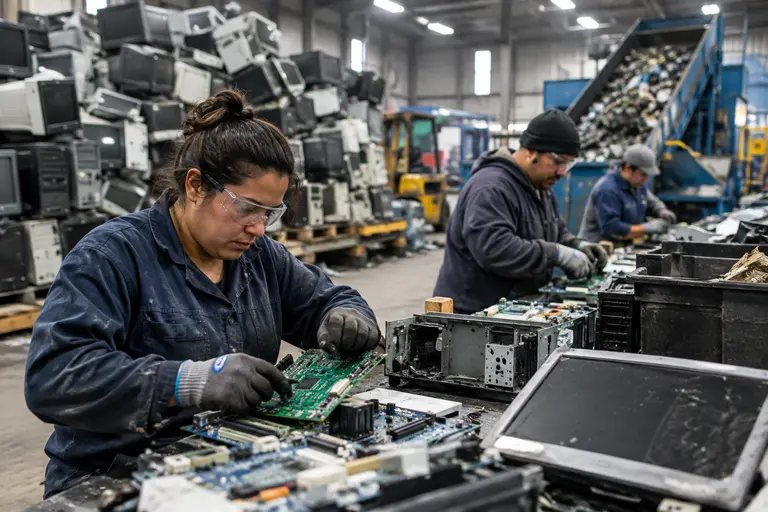
Electronic waste is a sharper test of collection and processing systems because it is growing quickly and requires more controlled handling than many common recyclables. The research notes state that 62 million tonnes of e-waste were generated globally in 2022, equal to about 7.8 kilograms per person. Only 22.3% was formally collected and recycled under environmentally sound conditions.
The same notes report that e-waste generation is projected to reach 82 million tonnes per year by 2030, while documented formal recycling is expected to fall unless infrastructure and regulatory systems improve. The evidence supports a cautious interpretation: electronics recovery is not keeping pace with generation, and formal systems are too limited for the projected waste stream.
Why Formal Collection Matters
Formal collection matters because e-waste is not a uniform material category. Devices can contain metals, plastics, batteries, glass, and components that need specific handling. The research notes do not provide a breakdown by device type or region, so this article cannot estimate the costs or recovery yields for particular programs. What can be said is that low formal recycling rates point to a system gap between discarded electronics and environmentally sound treatment.
For cities, e-waste also raises transportation and access questions. Drop-off events, permanent collection points, retailer takeback, and scheduled pickups all place different demands on residents and municipal logistics. A program that is hard to reach may fail even if a processing outlet exists. A program that collects material without verified downstream capacity may shift the problem rather than solve it.
Recycling Infrastructure Priorities For Cities
Transport-Aware Planning Questions
Recycling Infrastructure should be assessed as part of city operations, not as an isolated environmental service. Waste collection routes use street capacity. Drop-off stations require accessible locations. Processing sites need inbound and outbound material movement. These transport links do not mean recycling goals should be subordinated to traffic planning, but they do mean system design should account for how material physically moves.
Practical questions can keep planning grounded: Which neighborhoods lack collection access? Which materials are collected but not recovered at meaningful rates? Where do contamination problems appear? Which facilities are capacity-constrained? Which public instructions are unclear or outdated? Which investments can be measured against tonnage, participation, access, or processing quality?
Evidence Before Expansion
The strongest opportunity is not a single technology or policy. It is disciplined sequencing. Cities need collection access, processing capacity, reliable data, public communication, and funding aligned to the materials they are trying to recover. Extended Producer Responsibility and digital tools may help in some settings, as identified in the research notes, but their results should be evaluated through measured changes rather than assumed benefits.
The available data supports urgency without supporting exaggeration. Global waste generation is rising. U.S. recycling remains well below its 2030 target. Large investment estimates show that capital needs are not marginal. E-waste trends suggest that specialized streams require dedicated attention. Public confidence data shows that residents need clearer signals from local programs.
For urban waste systems, the next credible step is to connect infrastructure spending to observable outcomes: more access where collection is weak, better processing where capacity is constrained, cleaner material where confusion is high, and clearer reporting where trust has eroded. That evidence-first approach is slower than slogans, but it is the path most likely to improve recycling performance without overstating what the data can prove.