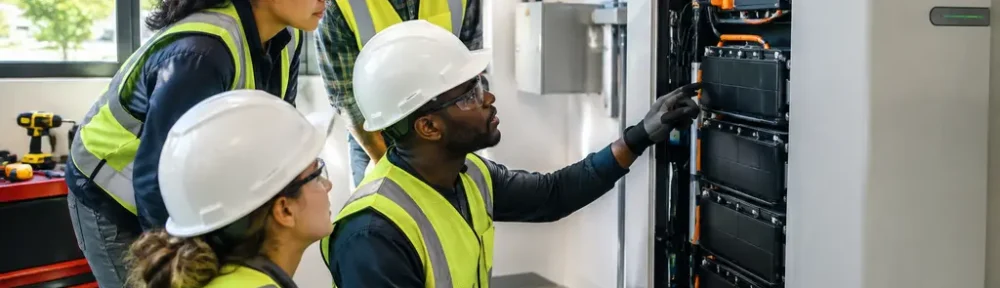
Buffalo’s Peace Bridge Place has made indoor battery storage a practical test case rather than a distant energy concept. On October 20, 2026, Viridi and Good Carbon Co. announced that a 3.75 megawatt-hour lithium-ion battery energy storage system had been deployed and was operating inside Peace Bridge Place, a 105-unit affordable housing apartment building in Buffalo, New York. The project pairs building electrification with a large battery system, creating a useful example of how clean-energy retrofits, backup power, and grid flexibility may intersect in multifamily housing. Viridi and Good Carbon described the deployment as one of the largest indoor residential battery installations in an occupied U.S. apartment building, with support from NYSERDA’s Future Grid Challenge and a National Grid pilot focused on flexible grid-responsive technologies project announcement.
The site deserves careful reading. A 3.75 MWh system is large for an occupied apartment building, but the available public evidence does not yet show long-term performance data, verified bill impacts, maintenance costs, or outage performance across multiple real events. What can be assessed today is the project design, its reported safety approach, and why the building type matters. Peace Bridge Place qualifies as affordable housing because residents earn no more than 80% of the area median income. That makes reliability, energy affordability, and retrofit disruption more than technical details; they are housing-quality concerns.
Why Indoor Battery Storage Matters In Affordable Housing
Affordable multifamily housing often faces a different set of energy constraints than new market-rate buildings. Owners may need to improve resilience and reduce operating costs while limiting tenant disruption and keeping upgrades within available financing. Peace Bridge Place is notable because the battery system was not described as a standalone device added to an otherwise unchanged building. It is part of a broader clean-energy retrofit in a fully electrified property that uses geothermal heating and cooling, domestic hot water systems, and envelope upgrades.
The Peace Bridge Place Configuration
The battery system is entirely indoors and distributed across seven separate battery rooms. That configuration matters because space, fire protection, ventilation, access, and maintenance are all more difficult inside an occupied residential building than on an exterior pad or in a utility-scale installation. The public project materials identify the system as a lithium-ion battery energy storage system with 3.75 MWh of capacity. Capacity alone does not tell readers how much of the building can be powered during an outage, for how long under different load conditions, or how the system prioritizes critical loads. Those details would require operating data that has not yet been made public.
Why Backup Power Has Equity Significance
The project is designed to provide extended backup power for multiple days during outages, reduce peak demand when electricity is most expensive, and participate in utility demand response programs, according to reporting on the installation AP coverage. For residents, the practical value of backup power depends on which loads are supported. Elevators, refrigeration, heating or cooling circulation equipment, lighting, communications, and medical-device charging can have very different priority levels. The research notes do not provide a load-by-load backup plan, so it would be premature to claim a specific quality-of-life result. Still, the project targets a real resilience gap: apartment residents generally have fewer backup-power options than owners of single-family homes.
Grid Services Depend On Control, Not Capacity Alone
A large battery inside a building is not automatically useful to the grid. Its value depends on how it is controlled, what signals it receives, and whether it can respond without compromising the building’s own energy needs. Peace Bridge Place is tied to National Grid’s effort to integrate flexible grid-responsive technologies into the distribution network. That is where building-scale storage becomes relevant beyond one property.
Demand Response And DERMS
The system is integrated with EnergyHub’s Edge Distributed Energy Resource Management System, or DERMS. A DERMS platform can automate responses to grid signals, including periods of peak demand. In practice, that means the battery can be managed as a flexible asset rather than only as emergency backup. The public materials indicate that the system participates in utility demand response programs, but they do not yet disclose measured response rates, compensation levels, event frequency, or tenant-facing cost outcomes.
Peak Demand Reduction
Peak demand reduction is especially relevant in electrified buildings. Geothermal heating and cooling can reduce fossil fuel use in building operations, but electrification shifts more building services onto the electric system. A battery can help manage that load by discharging during expensive or grid-stressed periods, then recharging during lower-demand periods. For indoor battery storage in multifamily housing, this control strategy may be as important as the hardware. Without clear controls, a battery can sit underused, discharge at the wrong times, or fail to align with utility program requirements.
This site has also examined broader questions around U.S. battery storage growth, including why reliability benefits depend on duration, grid services, siting, and market rules rather than total installed capacity alone.
Safety Evidence Sets The Boundary
Residential deployment raises sharper safety questions than many commercial or utility-scale projects. People live near the equipment, and building managers must consider evacuation procedures, inspection access, emergency response, and long-term system monitoring. The Peace Bridge Place project uses Viridi’s RPSLinkIN indoor battery energy storage architecture with a fail-safe anti-propagation design. The research notes state that the system passed UL 9540A testing, including an induced thermal runaway event, with no propagation, gas, smoke, heat, or flame, and earned UL 9540 Listing by TÜV Rheinland in April 2026.
Indoor Battery Storage Safety Claims
Those safety details are important, but they should be interpreted within the scope of the tests. UL 9540A is used to evaluate thermal runaway fire propagation characteristics in battery energy storage systems. A successful test result supports the claim that the system design performed under specified test conditions. It does not remove the need for code compliance, installation review, operations training, monitoring, maintenance, and coordination with local fire officials. In occupied affordable housing, those follow-through steps are central to whether the technology remains acceptable over time.
What The Test Result Does Not Prove
No single test can prove that every future field condition is risk-free. Real buildings introduce variables such as maintenance quality, room layout, environmental conditions, inspection practices, and human behavior. The best reading of the Peace Bridge Place safety case is cautious: the system has reported test and listing credentials that support indoor deployment, but long-term safety evidence will depend on continued operation and documentation. That distinction matters because indoor battery storage will face public trust questions if it moves into more occupied residential buildings.
Cost, Replication, And Implementation Limits

The Buffalo project shows one path for pairing building electrification with storage, but it should not be treated as a universal template. Public information does not provide a full project cost, tenant bill changes, lifecycle cost comparison, or payback period. It also does not show how much public support was required relative to private capital. Those missing data points are not minor. They determine whether similar buildings can replicate the model without unusual financing or project-specific subsidies.
What Buffalo Shows
What Buffalo does show is that a large battery system can be integrated into an occupied affordable housing building as part of a wider retrofit. The project also shows that agencies and utilities are testing how behind-the-meter batteries can participate in distribution-level grid management. Viridi’s Buffalo manufacturing presence adds a local industrial angle: the research notes state that the company operates manufacturing facilities in Buffalo and Richmond, California, and that its Buffalo facility can currently produce about 400 MWh of battery systems annually. That reported production figure gives the project a regional manufacturing connection, though it does not establish job counts, cost reductions, or future deployment rates.
What Other Buildings Still Need To Check
Other affordable housing owners would need to evaluate electrical room availability, structural limits, fire-code requirements, interconnection rules, utility tariff design, emergency planning, and resident communication. A building with limited interior space may not be able to copy a seven-room battery layout. A property without an electrification plan may gain less value from the same storage capacity. A utility territory without suitable demand response compensation may produce weaker economics. These barriers do not negate the Buffalo project, but they do limit how far one example can be generalized.
- Known: Peace Bridge Place has a deployed 3.75 MWh lithium-ion battery system inside a 105-unit affordable housing building.
- Known: The building is fully electrified and includes geothermal heating and cooling, domestic hot water systems, and envelope upgrades.
- Known: The system is designed for backup power, peak-demand reduction, and demand response participation.
- Unknown from public data: Verified long-term savings, tenant bill effects, full lifecycle cost, and measured outage performance.
Peace Bridge Place Battery Storage Lessons
The Peace Bridge Place project is best understood as an early, field-deployed example of large-scale residential storage in an occupied affordable housing setting. It is not merely a battery story; it is a test of whether electrified multifamily buildings can combine resilience, grid flexibility, and safety requirements without placing the burden on residents. The evidence available as of October 26, 2026 supports measured interest, not broad claims that the model is ready for every building.
For people tracking green transportation and building electrification together, the project also hints at a wider planning issue. As homes, buildings, and vehicles rely more on electricity, local grids will need flexible assets that can manage demand at the neighborhood level. A building battery is one such asset, but only if controls, safety systems, financing, and utility programs align. Readers interested in related evidence-based science coverage can also explore more findings by visiting the Harvard Science Review site for in-depth articles.
The strongest lesson from Buffalo is disciplined rather than dramatic: indoor battery storage may be feasible in an occupied affordable housing building when paired with safety testing, dedicated rooms, grid controls, and retrofit planning. The next test is performance evidence. If future public reporting shows reliable outage support, clear grid response, manageable costs, and resident benefits, Peace Bridge Place will offer a stronger basis for replication. Until then, it remains an important project to study carefully, not a reason to assume that every multifamily building is ready for the same approach.